The hand of Homo naledi points to life before birth

Homo naledi is one of my favorite extinct humans, in part because its impressive fossil record provides rare insights into patterns and process of growth and development. When researchers began recovering naledi fossils from Rising Star Cave 10 years ago, one of the coolest finds was this nearly complete hand skeleton. The individual bones were still articulated practically as they were in life so we know which bones belong to which fingers, allowing us grasp how dextrous this ancient human was. And since finger proportions are established before birth during embryonic development, we can see if Homo naledi bodies were assembled in ways more like us or other apes.
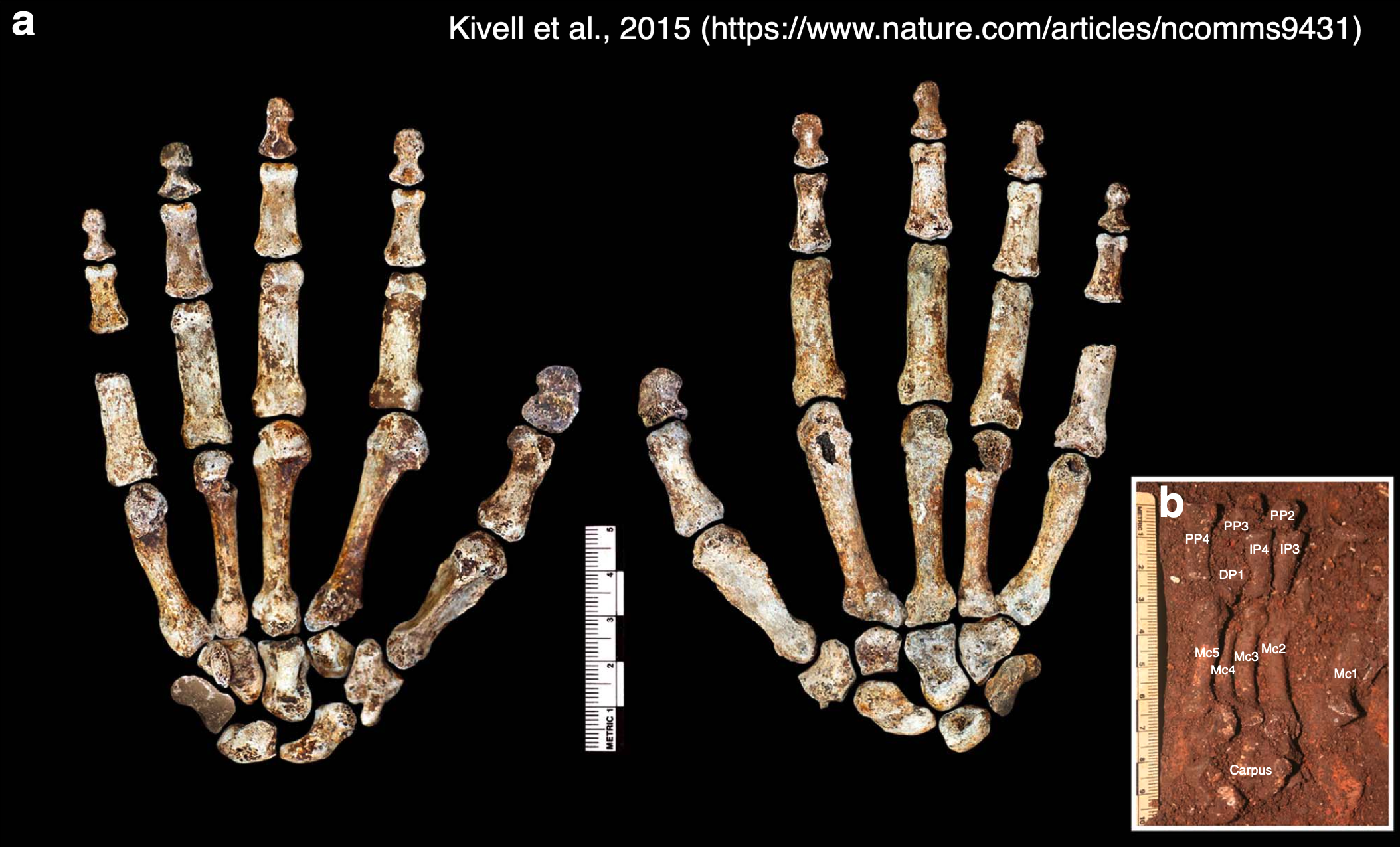
The “Hand 1” skeleton of Homo naledi, adapted from a figure by Kivell and colleagues (2015). Left shows the palm-side view while the middle shows the back of the hand. The inset (b) shows many of the palm and finger bones as they were found in situ in Rising Star Cave.

In a paper hot off the press (here), I teamed up with Dr. Tracy Kivell to analyze finger lengths of Homo naledi from the perspective of developmental biology. On the one hand, repeating structures such as teeth or the bones of a finger must be coordinated in their development, and scientists way smarter than me have come up with mathematical models predicting the relative sizes of these structures (for instance, teeth, digits, and more). On the other hand, the relative lengths of the second and fourth digits (pointer and ring fingers, respectively) are influenced by exposure to sex hormones during a narrow window in embryonic development: this ‘digit ratio’ tends to differ between mammalian males and females, and between primate species with different social systems.

So, Tracy and I examined the lengths of the three bones within the second digit (PP2, IP2, DP2) and of the first segment of the second and fourth digits (2P:4P) in Homo naledi, compared to published data for living and fossil primates (here and here). What did we find out?

Summary of our paper showing the finger segments analyzed (left), and graphs of the main results (right). The position of Homo naledi is highlighted by the blue star in each graph.

The first graph above compares the relative length of the first and last segments of the pointer finger across humans, apes, and fossil species. The dashed line shows where the data points are predicted to fall based on a theoretical model of development. There is a general separation between humans and the apes reflecting the fact that humans have a relatively long distal segment, which is important for precise grips when manipulating small objects. Fossil apes from millions of years ago and the 4.4 million year old hominin Ardipithecus are more like apes, while Homo naledi and more recent hominins are more like modern humans. Because both humans and apes fall close to the model predictions, this means the theoretical model does a good job of explaining how fingers develop. Because humans and apes differ from one another, this suggests a subtle ‘tweak’ to embryonic development may underlie the evolution of a precision grip in the human lineage, and that it occurred between the appearance of Ardipithecus and Homo.

The second graph compares the ‘digit ratio’ of the pointer and ring fingers from a handful of fossils with published ratios for humans and the other apes. Importantly, the digit ratio is high in gibbons (Hylobates) which usually form monogamous pair bonds, while the great apes (Pongo, Gorilla, Pan) are characterized by greater aggression and mating competition and have correspondingly lower digit ratios. Ever the bad primates, humans fall in between these two extremes. Most fossil apes and hominins have digit ratios within the range of overlap between the ape and human ratios, but Homo naledi has the highest ratio of all fossil hominins known, just above the human average. It has previously been suggested that humans’ higher ratio compared to earlier hominins may result from natural selection favoring less aggression and more cooperation recently in our evolution. If we can really extrapolate from digit proportions to behavior, this could mean Homo naledi was also less aggressive. This is consistent with the absence of healed skull fractures in the vast cranial sample (such skull injuries are common in much of the rest of the human fossil record).

You can see the amazing articulated Homo naledi hand skeleton for yourself on Morphosource. Its completeness reveals how handy Homo naledi was 300,000 years ago, and it can even shed light on the evolution of growth and development (and possibly social behavior) in the human lineage.

Results of the toe-tally easy lab activity

Alternate title: Dorsal canting in primate PPP4s

Earlier this year I suggested a classroom activity in which students can scrutinize the evidence used to argue that the >5 million year old (mya) Ardipithecus kadabba was bipedal. To recap: Ar. kadabba is represented by some teeth, a broken lower jaw, and some fragmentary postcrania. The main piece of evidence that it is a human ancestor and not just any old ape is from a single toe bone, and the orientation of its proximal joint. In Ar. kadabba and animals that hyperdorxiflex their toes (i.e., humans and other bipeds when walking), this joint faces upward, whereas it points backward or even downward in apes. This “dorsal canting” of the proximal toe joint has also been used as evidence that the 4.4 mya Ardipithecus ramidus and 3.5 mya owner of the mystery foot from Burtele are bipedal hominins. A question remains, though – does this anatomy really distinguish locomotor groups such as bipeds from quadrupeds?

Use ImageJ to measure the canting angle between the proximal joint and plantar surface. Proximal to the right, distal to the left.

STUDENT SCIENTISTS TO THE RESCUE! Use ImageJ to measure the canting angle between the proximal joint and plantar surface, as I’ve done on this Japanese macaque monkey (they are not bipedal). Proximal to the right, distal to the left Note I changed the measured angle from the March post.

I sicked my students in Ant 364 (Human Evolutionary Developmental Biology) here at NU on this task. I had students look at only 11 modern primates from the awesome KUPRI database. Most groups are only represented by 1 (Homo sapiens, Hylobates lar and Macaca fuscata) or two (Pongo species and Gorilla gorilla) specimens, all adults. For chimpanzees (Pan troglodytes) there is one infant and four adults. The database has more individuals, and it would be better to include more specimens to get better ideas of species’ ranges of variation, but this is a good training sample for a class assignment. The fossil group includes one Ardipithecus ramidus, one Ar. kadabba, one Australopithecus afarensis, and the PPP4 of the mystery foot from Burtele. The human and all fossils except Ar. kadabba are based off of lateral photographs and not CT scans like for the living primates, meaning there may be some error in their measurements, but we’ll assume for the assignment this is not a problem. Here are their results:

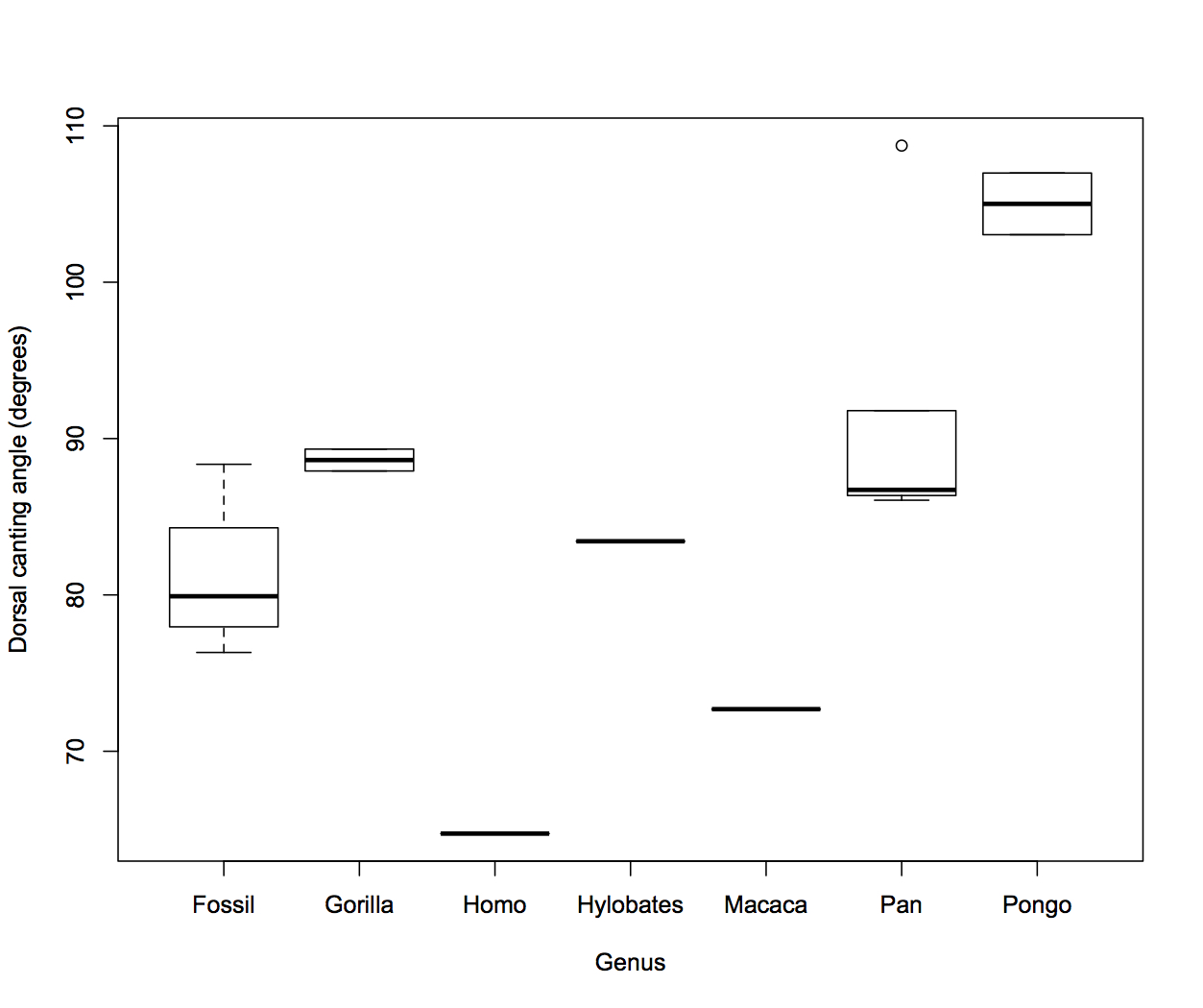
Dorsal canting angle of the fourth proximal pedal phalanx in primates.

Dorsal canting angle of the fourth proximal pedal phalanx in primates. The lower the angle, the more dorsally canted the proximal joint surface. The “Fossil” group includes specimens attributed to ArdipithecusAustralopithecus and something unknown.

Great apes have fairly high angles, meaning generally not dorsally canted proximal joint surfaces. The two gorillas fall right in the adult chimpanzee (adult) range of variation, while chimp infant and orangutans have much higher angles (≥90º means they’re actually angled downward or plantarly). The gibbon (Hylobates) is slightly lower than the chimpanzee range. The macaque has an even more dorsally canted joint, and the human even more so. The fossils, except the measurement for Ar. ramidus (see note above), have lower angles than living apes, but higher than the human and the monkey. If dorsal canting really is really a bony adaptation to forces experienced during life, then the fossil angles suggest these animals’ toes were dorsiflexed more so than living great apes (but not as much as the single monkey and human).

This lab helps students become familiar with CT data, the fossil record, taking measurements (students also measure maximum length of the toe bones and look at the relationship between length and canting), analyzing data, and hypothesis testing. You can also have fun exploring inter-observer error by comparing students’ measurements.

Here’s the full lab handout if you want to use or modify it for your own class: Lab 5-Toe instructions and report

Evolution of human fingers and toes: The two go foot in hand

A really cool study was just published in the journal Evolution, and what with getting my apartment ready for a New Year’s party on the 31st, and my being completely incapacitated yesterday, I didn’t get to read through it until today. Campbell Rolian and colleagues (in press) address the question: In human evolution, were hand and foot digital proportions each the targets of direct selection, or could hand/foot proportions have evolved as a byproduct of selection on only the hand or only the foot?

This is an interesting question. In your standard Anthropology 101 class, you learn about how humans (and hominins) are unique relative to apes. Two unique things about us are: a robust, adducted big toe for bipedalsim, and a hand adapted for tasks requiring a fairly high degree of dexterity, such as tool use. But something to keep in mind–indeed the authors of this study did–is that the hand and foot are serially homologous, each is a variant on a common theme. Because the developmental architecture behind the hand and foot are largely similar, an intuitive question is whether selection on the hand or foot only would effect the evolution of the element that wasn’t under selection. Could developmental integration of the hominin hand and foot have led to evolutionary integration, do/did the hand and foot co-evolve?

Turns out this may well be the case. Authors looked at lengths and widths of hand and foot phalanges (finger bones) in a sample of humans and chimpanzees. Generally, in both Pan and Homo, homologous traits in the hand and foot are more highly correlated than expected by chance, even compared to correlations between traits within the hand and foot. Cool!

But then the authors did some crazy simulations, to see what kinds of selection regimes on the hand and foot may have led from a chimp-like morphology to the morphology we humans enjoy today. I’ll need to reread this section a couple times, but it looks like selection on the big toe is one of the most important aspects of hominin hand/foot evolution. And it would not be impossible for evolutionary changes in the human hand to be largely by-products of selection on the foot, due to the nature of covariation (integration) of the hand and foot. Whoa!

The implication, which the authors seem to like, is this: given a chimp-like ancestral morphology for the hand and foot, it seems that the two major hominin/human traits given above (bipedalism and tool-use/manual dexterity) are largely due to selection simply on the foot. That is, because of the developmental integration of the hand and foot, selection for a bipedally capable foot indirectly induced the evolution of a hand conducive to manipulation. Ha, the hand was just along for the ride! Get it, because the feet move the body, and so the hand… but also evolutionarily… Dammit.

Anyway, that’s nuts! Of course, another very interesting thing about the first digits of the human hand and foot, aside from the fact that the first digit on both is relatively large and robust, is that the mobility of these digits is just about opposite what it is in the apes. Whereas the big toe is very mobile/opposable in apes (and the 4.4 million year hold putative hominin, Ardipithecus ramidus), it is completely adducted in humans (and fossil hominins that aren’t Ar. ramidus). Less extreme, the human thumb joint is allegedly more mobile than apes’ thumbs. So this is the next step, I guess: what is the developmental basis for the wild evolution of the human hallux and pollex joints?

Reference
Rolian C, Lieberman DE, and Hallgrimsson B. Coevolution of human hands and feet. Evolution: in press.