eFfing Fossil Friday: Funky facial flanges #FFF

David Krause and colleagues announced in this week’s Nature the discovery of a new species of extinct mammal, Vintana sertichi, that lived in what is now Madagascar between 66-72 million years ago. The species is based on a very well-preserved cranium of an early gondwanatherian (if you want to impress your friends this weekend, gratuitously use the word “gondwanatherian”). I don’t know much about early mammals like this, but it sounds like it was a weird creature (see the Stony Brook press release). Just looking at it’s face there’s something that sticks out as strange:
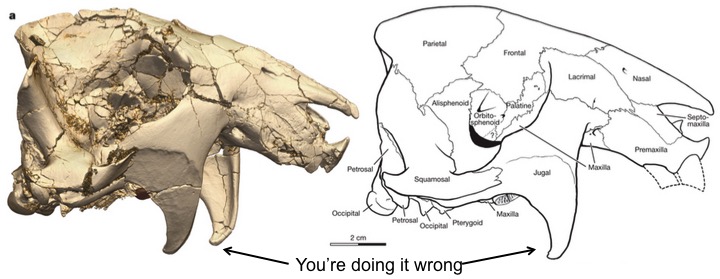
Ventana sertichi cranium (Reich et al. 2014, Figure 1a). Left is a 3D CT reconstruction, right is a line drawing highlighting all the individual bones (so many cranial bones). The view is from the right side, so the nose is on the right, the eye is the big hollow in the middle, and the back of the skull is on the left. The jugal flanges are the downward projections.

Vintana sertichi cranium (Reich et al. 2014, Figure 1a). On the left is a 3D CT reconstruction, and on the right is a line drawing highlighting all the individual bones (so many cranial bones). The view is from the right side, so the nose is to the right, the eye socket is the shadowy hollow in the middle, and the back of the skull is on the left. The jugal flanges are the downward projections.

Jutting downward from the sides of the jaw are ‘jugal flanges,’ projections of bone on the homologs of human cheeks. Projections of like these usually serve as muscle attachment sites, and the size of the projection generally reflects the size of the muscle. These facial flanges anchor the masseter muscle, a major chewing muscle that helps close the jaw. The size of this flange in Vintana suggests its chomp packed a punch. A debilitating bite. A face not even a mother could love (so now they’re extinct).

Vintana‘s bony tear-catchers caught my eye because most primates I’ve seen have, you know, less heinous faces. Scouring the internet, big jugal flanges are a fairly rare sight, but can apparently be found in glyptodonts (giant, armadillo-like mammals that lived tens of thousands of years ago) and various sloths. The closest thing I’ve seen to this gross bony flange in Primates are on the zygomatic bones of some extinct, baboon-like animals, such as Dinopithecus ingens:

Fragmentary skull, viewed from the top, of Papio (a.k.a. Dinopithecus) ingens, from Swartkrans, South Africa. Photo credit: CalPhotos.

Fragmentary skull, viewed from the top, of Papio (a.k.a. Dinopithecus) ingens, from Swartkrans, South Africa. As a punishment for its zygomatic excess, its face was confiscated. Photo credit: CalPhotos.

and Theropithecus brumpti

Theropithecus brumpti from the Omo basin. Photo credit: CalPhotos.

Theropithecus brumpti from the Omo Basin, Ethiopia. Photo credit: CalPhotos.

So some primates dabbled in jugal flangery like Vintana, but Natural Selection was having none of it. Anyway, Vintana overcame this craniofacial adversity with characteristic Mesozoic moxie, and is an important piece in the puzzle of mammal evolution. It will be interesting to see what other mammalian surprises the Mesozoic has in store for paleontologists.

Osteology everywhere: Pollicem verte(b)r(a)e [Latin puns are hard]

I just got back from the meetings of the European Society for the Study of Human Evolution in Florence. As you can guess, bones and genes and anatomy and apes and biomechanics and energetics and everything were on everyone’s minds. Even in the midst of an unseasonal surprise typhoon of lunch time ice:

Ambush of hail.

Aw hail no.

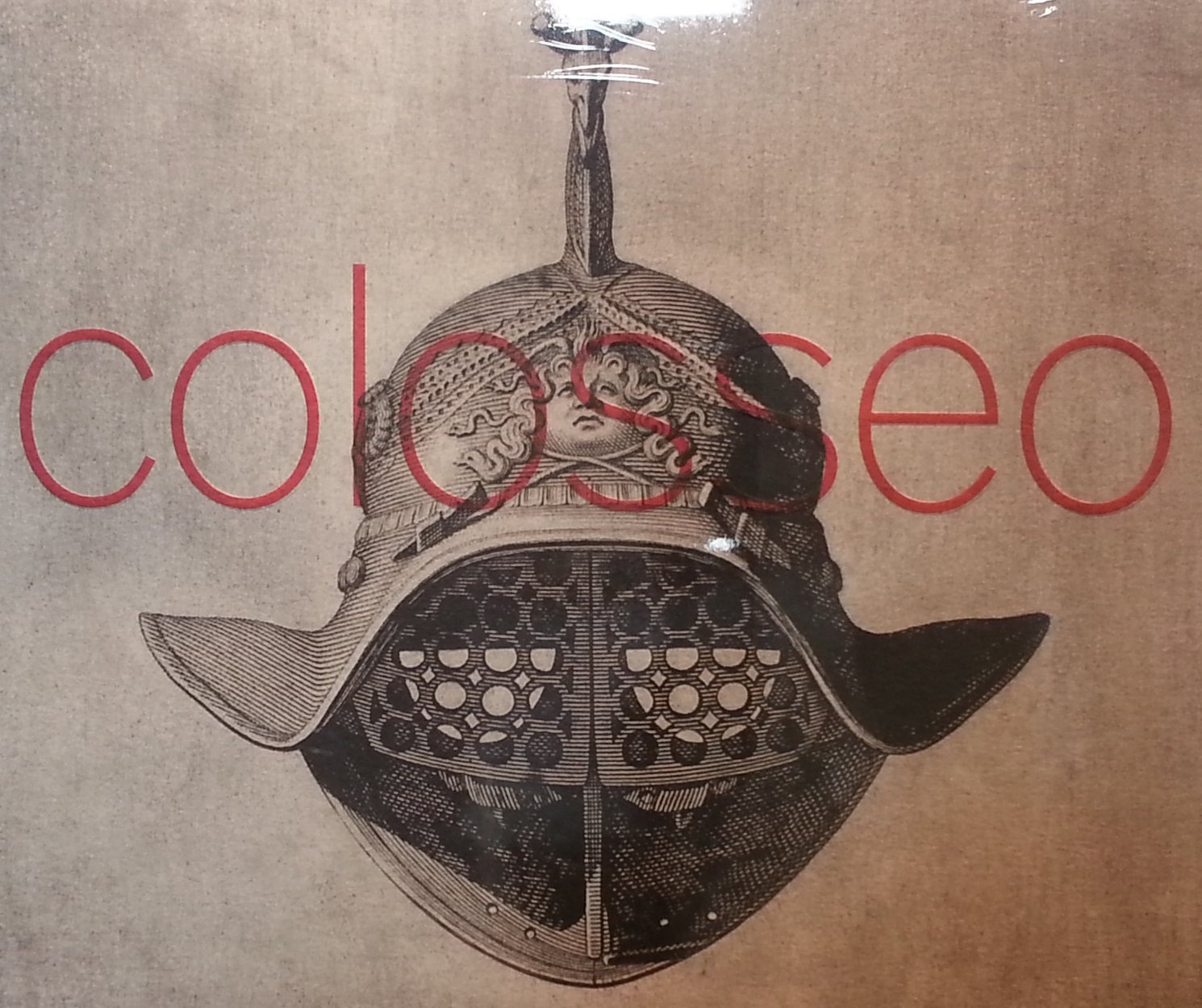
Along the way, I passed a gift shop window and this book cover immediately caught my eye:helert

No, it’s not an ancient Roman gladiator’s helmet. It’s clearly a lumbar vertebra, probably of some quadruped. We’re looking down onto the top (or front of it) from the cranial view. The body or centrum is the rounded part toward the bottom of the picture, the short transverse processes jutting off to the sides. The spinous process, pointing toward the top, is even thick and blunt distally as is characteristic of lumbar verts. Here’s a comparison:

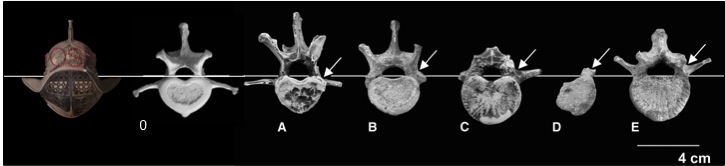
Middle lumbar vertebrae, from the cranial view (modified from Figs. 3-4 of Moyà-Solà et al., 2004). 0=modern baboon, A=Proconsul nyanzae (KNM-MW 13142-J)(B) P. catalaunicus (IPS-21350.59). (C) Cast of Morotopithecus bishopi (UPM 67.28) from Moroto (Uganda). (D) D. laietanus (IPS-18000) from Can Llobateres (Spain). (E) Pongo pygmaeus

Middle lumbar vertebrae of various Miocene apes (A-D) in cranial view (modified from Figs. 3-4 of Moyà-Solà et al., 2004). 0=modern baboon, A=Proconsul nyanzae (KNM-MW 13142-J), B=Pierolapithecus catalaunicus (IPS-21350.59), C=Morotopithecus bishopi (UPM 67.28), D=Hispanopithecus laietanus (IPS-18000), and E= modern orangutan.

Modern apes use an upright posture more frequently than living monkeys, who are quadrupedal. An anatomical correlate of these postures is the position of the transverse processes. Compare the baboon (0 in the figure above) with the orangutan (E). In the monkey the transverse processes come off the sides of the centrum (below the horizontal line), while in the orangutan the processes come off the pedicle further back. In your lumbars the transverse processes arise a little bit more toward the back than in the orangutan.

This is a pretty characteristic pattern, meaning that we can reconstruct the habitual posture of an animal based on a single bone – even just part of a single bone as in the case of Hispanopithecus (D, above). Proconsul nyanzae (A), dating to around 19 million years ago and therefore one of the earliest apes, has a monkey-like lumbar vert; the rest of its skeleton is monkey-like and so we think many of the earliest apes moved around like modern monkeys. In contrast, Morotopithecus bishopi (C), at 20.6 million years ago, is also one of the earliest apes but has a more modern-ape-like lumbar. And so with Pierolapithecus and Hispanopithecus.

The vertebra gracing the cover of our gift shop book is clearly more monkey-like, presumably from a simian who long ago walked on all fours across the blood-soaked floors of a cacophonous Colosseum.