Hip new Australopithecus deyiremeda juveniles

Header: "Australopithecus deyiremeda" but in a gold Harry Potter font, beneath which in the "Chalkduster" font is written, "And the Explosion of non-adult fossils"

Dr. Yohannes Haile-Selassie & colleagues just published some amazing fossils from around 3.4 million years ago, that convincingly link an unusual hominin foot fossil to an ancient human called Australopithecus deyiremeda.

In 2012, Haile-Selassie and team reported a foot fossil from Burtele, Ethiopia, revealing a bipedal creature (like a human) but with some grasping ability in the big toe (like all other primates). Then in 2015, the team presented some jaws and teeth from a nearby geological locality in the Burtele region, around which they designated a new hominin species, Australopithecus deyiremeda. The researchers hesitated to allocate the Burtele foot to this new species since they didn’t have similar fossils for comparison between the different fossil localities. But as the scientists have recently reported, jaws and teeth discovered from the foot site, including an incredible juvenile mandible, match those of Au. deyiremeda from the nearby Burtele sites. Now we can put a foot to the name.

The Burtele fossils help reveal the diversity of early hominins like Australopithecus and the contexts out of which our own genus Homo evolved. What caught my attention hiding among this amazing assemblage was a fossil that only gets a quick mention in the paper—the ischium bone from the hip of a juvenile deyiremeda:
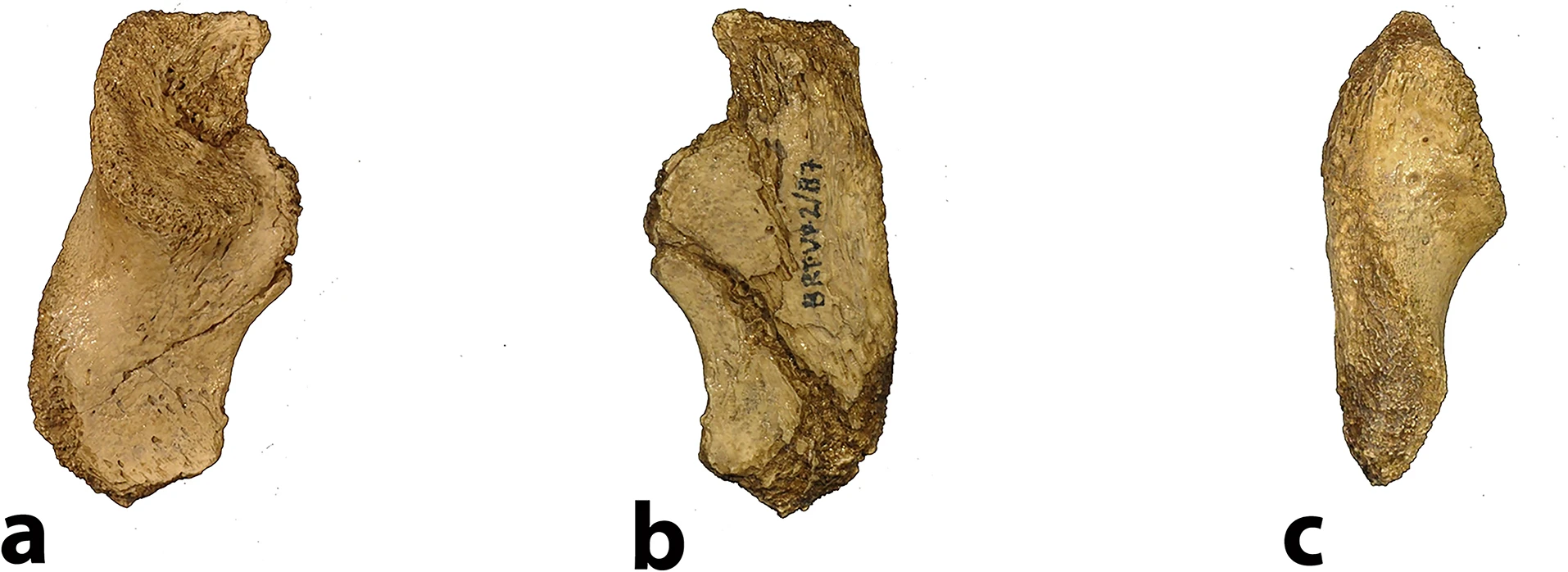
Extended Data Figure 7 from Haile-Selassie et al. (2025). The BRT-VP-2/87 juvenile ischium (from the right side of the body), depicted in side (a), middle (b), and back (c) views.

The fossil, given the catalog number BRT-VP-2/87, represents a different individual from the juvenile jaw mentioned above. It nevertheless provides a great deal of information despite being a small fragment (less than 2 inches long). The authors observe that the body of the ischium that extends beneath the hip joint is quite long, similar to modern apes, fossil Ardipithecus ramidus, and australopiths. This contrasts with the ischium of modern and fossil Homo in which the bone projects less beyond the hip socket:

Right juvenile ischium bones, scaled to similar size and oriented in similar positions. The black line on each depicts the distance from the hip socket margin to the top of the ischial tuberosity (left modified from Scheuer & Black, 2000 Fig. 10.15)

The bottom of the ischium is called the “ischial tuberosity,” and is the attachment surface for the hamstrings muscles. Having a long ischium provides the hamstrings of apes and other arboreal primates with more powerful hip extension—very useful when climbing trees but it also limits how far back the thigh can extend away from the body (Kozma et al., 2018). The shorter ischium of humans, Homo naledi, and other members of our genus may make our hamstrings a little less powerful, but it also helps us fully extend our legs which is crucial to our efficient bipedal walking and running.
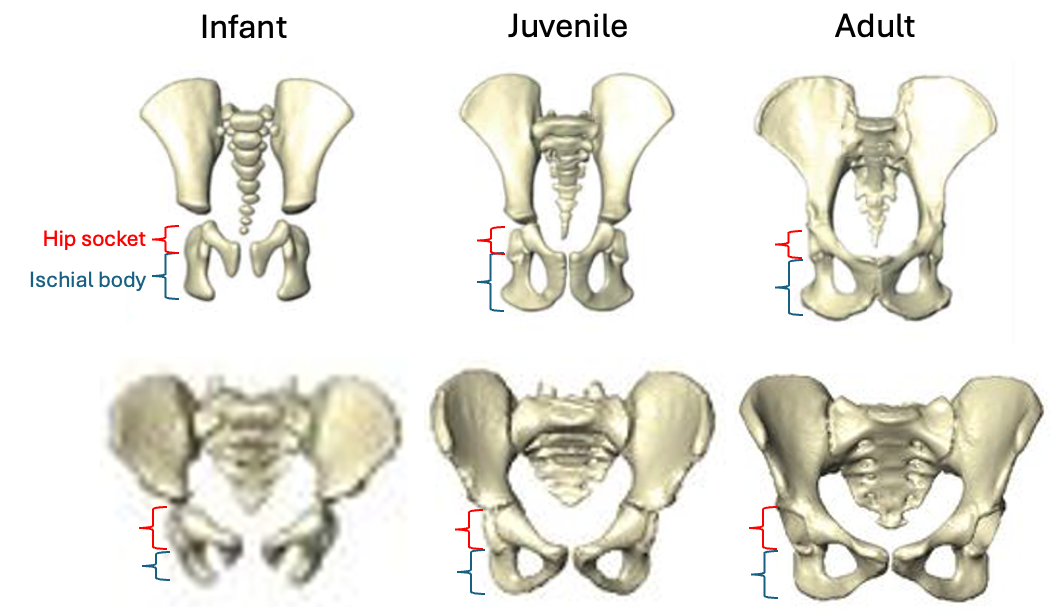
Pelvis growth and development in chimpanzees (top row) and humans (bottom row), all scaled to a similar vertical height. Notice the differences in both the relative length of the ischium (blue bracket) and orientation of the ischial tuberosities between chimps and humans, consistent across the growth period. Images modified from Huseynov et al. (2016 and 2017).

Based on studies of modern humans and other primates, we know that this configuration of bones and muscles is established before birth, so we can be confident that adult Au. deyiremeda would have had a similar anatomy to BRT-VP-2/73, albeit at an unknown, larger size. A hip well adapted for climbing is consistent with the Burtele foot with a grasping big toe.

As Haile-Selassie and colleagues note in the online supplementary information accompanying the paper, only immature fossils allow us to reconstruct the evolution of growth and development. But one of the major challenges of studying immature remains is determining their age or state of maturation, which is critical for understanding how much change occurs between, say, infancy and adulthood. The authors of this study note that the qualitative appearance of the BRT-VP-2/73 hip socket surface is like that of modern humans around 6 years of age, yet the fossil is much smaller and more similar in size to 3 year-old humans. My colleagues and I (2022) faced a similar challenge when analyzing a juvenile Homo naledi hip, and we also relied on qualitative comparisons of how the joint “looks” at different stages of development.

But I think we’re at a point now where we can try to quantify some of these tricky developing surfaces to help place immature fossils more precisely along a timeline of development. For example, Peter Stamos & Tim Weaver (2020) adapted a method for quantifying the topography of teeth, to measure the complex curvature of the developing surface of the knee. If these quantitative methods can distinguish different phases of development in large samples of humans and other primates (e.g., Stamos et al., 2025), they could then be extended to the immature hominin fossil record.

Some cool insights could also be gained by applying older and established methods like landmark-based geometric morphometrics, even on quite fragmentary fossils. This approach could capture the development and orientation of the ischial tuberosity relative to the hip socket surface in fragments like BRT-VP-2/73, MLD 8, and Homo naledi fossils (depicted above) and compared with fossil adults. Researchers have also devised robust ways of quantifying size and shape changes during growth based on modern animals, and using these patterns to then ‘grow’ immature fossils to more developed states, for comparison with actual adult fossils (McNulty et al., 2006). Applying this approach to even just the small fossil sample of ischia described here could tell us a lot about how ancient animals moved at different periods in their lives. Someone just needs to park their ischial tuberosities in a chair and do it!

A growing fossil record of immature hominins, alongside technical advances in quantifying and comparing anatomy, mean that we are ready to learn much more about how our extinct ancestors and cousins grew into competent adults.

How small apes grow big canine teeth

Gibbons are sometimes referred to as “lesser apes” since they’re the smaller-bodied cousins of “great apes” like us humans, chimpanzees, gorillas, and orangutans. But what they lack in body mass they make up for in taxonomic diversity, with roughly 20 species distributed across four genus groups (Kim et al., 2011). And while male great apes (except humans) have large canine teeth, both sexes in gibbons have large maxillary canines — flashy weaponry for defending territory.

Pointy canine teeth peeking out from the upper and lower jaws of an adult female gibbon cared for at the International Primate Protection League (source)

My research has generally focused on brains and growth throughout human evolution, but I started looking at gibbons a few years ago when the COVID-19 pandemic put research travel on hold. Inspired by Julia Zichello’s 2018 article about gibbon models for understanding hominin evolution and appreciating that “overlooked small apes need more attention,” I had the opportunity to CT scan a unique skeletal collection of white-handed gibbons (Hylobates lar), which was sadly harvested from the forests of Thailand back in the late 1930s. Previous research on skull growth in gibbons has mostly used small samples compiled from different species (and sometimes even different genera). In contrast, this CT dataset includes many individuals at each stage of maturation from late infancy through adulthood, effectively representing a single population at a point in time. So with this larger cross-sectional sample of a single species, we can better understand how gibbon brains and faces grow. And because permanent teeth form in a long, continuous sequence throughout the growth period, an individual’s state of dental development can serve as a marker of where they are along the maturation process.

In a paper hot off the press, Julia Boughner and I analyzed dental development in this unique sample (article here). One of the coolest things we found was that gibbons’ large upper canine teeth are among the first to begin but last to finish tooth formation. In fact, the large canines growing inside relatively small faces may inhibit growth of one of the neighboring incisor teeth until the face has grown to create enough space for it. And while most teeth developing within the jaw begin emerging into the mouth once there’s enough room for them, gibbons’ gargantuan upper canines are forced out of hiding as they outgrow their bony crypts (check out the right-most jaw in the second row below).

Cross-sectional representation of tooth formation in white-handed gibbons, starting with the youngest in the top left and ending with the oldest in the bottom right. The first permanent tooth to form and emerge, M1, is highlighted along with the canine “C.”

In addition to characterizing ‘normal’ dental development, we also observed several developmental anomalies and pathologies in the sample. Our observations corroborate previous research showing that tooth formation generally proceeds ‘as scheduled’ despite various other disturbances to development.

It remains to be seen whether early development of the canine at the cost of delayed incisor formation is a pattern unique among all the apes, since most other studies of ape tooth formation have examined the lower jaw while our study focused on the upper jaws. But the canine-incisor tradeoff that we identified sets the stage for subsequent study of skull growth in this sample, as it highlights the many factors and functions that must be coordinated during growth.

While we have several projects planned with this unique dataset, we have also published the tooth formation data that we analyzed, and the original micro-CT scans themselves will be published to the online repository Morphosource.org imminently — stay tuned!

The hand of Homo naledi points to life before birth

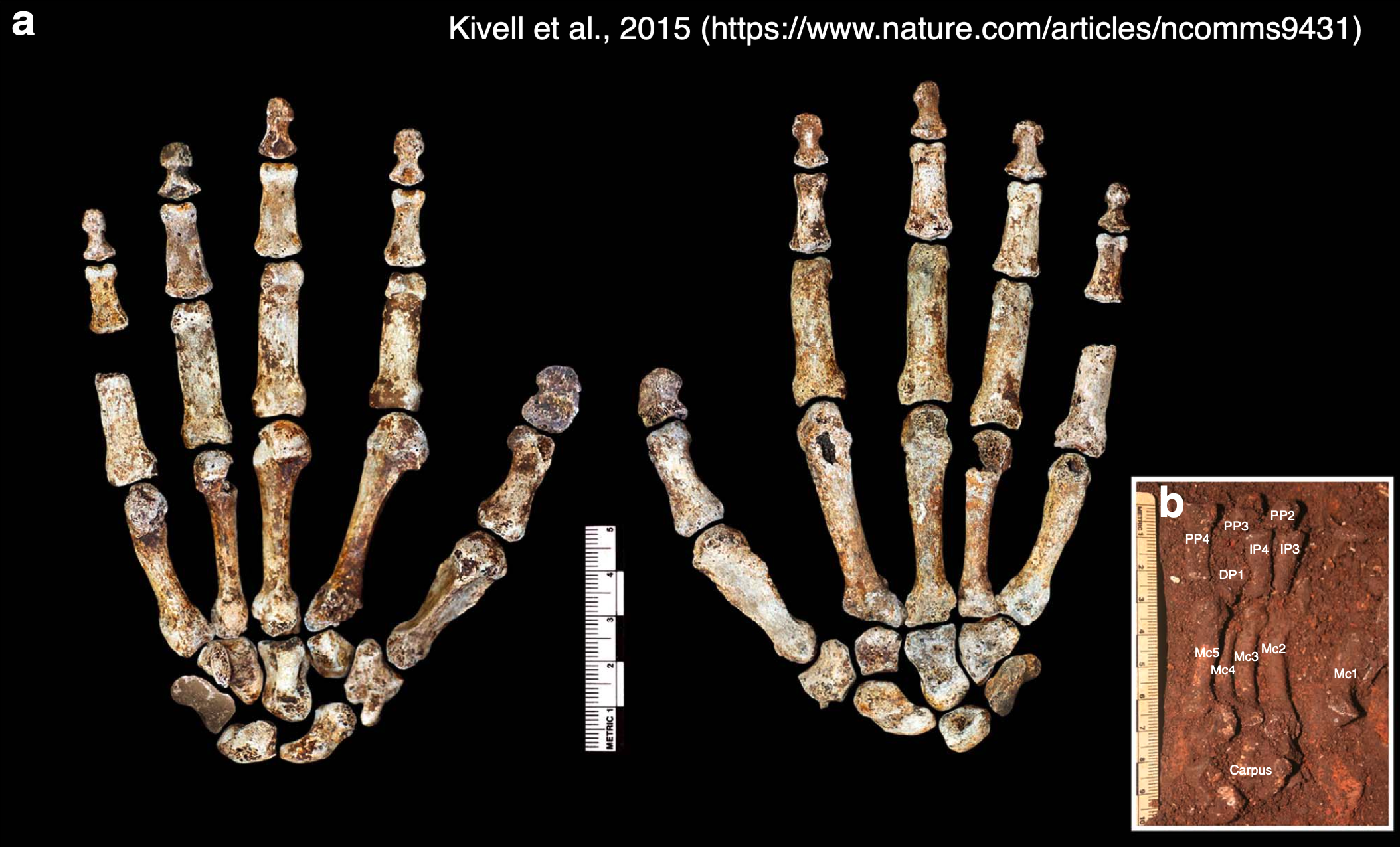
Homo naledi is one of my favorite extinct humans, in part because its impressive fossil record provides rare insights into patterns and process of growth and development. When researchers began recovering naledi fossils from Rising Star Cave 10 years ago, one of the coolest finds was this nearly complete hand skeleton. The individual bones were still articulated practically as they were in life so we know which bones belong to which fingers, allowing us grasp how dextrous this ancient human was. And since finger proportions are established before birth during embryonic development, we can see if Homo naledi bodies were assembled in ways more like us or other apes.

The “Hand 1” skeleton of Homo naledi, adapted from a figure by Kivell and colleagues (2015). Left shows the palm-side view while the middle shows the back of the hand. The inset (b) shows many of the palm and finger bones as they were found in situ in Rising Star Cave.

In a paper hot off the press (here), I teamed up with Dr. Tracy Kivell to analyze finger lengths of Homo naledi from the perspective of developmental biology. On the one hand, repeating structures such as teeth or the bones of a finger must be coordinated in their development, and scientists way smarter than me have come up with mathematical models predicting the relative sizes of these structures (for instance, teeth, digits, and more). On the other hand, the relative lengths of the second and fourth digits (pointer and ring fingers, respectively) are influenced by exposure to sex hormones during a narrow window in embryonic development: this ‘digit ratio’ tends to differ between mammalian males and females, and between primate species with different social systems.

So, Tracy and I examined the lengths of the three bones within the second digit (PP2, IP2, DP2) and of the first segment of the second and fourth digits (2P:4P) in Homo naledi, compared to published data for living and fossil primates (here and here). What did we find out?

Summary of our paper showing the finger segments analyzed (left), and graphs of the main results (right). The position of Homo naledi is highlighted by the blue star in each graph.

The first graph above compares the relative length of the first and last segments of the pointer finger across humans, apes, and fossil species. The dashed line shows where the data points are predicted to fall based on a theoretical model of development. There is a general separation between humans and the apes reflecting the fact that humans have a relatively long distal segment, which is important for precise grips when manipulating small objects. Fossil apes from millions of years ago and the 4.4 million year old hominin Ardipithecus are more like apes, while Homo naledi and more recent hominins are more like modern humans. Because both humans and apes fall close to the model predictions, this means the theoretical model does a good job of explaining how fingers develop. Because humans and apes differ from one another, this suggests a subtle ‘tweak’ to embryonic development may underlie the evolution of a precision grip in the human lineage, and that it occurred between the appearance of Ardipithecus and Homo.

The second graph compares the ‘digit ratio’ of the pointer and ring fingers from a handful of fossils with published ratios for humans and the other apes. Importantly, the digit ratio is high in gibbons (Hylobates) which usually form monogamous pair bonds, while the great apes (Pongo, Gorilla, Pan) are characterized by greater aggression and mating competition and have correspondingly lower digit ratios. Ever the bad primates, humans fall in between these two extremes. Most fossil apes and hominins have digit ratios within the range of overlap between the ape and human ratios, but Homo naledi has the highest ratio of all fossil hominins known, just above the human average. It has previously been suggested that humans’ higher ratio compared to earlier hominins may result from natural selection favoring less aggression and more cooperation recently in our evolution. If we can really extrapolate from digit proportions to behavior, this could mean Homo naledi was also less aggressive. This is consistent with the absence of healed skull fractures in the vast cranial sample (such skull injuries are common in much of the rest of the human fossil record).

You can see the amazing articulated Homo naledi hand skeleton for yourself on Morphosource. Its completeness reveals how handy Homo naledi was 300,000 years ago, and it can even shed light on the evolution of growth and development (and possibly social behavior) in the human lineage.

Osteology Everywhere: Skeletal Spice

The American winter holiday season is steeped in special spices, such as nutmeg, cloves, cinnamon, and whatever the hell pumpkin spice is. I guess as part of the never-ending War on Christmas, each year this sensory and commercial immersion begins earlier and earlier. Since these have become old news, I’d pretty much forgotten about the seasonal spicecapade until just the other day. In prep for minor holiday gluttony, I was grinding fresh nutmeg when I made a startling discovery. Nutmeg is not just the fragrant fruit of the Myristica fragrans tree. No, there’s something far more sinister in this holiday staple.

download

Merely nutmeg?

The ground section looks superficially like an unfused epiphyseal surface, whereas the rounded outer surface is more spherical. It turns out, in the most nefarious of all holiday conspiracies since the War on Christmas, nutmeg halves are nothing more than unfused femur heads! Compare with the epiphyseal surface of this Homo naledi femur head:

screen-shot-2016-11-26-at-5-36-05-pm

Nutmeg (left) and H. naledi specimen UW 101-1098 (right).

This immature H. naledi specimen was recently published (Marchi et al., in press), and the associated 3D surface scan has been available for free download on Morphosource.org for a while now. It fits onto a proximal femur fragment, UW 101-1000, also free to download from Morphosource.

screen-shot-2016-11-26-at-5-48-42-pm

Modified Fig. 11 from Marchi et al. It’s weird that only H. naledi bones were found in the Dinaledi chamber, but even weirder is the underreported presence of nutmeg.

Like most  bones in the skeleton, the femur is comprised of many separate pieces that appear and fuse together at different, fairly predictable ages. The shaft of the femur appears and turns to bone before birth, and the femur head, which forms the ball in the hip joint, usually appears within the first year of life and fuses to the femur neck in adolescence (Scheuer and Black, 2000). So we know this H. naledi individual was somewhere between 1–15ish years by human standards, probably in the latter half of this large range.

So there you have it. Osteology is everywhere – the holidays are practically a pit of bones if you keep your eyes open.

ResearchBlogging.orgREFERENCES

Marchi D, Walker CS, Wei P, Holliday TW, Churchill SE, Berger LR, & DeSilva JM (2016). The thigh and leg of Homo naledi. Journal of Human Evolution PMID: 27855981.

Scheuer L and Black S. 2000. Developmental Juvenile Osteology. New York: Elsevier Academic Press.

eFFING FOSSIL FRIDAYS!

I’m going to do my best to keep up with the blog during by Big Summer Adventure, and one thing I’d like to do is “F-ing Fossil Friday!” in which I focus on fossils for a bit. We’ll see if I can make this pan out.
Today I got out the rest of the Australopithecus robustus mandibles at the Transvaal Museum (above), save for I think maybe 1. As you can see from the picture, taphonomy (what happens to an animal’s remains between death and our digging them up) creates a serious challenge for the study of variation in this species. I’m focusing on ontogenetic variation – differences associated with growth and development. In spite of its fragmentary nature, so far as I know this is the best ontogenetic series of any fossil hominid (I should probably look more into A. afarensis here, too). In the bottom left you’ll see SK 438, the youngest in the sample, whose baby teeth haven’t quite come in all the way. Poor little guy! At the top right corner is SK 12, probably the oldest individual and also a big bugger.
One thing that I’ve noticed so far, only a preliminary observation that I need to actually run some numbers on, is that as individuals get older, the length of their tooth row (molars and premolars) gets shorter. This is because of the tendency for teeth to move forward during growth – “mesial drift” – and for adjacent teeth to literally wear into one another, their ends becoming flatter and flatter. While I should have realized this, it was surprising at first to find some dimensions of the lower jaw actually decreasing during growth. Now, I still have to run some tests to see if this is a biologically significant phenomenon. But it’s always nice to learn something new, even after just 2 days back with my best extinct buddies.
Stay tuned to future eFfing fossil Fridays!

100,000 year old child skeleton on National Geographic

National Geographic aired a special tonight about a recently-excavated child’s skeleton (they focused on the skull) from Grotte des Contrebandiers in Morocco, dated to around 108,000 years ago. So far as I know this material has not been fully published (aside from a brief blurb in Science).

The program presented work of archaeologists, paleontologists, reconstruction artists, taphonomists, and lots of other people, hoping to figure out who the kid was and such. All in all it was pretty cool, I’d recommend checking it out if you didn’t see it. Or again if you did see it.

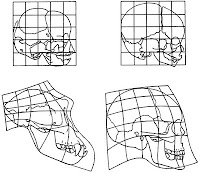
While I think it was a great program and the researchers involved are doing a terrific job, I had two main notes: first, I wish they’d treated the topic of growth-n-development a little more. They noted that the child (5-6 years old possibly) looked really “modern” because of its flat face. But looking at it, it didn’t really have that flat of a face, especially for a child. They talked about how human-like (rather than Neandertal-like) the kid was, but they only compared it with adults – children tend to have relatively smaller faces and larger brain-cases than adults (right), so it’s no wonder it looked more like an adult human than the adult Neandertal from Amud (Israel) that they compared it with. It would’ve been great to see more comparisons with other late Pleistocene hominid kids, such as from Skhul/Qafzeh or La Quina. A future program, perhaps.
Second, they kept asking whether the kid was “a Homo sapien.” I know it’s counterintuitive for English-speakers, but “H. sapiens” is the singular and plural of humans’ scientific name. Silly, right, cuz it doesn’t even get paid twice as much. But you’ll have take that up with C. Linnaeus. I am a Homo sapiens. You are a Homo sapiens. Fifty people are a gaggle of Homo sapiens.
Anyway it was a cool show. Check it out!
Figure credit: Fig. 2 from Bogin. 2003. The human pattern of growth and development in paleontological perspective. In Patterns of Growth and Development in the Genus Homo, eds. Thompson JL, Krovitz GE and Nelson AJ. New York: Cambridge University Press: 15-44.

"Big Man" and the scapula of Australopithecus afarensis

Last November I reported on recently described Australopithecus cf. afarensis craniodental remains from the site of Woranso Mille in Ethiopia. These fossils are significant in part because they date to around 3.6 million years ago; most of the postcranial evidence for A. afarensis comes from Hadar (~3.4 – 2.9 million years) or Maka (~3.5 million years). It is pretty awesome, then, that Yohannes Haile-Selassie and colleagues (2010a) have just reported on a partial skeleton from Woranso-Mille.

 
The specimen is given the catalog number KSD-VP-1/1 (right, from Nature), and the nickname Kadanuumuu, meaning “Big Man” in the language of the Afar people who live in the region where the fossils were discovered. Here, I’ll be focusing on the scapula.
 
Researchers have debated about what the scapular form of A. afarensis means functionally – how could, and did, these creatures use their shoulders? The scapula of AL 288 (the famous “Lucy”) preserves part of the glenoid fossa (shoulder socket) and only a little of the surrounding bone including the scapular spine (below). It has been argued that the angle between the glenoid fossa and the lateral border is more similar to modern apes than to humans. That is, the shoulder socket may have been oriented more upward, like in modern apes, compared to humans whose socket faces more to the side. The implication is that A. afarensis may have been preferentially exploiting arboreal environments.
 
Left: AL 288 scapular fragment. The glenoid fossa is the hollow that faces to the right, the lateral border is at the bottom paralleling the label “AL 288-1L.” The scapular spine is preserved only at the base, it is the small uprising of bone just to the left of the glenoid fossa. From Haile-Selassie et al. 2010b, Fig. S21.
 
Similarly, a juvenile afarensis skeleton from the Ethiopian site of Dikika (Alemseged et al. 2006), dating to around 3.4 million years ago, also suggested an ape-like shoulder for this extinct human ancestor. Principal components analysis of several measurements from the Dikika scapula showed it to be very similar to gorillas of comparable age, in terms of overall shape and proportions.
 
So from these two scapulae, one belonging to a very small-bodied female, the other from a small ~3-year-old possible female, we get the picture that A. afarensis had a fairly ape-like (i.e. arboreal) shoulder orientation, and may not have had independent movement of the head and trunk that we modern humans enjoy. Nevertheless, it is still unclear whether this means that the afarensis scapula functioned like that of an ape, and hence its shape, or whether the similarity in shape is a ‘hold-over’ from having an arboreal ancestor. I will say, I think one very telling feature noticeable in even the fragmentary AL 288 is the relative position and orientation of the scapular spine. Note that in the apes (the two juveniles scapulae on the right of the diagram to the left), the scapular spine roughly parallels the lateral border, and as a result, the flat areas above and below the spine are roughly equal in size. The above area houses the supraspinatus muscle, a rotator cuff muscle that acts largely in elevating the arm above the head and stabilizing the shoulder joint. In humans and afarensis, in contrast, the lower (insfraspinous) fossa is fairly large compared to the upper (supraspinous) fossa. Thus, the argument can be made that in humans and hominids, less power is needed to raise the arms over the head, or that humans and hominids have a greater reliance on the infraspinatus muscle for bringing the arm down toward the body and stabilizing the shoulder joint.
 
Now, KSD-VP-1 provides a remarkably complete scapula of an adult afarensis (right). In contrast to the specimens described above, KSD-VP-1 is very human-like. To the naked eye, and as borne out by principal components analysis of scapular angles, this thing is very human-like.
 
Now the question is, why does the morphology of this new specimen seem at odds with Lucy and Dikika? Part of the answer could be scaling – indeed, the authors note that the orientation of the glenoid relative to the lateral border (more specifically the scapular bar) in AL 288 can be found in modern humans of small size.
 
But that still does not answer the question of why the complete adult afarensis scapula is like adult humans, whereas the child afarensis is like young gorillas. The authors posit that perhaps it is due to Dikika’s fairly large supraspinous fossa. They also suggest that the measurements used in Alemseged et al’s study could not capture functional and discriminatory information about scapula shape. Nevertheless, a simple visual comparison the Dikika and KSD (x-ray…) scapulae reveals them to look fairly different, i.e. Dikika is relatively broader side-to-side.
 
Could ontogeny explain the differences between the child and adult afarensis? In a study of scapular growth and development in living primates, Young (2008) found childhood growth does not appear to explain adult shape variation. That is to say, most aspects of species-specific morphology are present in subadult scapulae. Rather, most variation in scapular shape among modern primates appears to be due to functional differences: climbers’ scapulae differ consistently from quadrupeds’. So what does that imply? That at 3.59 million years, adult male A. afarensis were not using their shoulders for arboreal activities, but at 3.4 million years ago, subadults were? Maybe this is just normal intraspecific variation? Maybe the ontogeny of the scapulae needs to be examined further?
 
I have to say I agree with Haile-Selassie et al. (2010a) here, that differences in the statistical analyses between the current study and that of Alemseged et al. (2006) may be partly responsible for the different interpretations of A. afarensis scapular morphology. Still, visual inspection of pictures of the fossils suggests to me that even if the principal components analyses were carried out using the same variables (Alemseged et al. used linear measurements, H-S et al. used angles), Dikika might seem gorilla-like, KSD still human-like; Nota bene that principal components analysis is not actually a test in itself, but rather an exploratory statistical technique. As such, it will never really “tell” how a bone was used. Still, I think this does raise an important issue about scapular function and ontogeny in hominoids.
 
References
Alemseged Z, Spoor F, Kimble WH, Bobe R, Geraads D, Reed D, and Wynn JG. 2006. A juvenile early hominin skeleton from Dikika, Ethiopia. Nature 443: 296-301.
 
Haile-Selassie Y, Latimer BM, Alene M, Deino AL, Gibert L, Melillo, Saylor BZ, Scott GR, and Lovejoy CO. 2010a. An early Australopithecus afarensis postcranium from Woranso-Mille, Ethiopia. Proceedings of the National Academy of Sciences, USA, in press.
 
Haile-Selassie et al. 2010b. Supplementary Online Material to 2010a.
 
Young NM. 2008. A Comparison of the Ontogeny of Shape Variation in the Anthropoid Scapula: Functional and Phylogenetic Signal. American Journal of Physical Anthropology 136: 247-264.