Trying to start on finishing my dissertation, I’m thinking about the issue dental development and how it relates to skeletal growth. Specifically I’m trying to decide whether I want to analyze my human and Australopithecus robustus samples based on estimates of “dental age,” or if I want to be a bit more cavalier and divide the sample into rougher age categories.
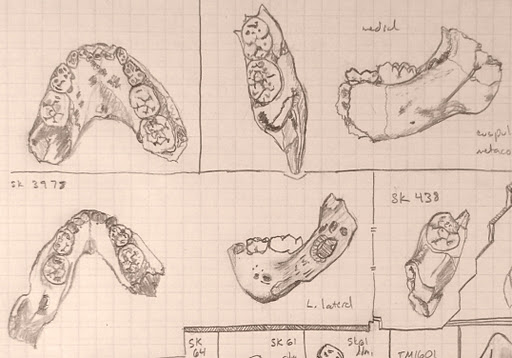
To avoid copyright issues, here’s a crappy picture I drew a few years ago, of the youngest A. robustus jaws. The youngest, “SK 438” is erupting its last baby tooth (bottom right), while the others have their full set of baby teeth, and none of them has its first adult tooth yet. I don’t think I can estimate ages accurately enough to capture the true chronological difference between SK 438 and the rest. Would I be better off just dividing the group into “younger” (SK 438) and “older” (the rest) infants, or even lumping them all together as simply “infants”?
On the one hand, I could assign individuals a chronological age based on a modern referent of known age, at similar stages of dental development. This could allow me to get more fine-scale glimpses into patterns of growth in my samples, but that’s assuming I’ve accurately estimated their ages. Individuals vary in the ages and sizes at which their teeth erupt; a person’s first molar, for example, may erupt at anywhere from 4-8 years of age. How can I estimate an individual’s age in light of such variation? And what if I’m as poor a judge of ages as Dennis Duffy?! Conceivably I could program my analysis to account for error estimation (which in itself could be educational and interesting, but is it worth the trouble?), but this would also add a further source of uncertainty. And it’s like Dwight Schrute said (Michael Scott said), “K-I-S-S: keep it simple, stupid. Great advice, hurts my feelings every time.”
On the other hand, I could divide my sample into coarse age categories – say, putting specimens who’ve attained a given level of dental development in the same group, such as ‘infant, child, juvenile, adolescent, and young adult.’ This method loses the temporal resolution of the first method, but also avoids the possible errors of assigning strict ages I’m pretty sure I would not infer accurately. But, tooth development does not show a clean 1-to-1 relationship with other systems in the body, such as hormonal axes or the bony skeleton. It’s uncertain how accurately kids can be put in any of the above categories (based on general life history variables; Bogin 1999) based on dental development.
Choices, choices.
Variation is a problem for biologists. The theory of evolution was conceived as a way to explain the conundrum of why there is such remarkable variation in the forms of life that Earth is lucky to have harbored. The problem of within-species variation in the relative timing of skeletal and dental development isn’t just a bug-bear for paleoanthropologists. It’s important to medical doctors and pathologists investigating genetically-based developmental disorders, and to epidemiologists looking at aspects of population health, such as the prevalence of growth stunting. It’s also important for forensics specialists who need to use biological clues about the age and identity of crime victims and defendants. I mean, how else would we know whether Jon Voight bit both Kramer and this pencil?


 The silver lining, I suppose, on this storm-cloud of biological of variation is that without variation there cannot be evolution. And stasis is boring. If nothing changed since the Cambrian, none of us would be here today. We’d probably be some gross stupid monstrous thing, like this Hallucigenia to the right. It’s the quirks and weird variants that arise randomly, that make evolution possible. If individuals all developed exactly the same, then all organisms through all time would be the exact same, and probably all would have gone extinct as they succumbed to some sinister fate, no new variants would have arisen that may have been able to survive the devastation.

So variation is a blessing and a curse. Individual and population variation make it difficult to state norms such as what is “average” or “healthy,” and nothing to be concerned about. Variation is also the magic ingredient of adaptation, without which Life could not survive the randomness inherent in any environment.
Things I cited
Bogin, B. (1999). Evolutionary perspective on human growth Annual Review of Anthropology, 28 (1), 109-153 DOI: 10.1146/annurev.anthro.28.1.109
Also 30 Rock, The Office and Seinfeld. Well done, NBC.

 Lawnchair Anthropology