The vernal awakening has brought rain to Ann Arbor, and right on here on main campus I spotted the rain-splotched silhouette of an articulated human pelvis (left).
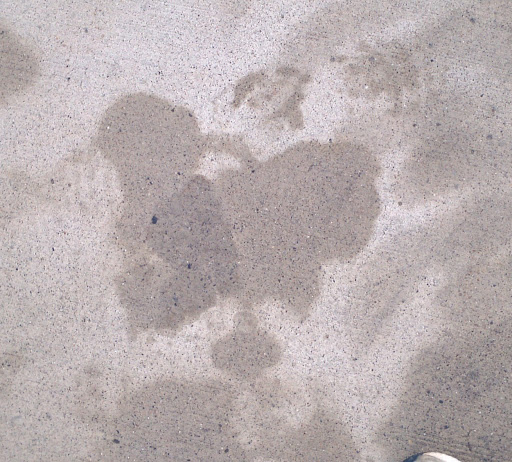
Check out those short and flaring iliac blades, and the shortness of the ischium. These features are associated with repositioning key muscles for walking and running on two feet, and are very unlike what is seen in the four-legged, suspensory climbing apes.
 Lawnchair Anthropology
Hope this won't come off as too self-serving, but have a look at Jungers (JHE, 1987) on "Body size and morphometric affinities of the appendicular skeleton in Oreopithecus bambolii (IGF 11778)." The ilium of Oreo isn't short at all; its relative length is comparable to that seen in a variety of apes and Old World Monkeys (Table 2).I had the opportunity to study the Ardipithecus fossils in Addis last November. The distance between the acetabular margin and the sacroiliac joint is remarkably short, and much more human-like than in Oreo or any extant ape; i.e., the ilium really was short in Ardi. And the lateral metatarsals are those of a bipedal hominin, a weird one to be sure, but they are uniquely hominin. Other bits of the postcranium also reveal shared-derived features with later hominins. Seeing really is believing in this case.I enjoy your blog. Tx.WL Jungers
not self-serving at all. Thanks for the reference and the first-hand insights into both these fossils!
PS ive been keeping up with you here and there and your titles, like you, have only gotten better with age! haha xx kristen