Osteology Everywhere: Ilium Nublar

Jurassic Park is objectively the greatest film ever made, so I don’t need to explain why I recently watched it for the bajillionth time. Despite having seen this empirically excellent movie countless times, I finally noticed something I’d never seen before.

Hold on to your butts. What's that on the screen in front of Ray Arnold?

Hold on to your butts – what’s that on the screen in front of John Arnold? (image credit)

The film takes place on the fictitional island “Isla Nublar,” a map of which features prominently in the computer control room when s**t starts to go down. Here’s a clearer screenshot of one of Dennis Nedry‘s monitors:

Isla Nublar from the JP control room. Quiet, all of you! They’re approaching the tyrannosaur paddock…. (image credit)

It dawned on me that the inspiration for this island is none other than MLD 7, a juvenile Australopithecus africanus ilium from the Makapansgat site in South Africa:

Figure 1 from Dart, 1958. Left side is MLD 7 and right is MLD 25. Top row is the lateral view (from the side) and bottom row is the medial view (from the inside).

Figure 1 from Dart, 1958. Left side is MLD 7 and right is MLD 25. Top row is the lateral view (from the side) and bottom row is the medial view (from the inside). These two hip bones are from the left side of the body (see the pelvis figure in this post). Note the prominent anterior inferior iliac spine on MLD 7, a quintessential feature of bipeds.

Isla Nublar is basically MLD 7 viewed at an angle so that appears relatively narrower from side to side:
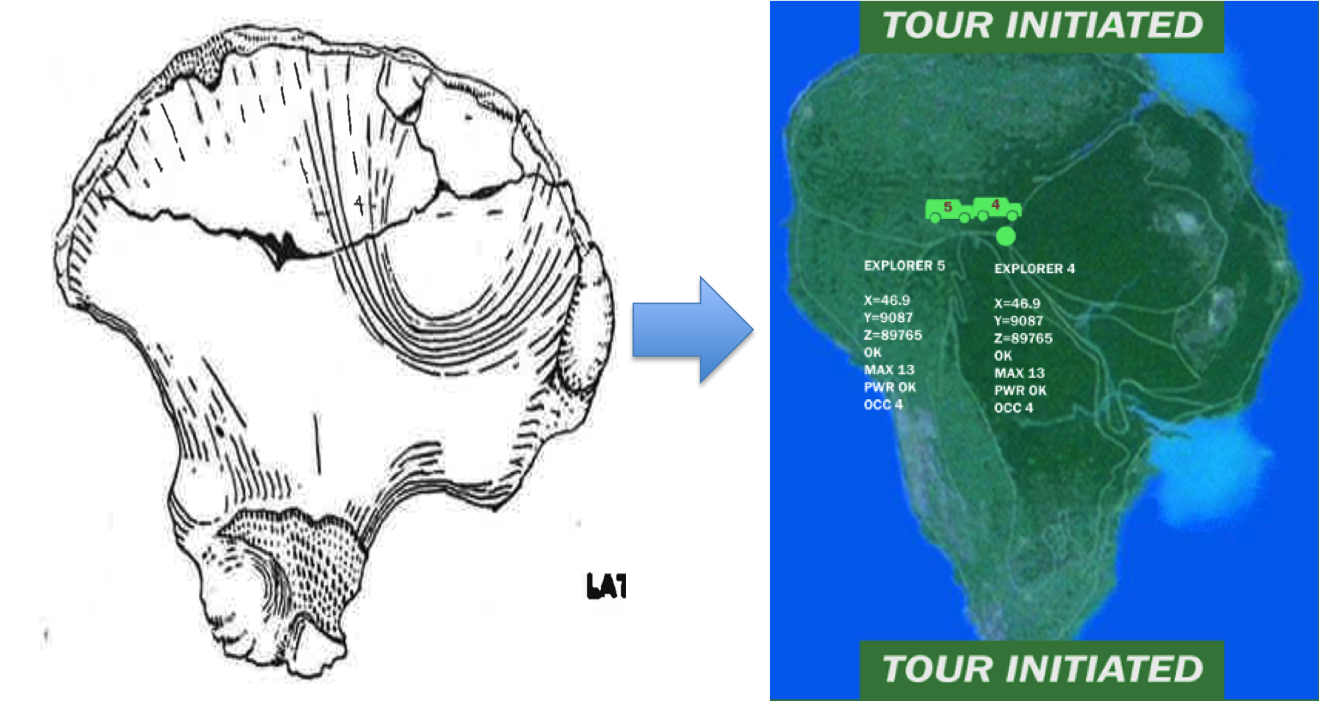
MLD at a slightly oblique view (or stretched top to bottom) magically transforms into Isla Nublar.

MLD 7 at a slightly oblique view (or stretched top to bottom) magically transforms into Isla Nublar.

It’s rather remarkable that some of the most complete pelvic remains we have for australopithecines are two juveniles of similar developmental ages and sizes from the same site. In both, the iliac crest is not fused, and joints of the acetabulum (hip socket) hadn’t fused together yet. The immaturity of these two fossils matches what is seen prior to puberty in humans and chimpanzees. Berge (1998) also noted that MLD 7, serving as an archetype for juvenile Australopithecus, is similar in shape to juvenile humans, whereas adult Australopithecus (represented by Sts 14 and AL 288) are much flatter and wider side to side. Berge took this pattern of ontogenetic variation to match an ape-like pattern of ilium shape growth. This suggests a role of heterochrony in the evolution of human pelvic shape, or as Berge (1998: 451) put it, “Parallel change in pelvic shape between human ontogeny and hominid phylogeny.” In layman’s terms, ‘similar changes in both pelvic growth and pelvis evolution.’
Osteology Everywhere: Barcade bone biology

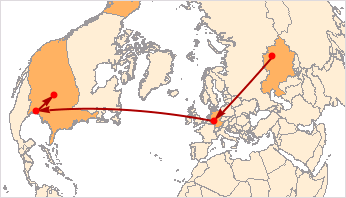
I’ve fled the Central Asian steppe to visit my childhood home, Kansas City, Missouri.

The tortuous path from the center of Eursia to the center of the US, a mere 8500 miles since there are no direct flights. Map made by Wolfram Alpha.

The tortuous path from the center of Eursia to the center of the US, a mere 8500 miles since there are no direct flights. Map made by Wolfram Alpha.

It would be a lie to say I don’t miss life in this Midwest metropolis. Kansas City is sprawling, with diverse cultures, foods and festivities in far-flung neighborhoods. It’s always a trip to revisit the people and places of my formative years.

Of course, there are differences between now and when I was growing up. A whole new world of experiences became available to me here once I was old enough to drink (legally; this is long ago now). The bar scene itself has evolved over the past decade or so, arguably culminating in Up-Down, a grown-up video game arcade that will confusingly make you both happy and sad to have become an adult.

Be still my heart. Image credit.

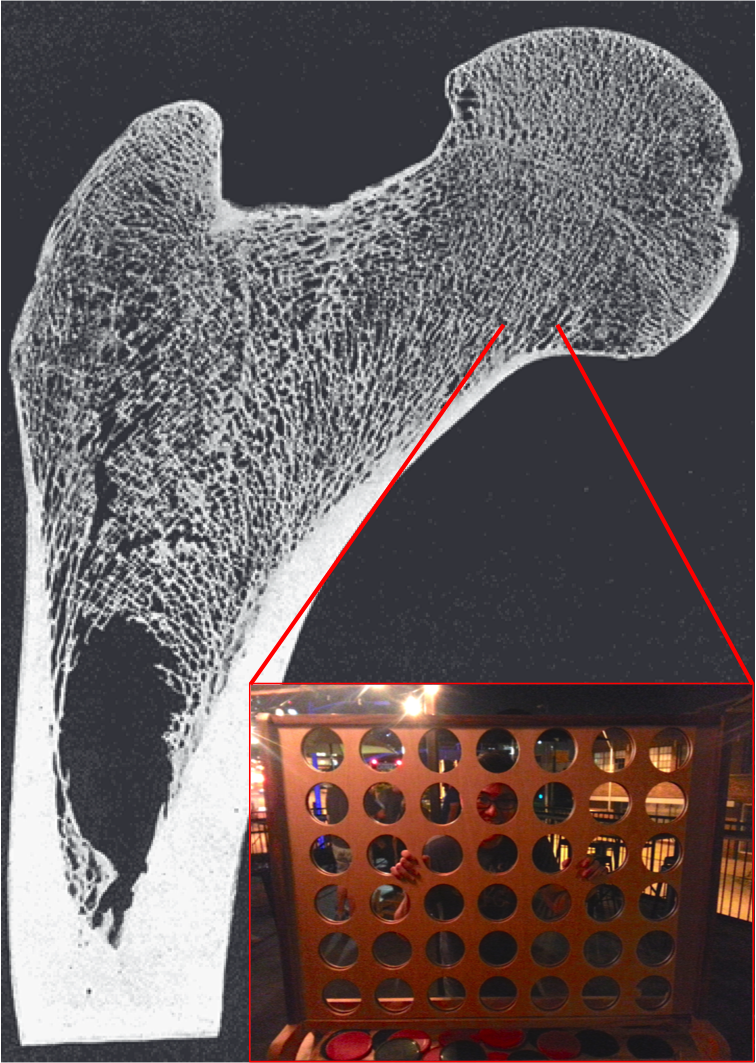
I’ve never seen anything like this before. But even in this novel environment, I still couldn’t help but notice Osteology Everywhere. What appears at first glance to be an oversized Connect Four contraption . . .

Go for the bottom, go for the top.

Go for the bottom, go for the top.

. . . is in fact a closeup of trabecular bone (with my friend creepily peering through):

Section through a human proximal femur (hip joint). Note the trabecular or "spongy" bone filling the top, in comparison with the thick and dense cortical bone of the shaft in the bottom left. Image credit.

Vertical section through a human proximal femur (hip joint). Note the trabecular or “spongy” bone filling the top, in comparison with the thick and dense cortical bone of the shaft in the bottom left. Image credit.

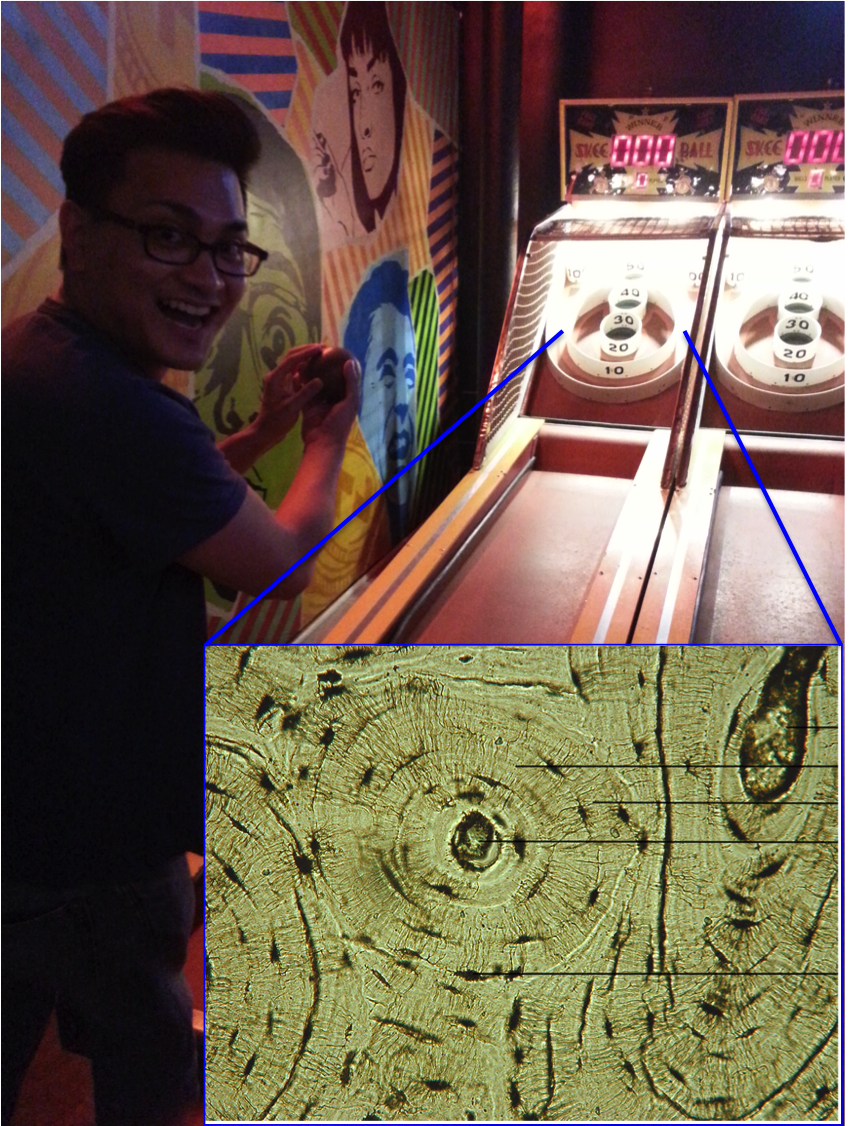
And here, we’re not playing Skee Ball . . .

20150618_003612. . . we’re hurling wooden balls into Haversian canals and lacunae of osteons. For Science.

Cross section through cortical bone, magnified to highlight an osteon. The big hole in the center is the Haversian canal, and the smaller satellite holes are lacunae housing osteocytes.

Cross section through cortical bone, magnified to highlight an osteon. The big hole in the center is the Haversian canal, and the smaller satellite holes are lacunae housing osteocytes. Image credit.

So if you’re in the KC area, I highly recommend you check out Up-Down, where you can review osteology while also playing games and sipping a refreshing beer. Who knew learning could be so fun?

Kazakhstan on #EarthCapture

BBC Earth – one of the greatest inventions of all time – has a “Big Earth” series, showcasing our planet’s awesome sights as captured by BBC readers and viewers. I submitted some pics from my recent trip to West Kazakhstan, and two are featured on the website:

Kazakhstan is an amazing place poorly known to most, and there is lots of great stuff to see in both the cities and the vast, open wilderness. You should come out and see it!

Til you make it out here, here are some more shots of the fun stuff I’ve seen here since I got a decent camera a few months ago.

Spilt milk.

Spilt milk over Mangystau, Kazakhstan.

eFfing #FossilFriday: Rekindling an old friend’s hip

Sorry for the crappy pun. Carol Ward and colleagues recently reported an associated hip joint, KNM-ER 5881, attributable to the genus Homo (1.9 million years old). Fossils coming from the same skeleton are pretty rare, but what’s more remarkable is that portions of this bone were discovered 29 years apart: a femur fragment was first found in 1980, and more of the femur and part of the ilium were found at the same location when scientists returned in 2009:

Figure 3 from Ward et al. 2015.

Figure 3 from Ward et al. 2015. A little distal to the hip, yes, but the pun still works. Views are, going clockwise starting at the top the top left, from above, from below, from the back, from the side, and from the front.

There’s also a partial ilium associated with the femur – that makes a pretty complete hip!

Figure 5 from Ward et al. shows the fossil. Jump for joy that it's complete enough for us to tell it comes from the left side!

Figure 5 from Ward et al. shows the fossil. Jump for joy that it’s complete enough for us to tell it comes from the left side!

Despite how fragmentary the femur and ilium are, the researchers were able to estimate the diameter of the femur head and hip socket reliably. The hip joints are smaller than all Early Pleistocene Homo except for the Gona pelvis. Comparing ER 5881 the large contemporaneous KNM-ER 3228 hip bone, the authors found these two specimens to be more different in size than is usually seen between sexes of many primate species. The size difference best matches male-female differences in highly dimorphic species like gorillas.

Ward et al. find that the specimen generally looks like early Homo but that the inferred shape of the pelvic inlet is a little different from all other Early and Middle Pleistocene human fossils. The authors take this discrepancy to suggest that there was more than one “morphotype” (‘kind of shape’), and therefore possibly species, of Homo around 1.9 million years ago. While I wouldn’t just yet go so far as to say this anatomy is due to species differences, I do agree that KNM ER 5881 helps our understanding and appreciation of anatomical variation in our early ancestors. Like all great fossil discoveries, the more we find, the more we learn that we don’t know. Here’s to more Homo hips in the near future!