Look inside bones for free on the interwebs

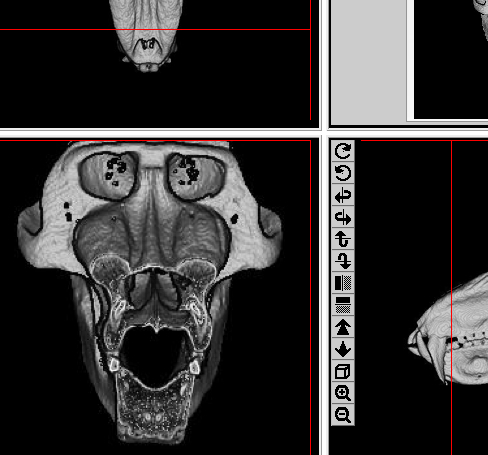
I forget how I stumbled upon this badass resource, but Kyoto University’s Primate Research Institute made a “Digital Morphology Museum: an awesome online database of CT scans of sundry primate skeletal parts. Ever wonder what an articulated siamang skeleton looks like? Or whether the flaring bony snout of a mandrill is hollow or filled with bone (below)? If you’re a normal person, probably not. But either way, this website provides easy access to the internal views of all sorts of body parts.

Coronal slice through a male mandrill face.  You can see a bone-filled lower jaw,  internal views of some teeth, the nasal cavity. The pics above and on the right give an idea of where in the skull we are. Note the fat flanks above the nasal cavity are filled with bone (they hollow out as you move further into the face).

What’s cool is you can view and manipulate 3D views of these things on the website, or you can register with KUPRI to download the raw CT data. Really a great resource.

A few weeks ago, a paper came out wherein researchers used CT scans to compare the the sides of the nasal opening in skulls of Australopithecus species (Villmoare and Kimbel 2011). They found that although the external nose of the South African Australopithecus africanus and A. robustus appear similar in looking like rounded “pillars,” on the inside these pillars differed between the two species. A. africanus‘s (and the earlier, east African A. afarensis‘s) nasal pillar was hollow, while A. robustus‘s was filled with “spongy” bone, like the contemporaneous A. boisei in East Africa. So the early (and “gracile”) australopiths had hollow pillars while the later (and “robust”) ones had a bony pillar, hmm… It’d be neat to try to see how such bone-filled or hollow pillars develop (i.e. are they hollow in babies but then fill with trabecular bone during growth in the “robust” group? Does this difference arise for functional (e.g. chewing) reasons, or could it be a developmental ‘byproduct’ of the tall robust australopithecine face [cf. McCollum 1999]).

It’s a neat study, and they include lots of great CT images of the hominid sample. But another question arises – what is the inside of the bony nose like in modern primates, and how much variation is there within a species? (NB Villmoare and Kimbel found pretty much no variation within each fossil species, save for two curious examples, but which were based on casts). If I had the time (i.e. weren’t dissertation-ating) I’d love to peruse the KUPRI files to see what “pillar” variation is like in, say, chimps (paleoanthropologists’ go-to referent species). Cursorily looking at just one (female chimpanzee, left), it looks like the sides of the nose are empty higher up, but then fill with bone to form the tooth socket surrounding the canine root. I’ll leave it to someone else to see what the rest look like.

But just lookit what other fun stuff you can see! At the top (anatomically toward the back) are the bone-filled mandibular condyles, beneath (anatomically a bit more toward the front) and between them are the pterygoid plates, and beneath them is a big gross maxillary sinus. Man, if only I had the time, I’d make an anatomy scavenger hunt on this site, and it’d be pretty epic.
ResearchBlogging.org


Those papers I mentioned
McCollum, M. (1999). The Robust Australopithecine Face: A Morphogenetic Perspective Science, 284 (5412), 301-305 DOI: 10.1126/science.284.5412.301

Villmoare, B., & Kimbel, W. (2011). CT-based study of internal structure of the anterior pillar in extinct hominins and its implications for the phylogeny of robust Australopithecus Proceedings of the National Academy of Sciences, 108 (39), 16200-16205 DOI: 10.1073/pnas.1105844108

ARDIPITHECUS BEER!!!

I just made what what may be the most amazing discovery of the century at a local booze emporium. Dogfish Head brewing company makes a beer whose label is adorned with Jay Matternes’s reconstruction of an upright Ardipithecus ramidus. Note that the left foot grasps the earth with it’s ape-like big toe.

In a whimsical use of artistic license, whoever adopted this image added a curlicue pig’s tail. In animals with a tail, a number of caudal vertebrae continue off the set of fused vertebrae called the sacrum. Humans and other apes don’t have true tails but a coccyx, a small clump of tiny, fused vertebral segments. Our tail vestige may not help us hang onto trees like in Ateline monkeys, or sting our enemies like a scorpion, but the coccyx is still pretty important. In people this evolutionary memory of a tail anchors some muscles of the pelvic floor (including sphincter ani externus and levator ani), which are critical for the to control of our bowels.

Below is a close up of the Ardipithecus ramidus pelvis fossils (from White et al. 2009, fig. 3). No coccyx was discovered for Ardi, and little is said about the sacrum, other than that it’s merely broken piece of the end of the bone (Lovejoy et al. 2009). Nevertheless, I’m sure this end of sacrum would lead one to reject this artist’s hypothesis that Ardipithecus had a tail.

Had I been in charge of labeling at Dogfish Head, the beer would’ve been called “Party-pithecus” instead of “namaste,” and this label would’ve been slapped on some exotic IPA or porter instead of a wheat beer. Still pretty awesome, though.

Learn about Ardi and its pelvis
Lovejoy, C., Suwa, G., Spurlock, L., Asfaw, B., & White, T. (2009). The Pelvis and Femur of Ardipithecus ramidus: The Emergence of Upright Walking Science, 326 (5949), 71-71 DOI: 10.1126/science.1175831

White, T., Asfaw, B., Beyene, Y., Haile-Selassie, Y., Lovejoy, C., Suwa, G., & WoldeGabriel, G. (2009). Ardipithecus ramidus and the Paleobiology of Early Hominids Science, 326 (5949), 64-64 DOI: 10.1126/science.1175802

ResearchBlogging.org

We should not try to clone Neandertals

Interesting that right after I posted about fossils, genotypes and phenotypes, the Leakey Foundation (via Twitter) posts a link to a discussion about cloning Neandertals in order to learn about the genetic bases of human uniqueness. It begins innocently enough, stating that the genotype-phenotype comparisons between humans and the Neandertal Frankenstein could lead us to insights about our genetic predispositions to certain pathogens. Sure, why not. But then this happens (emphases mine): 

“Yet, further discussion with [Harvard geneticist Dr. George Church] revealed an even more interesting benefit. Dr. Church thinks the cloning of a Neanderthal would encourage us to have a greater appreciation for and sensitivity to what he terms “neural diversity.” He believes that by listening to the thoughts of a cloned Neanderthal, who might seem foreign and unusual to us, greater anti-discrimination and de-stigmatization efforts on behalf of those people whose actions are usually considered outside the range of “normal” human behavior might result. These would include individuals diagnosed with dyslexia, narcolepsy, autism, and bipolar disorders.”

Dr. Church belies his own statements of concern for ethics and people’s rights. “Neandertal” has historically been synonymous with ideas of what is ugly, stupid and an anthropological Other (i.e. unlike and less than human), and Church seems to follow this. However, decades of archaeology show us that Neandertals were probably just as capable of complex thinking as recent humans Neandertals buried their dead. Italian Neandertals over 40 thousand years ago appear to have made symbolic use of feathers (Peresani et al. 2011). We also know that the hearing range of the Sima de los Huesos hominids was probably tuned to frequencies used in human speech (Martinez et al. 2004). In addition, the presence of the human-derived FOXP2 gene in Neandertals (Krause et al. 2007) suggests (but of course does not prove) that they could, and probably did, speak to one another with language.

Neandertals were not dumb, so there’s no a priori reason to think that reanimating Neandertal consciousness would provide us with novel insights into a ‘neural other.’ Worse, by equating people who have forms of cognitive/neural impairment with Neandertals, Church (probably inadvertently) otherizes the people he hopes we stop otherizing. Why the hell would a Neandertal clone – a being whose existence is solely an experiment to show us what makes us human based on what’s not like the clone – make us treat differently-abled people better? Worse, what to do if Neandertal shows no cognitive impairments whatsoever? Have Eegah and Encino Man taught us nothing?!

And then there’s the icing on the cake:

“Chicago-Kent College Law Professor Lori Andrews has stated unequivocally that Neanderthals should be accorded all forms of human rights.”

Yes!

UPDATE: Obviously, “Prehistoric Ice Man” (1999), the last episode of the 2nd season of Southpark, provides further reasons not to bring cave-persons of the past into the present day.


ResearchBlogging.orgReferences
Krause, J., Lalueza-Fox, C., Orlando, L., Enard, W., Green, R., Burbano, H., Hublin, J., Hänni, C., Fortea, J., de la Rasilla, M., Bertranpetit, J., Rosas, A., & Pääbo, S. (2007). The Derived FOXP2 Variant of Modern Humans Was Shared with Neandertals Current Biology, 17 (21), 1908-1912 DOI: 10.1016/j.cub.2007.10.008


Martinez, I. (2004). Auditory capacities in Middle Pleistocene humans from the Sierra de Atapuerca in Spain Proceedings of the National Academy of Sciences, 101 (27), 9976-9981 DOI: 10.1073/pnas.0403595101


Peresani, M., Fiore, I., Gala, M., Romandini, M., & Tagliacozzo, A. (2011). Late Neandertals and the intentional removal of feathers as evidenced from bird bone taphonomy at Fumane Cave 44 ky B.P., Italy Proceedings of the National Academy of Sciences, 108 (10), 3888-3893 DOI: 10.1073/pnas.1016212108


Sterling, J. “Concerns over the cloning of a Neanderthal.” GEN News. 02 November 2011. http://bit.ly/uGAnRK

Leopard horse: Fossils, phenotypes and genotypes

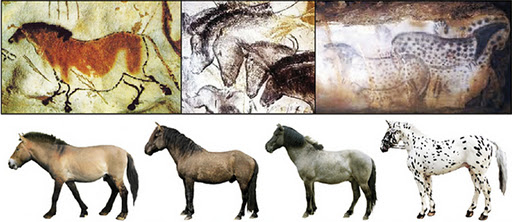
I wish I were talking about some beastly horse-big-cat hybrid, or at least a carnivorous horse. Instead… a ton of anthropology-related papers came out today in PNAS, and possibly the coolest one is a study that compares the DNA of Pleistocene fossil and modern horses with different coat colors/patterns, and then ties this in with Paleolithic cave art. A crazy confluence of four-field anthropology right there.

Modern horses and their depictions in Late Pleistocene French caves (Pruvost et al. 2011)
Melanie Pruvost and colleagues (in press) noted that the depiction of spotted horses at the site of Pech-Merle (they give 24 kya) could mean one of two things: (1) either the early human painters were depicting horses they actually saw on the landscape at the time, or (2) they were just being fanciful and frivolous, creative and carefree with their cavern canvas. Now, some modern horse breeds have a similar spotted, “leopard” phenotype, and a genetic basis for this is understood. So Pruvost and pals examined DNA from fossil horse bones from European sites dating to 20 – 2 kya to see if these mottled mares roamed the lands of the cave-painters. Sure enough, several samples show evidence for the mutation causing leopard spots.

This is pretty cool for evolutionary biology and paleontology. A major question in biology is how an individual’s genes (genotype) relate to overall appearance/behavior (phenotype). To a certain extent, physical variation between organisms arises from genetic variation, so when we see things evolve through the fossil record, this ought to correspond with some genetic changes as well. But linking genes to appearances isn’t so easy (especially for extinct animals). Pruvost and colleagues’ study is a step in this direction, though. Plus, the recent sequencing of the fossil Neandertal (Green et al. 2010) and Denisovan (Reich et al. 2010) genomes makes it possible to try to figure out if/how humans’ unique physical traits reflect our genes. In fact, even before these genomes were fully sequenced, Carles Lalueza-Fox and team (2007) identified a mutation on Neandertals’ MC1R gene, strongly suggesting the Neandertals sampled had light skin and red hair.

But the genetic basis for skeletal phenotypes is harder to discern. For example, Green et al. (2010) identified the unique human version of the RUNX2 gene as having come under strong natural selection since the disappearance of Neandertals. The authors noted that because mutations of RUNX2 in humans are associated with a cleidocranial dysplasia affecting the form of the skull and shoulders, and because humans and Neandertals differ in some aspects of their skulls and shoulders, then RUNX2 variation between humans and Neandertals is likely related to visible differences in their skeletons. But that’s about as much as could be said at the moment – RUNX2 is involved in bony development of the entire skeleton, interacting with other various genes in various places during ontogeny. So while it’s tempting, it’s still a little early to link RUNX2, or pretty much any other development-related gene, with physical differences between humans and our fossil relatives. But one day!

ResearchBlogging.org
A Neandertal’s ruddy locks have never preserved in the fossil record, but its bones are very well known. In an ironic twist, we may have a better understanding of the genetic basis of variation in a soft-tissue (for which there are no fossils), than we do for the skeleton (for which we have lots of fossils).

And maybe one day I’ll get that leopard horse I was hoping for.

References
Green, R., Krause, J., Briggs, A., Maricic, T., Stenzel, U., Kircher, M., Patterson, N., Li, H., Zhai, W., Fritz, M., Hansen, N., Durand, E., Malaspinas, A., Jensen, J., Marques-Bonet, T., Alkan, C., Prufer, K., Meyer, M., Burbano, H., Good, J., Schultz, R., Aximu-Petri, A., Butthof, A., Hober, B., Hoffner, B., Siegemund, M., Weihmann, A., Nusbaum, C., Lander, E., Russ, C., Novod, N., Affourtit, J., Egholm, M., Verna, C., Rudan, P., Brajkovic, D., Kucan, Z., Gusic, I., Doronichev, V., Golovanova, L., Lalueza-Fox, C., de la Rasilla, M., Fortea, J., Rosas, A., Schmitz, R., Johnson, P., Eichler, E., Falush, D., Birney, E., Mullikin, J., Slatkin, M., Nielsen, R., Kelso, J., Lachmann, M., Reich, D., & Paabo, S. (2010). A Draft Sequence of the Neandertal Genome Science, 328 (5979), 710-722 DOI: 10.1126/science.1188021

Pruvost, M., Bellone, R., Benecke, N., Sandoval-Castellanos, E., Cieslak, M., Kuznetsova, T., Morales-Muniz, A., O’Connor, T., Reissmann, M., Hofreiter, M., & Ludwig, A. (2011). Genotypes of predomestic horses match phenotypes painted in Paleolithic works of cave art Proceedings of the National Academy of Sciences DOI: 10.1073/pnas.1108982108

Reich, D., Green, R., Kircher, M., Krause, J., Patterson, N., Durand, E., Viola, B., Briggs, A., Stenzel, U., Johnson, P., Maricic, T., Good, J., Marques-Bonet, T., Alkan, C., Fu, Q., Mallick, S., Li, H., Meyer, M., Eichler, E., Stoneking, M., Richards, M., Talamo, S., Shunkov, M., Derevianko, A., Hublin, J., Kelso, J., Slatkin, M., & Pääbo, S. (2010). Genetic history of an archaic hominin group from Denisova Cave in Siberia Nature, 468 (7327), 1053-1060 DOI: 10.1038/nature09710
Inanimate fossils getting older still

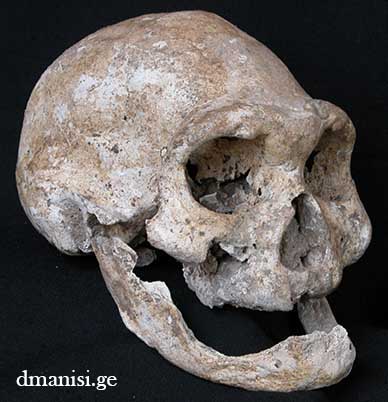
Two reports came out last week in the journal Nature, re-dating some European human fossils to before 40 thousand years ago (kya), a few thousand years older than previous evidence for modern-looking people in the region. The media have been reporting these studies as revealing “the first Europeans,” but of course we all know that the first Europeans were the badass hominids, my favorites, from the 1.8 million year old site of Dmanisi.

KC4 maxilla (Higham et al. 2011)

From Kent’s Cavern (United Kingdom) is a partial maxilla, now dated to 44 – 41 kya* (Higham et al. 2011; but see below). The jaw fragment with highly worn teeth was found just above some Aurignacian-like (Upper Paleolithic) blades in 1927. [NB below these 2 blades were 2 other blades of a tool “complex…tentatively associated with Neandertals] The laughable amount of bone makes it rather impossible to say whether the fossil represents a Neandertal or more modern-looking human. The authors examined what little of the morphology was left and concluded that the fossil shared the most similarities with recent humans but only a few with Neandertals. A more rigorous analysis of what this mix of traits means would have been nice (i.e. why would an individual have derived traits of both ‘modern’ humans and Neandertals?). The researchers tried to extract DNA for analysis, but apparently organic remains were too poorly preserved for a good analysis. Bummer.

Cavallo B and C (Benazzi et al. 2011)

A similar older-than-we-thought story is reported by Stefano Benazzi and buddies, who reanalyzed teeth from the Italian site of Grotta del Cavallo (left). After the site was excavated in 1967, the teeth were attributed to Neandertals and the lithics classified as “Uluzzian.” I would be a dirty liar if I said knew anything about the “Uluzzian” industry (try this other site which may be more informative), but apparently it’s seen as transitional between the Neandertal-associated Mousterian and ‘more advanced’ Upper Paleolithic toolkits. So this assemblage could be used to argue that Neandertals were smart enough to upgrade to a sexier stone tool industry shortly before their anatomy (but not their genes!) disappeared. BUT! also like in Kent’s Cavern paper, Benazzi and colleagues examined what little morphology is preserved in the fossil teeth, and (re)assigned them to modern-looking humans. The authors provided nice qualitative and quantitative arguments for the human status of the teeth, though again I have to raise caution that these are only teeth and we have no idea what the rest of the skeleton would have looked like. Researchers also analyzed shells associated with the now-human teeth and dated the site to around 44 kya, making them the oldest probably-human remains in Europe.

Now, according to conventional wisdom, the Neandertals were dullards who made and used the Mousterian stone tool industry. The Mousterian was nice and all, but not nearly as wicked-pisser as the smart and sassy modern-looking humans’ Aurignacian toolkit. The thing is, though, there really hasn’t been really a lot of evidence unequivocally linking modern-looking fossils with Aurignacian artifacts. So both of the recent studies in Nature lend support to the idea that maybe modern humans were the sole makers (and users) of an advanced stone tool industry. But it’s important to remember [1] that the blades ‘associated’ with the Kent’s Cavern jaw can’t really be definitively attributed to a stone tool industry; [2] the blades were deeper in the cave than the jaw, and so may actually be appreciably older than the jaw; and [3] while the teeth from Kent’s Cavern and Cavallo do look most comparable to those belonging to ‘anatomically’ modern humans, we don’t know what the skulls or skeletons containing the teeth looked like. All that said, it’s neat to see the possible appearance of certain anatomy and technology in Europe thousands of years earlier than previously thought. It also re-raises the issue of the degree to which modern-looking humans and Neandertals overlapped in space and time, and what these interactions would have been like (I’d guess terrifying, hilarious and/or sexy).

KC4 originally
(Higham et al. 2011)

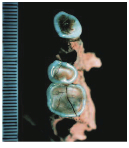
A fun lesson also comes from the Kent’s Cavern study. Higham and colleagues report that the KC4 human maxilla was excavated in 1927 and analyzed by Sir Arthur Keith, a well-trained anatomist and paleoanthropologist famous in his day. Keith described the fossil as containing a canine, second premolar and first molar (right, compare with above). Higham and colleagues, however, noticed that what Keith described as a second premolar was in fact a first premolar. The teeth are so worn they mostly lack information about their form and features, so this mistake probably didn’t really mislead anatomists in any way. Still, it goes to show that even experts like Keith can make mistakes or overlook the things they know best, and this is not the first time I’ve seen this happen with fossils. So always (politely) question those giants whose shoulders you’re standing upon.

*Update (07 Nov): John Hawks points out that the KC4 maxilla itself was not used to obtain the older radiocarbon age estimate. In 1989 the maxilla was directly dated to around 30 kya, over 10 ky younger than the new estimates. Higham and friends thought this date was too young, based on methodological grounds. An attempt to redate the KC4 maxilla based on one of the teeth yielded too little collagen (organic material) to produce a date. Bummer again! The new estimate is instead based on radiocarbon dates obtained from animal bones that were excavated from above and below the human jaw. So this ‘redating’ of the Kent’s Cavern maxilla is very interesting, but should be taken with a grain of salt.

ResearchBlogging.org
See for yourself
Benazzi, S., Douka, K., Fornai, C., Bauer, C., Kullmer, O., Svoboda, J., Pap, I., Mallegni, F., Bayle, P., Coquerelle, M., Condemi, S., Ronchitelli, A., Harvati, K., & Weber, G. (2011). Early dispersal of modern humans in Europe and implications for Neanderthal behaviour Nature DOI: 10.1038/nature10617

Higham, T., Compton, T., Stringer, C., Jacobi, R., Shapiro, B., Trinkaus, E., Chandler, B., Gröning, F., Collins, C., Hillson, S., O’Higgins, P., FitzGerald, C., & Fagan, M. (2011). The earliest evidence for anatomically modern humans in northwestern Europe Nature DOI: 10.1038/nature10484

And so the plot thickens


These results suggest admixture between Denisovans or a Denisova-related population and the ancestors of East Asians, and that the history of anatomically modern and archaic humans might be more complex than previously proposed.


I’m sure it will turn out to be more complex still. Onward and upward!


Freely available online through the PNAS open access option.”
http://www.pnas.org/content/early/2011/10/24/1108181108.abstract


Sweet!


Here you go
Skoglund P and Jakobsson M. Archaic human ancestry in East Asia. Proceedings of the National Academy of Sciences in press. doi:10.1073/pnas.1108181108.

Dmanisi Homo erectus: I’ll have what she’s having

Herman Pontzer and buddies just published a brief analysis of fine-scale tooth wear in the Dmanisi Homo erectus specimens.

Teeth are useful as hell in life. Humans’ teeth are critical not only for eating, sporting a sexy smile, and biting people, but also for speech and song (“f,” “th” and “v” sounds). Some parents even harvest their childrens’ exfoliated baby teeth. The things we do with teeth.

Teeth are also really useful for studying long-dead people and animals – teeth may preserve pretty well for millions of years, they can be used to estimate an individual’s age-at-death, and their shape and composition can be used to learn about diet. In a vile act of revenge, the food that sustains us also scrawls its Nom Hancock into the surfaces of our teeth. So, scientists can study the microscopic marks (= “microwear”) on tooth surfaces to see what kinds of foods were eaten shortly before death. Peter Ungar, an author of the current paper, has done a lot of work here, and his website is worth checking out if you’re interested in learning more. Microwear can’t really tell you exactly what an animal was eating, but can tell you whether the animal mostly ate grasses, leaves, hard objects like nuts, and so forth.

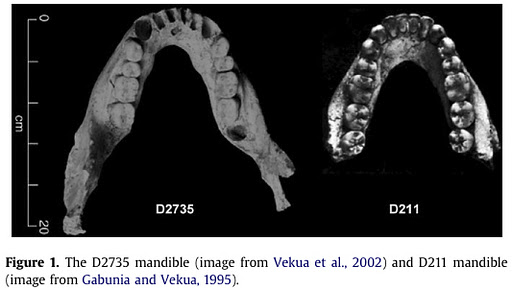
So Pontzer and colleagues examined the microwear on some of the lower molars of the youngest individuals from the nearly 1.8 million year old Homo erectus group from Dmanisi in the Republic of Georgia . To the left is a picture of the jaws, from the paper (from another paper. how meta). The microwear patterns of these badass early humans fit cozily within the variation exhibited by other Homo erectus specimens.

Microwear in Homo erectus is pretty variable, but still rather distinct from other fossil groups like robust Australopithecus, and a little less distinct from their putative ancestor H. habilis. This suggests that something special about Homo erectus was the species’ great dietary breadth – Homo erectus‘ key to geographic and evolutionary success might not have been the adoption of a specific dietary resource, but rather the ability to utilize a wide range of food resources. Atkins diet be damned. What’s neat is that the Dmanisi hominids, though kind of primitive (Australopithecus-like) in terms of brain size and some aspects of skull shape, nevertheless demonstrated key behaviors of H. erectus, namely geographic expansion (Dmanisi is the oldest reliably-dated hominid site outside Africa), and dietary flexibility. This really suggests the success of our ancestors was due to some behavioral innovation, aside from advances in stone tool technology.

Now, these Dmanisi H. erectus folks’ teeth wore like other H. erectus, and it would be reasonable to infer that this is because they ate similar foods. This makes it all the more mysterious that the other Dmanisi jaws, from older adults, have teeth completely worn to smithereens. Most notably, D3444 and D3900 (left, from here) comprise the skull of an individual who was missing all their teeth, except maybe a lower canine – the earliest example of edentulism in the human fossil record (Lordkipanidze et al. 2005). A very large mandible, D2600,  with teeth so worn that the pearly-white first-molar crowns were gone and the internal pulp cavity (and nerve) were exposed. (Interestingly, D2600 is so large that some researchers initially argued it represented a different species from the other jaws – yet Adam Van Arsdale presented evidence that this extreme tooth wear may actually be responsible for making jaws relatively taller in early humans).

So what’s curious is why the older Dmanisi hominids should show such an extreme amount of tooth wear compared to other H. erectus, but microwear on the young suggests their diet was the same (that is, just as diverse in texture) as others in the species. Was Dmanisi-level tooth wear (and tooth loss) comparable to other H. erectus, and we just happen not to have found them at other sites? (KNM-ER 730 from Kenya is the next-most worn early Homo that next comes to mind) Is there another aspect of diet we don’t know about, that caused the Dmanisi teeth to wear especially quickly? Or were these early Homo from Dmanisi actually living longer than other H. erectus? I suspect the second is more likely, but that’s a hypothesis that remains to be tested.

ResearchBlogging.org
Read more:
Ferring, R., Oms, O., Agusti, J., Berna, F., Nioradze, M., Shelia, T., Tappen, M., Vekua, A., Zhvania, D., & Lordkipanidze, D. (2011). From the Cover: Earliest human occupations at Dmanisi (Georgian Caucasus) dated to 1.85-1.78 Ma Proceedings of the National Academy of Sciences, 108 (26), 10432-10436 DOI: 10.1073/pnas.1106638108
Lordkipanidze, D., Vekua, A., Ferring, R., Rightmire, G., Agusti, J., Kiladze, G., Mouskhelishvili, A., Nioradze, M., de León, M., Tappen, M., & Zollikofer, C. (2005). Anthropology:  The earliest toothless hominin skull Nature, 434 (7034), 717-718 DOI: 10.1038/434717b
Pontzer H, Scott JR, Lordkipanidze D, Ungar PS. In press. Dental microwear texture analysis and diet in the Dmanisi hominins, Journal of Human Evolution (2011). DOI:10.1016/j.jhevol.2011.08.006

Data, development and diets

As mentioned briefly but repeatedly on this blog, my dissertation is about growth of the lower jaw in Australopithecus robustus (right), comparing it with jaw growth in recent humans. This is important because we don’t really know exactly how skeletal-dental (especially skeletal) maturation of our fossil relatives compares with us today. From a developmental perspective, it is also important to know how and when adult form arises during growth, and how these processes vary within and between species.


It’s not easy to examine ontogeny in fossil samples. In a post a few weeks ago I included a drawing of some of the A. robustus juvenile jaws. At the time, I was pointing out variation in dental maturity (which is a nice thing when studying growth), but the picture also reveals a bigger bugbear – variable preservation of features (which is a terrible thing if you’re trying to study growth).

For example, the youngest individual in the fossil sample (right, viewed from above, front is at the top of the picture) includes only the second baby molar tooth, a bit of the bone surrounding the sides and back of the tooth, and a small portion of the ascending ramus. The oldest subadult in the sample (SKW 5), on the other hand, is almost entirely complete. In between these ages, jaws variously preserve different parts. Under these circumstances (i.e. lots of missing data), growth cannot be studied by traditional (namely, multivariate) methods (how I will deal with this is a topic for another day).


So while studying the fossils in South Africa, in order to maximize the number of comparisons I could possibly make, I measured just about every single linear dimension conceivable on these jaws. I thus have a spreadsheet with 300 columns of measurements I could take on each specimen. Most of the cells are empty : (


What’s a boy to do?! In order to compare A. robustus with humans, I need to take the same measurements on a growth series of human jaws, too. But life is short, and if I want to finish this project before I succumb to some sinister signature of senescence, I really can’t take hundreds of measurements on a human sample which is much larger than the fossils. Plus, a lot of the individual measurements are a bit redundant: some of the distances overlap, many of the variables can be taken on the right and the left sides, etc.


If I am to finish collecting data in a reasonable time frame, I need to cull my variables from 300 to however many (a) maximizes the comparisons I can make within the less-complete A. robustus sample, and (b) are not too repetitive. Boo. Plus I have to get these spreadsheets ready to be read and analyzed in the program R, which for whatever reason is always a pain in the ass.

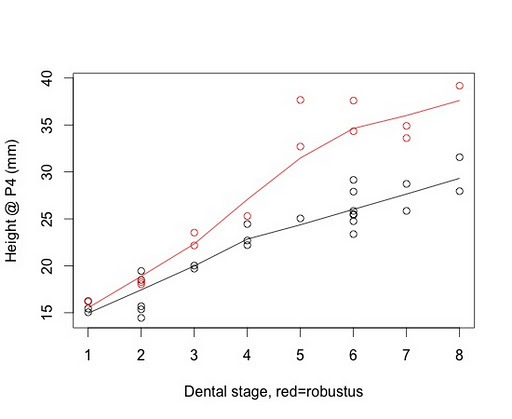
Again, the statistics of the overall comparisons is a topic for another day, and I haven’t had the opportunity yet to write the analytical program(s). But I have looked at some individual traits in A. robustus compared with a subsample of humans. For example, at the left is a plot of changes in height of the jaw at the baby second molar or adult second premolar (which replaces the baby molar). Obviously my human sample is way to small at the moment to make any really meaningful statements about how growth compares between the two species. Note also that these are absolute measures and not size-corrected, and that these are stages of dental eruption rather than chronological ages. But from this preliminary view, the two species are very similar up to around when the first adult molar comes in (“stage 4” here). Thereafter, the A. robustus individuals dramatically increase in size rather fast, whereas humans only slowly increase in size.


Again, this is a very preliminary result, and only for a single measurement. But it is interesting in light of a recent study by Megan Holmes and Christopher Ruff (2011). These researchers compared jaw growth recent humans who differed in the consistency of their diets. They found that kids in the two populations were not too different, but the samples became more different with age to become fairly different as adults. Now, A. robustus seems to have eaten a diet with lots of hard objects (see recent review by Peter Ungar and Matt Spohneimer), but humans’ diet (and technology) really obviates the need for chewing as powerful as seen in A. robustus. So this dietary divergence may well be reflected in the growth difference suggested above, but it may not be the sole factor. PLUS I NEED TO INCREASE MY HUMAN SAMPLE.


Stay tuned for more analyses and results!


ResearchBlogging.orgReferences to make you smarter and stronger
Holmes, M., & Ruff, C. (2011). Dietary effects on development of the human mandibular corpus American Journal of Physical Anthropology, 145 (4), 615-628 DOI: 10.1002/ajpa.21554


Ungar, P., & Sponheimer, M. (2011) The Diets of Early Hominins. Science 334(6053), 190-193. DOI: 10.1126/science.1207701  

Genetic basis of disgusting

The genome of the naked mole rat (Heterocephalus glaber, below right) has been sequenced (Kim et al. 2011), shedding insight into how mammalian evolution made gross.

Here are some factoids about these murine monsters, from a nice editorial accompanying the research paper in Nature. These critters live in underground colonies – because who could suffer to see them on the surface? These bald rats are unique among mammals in that they are “eusocial” like bees or ants. Also like bees and ants, a colony has a single, breeding “queen” in the group, whose mere presence prevents other female mole rats from becoming sexually mature. When a queen dies, females fight for the vacant throne. When one wins and becomes the new queen, she subsequently undergoes a “growth spurt,” becoming up to 80% heavier and dramatically lengthening her lower spine (Dengler-Crish and Catania 2007; figure below) – a marvel of phenotypic plasticity. These rats dwell in crowded, dirty tunnels low in light and oxygen, kind of like the teenage mutant ninja turtles. Plus, they can live for up to 30 years, which is an amazingly long time for an animal so small you can hold in it your hand. They are also apparently resistant to cancer and to some kinds of pain and itching. So, so strange.

With only one female contributing half a generation’s genes, you can imagine the shamelessly-naked mole rats are a little more inbred than most of us. In spite of this potential drag to genetic variation (and thereby natural selection), the naked mole rat genome demonstrates a number of adaptations to the species’ peculiar lifestyle. For example, the genes TEP1 and TERF1, which have been implicated in determining the lengths of the ends of chromosomes (“telomeres“), show evidence of positive natural selection in the mole rat. Kim and colleagues (2011: 2) say their analyses “point to altered telomerase function … which may be related to its evolution of extended lifespan and cancer resistance.” Cancer resistance!? I think the paper’s final paragraph (p. 4) lays out nicely what’s most important about research into the genome of this most ghastly rodent:

To summarize, sequencing and analysis of the [naked mole rat] genome revealed numerous insights into the biology of this remarkable animal. In addition, this genome and the associated data sets offer the research communities working in ageing, cancer, eusociality and many other areas a rich resource that can be mined in numerous ways to uncover the molecular bases for the extraordinary traits of this most unusual mammal. In turn, this information provides unprecedented opportunities for addressing some of the most challenging questions in biology and medicine, such as mechanisms of ageing, the role of genetic makeup in regulating lifespan, adaptations to extreme environments, hypoxia tolerance, thermogenesis, resistance to cancer, circadian rhythms, sexual development and hormonal regulation.

It’s not news that Life on Earth can be pretty weird sometimes. Understanding how Life became and becomes weird can provide us with tools to make life better for people.


Things I cited
Anonymous (2011). More than teeth. Nature, 478 (7368), 156-156 DOI: 10.1038/478156a


Dengler-Crish, C., & Catania, K. (2007). Phenotypic plasticity in female naked mole-rats after removal from reproductive suppression Journal of Experimental Biology, 210 (24), 4351-4358 DOI: 10.1242/jeb.009399


Kim, E., Fang, X., Fushan, A., Huang, Z., Lobanov, A., Han, L., Marino, S., Sun, X., Turanov, A., Yang, P., Yim, S., Zhao, X., Kasaikina, M., Stoletzki, N., Peng, C., Polak, P., Xiong, Z., Kiezun, A., Zhu, Y., Chen, Y., Kryukov, G., Zhang, Q., Peshkin, L., Yang, L., Bronson, R., Buffenstein, R., Wang, B., Han, C., Li, Q., Chen, L., Zhao, W., Sunyaev, S., Park, T., Zhang, G., Wang, J., & Gladyshev, V. (2011). Genome sequencing reveals insights into physiology and longevity of the naked mole rat. Nature DOI: 10.1038/nature10533

Variation: a blessing and a curse

Trying to start on finishing my dissertation, I’m thinking about the issue dental development and how it relates to skeletal growth. Specifically I’m trying to decide whether I want to analyze my human and Australopithecus robustus samples based on estimates of “dental age,” or if I want to be a bit more cavalier and divide the sample into rougher age categories.

To avoid copyright issues, here’s a crappy picture I drew a few years ago, of the youngest A. robustus jaws. The youngest, “SK 438” is erupting its last baby tooth (bottom right), while the others have their full set of baby teeth, and none of them has its first adult tooth yet. I don’t think I can estimate ages accurately enough to capture the true chronological difference between SK 438 and the rest. Would I be better off just dividing the group into “younger” (SK 438) and “older” (the rest) infants, or even lumping them all together as simply “infants”?

On the one hand, I could assign individuals a chronological age based on a modern referent of known age, at similar stages of dental development. This could allow me to get more fine-scale glimpses into patterns of growth in my samples, but that’s assuming I’ve accurately estimated their ages. Individuals vary in the ages and sizes at which their teeth erupt; a person’s first molar, for example, may erupt at anywhere from 4-8 years of age. How can I estimate an individual’s age in light of such variation? And what if I’m as poor a judge of ages as Dennis Duffy?! Conceivably I could program my analysis to account for error estimation (which in itself could be educational and interesting, but is it worth the trouble?), but this would also add a further source of uncertainty. And it’s like Dwight Schrute said (Michael Scott said), “K-I-S-S: keep it simple, stupid. Great advice, hurts my feelings every time.”

On the other hand, I could divide my sample into coarse age categories – say, putting specimens who’ve attained a given level of dental development in the same group, such as ‘infant, child, juvenile, adolescent, and young adult.’ This method loses the temporal resolution of the first method, but also avoids the possible errors of assigning strict ages I’m pretty sure I would not infer accurately. But, tooth development does not show a clean 1-to-1 relationship with other systems in the body, such as hormonal axes or the bony skeleton. It’s uncertain how accurately kids can be put in any of the above categories (based on general life history variables; Bogin 1999) based on dental development.

Choices, choices.

Variation is a problem for biologists. The theory of evolution was conceived as a way to explain the conundrum of why there is such remarkable variation in the forms of life that Earth is lucky to have harbored. The problem of within-species variation in the relative timing of skeletal and dental development isn’t just a bug-bear for paleoanthropologists. It’s important to medical doctors and pathologists investigating genetically-based developmental disorders, and to epidemiologists looking at aspects of population health, such as the prevalence of growth stunting. It’s also important for forensics specialists who need to use biological clues about the age and identity of crime victims and defendants. I mean, how else would we know whether Jon Voight bit both Kramer and this pencil?

The silver lining, I suppose, on this storm-cloud of biological of variation is that without variation there cannot be evolution. And stasis is boring. If nothing changed since the Cambrian, none of us would be here today. We’d probably be some gross stupid monstrous thing, like this Hallucigenia to the right. It’s the quirks and weird variants that arise randomly, that make evolution possible. If individuals all developed exactly the same, then all organisms through all time would be the exact same, and probably all would have gone extinct as they succumbed to some sinister fate, no new variants would have arisen that may have been able to survive the devastation.

ResearchBlogging.org
So variation is a blessing and a curse. Individual and population variation make it difficult to state norms such as what is “average” or “healthy,” and nothing to be concerned about. Variation is also the magic ingredient of adaptation, without which Life could not survive the randomness inherent in any environment.

Things I cited
Bogin, B. (1999). Evolutionary perspective on human growth Annual Review of Anthropology, 28 (1), 109-153 DOI: 10.1146/annurev.anthro.28.1.109

Also 30 Rock, The Office and Seinfeld. Well done, NBC.