Gamarjoba from Dmanisi!

It’s been a bit harder to keep things updated as I journey across latitudes this summer. My last post was from Nairobi, and a few days later I arrived in Tbilisi in the Republic of Georgia (lamazi Sakartvelo). I’ve been involved with the 2nd annual Dmanisi Paleoanthropology Field School, which has been going on for about a week now. Things have been going fast and we’ve been having a lot of fun, so it’s a bit too difficult to recap everything so far. But we’ve had a series of lectures from great people in various fields. Here are some highlights:

Our first lecture was by Dr. Bernard Wood, at the site of Dmanisi itself. He discussed some of the progress and pitfalls in the field of Paleoanthropology. Next was Dr. G. Philip Rightmire, who discussed some aspects of hominid morphology and taxonomy. Then Dr. Reid Ferring discussed the geology of the site. As someone who focuses more on the fossils themselves, Ferring’s lecture was refreshingly fascinating for me. In brief, Argon-Argon dating was used to establish that the Mashavera basalt underlying the hominid (and other!) fossils is around 1.85 million years old. Then there were a series of ash falls that led to the soil formation of the site. A little (stratigraphically) above the fossil deposits is a layer dated by paleomagnetism to correspond to the Olduvai polarity reversal, around 1.76(?) million years ago. So the hominid fossils themselves are pretty well constrained to somewhere between 1.85-1.75 million years ago.

Then Dr. Martha Tappan gave a lecture about the taphonomy (site formation and burial processes) of the site; the neighbors invited me in for some delicious ch’ach’a shortly before the lecture, so I’m afraid my memory of this one is a bit foggy. 😦

Last night Dr. Jordi Agusti lectured about the micromammals at Dmanisi, and at some Spanish Pleistocene sites. Micromammals have large litters and short generation times, so they are good indicators for relative dating. Tonight Dr. Adam Van Arsdale will be lecturing about early Homo from Dmanisi and other sites. It’s been a great lecture series so far, and there are sure to be many great more lectures in the next few fast-paced, fun-filled weeks.

We’ve also been excavating the site, working mostly so far on taking down some of the layers stratigraphically above the hominids to hopefully more fossiliferous layers. I injured my hand on some monkeybars at the park yesterday (they seriously ripped off a big layer of skin, so I’m partially mummified), so I was down for the count today, doing lab work in lieu of excavating. I should be ready to go by tomorrow though.

I know I owe the world a few Effing Fossil Friday posts, so I’ll hopefully have those up soon, too. Nakhvamdis!
New beef with boisei – maybe the dingo ate their babies?

Unfortunately, the title is not in reference to a study demonstrating that early hominins fell prey to wild dogs. But Elaine Benes would have appreciated it.

As part of my Latitudes Tour, I’m in Nairobi for a couple of days, hoping to spend some quality time with the young Australopithecus boisei kids at the Nairobi National Museum. Recall (that is, if I’ve mentioned it here?) that my dissertation research is on growth of the lower jaw, in Australopithecus robustus as compared to modern humans. The study of growth obviously requires analyzing individuals across different age groups (an “ontogenetic series” is the fancy term). Admittedly, then, the focus on A. robustus is chiefly because this species has the largest ontogenetic sample of any early hominin (tho at nearly 15 non-adults, it’s still not as large as one could hope). Also because A. robustus was totally badass.

Australopithecus boisei makes an important comparison for A. robustus, because the two species are allegedly evolutionary ‘sisters’ – the “robust” australopithecines (though I’m personally not convinced that these two are each other’s closest relative). So their growth should be pretty similar. At the same time, though, A. boisei shows much greater adaptations to heavy chewing – they’ve been referred to as “hyper-robust.” So comparing growth in these species should elucidate how their differences arise.
Problem is, there just aren’t enough kids. Wood and Constantino (2007) published a pretty comprehensive review of A. boisei, including a 1.5-page table of the skulls and teeth attributed to the species. So far as I know, only 4 specimens in that table are non-adult mandibles, and so far as I can tell, they’re all about the same age (right around the age that the first permanent molar comes in). There are so many jaws of adult A. boisei (although many of these are abraded mandibular bodies lacking teeth) — where are all the damned kids?
 
A quick look at pairs of infant and juvenile jaws of the two species suggests they both increase in size fairly dramatically between when they only have baby (a.k.a. “deciduous” or “milk”) teeth and when the first permanent molar comes in. But this is just a preliminary observation based on two specimens of each species, so this has to be taken with a grain of salt.
On second thought, maybe I’ll propose the nearly untestable hypothesis that bone-eating hyenas ate the boisei babes, and that’s why we don’t have their jaws. What could have been nicely preserved young boisei bones are instead coprolites (fossilized poops). Spectacular, yes, but it’s also been hypothesized that many of the A. robustus fossils we know and love came to us as carnivores’ scraps.
Further reading:
Wood, B., & Constantino, P. (2007). Paranthropus boisei: Fifty years of evidence and analysis American Journal of Physical Anthropology, 134 (S45), 106-132 DOI: 10.1002/ajpa.20732

eFfing Fossil Friday – Renaissance and Designer Fossils

Sorry I’m a bit late on this one, and that I’ve fallen behind on keeping the blog updated. I’ve been scrambling to make all the observations on, and collect all the data from, these Australopithecus robustus mandibles in a short time. As my advisor likes to remind me, everything always takes 3x longer than you initially anticipate, and this is certainly true of my work here. Yesterday (the actual Fossil Friday), in fact, I probably spent only 30 min with these fossils. Instead, I accompanied Lee Berger and John Hawks on a trip to Malapa – the site that recently yielded fossils of the mysterious Australopithecus sediba – and other sites in the area. To get there, I rented a car and drove on the wrong side of the road for the first time – it was a trippy trip, every time I got in the car I reached to my left for a phantom seat belt, and kept searching for the gear-shift my mind thought was in the door. Nuttiness.
Anyway, I have two thoughts for this edition of eFfing Fossil Friday. First point, related to the great tour from Dr. Berger, is that a ton of hominid fossils are lying in wait for us to re-expose them to the light of day. In South Africa, the classic Plio-Pleistocene sites have been Makapansgat (A. africanus), Sterkfontein (A. africanus) and Swartkrans (A. robustus and early Homo). These sites have variously been worked since the early 20th century. Since then, a number of other hominid-bearing sites – largely in the same area as Sterkfontein and Swartkrans – have been discovered: Gladysvale, Gondolin, Drimolen, and most recently Malapa. Yet still a metric-tonne of work is still being done on the more classic sites (except maybe Makapansgat?).
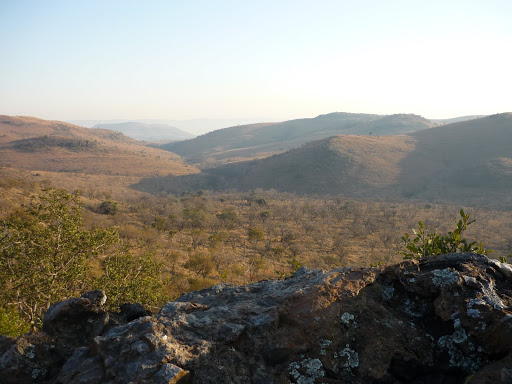
View of the valley, Malapa is somewhere in the background, I think the green patch of trees near the center, just before the big hill-shadow (?).
But these sites are just the tip of a fossiliferous iceberg. A few years ago when I was working here I accompanied some other researchers on a survey for more fossil sites in the area. What I learned then is that if you look across the Sterkfontein valley in the winter, the dessicated grassland is pimpled with the occasional patch of green trees – these small verdant isles are the tells of underlying cave systems (the caves contain water that plants will cut throats for). What was driven home yesterday at Malapa and other sites Dr. Berger showed us, is that these caves are all over the place, many fossil treasure-troves. What’s more, the A. sediba discovery (and the massive hominid molars from Gondolin) points to the idea that we are only beginning to understand what hominid life was like in the past. There is a rich prehistory still waiting to be discovered in South Africa, and undoubtedly also the rest of the African continent. Human paleontological work is far from exhausted. Let us usher in a Renaissance of field Paleoanthropology!
My next thought is that the process of fossilization can make the fossil-memories of past life quite beautiful. Now, in life the enamel of teeth is white-ish (yellow/brown is also not uncommon), and bone is this off-white/yellowish color. But during the process of fossilization, the original minerals used to make the bone (and less commonly teeth) are replaced by those in the surrounding soil. Often these minerals gussy up the fossils in neat new ways – manganese for example tends to make bone/tooth black.


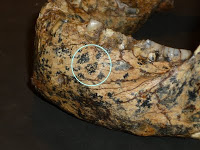
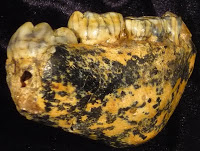
Check out SK 61, an infant/child Australopithecus robustus. After fossilization, this thing takes on a designer, tortoise-shell coloration (left, above). SK 12, an older adult A. robustus (right, above), is another good example: some subterranean joker has drawn a smiley face beneath his left premolar (circled). So while we are often left with a meager fossil record, at least the fragments we get are voluptuously variegated.

eFFING FOSSIL FRIDAYS!

I’m going to do my best to keep up with the blog during by Big Summer Adventure, and one thing I’d like to do is “F-ing Fossil Friday!” in which I focus on fossils for a bit. We’ll see if I can make this pan out.
Today I got out the rest of the Australopithecus robustus mandibles at the Transvaal Museum (above), save for I think maybe 1. As you can see from the picture, taphonomy (what happens to an animal’s remains between death and our digging them up) creates a serious challenge for the study of variation in this species. I’m focusing on ontogenetic variation – differences associated with growth and development. In spite of its fragmentary nature, so far as I know this is the best ontogenetic series of any fossil hominid (I should probably look more into A. afarensis here, too). In the bottom left you’ll see SK 438, the youngest in the sample, whose baby teeth haven’t quite come in all the way. Poor little guy! At the top right corner is SK 12, probably the oldest individual and also a big bugger.
One thing that I’ve noticed so far, only a preliminary observation that I need to actually run some numbers on, is that as individuals get older, the length of their tooth row (molars and premolars) gets shorter. This is because of the tendency for teeth to move forward during growth – “mesial drift” – and for adjacent teeth to literally wear into one another, their ends becoming flatter and flatter. While I should have realized this, it was surprising at first to find some dimensions of the lower jaw actually decreasing during growth. Now, I still have to run some tests to see if this is a biologically significant phenomenon. But it’s always nice to learn something new, even after just 2 days back with my best extinct buddies.
Stay tuned to future eFfing fossil Fridays!

Let’s hear it for the Null!

via Carl Zimmer, Dr. Jon Brock in his blog, “Cracking the enigma,” has some thoughts on why null hypotheses don’t suck so bad as so many people think. Null hypotheses are generally along the lines of, “there is no difference between these groups,” or “this variable has no effect on something,” or “there is no relationship between variables.” The more general statistical statement behind the null hypothesis is usually along the lines of “this phenomenon can be explained just as well by a completely random process.” I’d agree with Brock that it seems that a good many researchers (not me!) view the null hypothesis as a bore or meaningless. But I like his final thought:

This brings me neatly to my final point. In research on disorders such as autism or Williams syndrome, a significant group difference is considered to be the holy grail. In terms of getting the study published, it certainly makes life easier. But there is another way of looking at it. If you find a group difference, you’ve failed to control for whatever it is that has caused the group difference in the first place. A significant effect should really only be the beginning of the story.

Bloodsport in Australopithecus africanus?

ResearchBlogging.orgA few months ago in a post about the ilium and cannibals, I relayed a quote by Dr. Raymond Dart who was the first to recognize (and name) the hominid genus Australopithecus, back in 1925. I’d also mentioned that he was described [in a reference that escapes me] as “blood-thirsty.” This macabre descriptor came to mind again, as I’m reading his (1948) description of the MLD 2 mandible, of a juvenile A. africanus from Makapansgat cave in South Africa (figure is from the paper):

“[Individuals represented by MLD2 and another skull fragment] met their death by manually applied violence. The fractures exhibited by the mandible show that the violence, which probably occurred in fatal combat, was a localized crushing impact received by the face slightly to the left of the midline in the incisor region, and administered presumably by a bludgeon… this youth probably met his fate at the hands of a kinsman more expert than himself in the accurate application of directed implements” (p. 393-394)

This rather fanciful hypothesis may reflect Dart’s alleged bloodlust, and the condition of the fossil likely reflects damage that occurred after death during the sometimes abusive process of fossilization.


Reference
Dart, R. (1948). The adolescent mandible of Australopithecus prometheus American Journal of Physical Anthropology, 6 (4), 391-412 DOI: 10.1002/ajpa.1330060410

100,000 year old child skeleton on National Geographic

National Geographic aired a special tonight about a recently-excavated child’s skeleton (they focused on the skull) from Grotte des Contrebandiers in Morocco, dated to around 108,000 years ago. So far as I know this material has not been fully published (aside from a brief blurb in Science).

The program presented work of archaeologists, paleontologists, reconstruction artists, taphonomists, and lots of other people, hoping to figure out who the kid was and such. All in all it was pretty cool, I’d recommend checking it out if you didn’t see it. Or again if you did see it.

While I think it was a great program and the researchers involved are doing a terrific job, I had two main notes: first, I wish they’d treated the topic of growth-n-development a little more. They noted that the child (5-6 years old possibly) looked really “modern” because of its flat face. But looking at it, it didn’t really have that flat of a face, especially for a child. They talked about how human-like (rather than Neandertal-like) the kid was, but they only compared it with adults – children tend to have relatively smaller faces and larger brain-cases than adults (right), so it’s no wonder it looked more like an adult human than the adult Neandertal from Amud (Israel) that they compared it with. It would’ve been great to see more comparisons with other late Pleistocene hominid kids, such as from Skhul/Qafzeh or La Quina. A future program, perhaps.
Second, they kept asking whether the kid was “a Homo sapien.” I know it’s counterintuitive for English-speakers, but “H. sapiens” is the singular and plural of humans’ scientific name. Silly, right, cuz it doesn’t even get paid twice as much. But you’ll have take that up with C. Linnaeus. I am a Homo sapiens. You are a Homo sapiens. Fifty people are a gaggle of Homo sapiens.
Anyway it was a cool show. Check it out!
Figure credit: Fig. 2 from Bogin. 2003. The human pattern of growth and development in paleontological perspective. In Patterns of Growth and Development in the Genus Homo, eds. Thompson JL, Krovitz GE and Nelson AJ. New York: Cambridge University Press: 15-44.

Earliest human migrations

One of my favorite paleoanthropological sites is Dmanisi, in the Republic of Georgia. It is the oldest securely dated hominid site outside Africa (just under 1.85 million years ago), and the hominids found there display a neat mix of primitive Homo habilis and derived H. erectus features. I consider myself lucky to have had the opportunity to excavate at Dmanisi last year, and to return to Georgia (lamazi Sakartvelo! [I hope I translated that correctly]) for more fieldwork next month.
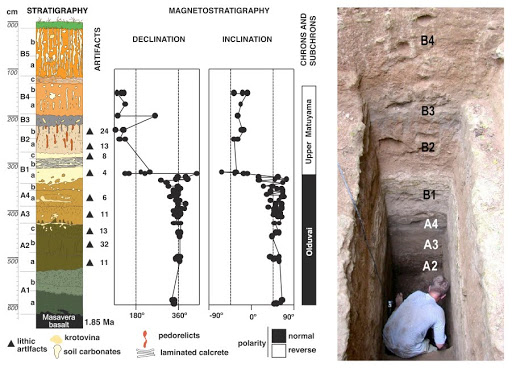
Recently, Reid Ferring and others (2011) described the results of excavations of M5, a section of the site a bit aways from the area where the hominids were found. M5 is pretty cool because it presents a nice geological “layer cake,” as Ferring described it to us: each of the strata (different layers of deposition) are nicely and evenly stacked on one another. Check out the labeled layers on the right of the figure, from Ferring et al. 2011:
This is in stark contrast to the jumbled strata (like ‘spaghetti’) where the hominids were found. In geology and archaeology, there is a general “law of superposition,” which states that the lowest layers in a sequence would have been deposited earlier than the layers above them. The A sediments at Dmanisi, as seen in the figure above, are thus older than the Bs. Hominids have only been found in the B sediments. But work at M5 has shown that stone tools are found in the older A sediments, meaning that hominids arrived at the site and used it continually, beginning just after 1.85 million years ago.
Tools from the site differ between the older A and slightly later (still older than 1.75 million years!) B sediments in both material and manufacture. As they say in the paper (p. 2/5), a major difference in tool manufacture between the strata A and B occupations could be that during the earlier A times, “either cores were more intensively reduced or selected flakes were made elsewhere and carried to the site.” I’m not sure why this may be, but it is neat that within a fairly narrow time span, researchers can see habits change in our early ancestors.
The authors also note that the older tools from A sediments indicate “that Eurasia was probably occupied before Homo erectus appears in the East African fossil record” (from the paper’s abstract). If only hominids also came out of the A sediments! The News is touting this as meaning H. erectus evolved in Eurasia and then some members of the ‘new species’ moved back into Africa, but I don’t think this is necessarily the case. The Dmanisi hominids are described as H. erectus, but lack some key H. erectus apomorphies (most notably a large brain size) and really look pretty similar to contemporary hominids in Kenya (such as KNM-ER 3733) and Tanzania (such as OH 16). Plus, the E. African hominid fossil record around 1.9 million years ago leaves some tantalizing hints at hominids more erectus-like than habilis-like, such as the ER 2598 occipital fragment.
So while Dmanisi definitely demonstrates the presence of hominids outside Africa earlier than most well-accepted “Homo erectus” (or “ergaster”) fossils in E. Africa, I don’t think they necessarily indicate that the species arose in Eurasia. Rather, what the fossil record likely shows is the evolution of populations of early Homo, in Africa and Eurasia, toward the more ‘advanced’ H. erectus we know and love (due to gene flow w/in a widespread species, rather than parallel evolution of similar traits in different species).
ResearchBlogging.org


Reference
Ferring R, Oms O, Agustí J, Berna F, Nioradze M, Shelia T, Tappen M, Vekua A, Zhvania D, & Lordkipanidze D (2011). Earliest human occupations at Dmanisi (Georgian Caucasus) dated to 1.85-1.78 Ma. Proceedings of the National Academy of Sciences of the United States of America PMID: 21646521

Culinary trends in an extinct hominid

A few weeks ago I discussed a recent paper that analyzed the carbon and oxygen isotope ratios from Australopithecus boisei molars (Cerling et al. 2011). The major finding here was that an enlarged sample (n=24 more) corroborated earlier isotopic (van der Merwe et al. 2008) and tooth wear evidence (Ungar et al. 2008) that A. boisei probably did not subsist on as much hard foods as previously thought. Although this strange hominid probably ate mostly grass/aquatic tubers, some researchers think it may have looked something like this:
Left, A. boisei reconstructed skull, from McCollum (1999, Fig. 1). Right, artist’s reconstruction of what the individual on the left may have looked like during life.
But looking at the numbers I’m wondering if the carbon isotopes reveal anything more about this curious hominid. If we plot boisei‘s carbon 13 values against the fossils’ estimated ages, there’s a small hint of a temporal trend, of increasing carbon 13 levels over time (more C4 plant consumption). Fitting a line to these data does indicate an increasing C4 component over time, but the slope of the line is not significantly different from zero. The early, high value could be an outlier (not eating the same stuff as his/her peers?), although the lowest carbon 13 value of all that would support this trend is also much lower than the other values; it could be a more anomalous one. So while it’s tempting to hypothesize dietary change over time in A. boisei, at the moment it looks like you can’t reject the hypothesis that diet is consistent throughout the Pleistocene until the A. boisei’s demise.  Supporting dietary stasis, Ungar and colleagues (2008) reported similar molar tooth wear in specimens from 2.27-1.4 million years ago.
In addition, Cerling and colleagues sampled at least one of each of the cheek teeth. Because teeth form in the jaws in a sequence (not all at the exact same time), the isotopic signatures from given teeth represent the dietary intake of carbon at various different points in an individual’s childhood. In the figure below I lumped upper and lower teeth together; the un-numbered “M” indicates molars unassigned to a specific position.

The first molar crown starts to form right around birth, and note here that it’s carbon 13 values are slightly higher than the other molars. The premolars and second molar start to form around the same time, so it is curious that each of these teeth show distinctly different ranges of carbon 13 levels. The sole P3 is also the lowest value (eating fewer C4 plants) in the entire sample, but the P4 has less negative values (eating more C4 plants). Not sure what’s going on here, but maybe later analyses of more specimens will clarify the situation.

ResearchBlogging.org
Our australopithecine ancestors and cousins have proven to be a rag-tag bunch of funny bipeds, and A. boisei has proven to be one of the weirder ones, in my opinion. Of course descriptions of Ardipithecus ramidus and Australopithecus sediba skeletons have been recent reminders that we have lots left to learn about Pleistocene hominids. For my part, I’m interested in working out the deal with the group of “robust” Australopithecus.
References
Cerling, T., Mbua, E., Kirera, F., Manthi, F., Grine, F., Leakey, M., Sponheimer, M., & Uno, K. (2011). Diet of Paranthropus boisei in the early Pleistocene of East Africa Proceedings of the National Academy of Sciences DOI: 10.1073/pnas.1104627108
McCollum, M. (1999). The Robust Australopithecine Face: A Morphogenetic Perspective Science, 284 (5412), 301-305 DOI: 10.1126/science.284.5412.301
Ungar PS, Grine FE, & Teaford MF (2008). Dental microwear and diet of the Plio-Pleistocene hominin Paranthropus boisei. PloS one, 3 (4) PMID: 18446200
van der Merwe NJ, Masao FT and Bamford MK. 2008. Isotopic evidence for contrasting diets of early hominins Homo habilis and Australopithecus boisei of Tanzania. South African Journal of Science 104: 153-155

Good olde dentistrie

I’m reading up on mandibular rotation, which is the change in orientation of the mandibular corpus relative to the rest of the skull during growth (the corpus is the horizontal part of your jaw that holds up your teeth; check out the shape changes in the mandibles in the blog header). So far as I can tell, the original classic paper on the topic is by Bjork (1955). Growth was studied by implanting metal pins into the jaws, then seeing how they move across ontogeny via X-rays (which were once called “roentgenograms,” neat-o!) Here’s a picture of the procedure, from Bjork (1955):
HOLY GOD WHAT DID THAT KID DO TO DESERVE THIS?! And although there must be a third person there, it sorta looks like there’s a three-handed dentist wielding a hammer, a nail, and a kid’s face. No wonder so many people are afraid of the dentist.
ResearchBlogging.org
Reference
BJORK A (1955). Facial growth in man, studied with the aid of metallic implants. Acta odontologica Scandinavica, 13 (1), 9-34 PMID: 14398173