Iron Chef: Middle Paleolithic

New evidence suggests Neandertals ate cooked foods, and plants at that.
Amanda Henry and colleagues (in press) extracted phytoliths – small mineralized parts from plants – and starch grains from dental calculus found on 2 Belgian (Spy) and 1 Iraqi (Shanidar) Neandertal fossils. I’ve never seen a study look at this kind of evidence before, I have to say it’s pretty neat. Calculus, not just a badass type of mathematics, is mineralized plaque that can build up on teeth. As the Neandertals chewed their foods, the small food particles got trapped in their plaque and this gross matrix hardened onto their teeth. So, if you want to obliterate traces of your diet, and otherwise conform to Western norms of dental hygiene, one thing you can do is be sure always to brush. And floss.

Microscopic barley grains. Top row are examples of grains from Shanidar calculus, and beneath each are examples of modern barley to which they are probably related. Fig. 1 from Henry et al. (in press)

Types of plants eaten by the Shanidar individual include relatives of modern wheat, barley (see figure), and rye, and what looked like beans and date palm, too. In addition, some of the starch grains bear strong resemblance to plant remains after cooking, probably either by boiling or baking. The Belgian samples provided less broad evidence, indicating presence mainly of some type of underground storage organ (like a tuber) and grass seeds. Many phytoliths and grains were unable to be identified, leaving open the chance that future research on these will uncover utilization of a greater breadth of plants.
This is pretty neat, since studies of the isotopes in Neandertal teeth indicated a strong meat component to the diet. In fact, Neandertals have often been referred to as ‘top carnivores.’ This new study supports other evidence of a large plant component as well. After all, isotope studies are only one form of evidence of diet. Neandertals weren’t just big game hunters, they were hunter-gatherers. What’s more, they improved the edibility and nutritive value of their plant (and probably also animal) foods by cooking them. So, this study presents another way in which Neandertals were probably no different from contemporaneous humans.
One has to wonder what these paleolithic meals would have been like. Especially what with claims of cannibalism in some Neandertal sites – perhaps “liver with some fava beans and a nice chiaaanti…fhfhfhfhfhfhfh,” to quote Hannibal Lecter. And who would win Iron Chef – the classic Neandertals, or their more ‘modern’ looking contemporaries?

ResearchBlogging.org
Reference
Henry, A., Brooks, A., & Piperno, D. (2010). Microfossils in calculus demonstrate consumption of plants and cooked foods in Neanderthal diets (Shanidar III, Iraq; Spy I and II, Belgium) Proceedings of the National Academy of Sciences DOI: 10.1073/pnas.1016868108

Unwarranted zeal: Melvin Moss on modern methods

I’m doing some reading on the study of craniofacial growth, I stumbled across this poignant quote from Melvin Moss, from a seminar on “New Techniques in Processing and Handling Growth Data”:

“This is very beautiful. It is neat, it is modern technology, and it is fast. I am just wondering very seriously about the biological validity of what we are doing with this machine.” (Moyers & Krogman, eds: p. 326)

Reference
Cranio-Facial Growth in Man. RE Moyers & WM Krogman, eds. 1967. New York: Pergamon Press.

Atavisms: talk about old school

This month’s Current Biology has a “Quick Guide” segment by Brian Hall on atavisms: the occasional and random appearance of ancestral traits in individuals of species that no longer have that trait. Examples Hall provides are vestigial hindlimbs (legs or fins) occasionally found on dolphins or snakes, which evolved from animals that did have limbs.

This is wild, because it implies that part of the ancestor’s developmental program has been furtively retained in its descendants, but this program generally never gets carried out. But every now and again a mutation may arise that causes the ancestor’s developmental program come alive all Franken-style. Nuts!
Here’s a crazy hypothetical example: the axolotl is an evolutionary abomination, a salamander in a state of arrested development. It’s basically a salamander that terminates development in what would otherwise be the larval stage of any other salamander. This is a nice real-life example of heterochrony (changes in the timing and rates of developmental events). Here, it’s a adult descendant that resembles the juvenile form of the ancestor (“neoteny”). (photo credit: John Clare, axolotl.org)
Wouldn’t it be wild, then, if the there was an axolotl in whom the ancestral full-salamander developmental plan was completed, resulting in an accidental salamander?! And then you could try to select for this atavism, possibly breeding peramorphic-atavistic-salamander axolotls (“salamander axolotls” for short)! If grad school doesn’t work out, this’ll be my Plan B.
Poll: If you could have any atavism, what would it be?
Reference
Hall BK. 2010. Quick guide: Atavisms. Current Biology 20: R871.

Growing a Homo erectus kid, sort of

A paper, given at this year’s Physical Anthropology meetings, was just published online in the Journal of Human Evolution, with a re-evaluation of the height and possible growth pattern of a subadult skeleton of Homo erectus (KNM-WT 15000, aka “Nariokotome boy,” aka “Stripling youth”). When initially described, it was estimated that this young chap would gave grown to be around 6 feet tall. However, controversy around the skeleton’s age at death and probable growth pattern have made this quite a contentious topic. In the recent paper, Ronda Graves and colleagues used a South African human growth pattern and a pattern from “naturally-reared captive” chimpanzees to devise a series of intermediate growth patterns that might have characterized H. erectus. Using the pattern they felt most likely reflected the Nariokotome skeleton’s estimated life history parameters, the authors estimate the potential adult height of the youth to have been closer to about 5′ 4″.

All I’d like to say about this is that deciding how tall a subadult skeleton like this would have grown to be is inherently tricky. First, the individual’s height when he died has to be estimated, and this will always be an estimate, so there’s one level of error there. Next, in order to determine the duration of growth remaining had he lived, one must estimate the skeleton’s age at death. This has been debated for the Nariokotome skeleton, because the pattern of tooth eruption and tooth enamel formation seem to point toward an age of around 8-10 years; but the pattern of long-bone closure suggests an age closer to 13 or so years. If anything, this means we cannot assume a ‘human-like’ or ‘chimpanzee-like’ pattern of skeletal and dental development for H. erectus. But our final step in figuring out how tall this kid would’ve been is to use the previous 2 estimations to infer how much longer, and at what rate, he would have grown. Crap.
The authors tried to circumvent this issue by averaging/modifying the human and chimpanzee mathematical growth curves. The curves themselves come from averages of respective species samples, which then were combined (sort of like averaging) to create intermediate growth curves. They then also multiplied the intermediate curves by various constants, in attempt to model different life history patterns in the growth curves. Incidentally, one of these ‘altered life history’ models provided their preferred height estimate of 5′ 4″. I think this is a clever and interesting way to tackle the question of how to estimate height from fossils; but I think it’s important to bear in mind how far-removed from both their models they had to get to do this. How many assumptions and potential sources of error should be permissible? Are there any biological constraints that might actually render a human-chimp average growth pattern to be unrealistic? I dunno!
Anyway, an interesting paper, and with a pretty good literature review, too. As stated above, the model they preferred gave a much shorter height than traditionally accepted for this individual. The model (and so H. erectus) also lacks a modern human-like growth spurt, which this specimen would have ‘needed’ to attain a tall adult height like has been traditionally thought. Other researchers have used the cranial remains to argue that Nariokotome kid would have had a good amount of growth left to have a more characteristically H. erectus-like skull, though it is unclear if this necessarily means an adolescent growth spurt. So, this was a very interesting and thorough study, but I’m sure it’s not the last we’ll hear about growth and development in H. erectus.
The paper
Graves RR, Lupo AC, McCarthy RC, Wescott DJ, and Cunningham DL. Just how strapping was KNM-WT 15000? Journal of Human Evolution, in press.

doi:10.1016/j.jhevol.2010.06.007

"Big Man" and the scapula of Australopithecus afarensis

Last November I reported on recently described Australopithecus cf. afarensis craniodental remains from the site of Woranso Mille in Ethiopia. These fossils are significant in part because they date to around 3.6 million years ago; most of the postcranial evidence for A. afarensis comes from Hadar (~3.4 – 2.9 million years) or Maka (~3.5 million years). It is pretty awesome, then, that Yohannes Haile-Selassie and colleagues (2010a) have just reported on a partial skeleton from Woranso-Mille.

 
The specimen is given the catalog number KSD-VP-1/1 (right, from Nature), and the nickname Kadanuumuu, meaning “Big Man” in the language of the Afar people who live in the region where the fossils were discovered. Here, I’ll be focusing on the scapula.
 
Researchers have debated about what the scapular form of A. afarensis means functionally – how could, and did, these creatures use their shoulders? The scapula of AL 288 (the famous “Lucy”) preserves part of the glenoid fossa (shoulder socket) and only a little of the surrounding bone including the scapular spine (below). It has been argued that the angle between the glenoid fossa and the lateral border is more similar to modern apes than to humans. That is, the shoulder socket may have been oriented more upward, like in modern apes, compared to humans whose socket faces more to the side. The implication is that A. afarensis may have been preferentially exploiting arboreal environments.
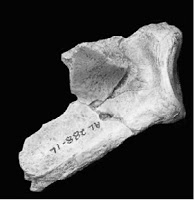
 
Left: AL 288 scapular fragment. The glenoid fossa is the hollow that faces to the right, the lateral border is at the bottom paralleling the label “AL 288-1L.” The scapular spine is preserved only at the base, it is the small uprising of bone just to the left of the glenoid fossa. From Haile-Selassie et al. 2010b, Fig. S21.
 
Similarly, a juvenile afarensis skeleton from the Ethiopian site of Dikika (Alemseged et al. 2006), dating to around 3.4 million years ago, also suggested an ape-like shoulder for this extinct human ancestor. Principal components analysis of several measurements from the Dikika scapula showed it to be very similar to gorillas of comparable age, in terms of overall shape and proportions.
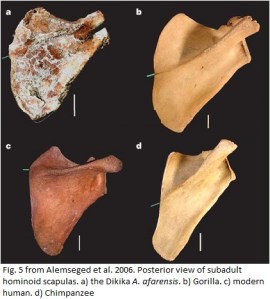
 
So from these two scapulae, one belonging to a very small-bodied female, the other from a small ~3-year-old possible female, we get the picture that A. afarensis had a fairly ape-like (i.e. arboreal) shoulder orientation, and may not have had independent movement of the head and trunk that we modern humans enjoy. Nevertheless, it is still unclear whether this means that the afarensis scapula functioned like that of an ape, and hence its shape, or whether the similarity in shape is a ‘hold-over’ from having an arboreal ancestor. I will say, I think one very telling feature noticeable in even the fragmentary AL 288 is the relative position and orientation of the scapular spine. Note that in the apes (the two juveniles scapulae on the right of the diagram to the left), the scapular spine roughly parallels the lateral border, and as a result, the flat areas above and below the spine are roughly equal in size. The above area houses the supraspinatus muscle, a rotator cuff muscle that acts largely in elevating the arm above the head and stabilizing the shoulder joint. In humans and afarensis, in contrast, the lower (insfraspinous) fossa is fairly large compared to the upper (supraspinous) fossa. Thus, the argument can be made that in humans and hominids, less power is needed to raise the arms over the head, or that humans and hominids have a greater reliance on the infraspinatus muscle for bringing the arm down toward the body and stabilizing the shoulder joint.
 
Now, KSD-VP-1 provides a remarkably complete scapula of an adult afarensis (right). In contrast to the specimens described above, KSD-VP-1 is very human-like. To the naked eye, and as borne out by principal components analysis of scapular angles, this thing is very human-like.
 
Now the question is, why does the morphology of this new specimen seem at odds with Lucy and Dikika? Part of the answer could be scaling – indeed, the authors note that the orientation of the glenoid relative to the lateral border (more specifically the scapular bar) in AL 288 can be found in modern humans of small size.
 
But that still does not answer the question of why the complete adult afarensis scapula is like adult humans, whereas the child afarensis is like young gorillas. The authors posit that perhaps it is due to Dikika’s fairly large supraspinous fossa. They also suggest that the measurements used in Alemseged et al’s study could not capture functional and discriminatory information about scapula shape. Nevertheless, a simple visual comparison the Dikika and KSD (x-ray…) scapulae reveals them to look fairly different, i.e. Dikika is relatively broader side-to-side.
 
Could ontogeny explain the differences between the child and adult afarensis? In a study of scapular growth and development in living primates, Young (2008) found childhood growth does not appear to explain adult shape variation. That is to say, most aspects of species-specific morphology are present in subadult scapulae. Rather, most variation in scapular shape among modern primates appears to be due to functional differences: climbers’ scapulae differ consistently from quadrupeds’. So what does that imply? That at 3.59 million years, adult male A. afarensis were not using their shoulders for arboreal activities, but at 3.4 million years ago, subadults were? Maybe this is just normal intraspecific variation? Maybe the ontogeny of the scapulae needs to be examined further?
 
I have to say I agree with Haile-Selassie et al. (2010a) here, that differences in the statistical analyses between the current study and that of Alemseged et al. (2006) may be partly responsible for the different interpretations of A. afarensis scapular morphology. Still, visual inspection of pictures of the fossils suggests to me that even if the principal components analyses were carried out using the same variables (Alemseged et al. used linear measurements, H-S et al. used angles), Dikika might seem gorilla-like, KSD still human-like; Nota bene that principal components analysis is not actually a test in itself, but rather an exploratory statistical technique. As such, it will never really “tell” how a bone was used. Still, I think this does raise an important issue about scapular function and ontogeny in hominoids.
 
References
Alemseged Z, Spoor F, Kimble WH, Bobe R, Geraads D, Reed D, and Wynn JG. 2006. A juvenile early hominin skeleton from Dikika, Ethiopia. Nature 443: 296-301.
 
Haile-Selassie Y, Latimer BM, Alene M, Deino AL, Gibert L, Melillo, Saylor BZ, Scott GR, and Lovejoy CO. 2010a. An early Australopithecus afarensis postcranium from Woranso-Mille, Ethiopia. Proceedings of the National Academy of Sciences, USA, in press.
 
Haile-Selassie et al. 2010b. Supplementary Online Material to 2010a.
 
Young NM. 2008. A Comparison of the Ontogeny of Shape Variation in the Anthropoid Scapula: Functional and Phylogenetic Signal. American Journal of Physical Anthropology 136: 247-264.

Evolution of human fingers and toes: The two go foot in hand

A really cool study was just published in the journal Evolution, and what with getting my apartment ready for a New Year’s party on the 31st, and my being completely incapacitated yesterday, I didn’t get to read through it until today. Campbell Rolian and colleagues (in press) address the question: In human evolution, were hand and foot digital proportions each the targets of direct selection, or could hand/foot proportions have evolved as a byproduct of selection on only the hand or only the foot?

This is an interesting question. In your standard Anthropology 101 class, you learn about how humans (and hominins) are unique relative to apes. Two unique things about us are: a robust, adducted big toe for bipedalsim, and a hand adapted for tasks requiring a fairly high degree of dexterity, such as tool use. But something to keep in mind–indeed the authors of this study did–is that the hand and foot are serially homologous, each is a variant on a common theme. Because the developmental architecture behind the hand and foot are largely similar, an intuitive question is whether selection on the hand or foot only would effect the evolution of the element that wasn’t under selection. Could developmental integration of the hominin hand and foot have led to evolutionary integration, do/did the hand and foot co-evolve?

Turns out this may well be the case. Authors looked at lengths and widths of hand and foot phalanges (finger bones) in a sample of humans and chimpanzees. Generally, in both Pan and Homo, homologous traits in the hand and foot are more highly correlated than expected by chance, even compared to correlations between traits within the hand and foot. Cool!

But then the authors did some crazy simulations, to see what kinds of selection regimes on the hand and foot may have led from a chimp-like morphology to the morphology we humans enjoy today. I’ll need to reread this section a couple times, but it looks like selection on the big toe is one of the most important aspects of hominin hand/foot evolution. And it would not be impossible for evolutionary changes in the human hand to be largely by-products of selection on the foot, due to the nature of covariation (integration) of the hand and foot. Whoa!

The implication, which the authors seem to like, is this: given a chimp-like ancestral morphology for the hand and foot, it seems that the two major hominin/human traits given above (bipedalism and tool-use/manual dexterity) are largely due to selection simply on the foot. That is, because of the developmental integration of the hand and foot, selection for a bipedally capable foot indirectly induced the evolution of a hand conducive to manipulation. Ha, the hand was just along for the ride! Get it, because the feet move the body, and so the hand… but also evolutionarily… Dammit.

Anyway, that’s nuts! Of course, another very interesting thing about the first digits of the human hand and foot, aside from the fact that the first digit on both is relatively large and robust, is that the mobility of these digits is just about opposite what it is in the apes. Whereas the big toe is very mobile/opposable in apes (and the 4.4 million year hold putative hominin, Ardipithecus ramidus), it is completely adducted in humans (and fossil hominins that aren’t Ar. ramidus). Less extreme, the human thumb joint is allegedly more mobile than apes’ thumbs. So this is the next step, I guess: what is the developmental basis for the wild evolution of the human hallux and pollex joints?

Reference
Rolian C, Lieberman DE, and Hallgrimsson B. Coevolution of human hands and feet. Evolution: in press.

Pongo amidst conservation and industry

The December issue of Current Biology has a short summary about collaborations between the palm oil industry and conservationists to preserve orangutan (Pongo pygmaeus) habitats in Borneo. As the palm oil industry has burgeoned, orangutan populations have lost contact due to deforestation for industry and agriculture. Apparently palm oil companies have made an agreement with the government of the Malaysian state of Sabah in Borneo, in which the companies will help construct corridors that will reconnect isolated populations of the orangutan.

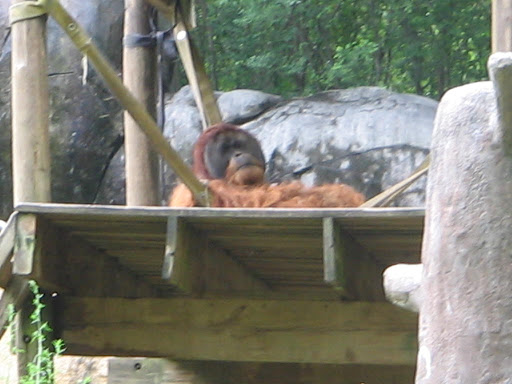
Lethargic orangutan at the Zoo Atlanta, in Hottlanta GA. He was cool but boring because he didn’t do anything.

Good to see cooperation rather than conflict between conservationists and industries. Let’s hope it proves beneficial for the endangered orangutans.

Assuming the project works out, it will be interesting to see population genetics and behavioral studies documenting the results of renewed contact and gene flow of these erstwhile isolated apes. Since the prior isolation and future reconnection are anthropogenic, or due to human activity, it will be an interesting (and hopefully not too depression) lesson about how human behavior affects biodiversity.

On an aside, I just heard, “Goonies never say ‘die'” (Sean Astin, Goonies).
Reference
Williams N. 2009. Orang-utan plan. Current Biology 19: R1098

Hybrids, hominoids and hominins

Is the Eastern lowland gorilla (Gorilla beringei graueri) a hybrid (sub)species? A recent study by RR Ackermann and JM Bishop suggests this scenario.

Their study used morphological, genetic and geographic information to analyze variation in extant gorilla species and subspecies. A previous study by Ackermann and colleagues (2006) on baboons found that non-metric traits–namely pairs of extra teeth and unusual sutures between some facial bones–have freakishly high frequencies in known hybrids compared to their parents of different species. Well wouldn’t you know it: G. b. graueri had a significantly higher frequency of such traits than the other gorilla species/subspecies (the putative ‘parental’ species, the Eastern mountain gorilla G. b. beringei and the Western lowland gorilla G. gorilla gorilla).

Additionally, for a number of cranial metric traits, graueri had significantly higher values than the other gorilla species’ sample averages. “Heterosis” refers to a condition wherein a hybrid phenotype exceeds the combined parental mean–it appears that if this is truly a hybrid population, graueri displays heterosis for a number of cranial features. Finally, it is notable that graueri has been described as more like Western gorillas in some respects, but more like Eastern mountain gorillas in others, and then totally unique in some aspects. This is arguably a result of graueri possessing genes from two other distinct species.

Oh, and the mtDNA evidence suggests fairly recent gene flow from Western lowland gorillas eastward. Because mtDNA is maternally inherited, this implies that females have been involved in this west-to-east gene flow. However, it is unclear the extent to which there was east-to-west gene flow, or the potential involvement of male gorillas here.

Why is graueri likely a largely hybrid sample, and not just part of a morphological and genetic cline conecting Western and Eastern gorilla populations (i.e. making gorillas a single, polymorphic, geographically broad species)? The hybrid morphologies above are believed to indicate complications that arise in development, due to the union of two species’ distinct sets of genes. Such signatures of hybridizaiton would not be expected to appear in a regularly panmictic species. It also seems that the separation of Western and Eastern gorilla species occurred during the Pleistocene, which means that the two sides have been diverging for quite a long time and have recently come back into contact.

I think the authors make a very good case for the importance of hybridization in the evoluton of gorillas, at least as we know them today. I like their use of both morphological and genetic data, which complement one another nicely in support of a hybrid-type nature of Gorilla beringei graueri. In addition, the implicaitons of the study are fantastic! Even though the authors did not know for sure whether individual specimens were hybrids, they were able to use the results of previous work to make a convicning case that a number of their specimens were very likely to be hybrids. This is a good sign for persons like myself who are interested in the detection of hybrids in skeletal/fossil samples. Another great implication is that hybridization indeed has a place in hominoid evolution–it awaits to be seen what role hybridization may have played in the course of human evolution.

References
Ackermann RR, Rogers J and Cheverud JM. 2006. Identifying the morphological signatures of hybridization in primate and human evolution. Journal of Human Evolution 51: 621-645.

Ackermann RR and JM Bishop. Morphological and molecular evidence reveals recent hybridization between gorilla taxa. Evolution: in press.

Bridging the gap: Australopithecus from Woranso

Recently discovered Australopithecus fossils from the Ethiopian site of Woranso-Mille help fill a gap between parts of the early hominin fossil record (Haile-Selassie et al, in press). The fossils date to between 3.8-3.6 million years ago (Ma), and consist of several teeth and a jaw fragment. These specimens show a number of features that are intermediate in morphology between the earlier Au. anamensis (4.2-3.9 Ma) and later Au. afarensis from Laetoli (~3.7-3.5 Ma). As a result, the Woranso fossils lend support to the hypothesis that Au. anamensis and Au. afarensis represent a single evolving species (i.e. Kimbel et al. 2006).


I think this is exciting for two reasons. First, the fossils bridge the morphological gap between the older anamensis and younger afarensis fossils. As a result, we get to ‘see’ anagenetic evolution—changes within a single lineage. One topic in evolutionary biology is about the mode and tempo of evolution: are species fairly constant, then evolve into multiple ‘daughter’ species (“punctuated equilibrium”); or does evolutionary change tend to occur more within individual lineages (“anagenesis”)? Obviously neither is mutually exclusive, rather evolution is probably best characterized variously by both processes. Still, in the world of paleoanthropology, where many researchers argue for rapid and constant species turnover within the human lineage, it is cool to see a convincing argument for anagenesis. However, this ignores the meager (but intriguing) K. platyops material (Leakey et al. 2001), dating to around 3.5 Ma, possibly indicating the proliferation of at least two hominin species shortly after 4 Ma.


Second, the morphological intermediacy of the Woranso fossils allow a look at the patterns of evolutionary change within the anamensisafarensis lineage. The authors note that the teeth of the Woranso hominins are generally more similar to anamensis, but have some derived characters of the later afarensis teeth. If we truly have a glimpse of dental evolution within a single lineage, we can ask questions about the evolution and development (“Evo-Devo”) of teeth. Are changes in these teeth correlated in a way that could be predicted by certain developmental models? Or is selection acting independently on various tooth traits?


References

Haile-Selassie Y, Saylor BZ, Deino A, Alene M, and Latimer BM. New hominid fossils from Woranso-Mille (Central Afar, Ethiopia) and Taxonomy of Early Australopithecus. American Journal of Physical Anthropology, in press.

Kimbel WH, Lockwood CA, Ward CV, Leakey MG, Rak Y, and Johanson DC. 2006. Was Australopithecus anamensis ancestral to A. afarensis? A case of anagenesis in the hominin fossil record. Journal of Human Evolution 51: 134-152.

Leakey MG, Spoor F, Brown FH, Gathogo PN, Kiarie C, Leakey LN, and McDougall I. 2001. New hominin genus from eastern Africa shows diverse middle Pliocene lineages. Nature 410: 433-440.

Claude Levi-Strauss: 1908-2009

The great, dare we say legendary, anthropologist Claude Levi-Strauss passed away this past weekend at the ripe age of 100. Levi-Strauss is largely responsible for establishing the structuralist school in anthropology, which emphasized the prevalence of binary opposition in culture, myths, language, and the like. I recall reading some of his work for a Theories of Myth course, which provided a fascinating of viewing the creation and roles of myths. Few anthropologists have had such an impact within their own field and beyond, as Claude Levi-Strauss.