Bonobos and the ultimate hidden truth of the world

A recent study finds that bonobos are no less aggressive than chimpanzees, but levels of aggression also vary across different groups in either species.

Chimpanzees and bonobos are humans’ closest living relatives, their ancestors having diverged from ours around 6 million years ago, before our two evolutionary cousins started becoming separate species over a million years ago (Yoo et al., 2025). Chimpanzees have long been depicted as violent, with males especially “warlike” — see for instance the recent documentary Rise of the Warrior Apes (which is excellent, although it doesn’t pass the Bechdel Test). Early studies of bonobos, on the other hand, revealed different social dynamics: females dominate males, all individuals use sexual contact for establishing and maintaining social bonds, and individuals are generally less aggression compared to chimpanzees.

Because these two species are equally related to humans, they provided starkly different models for the possible ancestral conditions out of which humans evolved (Parish et al., 2000). People often look to the animal world to support their ideas of what constitues ‘human nature.’ If either chimpanzees or bonobos are selected as the proxy for our last shared ancestor millions of years ago, one could argue that humans are ‘naturally’ aggressive or peaceful.

However, reports of violent aggression among bonobos in the wild have emerged in recent years, including a likely case in which several females attacked (and probably killed) a male in their group (Pachevskaya et al., 2025). So, are chimpanzees and bonobos that different after all?

Yesterday, Emile Bryon & colleagues reported the results of a systematic comparison between chimpanzees and bonobos in terms of their aggression toward others. The researchers studied 22 groups of chimpanzees (9 groups) and bonobos (13 groups) living in zoos, examining who antagonized whom and whether this involved more of a threat or came to physical contact that could cause bodily harm. The comparison among apes living in captivity as opposed to the wild provides greater sample sizes and reduces some of the variance that could be attributed to habitat differences.

Bryon and team found that, as their article title succinctly reports, “chimpanzees are not more aggressive than bonobos but target sexes differently.” Their results support earlier observations from wild-living apes in that among chimpanzees males are extremely aggressive toward females, while among bonobos females direct more aggression toward males. Overall rates of aggression did not differ between the two species, however, and within each species different groups varied extensively; wild-living apes vary between groups in similar ways.

This variability between groups of the same species is really important. Some groups had more aggressive encounters than others, and both chimpanzees and bonobos had groups with lower rates than expected from the species-wide patterns. It is easy to overgeneralize and essentialize animals based on limited observations—in this case, that ‘bonobos make love while chimpanzees make war.’ In contrast, the study shows that there’s no one way to form a bonobo or chimpanzee society. Our closest living relatives are more flexible in their behavior than we tend to give them credit for.

The animal kingdom and especially our ape cousins are frequently invoked in order to naturalize or justify violence and inequality in the human world, and I think this study illustrates that we shouldn’t overgeneralize about other animals or ourselves. Many people including Donald Trump use naïve evolutionary reasoning to argue that ‘might makes right,’ that being a selfish asshole is a natural state molded by our evolutionary history. But as the late, great David Graeber (2015) has argued (admittedly, about bureaucracies), “The ultimate hidden truth of the world is that it is something that we make, and could just as easily make differently.” This study by Bryon and colleagues suggests that the ability to choose or avoid conflict and aggression may well be the ancestral condition out of which humanity evolved—that despite the violence and warmongering making headlines today, there’s nothing in nature that says it has to be this way.

References

Bryon, E. et al. (2026). Chimpanzees are not more aggressive than bonobos but target sexes differently. Science Advances 12, eadz2433. doi:10.1126/sciadv.adz2433

Graeber, D. (2015). The Utopia of Rules: On Technology, Stupidity, and the Secret Joys of Bureaucracy. Melville House.

Parish, A. et al., (2000), The Other “Closest Living Relative”: How Bonobos (Pan paniscus) Challenge Traditional Assumptions about Females, Dominance, Intra- and Intersexual Interactions, and Hominid Evolution. Annals of the New York Academy of Sciences, 907: 97-113. https://doi.org/10.1111/j.1749-6632.2000.tb06618.x

Pashchevskaya, S et al. (2025) Coalitionary intra-group aggression by wild female bonobos. Current Biology 35, Issue 19, R912 – R913. https://doi.org/10.1016/j.cub.2025.08.010

Yoo, D., Rhie, A., Hebbar, P. et al. (2025) Complete sequencing of ape genomes. Nature 641, 401–418. https://doi.org/10.1038/s41586-025-08816-3

Scientific Racism

The site’s been quiet in 2017, with little time to blog on top of my regular professional responsibilities, and of course watching the fascist smoke rising from the garbage fire of our 45th presidential administration with horrified disbelief. At work, my two new classes are keeping me plenty busy, and their content is quite distinct – one is on the archaeological record of Central Asia, the other centers around Homo naledi to teach about fossils. But by complete accident, examples of scientific racism came up in the readings for each course last week.

scientific-racism

Scientific racism refers to using data or evidence from the biological and social sciences to support racist arguments, that one racial group is better or worse than another group; the groups of course, are culturally determined rather than empirically discrete biological entities. This evidence is often cherry-picked, misinterpreted, and/or outright weak. Nicolas’ Wade’s 2014 A Troublesome Inheritance is a recent example of such a work. The book’s racial claims amount to nothing more than handwaving, and so egregious is the misrepresentation of genetic evidence that nearly 150 of the world’s top geneticists signed a letter to the editor rebuking Wade for “misappropriation of research from our field to support arguments about differences among human societies.” Wade’s book has no place in scientific discourse, but then almost anyone can write a book as long as a publisher thinks it will sell.

In addition to the outright misrepresentation of scientific evidence to support racist arguments, another manifestation of scientific racism is the influence of cultural biases in the interpretation of empirical observations. This may be less malicious than the first example, but is equally dangerous as it more tacitly supports systemic and pervasive racism. And this brings us to my classes’ recent readings.

First was a reference to the “Movius Line” in a review of the Paleolithic record of Central Asia (Vishnyatsky 1999) for my prehistory class. Back in the 1940s Hallum Movius, archaeologist and amazing-name-haver, noticed a distinct geographic pattern in the distribution of early stone tool technology across the Old World: “hand-axes” could be found at sites across Africa and western Eurasia, while they were largely absent from East Asian sites, which were dominated by more basic stone tools.

screen-shot-2017-02-25-at-8-28-56-am

Movius’ illustration of the distribution of Early Paleolithic technologies. From Fig. 1 in Dennell (2015).

Robin Dennell (2016) provides a nice review of how Movius’ personal, culturally influenced perception of China colored his interpretation of this pattern. Movius read this archaeological evidence to mean that early East Asian humans were unable to create the more advanced technology of the west, a biological and cognitive deficiency resulting from cultural separation: “East Asia gives the impression of having acted (just as historical China and in sharp contrast with the Mediterranean world) as an isolated and self-sufficient area, closed to any major human migratory wave” (Movius 1941: 86, cited in Dennell 2015). Racial and cultural stereotypes about East Asia directly translated to his interpretation of an archaeological pattern.

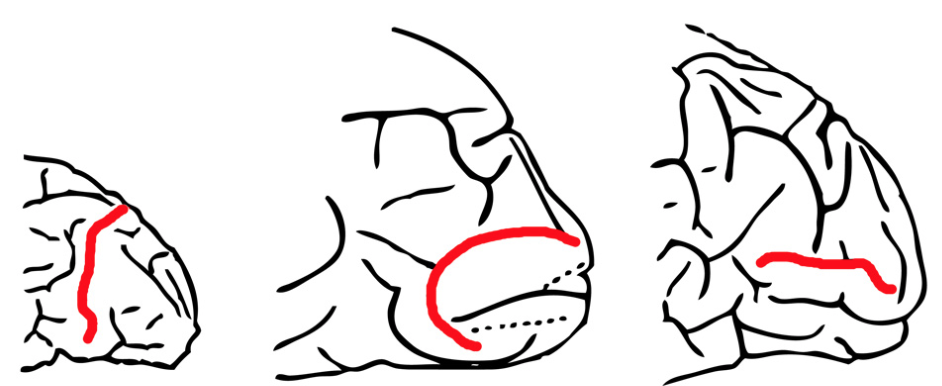
This type of old school scientific racism also arose in a review of endocasts (Falk, 2014) for my Homo naledi class. Endocasts are negative impressions or casts of a space or cavity, and comprise the only direct evidence of what extinct animals’ brains looked like. So to see how the structure of the brain has changed over the course of human evolution, scientists can search for the impressions of important brain structures in fossil human endocasts. Falk (2014) reviews one of the most famous of these structures – the “lunate sulcus” – which was used as evidence for reorganization of the hominin brain for nearly 100 years. In the early 20th century, anatomist and anthropologist GE Smith (not GE Smith from the Saturday Night Live Band)  thought he’d identified the human homologue of a groove that in apes separates the parietal lobe from the visual cortex. In humans, however, this groove was positioned more toward the back of the brain, which Smith interpreted as an expansion of an area relating to advanced cognition.

Screen Shot 2017-02-25 at 9.07.54 AM.png

The back of the brain, viewed from the left, of a chimpanzee (left) and two humans, the red line illustrating the Affenspalte or lunate sulcus (Fig. 1 from Falk 2014, which was modified from Smith 1903). The middle one also might be a grumpy fish.

It turns out that the lunate sulcus does not actually exist in humans, as the grooves identified as such are not structurally or functionally the same as the lunate sulcus in apes (Allen et al., 2006). Nevertheless, given what Smith thought the lunate sulcus was, it’s tragic to read his interpretations of human variation: “resemblance to the Simian [ape] pattern… is not quite so obvious…. in European types of brain….” (Smith 1904: 437, quoted in Falk 2014). The human condition for this trait was for it to be located in the back, reflecting an expansion of the cognitive area in front of it, and this pattern was less pronounced, according to Smith, in non-European people’s brains. This interpretation reflects two traditions at the time: 1) to refer to racial ‘types,’ ignoring variation within and overlap between groups, as well as 2) the prevailing wisdom that Europeans were more intelligent or advanced than other geographical groups.

ResearchBlogging.orgAnecdotes such as these may seem like mere scientific and historical curios, but they should serve as important reminders both that science can be accidentally guided by cultural values, or intentionally used for malevolent ends. Misconceptions and errors of the past shouldn’t be erased, but rather touted so that we don’t repeat mistakes that can have major consequences in our not-so-post-racial society.

References

Allen JS, Bruss J, & Damasio H (2006). Looking for the lunate sulcus: a magnetic resonance imaging study in modern humans. The anatomical record. Part A, Discoveries in molecular, cellular, and evolutionary biology, 288 (8), 867-76 PMID: 16835937

Dennell, R. (2016). Life without the Movius Line: The structure of the East and Southeast Asian Early Palaeolithic Quaternary International, 400, 14-22 DOI: 10.1016/j.quaint.2015.09.001

Falk D (2014). Interpreting sulci on hominin endocasts: old hypotheses and new findings. Frontiers in human neuroscience, 8 PMID: 24822043

Vishnyatsky L (1999). The Paleolithic of Central Asia. Journal of World Prehistory, 13, 69-122.

What do capuchin stone tools tell us about human evolution?

A month ago at ESHE and now online in Nature, Proffitt and colleagues describe stone-on-stone smashing behavior among wild bearded capuchin monkeys (Sapajus libidinosus). The online paper includes a great video documenting the action; here’s a screenshot:

screen-shot-2016-10-20-at-7-57-24-am

Holding the rock with both hands just above head-level, the monkey prepares to crush its enemies. Which in this case are another rock stuck in a pile of more rocks.

In the fairly rare cases where non-human primates use stones, it’s for smashing nuts or something. But when these capuchins see a stone they don’t just see a smasher, they see a world of possibilities* – why use a rock to break a rock, when you could use it to break a heart? So this group of capuchins is unique in part because they’ve been documented to use stones for many purposes.

Now why on earth a monkey would use one rock to break another rock is anyone’s guess. In human evolution, the purpose was to break off small, sharp flakes that could be used to butcher animals or work plants. Proffitt et al. did observe small flakes being removed when capuchins pounded rocks, but the monkeys showed little interest in this debitage, other than using it to continue smashing stuff. More curiously, the monkeys frequently lick the rock after hammering at it:

screen-shot-2016-10-20-at-7-56-44-am

Mmm, rocks.

Proffitt et al. venture that maybe these monkeys are doing this to ingest lichens or trace elements like silicon. This hypothesis merits further investigation, but what’s clear is that these monkeys’ lithics differ from the hominin archaeological record wherein the express purpose of breaking rocks is to make flakes.

What’s striking to me (pun intended) is the relative size of the rocks. These monkeys that weigh only 2-3 kg are lifting and smashing stones that weigh about half a kilogram on average. Because these stones are fairly large given the monkeys’ body size, they have to be lifted with two hands and brought down on a surface, a “passive hammer” technique. The earliest-known tools made by hominins, from the 3.3 million year old Lomekwi site in Kenya, are also pretty big. Weighing 3 kg on average but topping at 15 kg, these earliest tools would have required the same knapping technique as is used by these little monkeys (Harmand et al., 2015).

Picture1.png

Left: Cover of Nature vol. 521 (7552). Right: Bearded capuchin letting a pebble know who’s boss (link).

Why the big stuff at first? Did the earliest hominin tool-makers lack the dexterity to make tools from the smaller rocks comprising the later Oldowan industry? These creative capuchins could lead to predictions about the hand/arm skeleton of the Lomekwian tool-makers (testable, of course, only with fortuitous fossil discoveries). Capuchins are noted for their manual dexterity (Truppa et al., 2016) and have a similar thumb-index finger ratio to humans and early hominins (Feix et al. 2015), although they differ from humans in the insertion of the opponens muscle and resultant mobility of the thumb (Aversi-Ferreira et al., 2014). Maybe these tech-smart monkeys can tell us more about the earliest human tool-makers’ bodies than their brains.

ResearchBlogging.orgReferences

Aversi-Ferreira RA, Souto Maior R, Aziz A, Ziermann JM, Nishijo H, Tomaz C, Tavares MC, & Aversi-Ferreira TA (2014). Anatomical analysis of thumb opponency movement in the capuchin monkey (Sapajus sp). PloS one, 9 (2) PMID: 24498307

Feix T, Kivell TL, Pouydebat E, & Dollar AM (2015). Estimating thumb-index finger precision grip and manipulation potential in extant and fossil primates. Journal of the Royal Society, Interface, 12 (106) PMID: 25878134

Harmand S, Lewis JE, Feibel CS, Lepre CJ, Prat S, Lenoble A, Boës X, Quinn RL, Brenet M, Arroyo A, Taylor N, Clément S, Daver G, Brugal JP, Leakey L, Mortlock RA, Wright JD, Lokorodi S, Kirwa C, Kent DV, & Roche H (2015). 3.3-million-year-old stone tools from Lomekwi 3, West Turkana, Kenya. Nature, 521 (7552), 310-5 PMID: 25993961

Proffitt, T., Luncz, L., Falótico, T., Ottoni, E., de la Torre, I., & Haslam, M. (2016). Wild monkeys flake stone tools Nature DOI: 10.1038/nature20112

Truppa V, Spinozzi G, Laganà T, Piano Mortari E, & Sabbatini G (2016). Versatile grasping ability in power-grip actions by tufted capuchin monkeys (Sapajus spp.). American Journal of Physical Anthropology, 159 (1), 63-72 PMID: 26301957

*well, at least four uses given by Proffitt et al.: mating display, aggression, food-crushing, and digging.