Bonobos and the ultimate hidden truth of the world

A recent study finds that bonobos are no less aggressive than chimpanzees, but levels of aggression also vary across different groups in either species.

Chimpanzees and bonobos are humans’ closest living relatives, their ancestors having diverged from ours around 6 million years ago, before our two evolutionary cousins started becoming separate species over a million years ago (Yoo et al., 2025). Chimpanzees have long been depicted as violent, with males especially “warlike” — see for instance the recent documentary Rise of the Warrior Apes (which is excellent, although it doesn’t pass the Bechdel Test). Early studies of bonobos, on the other hand, revealed different social dynamics: females dominate males, all individuals use sexual contact for establishing and maintaining social bonds, and individuals are generally less aggression compared to chimpanzees.

Because these two species are equally related to humans, they provided starkly different models for the possible ancestral conditions out of which humans evolved (Parish et al., 2000). People often look to the animal world to support their ideas of what constitues ‘human nature.’ If either chimpanzees or bonobos are selected as the proxy for our last shared ancestor millions of years ago, one could argue that humans are ‘naturally’ aggressive or peaceful.

However, reports of violent aggression among bonobos in the wild have emerged in recent years, including a likely case in which several females attacked (and probably killed) a male in their group (Pachevskaya et al., 2025). So, are chimpanzees and bonobos that different after all?

Yesterday, Emile Bryon & colleagues reported the results of a systematic comparison between chimpanzees and bonobos in terms of their aggression toward others. The researchers studied 22 groups of chimpanzees (9 groups) and bonobos (13 groups) living in zoos, examining who antagonized whom and whether this involved more of a threat or came to physical contact that could cause bodily harm. The comparison among apes living in captivity as opposed to the wild provides greater sample sizes and reduces some of the variance that could be attributed to habitat differences.

Bryon and team found that, as their article title succinctly reports, “chimpanzees are not more aggressive than bonobos but target sexes differently.” Their results support earlier observations from wild-living apes in that among chimpanzees males are extremely aggressive toward females, while among bonobos females direct more aggression toward males. Overall rates of aggression did not differ between the two species, however, and within each species different groups varied extensively; wild-living apes vary between groups in similar ways.

This variability between groups of the same species is really important. Some groups had more aggressive encounters than others, and both chimpanzees and bonobos had groups with lower rates than expected from the species-wide patterns. It is easy to overgeneralize and essentialize animals based on limited observations—in this case, that ‘bonobos make love while chimpanzees make war.’ In contrast, the study shows that there’s no one way to form a bonobo or chimpanzee society. Our closest living relatives are more flexible in their behavior than we tend to give them credit for.

The animal kingdom and especially our ape cousins are frequently invoked in order to naturalize or justify violence and inequality in the human world, and I think this study illustrates that we shouldn’t overgeneralize about other animals or ourselves. Many people including Donald Trump use naïve evolutionary reasoning to argue that ‘might makes right,’ that being a selfish asshole is a natural state molded by our evolutionary history. But as the late, great David Graeber (2015) has argued (admittedly, about bureaucracies), “The ultimate hidden truth of the world is that it is something that we make, and could just as easily make differently.” This study by Bryon and colleagues suggests that the ability to choose or avoid conflict and aggression may well be the ancestral condition out of which humanity evolved—that despite the violence and warmongering making headlines today, there’s nothing in nature that says it has to be this way.

References

Bryon, E. et al. (2026). Chimpanzees are not more aggressive than bonobos but target sexes differently. Science Advances 12, eadz2433. doi:10.1126/sciadv.adz2433

Graeber, D. (2015). The Utopia of Rules: On Technology, Stupidity, and the Secret Joys of Bureaucracy. Melville House.

Parish, A. et al., (2000), The Other “Closest Living Relative”: How Bonobos (Pan paniscus) Challenge Traditional Assumptions about Females, Dominance, Intra- and Intersexual Interactions, and Hominid Evolution. Annals of the New York Academy of Sciences, 907: 97-113. https://doi.org/10.1111/j.1749-6632.2000.tb06618.x

Pashchevskaya, S et al. (2025) Coalitionary intra-group aggression by wild female bonobos. Current Biology 35, Issue 19, R912 – R913. https://doi.org/10.1016/j.cub.2025.08.010

Yoo, D., Rhie, A., Hebbar, P. et al. (2025) Complete sequencing of ape genomes. Nature 641, 401–418. https://doi.org/10.1038/s41586-025-08816-3

Hip new Australopithecus deyiremeda juveniles

Header: "Australopithecus deyiremeda" but in a gold Harry Potter font, beneath which in the "Chalkduster" font is written, "And the Explosion of non-adult fossils"

Dr. Yohannes Haile-Selassie & colleagues just published some amazing fossils from around 3.4 million years ago, that convincingly link an unusual hominin foot fossil to an ancient human called Australopithecus deyiremeda.

In 2012, Haile-Selassie and team reported a foot fossil from Burtele, Ethiopia, revealing a bipedal creature (like a human) but with some grasping ability in the big toe (like all other primates). Then in 2015, the team presented some jaws and teeth from a nearby geological locality in the Burtele region, around which they designated a new hominin species, Australopithecus deyiremeda. The researchers hesitated to allocate the Burtele foot to this new species since they didn’t have similar fossils for comparison between the different fossil localities. But as the scientists have recently reported, jaws and teeth discovered from the foot site, including an incredible juvenile mandible, match those of Au. deyiremeda from the nearby Burtele sites. Now we can put a foot to the name.

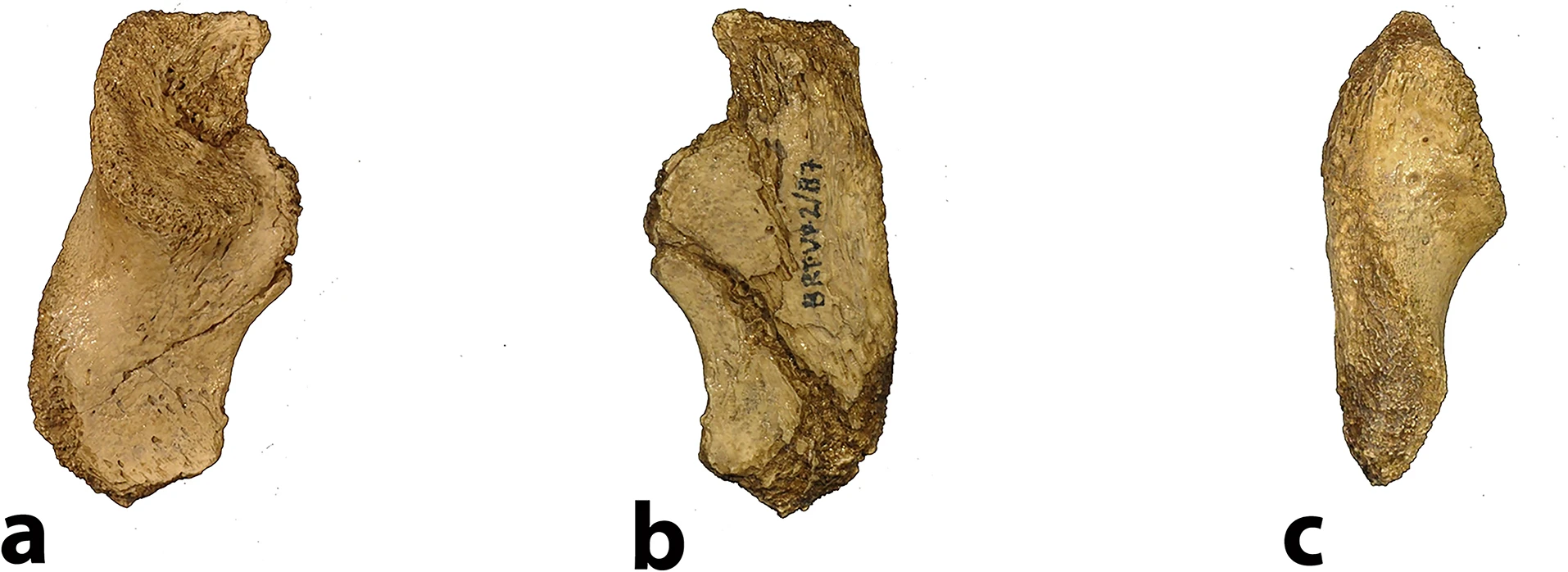
The Burtele fossils help reveal the diversity of early hominins like Australopithecus and the contexts out of which our own genus Homo evolved. What caught my attention hiding among this amazing assemblage was a fossil that only gets a quick mention in the paper—the ischium bone from the hip of a juvenile deyiremeda:

Extended Data Figure 7 from Haile-Selassie et al. (2025). The BRT-VP-2/87 juvenile ischium (from the right side of the body), depicted in side (a), middle (b), and back (c) views.

The fossil, given the catalog number BRT-VP-2/87, represents a different individual from the juvenile jaw mentioned above. It nevertheless provides a great deal of information despite being a small fragment (less than 2 inches long). The authors observe that the body of the ischium that extends beneath the hip joint is quite long, similar to modern apes, fossil Ardipithecus ramidus, and australopiths. This contrasts with the ischium of modern and fossil Homo in which the bone projects less beyond the hip socket:

Right juvenile ischium bones, scaled to similar size and oriented in similar positions. The black line on each depicts the distance from the hip socket margin to the top of the ischial tuberosity (left modified from Scheuer & Black, 2000 Fig. 10.15)

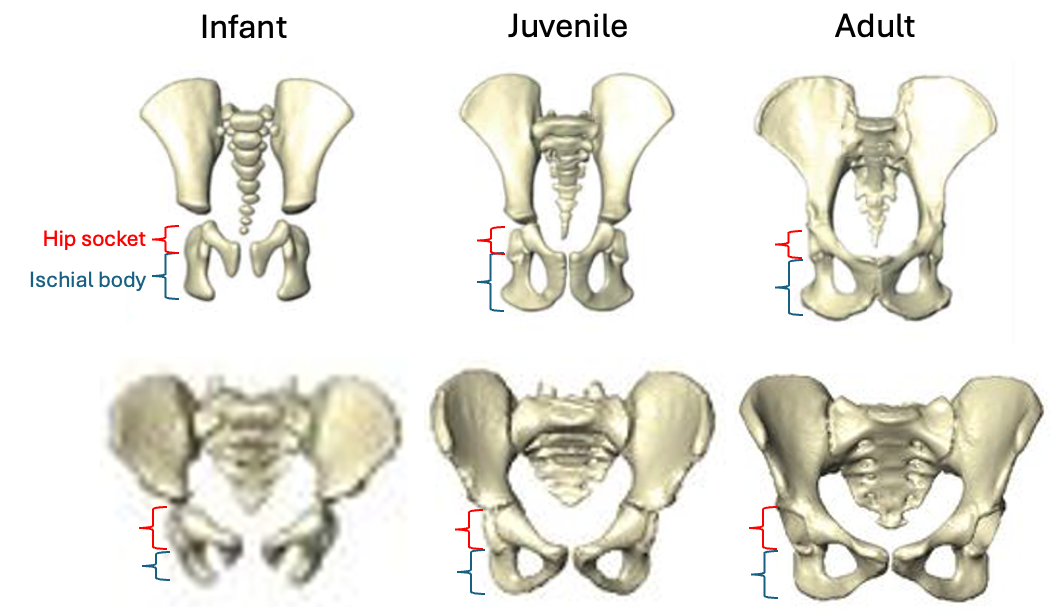
The bottom of the ischium is called the “ischial tuberosity,” and is the attachment surface for the hamstrings muscles. Having a long ischium provides the hamstrings of apes and other arboreal primates with more powerful hip extension—very useful when climbing trees but it also limits how far back the thigh can extend away from the body (Kozma et al., 2018). The shorter ischium of humans, Homo naledi, and other members of our genus may make our hamstrings a little less powerful, but it also helps us fully extend our legs which is crucial to our efficient bipedal walking and running.

Pelvis growth and development in chimpanzees (top row) and humans (bottom row), all scaled to a similar vertical height. Notice the differences in both the relative length of the ischium (blue bracket) and orientation of the ischial tuberosities between chimps and humans, consistent across the growth period. Images modified from Huseynov et al. (2016 and 2017).

Based on studies of modern humans and other primates, we know that this configuration of bones and muscles is established before birth, so we can be confident that adult Au. deyiremeda would have had a similar anatomy to BRT-VP-2/73, albeit at an unknown, larger size. A hip well adapted for climbing is consistent with the Burtele foot with a grasping big toe.

As Haile-Selassie and colleagues note in the online supplementary information accompanying the paper, only immature fossils allow us to reconstruct the evolution of growth and development. But one of the major challenges of studying immature remains is determining their age or state of maturation, which is critical for understanding how much change occurs between, say, infancy and adulthood. The authors of this study note that the qualitative appearance of the BRT-VP-2/73 hip socket surface is like that of modern humans around 6 years of age, yet the fossil is much smaller and more similar in size to 3 year-old humans. My colleagues and I (2022) faced a similar challenge when analyzing a juvenile Homo naledi hip, and we also relied on qualitative comparisons of how the joint “looks” at different stages of development.

But I think we’re at a point now where we can try to quantify some of these tricky developing surfaces to help place immature fossils more precisely along a timeline of development. For example, Peter Stamos & Tim Weaver (2020) adapted a method for quantifying the topography of teeth, to measure the complex curvature of the developing surface of the knee. If these quantitative methods can distinguish different phases of development in large samples of humans and other primates (e.g., Stamos et al., 2025), they could then be extended to the immature hominin fossil record.

Some cool insights could also be gained by applying older and established methods like landmark-based geometric morphometrics, even on quite fragmentary fossils. This approach could capture the development and orientation of the ischial tuberosity relative to the hip socket surface in fragments like BRT-VP-2/73, MLD 8, and Homo naledi fossils (depicted above) and compared with fossil adults. Researchers have also devised robust ways of quantifying size and shape changes during growth based on modern animals, and using these patterns to then ‘grow’ immature fossils to more developed states, for comparison with actual adult fossils (McNulty et al., 2006). Applying this approach to even just the small fossil sample of ischia described here could tell us a lot about how ancient animals moved at different periods in their lives. Someone just needs to park their ischial tuberosities in a chair and do it!

A growing fossil record of immature hominins, alongside technical advances in quantifying and comparing anatomy, mean that we are ready to learn much more about how our extinct ancestors and cousins grew into competent adults.