What do capuchin stone tools tell us about human evolution?

A month ago at ESHE and now online in Nature, Proffitt and colleagues describe stone-on-stone smashing behavior among wild bearded capuchin monkeys (Sapajus libidinosus). The online paper includes a great video documenting the action; here’s a screenshot:

screen-shot-2016-10-20-at-7-57-24-am

Holding the rock with both hands just above head-level, the monkey prepares to crush its enemies. Which in this case are another rock stuck in a pile of more rocks.

In the fairly rare cases where non-human primates use stones, it’s for smashing nuts or something. But when these capuchins see a stone they don’t just see a smasher, they see a world of possibilities* – why use a rock to break a rock, when you could use it to break a heart? So this group of capuchins is unique in part because they’ve been documented to use stones for many purposes.

Now why on earth a monkey would use one rock to break another rock is anyone’s guess. In human evolution, the purpose was to break off small, sharp flakes that could be used to butcher animals or work plants. Proffitt et al. did observe small flakes being removed when capuchins pounded rocks, but the monkeys showed little interest in this debitage, other than using it to continue smashing stuff. More curiously, the monkeys frequently lick the rock after hammering at it:

screen-shot-2016-10-20-at-7-56-44-am

Mmm, rocks.

Proffitt et al. venture that maybe these monkeys are doing this to ingest lichens or trace elements like silicon. This hypothesis merits further investigation, but what’s clear is that these monkeys’ lithics differ from the hominin archaeological record wherein the express purpose of breaking rocks is to make flakes.

What’s striking to me (pun intended) is the relative size of the rocks. These monkeys that weigh only 2-3 kg are lifting and smashing stones that weigh about half a kilogram on average. Because these stones are fairly large given the monkeys’ body size, they have to be lifted with two hands and brought down on a surface, a “passive hammer” technique. The earliest-known tools made by hominins, from the 3.3 million year old Lomekwi site in Kenya, are also pretty big. Weighing 3 kg on average but topping at 15 kg, these earliest tools would have required the same knapping technique as is used by these little monkeys (Harmand et al., 2015).

Picture1.png

Left: Cover of Nature vol. 521 (7552). Right: Bearded capuchin letting a pebble know who’s boss (link).

Why the big stuff at first? Did the earliest hominin tool-makers lack the dexterity to make tools from the smaller rocks comprising the later Oldowan industry? These creative capuchins could lead to predictions about the hand/arm skeleton of the Lomekwian tool-makers (testable, of course, only with fortuitous fossil discoveries). Capuchins are noted for their manual dexterity (Truppa et al., 2016) and have a similar thumb-index finger ratio to humans and early hominins (Feix et al. 2015), although they differ from humans in the insertion of the opponens muscle and resultant mobility of the thumb (Aversi-Ferreira et al., 2014). Maybe these tech-smart monkeys can tell us more about the earliest human tool-makers’ bodies than their brains.

ResearchBlogging.orgReferences

Aversi-Ferreira RA, Souto Maior R, Aziz A, Ziermann JM, Nishijo H, Tomaz C, Tavares MC, & Aversi-Ferreira TA (2014). Anatomical analysis of thumb opponency movement in the capuchin monkey (Sapajus sp). PloS one, 9 (2) PMID: 24498307

Feix T, Kivell TL, Pouydebat E, & Dollar AM (2015). Estimating thumb-index finger precision grip and manipulation potential in extant and fossil primates. Journal of the Royal Society, Interface, 12 (106) PMID: 25878134

Harmand S, Lewis JE, Feibel CS, Lepre CJ, Prat S, Lenoble A, Boës X, Quinn RL, Brenet M, Arroyo A, Taylor N, Clément S, Daver G, Brugal JP, Leakey L, Mortlock RA, Wright JD, Lokorodi S, Kirwa C, Kent DV, & Roche H (2015). 3.3-million-year-old stone tools from Lomekwi 3, West Turkana, Kenya. Nature, 521 (7552), 310-5 PMID: 25993961

Proffitt, T., Luncz, L., Falótico, T., Ottoni, E., de la Torre, I., & Haslam, M. (2016). Wild monkeys flake stone tools Nature DOI: 10.1038/nature20112

Truppa V, Spinozzi G, Laganà T, Piano Mortari E, & Sabbatini G (2016). Versatile grasping ability in power-grip actions by tufted capuchin monkeys (Sapajus spp.). American Journal of Physical Anthropology, 159 (1), 63-72 PMID: 26301957

*well, at least four uses given by Proffitt et al.: mating display, aggression, food-crushing, and digging.

Osteology Everywhere: Why we number our premolars 3-4

Portishead* came on the radio the other day, making iTunes display the cover of their album, Third. My inner osteologist rejoiced to see it prominently features a tooth!

Third album cover by Porthishead (2008). Image from Wikipedia

Well not a picture, but rather the name, of a tooth. In each quadrant of your mouth (most likely) are two premolars, commonly referred to as “bicuspids.” In the biz, we usually call these pals,  “P3” and “P4.”

UW 101-1277 mandible, part of the Homo naledi holotype skull. Modified from the Wits media gallery.

UW 101-1277 mandible, part of the Homo naledi holotype skull. Each capital letter stands for the tooth type (incisor, canine, premolar, and molar). Modified from Wits’ image gallery.

You might be wondering why we call them P3 and P4, when there are only two premolars per quadrant — what happened to P1 and P2?  Homology to the rescue!

The ancestral condition for (eutherian) mammals was to have four premolars (and a 3rd incisor) in each side of the jaw. This is a “dental formula” of 3-1-4-3, indicating the numbers of each tooth type from front to back. Over time, different groups of animals have lost some of these teeth. Baleen whales have lost all of them.

P1 and an incisor were lost early in the evolution of Primates. Most Strepsirrhines and Platyrrhine monkeys retain this ancestral “2-1-3-3″ dental formula :

Ring tailed lemur (left) and woolly monkey (right) maxillae, showing the primitive primate dental formula including a P2. For scale, gridlines are 10 mm (left) and 20 mm (right).

Ring tailed lemur (left) and woolly monkey (right) maxillae, showing the primitive primate dental formula including a P2. For scale, gridlines are 10 mm (left) and 20 mm (right). Images from the sadly defunct CT database from the Kyoto University Primate Research Institute.

The last common ancestor of catarrhines (living humans, apes and Catarrhine monkeys) lost the P2, and so we have only two premolars left in each side of the jaw. These are homologous with the third and fourth premolars of the earliest mammals. And that’s why we call them P3-4.

*The song was “The Rip.” It’s a very good song with an insanely creepy and trippy video:

Bioanthro lab activity: Primate proportions

My Intro to Bio Anthro course, focusing on human uniqueness, has moved from the brain to bipedalism. After the abysmally big brain, perhaps the most grotesque aspect of the human species is our wont to walk on two legs. It’s just not natural.

Image credit.

What a terrible biped. Image credit.

Seriously, why would an animal do such a horrid thing?

Image credit.

Most animals need extra help to stay upright on just two limbs. Image credit.

This peripatetic penchant is apparent in our skeletons, most visibly in our long-ass legs. And indeed, species’ limb lengths and proportions generally reflect how they tend to move around. Quadrupeds, animals that walk on four legs, tend to have roughly equally-lengthed arms and legs. Gibbons, notorious ricochetal brachiators, have insanely long arms. So for lab this week, students measured surface scans of different primates’ long bones to see if form really follows function.

Here, students try their hands at measuring long bones on surface scans of primate skeletons, and use their data to calculate indices reflecting the relative lengths of limb segments. These data will be used to test whether limb proportions can be used to distinguish different locomotor types, and to hypothesize how fossil species might have moved about.

Measuring siamang (Symphalangus syndactylus) limb lengths with Meshlab. Data credit.

Measuring siamang (Symphalangus syndactylus) limb lengths with Meshlab. Data credit.

Since this is my students’ introduction to primate skeletons and analysis software, I only had them measure three specimens: a siamang (above), a squirrel monkey, and a grivet.  But of course you can have students look at more if you wish. This activity uses the free Meshlab software  and surface scans made from CT scans in the KUPRI database (surface scans are much smaller files than CT scans, making for easier dissemination to swarms of students). If you’re interested in using or modifying this activity in your class, here are the lab handout and datasheet I created for it:

Lab 2-Primate proportions
Lab 2-Primate limb data sheet

Info about, and materials for, other lab activities can be found on my Teaching page.

Look inside bones for free on the interwebs

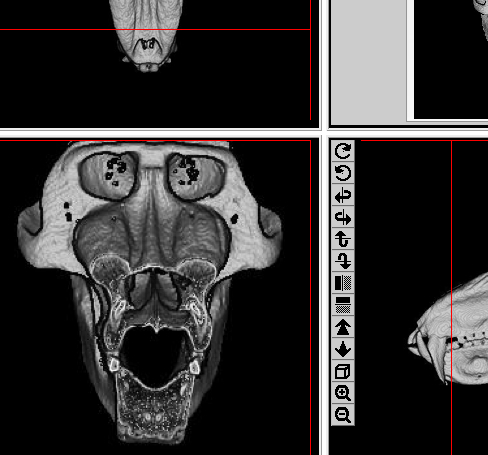
I forget how I stumbled upon this badass resource, but Kyoto University’s Primate Research Institute made a “Digital Morphology Museum: an awesome online database of CT scans of sundry primate skeletal parts. Ever wonder what an articulated siamang skeleton looks like? Or whether the flaring bony snout of a mandrill is hollow or filled with bone (below)? If you’re a normal person, probably not. But either way, this website provides easy access to the internal views of all sorts of body parts.

Coronal slice through a male mandrill face.  You can see a bone-filled lower jaw,  internal views of some teeth, the nasal cavity. The pics above and on the right give an idea of where in the skull we are. Note the fat flanks above the nasal cavity are filled with bone (they hollow out as you move further into the face).

What’s cool is you can view and manipulate 3D views of these things on the website, or you can register with KUPRI to download the raw CT data. Really a great resource.

A few weeks ago, a paper came out wherein researchers used CT scans to compare the the sides of the nasal opening in skulls of Australopithecus species (Villmoare and Kimbel 2011). They found that although the external nose of the South African Australopithecus africanus and A. robustus appear similar in looking like rounded “pillars,” on the inside these pillars differed between the two species. A. africanus‘s (and the earlier, east African A. afarensis‘s) nasal pillar was hollow, while A. robustus‘s was filled with “spongy” bone, like the contemporaneous A. boisei in East Africa. So the early (and “gracile”) australopiths had hollow pillars while the later (and “robust”) ones had a bony pillar, hmm… It’d be neat to try to see how such bone-filled or hollow pillars develop (i.e. are they hollow in babies but then fill with trabecular bone during growth in the “robust” group? Does this difference arise for functional (e.g. chewing) reasons, or could it be a developmental ‘byproduct’ of the tall robust australopithecine face [cf. McCollum 1999]).

It’s a neat study, and they include lots of great CT images of the hominid sample. But another question arises – what is the inside of the bony nose like in modern primates, and how much variation is there within a species? (NB Villmoare and Kimbel found pretty much no variation within each fossil species, save for two curious examples, but which were based on casts). If I had the time (i.e. weren’t dissertation-ating) I’d love to peruse the KUPRI files to see what “pillar” variation is like in, say, chimps (paleoanthropologists’ go-to referent species). Cursorily looking at just one (female chimpanzee, left), it looks like the sides of the nose are empty higher up, but then fill with bone to form the tooth socket surrounding the canine root. I’ll leave it to someone else to see what the rest look like.

But just lookit what other fun stuff you can see! At the top (anatomically toward the back) are the bone-filled mandibular condyles, beneath (anatomically a bit more toward the front) and between them are the pterygoid plates, and beneath them is a big gross maxillary sinus. Man, if only I had the time, I’d make an anatomy scavenger hunt on this site, and it’d be pretty epic.
ResearchBlogging.org


Those papers I mentioned
McCollum, M. (1999). The Robust Australopithecine Face: A Morphogenetic Perspective Science, 284 (5412), 301-305 DOI: 10.1126/science.284.5412.301

Villmoare, B., & Kimbel, W. (2011). CT-based study of internal structure of the anterior pillar in extinct hominins and its implications for the phylogeny of robust Australopithecus Proceedings of the National Academy of Sciences, 108 (39), 16200-16205 DOI: 10.1073/pnas.1105844108