Race is absolutely a human invention

Trump and his administration are actively dismantling our economy and democratic institutions. One of the most recent parts of this assault is an executive order issued last week, “Restoring Truth and Sanity to American History.” The title itself is Orwellian doublespeak since the order describes the rejection of truth and science, while it in fact aims to whitewash American history.

An entire section of the order is devoted to, “Saving our Smithsonian” Institution, the national complex of museums, education outreach programs, research facilities, and a large Zoo. The order singles out an exhibit at the American Art Museum because it, “promotes the view that race is not a biological reality but a social construct … ‘a human invention.'”

As noted in the New York Times, the exhibit displays many quotations from the Statement on Race & Racism published by the American Association of Biological Anthropologists a few years ago. The statement explains, “Humans are not divided biologically into distinct continental types or racial genetic clusters,” which I think gets at the fundamental misconception most Americans have about race. Whether uninformed or outright racist and malicious, many people conceive of race as an invisible, unchanging essence that determines an individual’s capacities and behaviors. In the olden days race was thought of as ancestral and ‘in the blood,’ but in the genomic age people began attributing racial essence to DNA. All of these biological data—from blood to whole genomes—for at least the past fifty fucking years have shown that, again, “Humans are not divided biologically into distinct continental types or racial genetic clusters.”

Now, some folks who call themselves “race realists” (you can’t spell “race realist” without “racist”) might point to scientific research about human genetic variation with graphs showing humans partitioned into statistically-inferred clusters corresponding roughly with geography. The problem that tends to arise from here is the over-interpretation this within-species variation. As Lewontin showed back in 1972, and subsequent studies have consistently confirmed with more and more data, the amount of genetic variation that distinguishes different populations is but a small proportion (less than 15%) of the overall variation within our species. What’s more, because this variation is scattered throughout all of our DNA, most of it should be “neutral” with regard to evolution, with little or no effect on how likely an individual is to survive or reproduce. Simply put, humans across the planet are more genetically similar than different, and the limited genetic differences between populations probably doesn’t really influence how they behave or what they are capable of. Even though geneticists have argued this for years, many Americans are still quick to over-interpret the biological significance of these minuscule genetic differences, often tragically so.

To the contrary, race as many people think of it today is a recent historical concept – a “Fatal Invention” as Dr. Dorothy Roberts explains in her 2012 book. This is the consensus among experts in both the natural and social sciences. Yet Trump’s executive order specifically rejects this well established knowledge that race is in fact “a human invention,” as the order quotes from the Smithsonian art exhibit. This is one of the many purposes of rejecting the science and claiming that race is a biological reality — it serves to naturalize social differences and social inequality. If you maintain that people’s qualities are genetically determined and that groups differ fundamentally in their inherited genetics, then you have justification for avoiding social interventions to racial (and other kinds of social) inequality. As Dr. Michael Blakey explained back in 1999, “Race is essentially a means of defining ethnic and social status groups as biological entities. … In a racist or White Supremacist society, such as the United States, this … will often become the basis for decisions about the allocation of social resources and the solutions to social problems.”

Trump and Musk are both known to harbor unscientific and racist views about genetics, and both have been associated with far right and often white supremacist groups. The recent executive order claims that by communicating the actual science of human variation and the history of racism in this country, the Smithsonian is “under the influence of a divisive, race-centered ideology.” But with this administration, every accusation is a confession. They are actively dismantling our institutions and efforts that aim to address and repair the damage from centuries of racism, in order to advance their own white supremacist agenda (see for example here, here, and here).

Osteology Everywhere: Skull in the Stone #FossilFriday edition

It’s that time of year again.

233313fc41ee3a63_tumblr_mgdqksndiz1ro7sbfo1_400-xxxlarge

It’s the end of the year and I’ve got Homo erectus on the brain somethin fierce. Our precedent-erect first popped up in Africa around 1.9 million years ago, quickly spread throughout much of the Old World, and persisted until perhaps as late as ~ 100,000 years ago in Java, Indonesia. This was a very successful species by all accounts, and as a result of its great range and duration, you can imagine it was also pretty variable.

screen-shot-2016-12-23-at-3-26-15-pm

Hominin brain sizes. Boxes and whiskers represent sample tendencies and points are individual specimens. 1 = Australopithecus, 2 = Early Homo (cf. habilisrudolfensis), 3 = Dmanisi H. erectus, 4 = Early African H. erectus, 5 = Early Indonesian H. erectus, 6 = Chinese H. erectus, 7 = Later Indonesian H. erectus, 8 = modern humans.

Despite this great variation, H. erectus skulls generally share a common visage: long and low cranial vault, low forehead, protruding brow ridges, fun tuberosities and tori in the back. You’d recognize them anywhere. Including the sidewalk!

20161220_202353.jpg

Homo erectus in front of Ploenchit Tower, Bangkok (lateral view, front is to the right).

The relief in this sidewalk slat superficially looks like a trace fossil of partial H. erectus cranium, the face either missing (from the lower right) or taphonomically displaced toward the left side of the tile (see here for actual H. erectus trace fossils). This looks really similar to H. erectus from Indonesia, not surprising given its discovery in Thailand. Why, it could have come straight out of Figure 6 from a 2006 paper by Yousuke Kaifu and colleagues:

Bangkok erectus.png

Left lateral views of Javanese H. erectus crania, modestly modified from Kaifu et al. (2006: Fig. 6). Front is to the left this time.

Using my insane photo editing skills, I’ve inserted the Ploenchit Tower trace fossil (reversed) within the horde of heads presented by Kaifu et al., above. Like many of the real fossils, the Ploenchit specimen is missing the face (due to taphonomy), the supraorbital torus or brow ridge juts out from a low-rising forehead, and the occipital bone also projects out about from the otherwise rounded contour of the cranium. Note that there is a good deal of variation in each of these features among the real fossils.

What a happy holiday accident to find a Homo erectus cranium on the street!

seinfeld-its-a-festivus-miracle

ResearchBlogging.org Reference
Kaifu Y, Aziz F, Indriati E, Jacob T, Kurniawan I, & Baba H (2008). Cranial morphology of Javanese Homo erectus: new evidence for continuous evolution, specialization, and terminal extinction. Journal of human evolution, 55 (4), 551-80 PMID: 18635247

eFfing #FossilFriday: Pleistocene ppl blowin up this week

This was a big week for Middle-Late Pleistocene fossil humans. Chun-Hsiang Chang and colleagues describe a mandible dredged up off the western coast of Taiwan, which they note in the title as, “The first archaic Homo” fossil known from the region. The geological context makes it difficult to date the specimen precisely, but authors argue it is probably younger than 190 thousand years old.

The Penghu mandible. Figure 3. From Chang et al.

In life, this individual was fully grown but appears never to have developed third molars (the “wisdom teeth”). Such “third molar agenesis” is relatively rare before modern times, but is also seen in the D2735 Homo erectus mandible from Dmanisi. I wouldn’t make much of this coincidence, but it does raise the question of whether the cause of agenesis, not uncommon today, was the same then as now.

Shortly after the announcement of the Penghu mandible, Israel Hershkovitz and colleagues presented a 55,000 year old brain case from Manot Cave in the Levant. The calvaria (fancy word for brain case) looks very similar to the skulls of the slightly younger “anatomically modern” humans of the Upper Paleolithic in Europe, albeit with a few Neandertal-like traits here and there (hey, just like many of the Upper Paleolithic humans).

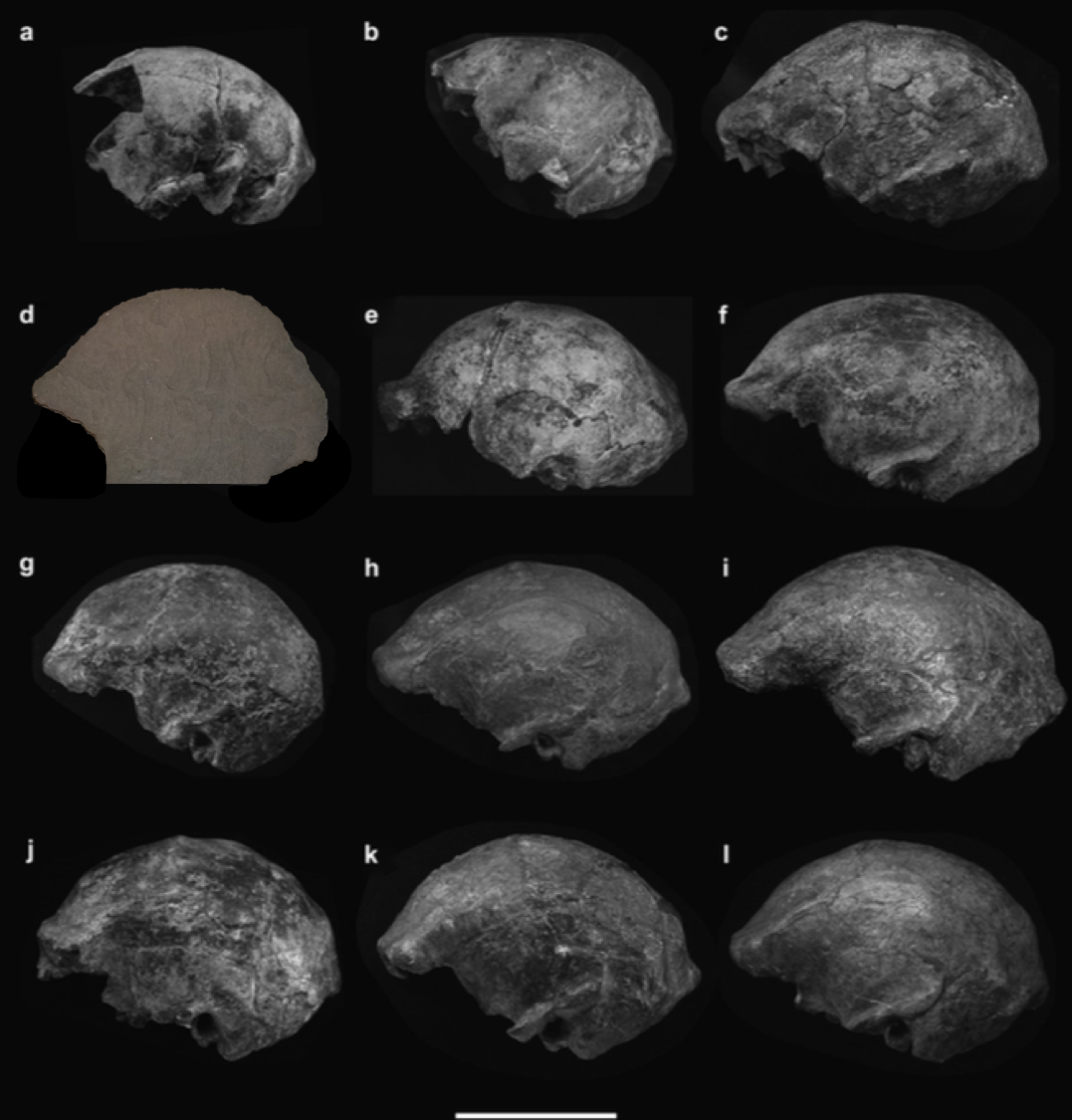
The Manot calvaria (Figure 2 from Hershkovitz et al.) The views are (a-d) from the top with front to the left; from the left; from the front; and from the back. Extra credit: In the top view (a), can you identify the features telling that the front is to the left?

The Manot calvaria (Figure 2 from Hershkovitz et al.) The views are (a-d) from the top with front to the left; from the left; from the front; and from the back. Extra credit: In the top view (a), can you identify the features telling that the front is to the left?

John Hawks has good posts dedicated to both Penghu and Manot. The upshot of these discoveries is that Middle and Late Pleistocene human population diversity, and the interactions between these populations, are probably much more complicated and interesting than the old model of ‘modern’ humans arising singly in Africa and replacing ‘archaic’ humans in different parts of the globe. With the technological advances and fossil discoveries of the past decade, the rather simple Replacement model has given way to a better appreciation of true complexity of human evolution toward the end of the Ice Age. Both of these new papers reflect this new perspective.

Along these lines, accompanying the Manot paper in Nature is an editorial, “Human history defies easy stories.” What caught my attention reading this (anonymous?) commentary is that it puts scientific interpretations of the past into a social and historical context. The author notes that the traditional story of modern humans arising, spreading and eradicating other groups of human has “imperialist framing, in which evolution and replacement can be justified after the fact as a kind of manifest destiny.” Science doesn’t occur in a vacuum, it’s done by people whose minds and creativities are molded in specific historical, economic and cultural contexts. This editorial comment makes one wonder how the human fossil record would have been interpreted, had most of it not discovered against the social backdrop of ruthless capitalism.

Another small Middle Pleistocene person

Last year I brought up the implications of the small female pelvis from Gona, Ethiopia for body size variation in Homo erectus (see previous post). This individual was much smaller than other Middle Pleistocene Homo fossils, indicating size variation comparable to highly sexually dimorphic gorillas and unlike recent human populations. Before this pelvis, most known Homo erectus fossils were fairly large (comparable to living people), with only a few hints of much smaller individuals (e.g., KNM-ER 427000, KNM-OL 45500). Now joining this petite party, this tiny troop, this little lot, this compact cadre, etc., is KNM-WT 51261, a 750,000 year old molar from Kenya (Maddux et al., in press).

Occlusal area for hominin first molars. The tooth is from Fig. 2 and the plot from Fig. 3 in the paper.

Occlusal area for first molars in the genus Homo. The tooth image is from Fig. 2 and the plot from Fig. 3 in Maddux et al. Lookit how tiny it is!

This ‘new’ specimen substantially increases the range of size variation among early African H. erectus molars, although the expanded range isn’t remarkable compared with later Homo samples such as from Zhoukoudian cave in China or Neandertals. What is different, though, is that most of the highly variable samples show a fairly continuous range of variation, while the WT 51261 molar is a considerable outlier from the rest of the African Middle Pleistocene sample (a lot like the situation with the Gona pelvis). So this tooth re-raises an important question: were smaller specimens like Gona and WT 51261 as rare in life as they are in the fossil record, or was such great size variation common in the Middle Pleistocene? How we reconstruct what kind of animal Homo erectus was differs depending on the answer to this question.

Variation: a blessing and a curse

Trying to start on finishing my dissertation, I’m thinking about the issue dental development and how it relates to skeletal growth. Specifically I’m trying to decide whether I want to analyze my human and Australopithecus robustus samples based on estimates of “dental age,” or if I want to be a bit more cavalier and divide the sample into rougher age categories.

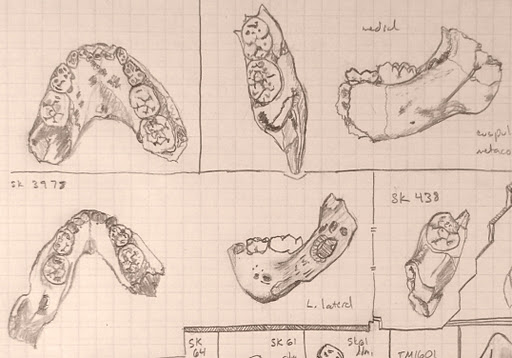
To avoid copyright issues, here’s a crappy picture I drew a few years ago, of the youngest A. robustus jaws. The youngest, “SK 438” is erupting its last baby tooth (bottom right), while the others have their full set of baby teeth, and none of them has its first adult tooth yet. I don’t think I can estimate ages accurately enough to capture the true chronological difference between SK 438 and the rest. Would I be better off just dividing the group into “younger” (SK 438) and “older” (the rest) infants, or even lumping them all together as simply “infants”?

On the one hand, I could assign individuals a chronological age based on a modern referent of known age, at similar stages of dental development. This could allow me to get more fine-scale glimpses into patterns of growth in my samples, but that’s assuming I’ve accurately estimated their ages. Individuals vary in the ages and sizes at which their teeth erupt; a person’s first molar, for example, may erupt at anywhere from 4-8 years of age. How can I estimate an individual’s age in light of such variation? And what if I’m as poor a judge of ages as Dennis Duffy?! Conceivably I could program my analysis to account for error estimation (which in itself could be educational and interesting, but is it worth the trouble?), but this would also add a further source of uncertainty. And it’s like Dwight Schrute said (Michael Scott said), “K-I-S-S: keep it simple, stupid. Great advice, hurts my feelings every time.”

On the other hand, I could divide my sample into coarse age categories – say, putting specimens who’ve attained a given level of dental development in the same group, such as ‘infant, child, juvenile, adolescent, and young adult.’ This method loses the temporal resolution of the first method, but also avoids the possible errors of assigning strict ages I’m pretty sure I would not infer accurately. But, tooth development does not show a clean 1-to-1 relationship with other systems in the body, such as hormonal axes or the bony skeleton. It’s uncertain how accurately kids can be put in any of the above categories (based on general life history variables; Bogin 1999) based on dental development.

Choices, choices.

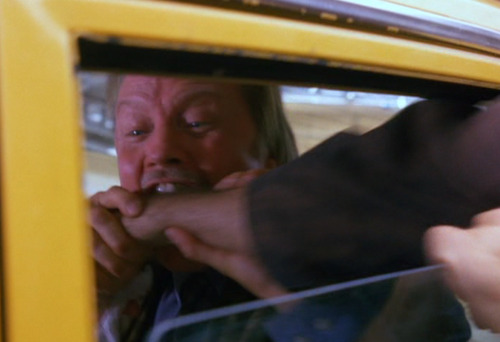
Variation is a problem for biologists. The theory of evolution was conceived as a way to explain the conundrum of why there is such remarkable variation in the forms of life that Earth is lucky to have harbored. The problem of within-species variation in the relative timing of skeletal and dental development isn’t just a bug-bear for paleoanthropologists. It’s important to medical doctors and pathologists investigating genetically-based developmental disorders, and to epidemiologists looking at aspects of population health, such as the prevalence of growth stunting. It’s also important for forensics specialists who need to use biological clues about the age and identity of crime victims and defendants. I mean, how else would we know whether Jon Voight bit both Kramer and this pencil?

The silver lining, I suppose, on this storm-cloud of biological of variation is that without variation there cannot be evolution. And stasis is boring. If nothing changed since the Cambrian, none of us would be here today. We’d probably be some gross stupid monstrous thing, like this Hallucigenia to the right. It’s the quirks and weird variants that arise randomly, that make evolution possible. If individuals all developed exactly the same, then all organisms through all time would be the exact same, and probably all would have gone extinct as they succumbed to some sinister fate, no new variants would have arisen that may have been able to survive the devastation.

ResearchBlogging.org
So variation is a blessing and a curse. Individual and population variation make it difficult to state norms such as what is “average” or “healthy,” and nothing to be concerned about. Variation is also the magic ingredient of adaptation, without which Life could not survive the randomness inherent in any environment.

Things I cited
Bogin, B. (1999). Evolutionary perspective on human growth Annual Review of Anthropology, 28 (1), 109-153 DOI: 10.1146/annurev.anthro.28.1.109

Also 30 Rock, The Office and Seinfeld. Well done, NBC.