#FossilFriday: Handy habilis’ formidable forearms

Homo habilis just got some long arms to go along with its dexterous hands. In a recent paper in the journal The Anatomical Record, Fred Grine and colleagues describe and analyze some spectacular fossils recovered near the town of Ileret in Kenya, dating to just over 2 million years ago. There were a few different kinds of human-like species inhabiting the planet around this time, but researchers were able to assign these bones to Homo habilis thanks to some chemical clues connecting them to a nearly complete set of teeth found a few meters away. This partial skeleton of a young adult individual is an incredible discovery, connected by clever scientific sleuthing, and provides important information about an early member of the human lineage.

You can see some great photos of these fossils (as well as a fantastic fossil foot of a different individual) in a 2015 press release from the Turkana Basin Institute. A more recent announcement from the Institut Català Paleontologia includes a photo showing the late great Bill Jungers and fossil maven Meave Leakey with the fossils, which helps show the actual size of the bones.

Ann Gibbons’ article about the discovery has a great quote from paleoanthropologist Stephanie Melillo (who discovered the Burtele foot fossil): “If you dressed up a Homo habilis individual in clothes and you saw her walking in the distance, would you do a double take? This study shows us that the answer is YES!”

Still from a scent of the 1982 movie ET, showing the eponymous ET wearing a wig, dress, bowler hat, shawl, jewelry
Artist’s depiction of Homo habilis dressed up in clothes and you see her walking in the distance (image source)

The reason we might react to seeing Homo habilis like Gertie glimpsing E.T., as this skeleton shows, is that this early human had longer arms (especially forearms) than most of us do today. Thickness of the bones also shows that they were probably quite strong as a result of experiencing lots of force from use during life. Long and strong hominin arms are typically interpreted as evidence that these ancient ancestors spent a good deal of time climbing trees.

These features have previously been documented in some of the few other partial skeletons attributed to Homo habilis, as Grine and colleagues note. Indeed, the new article does a deep dive into what is known (and unknown) about the bones and body of Homo habilis, and it also provides a thoughtful review of recent research cautioning against over-interpreting climbing behaviors from fossil remains.

For more fossil fun, the article’s supporting online material includes “3D manipulative files” of the original specimens, so anyone can have a look at the bones in 3D using Microsoft Word:

Two-panels showing a Microsoft Word window (left panel) with a 3D model of a fossil, beneath which is written "SOM Figure 9. 3D manipulative file of shaft of right acetabulum"; and an internet browser screenshot (right panel) depicting the "Supporting Information" section from this website: https://anatomypubs.onlinelibrary.wiley.com/doi/full/10.1002/ar.70100

Osteology Everywhere: Skull in the Stone #FossilFriday edition

It’s that time of year again.

233313fc41ee3a63_tumblr_mgdqksndiz1ro7sbfo1_400-xxxlarge

It’s the end of the year and I’ve got Homo erectus on the brain somethin fierce. Our precedent-erect first popped up in Africa around 1.9 million years ago, quickly spread throughout much of the Old World, and persisted until perhaps as late as ~ 100,000 years ago in Java, Indonesia. This was a very successful species by all accounts, and as a result of its great range and duration, you can imagine it was also pretty variable.

screen-shot-2016-12-23-at-3-26-15-pm

Hominin brain sizes. Boxes and whiskers represent sample tendencies and points are individual specimens. 1 = Australopithecus, 2 = Early Homo (cf. habilisrudolfensis), 3 = Dmanisi H. erectus, 4 = Early African H. erectus, 5 = Early Indonesian H. erectus, 6 = Chinese H. erectus, 7 = Later Indonesian H. erectus, 8 = modern humans.

Despite this great variation, H. erectus skulls generally share a common visage: long and low cranial vault, low forehead, protruding brow ridges, fun tuberosities and tori in the back. You’d recognize them anywhere. Including the sidewalk!

20161220_202353.jpg

Homo erectus in front of Ploenchit Tower, Bangkok (lateral view, front is to the right).

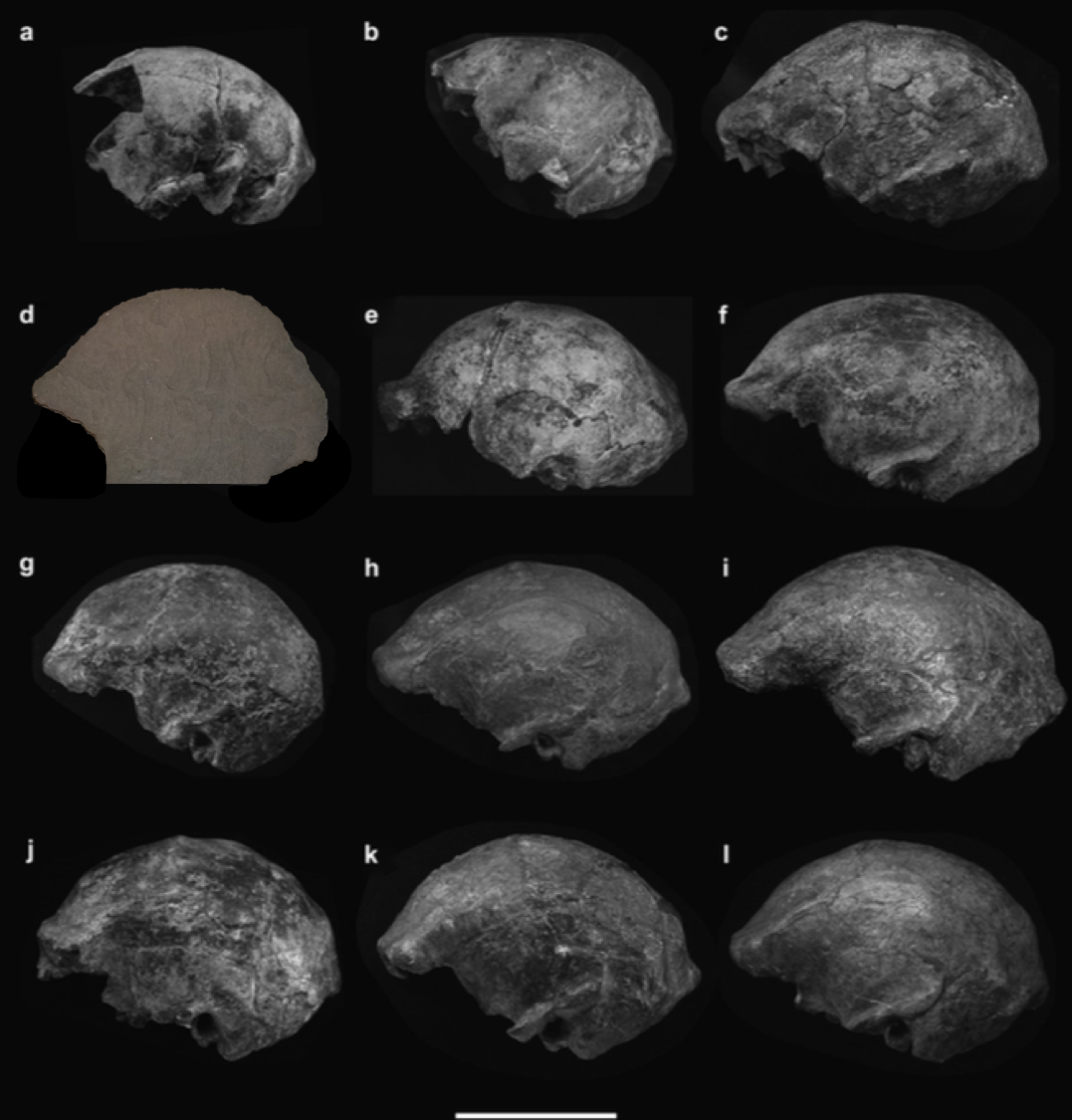
The relief in this sidewalk slat superficially looks like a trace fossil of partial H. erectus cranium, the face either missing (from the lower right) or taphonomically displaced toward the left side of the tile (see here for actual H. erectus trace fossils). This looks really similar to H. erectus from Indonesia, not surprising given its discovery in Thailand. Why, it could have come straight out of Figure 6 from a 2006 paper by Yousuke Kaifu and colleagues:

Bangkok erectus.png

Left lateral views of Javanese H. erectus crania, modestly modified from Kaifu et al. (2006: Fig. 6). Front is to the left this time.

Using my insane photo editing skills, I’ve inserted the Ploenchit Tower trace fossil (reversed) within the horde of heads presented by Kaifu et al., above. Like many of the real fossils, the Ploenchit specimen is missing the face (due to taphonomy), the supraorbital torus or brow ridge juts out from a low-rising forehead, and the occipital bone also projects out about from the otherwise rounded contour of the cranium. Note that there is a good deal of variation in each of these features among the real fossils.

What a happy holiday accident to find a Homo erectus cranium on the street!

seinfeld-its-a-festivus-miracle

ResearchBlogging.org Reference
Kaifu Y, Aziz F, Indriati E, Jacob T, Kurniawan I, & Baba H (2008). Cranial morphology of Javanese Homo erectus: new evidence for continuous evolution, specialization, and terminal extinction. Journal of human evolution, 55 (4), 551-80 PMID: 18635247

eFfing #FossilFriday: Rekindling an old friend’s hip

Sorry for the crappy pun. Carol Ward and colleagues recently reported an associated hip joint, KNM-ER 5881, attributable to the genus Homo (1.9 million years old). Fossils coming from the same skeleton are pretty rare, but what’s more remarkable is that portions of this bone were discovered 29 years apart: a femur fragment was first found in 1980, and more of the femur and part of the ilium were found at the same location when scientists returned in 2009:

Figure 3 from Ward et al. 2015.

Figure 3 from Ward et al. 2015. A little distal to the hip, yes, but the pun still works. Views are, going clockwise starting at the top the top left, from above, from below, from the back, from the side, and from the front.

There’s also a partial ilium associated with the femur – that makes a pretty complete hip!

Figure 5 from Ward et al. shows the fossil. Jump for joy that it's complete enough for us to tell it comes from the left side!

Figure 5 from Ward et al. shows the fossil. Jump for joy that it’s complete enough for us to tell it comes from the left side!

Despite how fragmentary the femur and ilium are, the researchers were able to estimate the diameter of the femur head and hip socket reliably. The hip joints are smaller than all Early Pleistocene Homo except for the Gona pelvis. Comparing ER 5881 the large contemporaneous KNM-ER 3228 hip bone, the authors found these two specimens to be more different in size than is usually seen between sexes of many primate species. The size difference best matches male-female differences in highly dimorphic species like gorillas.

Ward et al. find that the specimen generally looks like early Homo but that the inferred shape of the pelvic inlet is a little different from all other Early and Middle Pleistocene human fossils. The authors take this discrepancy to suggest that there was more than one “morphotype” (‘kind of shape’), and therefore possibly species, of Homo around 1.9 million years ago. While I wouldn’t just yet go so far as to say this anatomy is due to species differences, I do agree that KNM ER 5881 helps our understanding and appreciation of anatomical variation in our early ancestors. Like all great fossil discoveries, the more we find, the more we learn that we don’t know. Here’s to more Homo hips in the near future!