eFfing #FossilFriday: Pleistocene ppl blowin up this week

This was a big week for Middle-Late Pleistocene fossil humans. Chun-Hsiang Chang and colleagues describe a mandible dredged up off the western coast of Taiwan, which they note in the title as, “The first archaic Homo” fossil known from the region. The geological context makes it difficult to date the specimen precisely, but authors argue it is probably younger than 190 thousand years old.

The Penghu mandible. Figure 3. From Chang et al.

In life, this individual was fully grown but appears never to have developed third molars (the “wisdom teeth”). Such “third molar agenesis” is relatively rare before modern times, but is also seen in the D2735 Homo erectus mandible from Dmanisi. I wouldn’t make much of this coincidence, but it does raise the question of whether the cause of agenesis, not uncommon today, was the same then as now.

Shortly after the announcement of the Penghu mandible, Israel Hershkovitz and colleagues presented a 55,000 year old brain case from Manot Cave in the Levant. The calvaria (fancy word for brain case) looks very similar to the skulls of the slightly younger “anatomically modern” humans of the Upper Paleolithic in Europe, albeit with a few Neandertal-like traits here and there (hey, just like many of the Upper Paleolithic humans).

The Manot calvaria (Figure 2 from Hershkovitz et al.) The views are (a-d) from the top with front to the left; from the left; from the front; and from the back. Extra credit: In the top view (a), can you identify the features telling that the front is to the left?

The Manot calvaria (Figure 2 from Hershkovitz et al.) The views are (a-d) from the top with front to the left; from the left; from the front; and from the back. Extra credit: In the top view (a), can you identify the features telling that the front is to the left?

John Hawks has good posts dedicated to both Penghu and Manot. The upshot of these discoveries is that Middle and Late Pleistocene human population diversity, and the interactions between these populations, are probably much more complicated and interesting than the old model of ‘modern’ humans arising singly in Africa and replacing ‘archaic’ humans in different parts of the globe. With the technological advances and fossil discoveries of the past decade, the rather simple Replacement model has given way to a better appreciation of true complexity of human evolution toward the end of the Ice Age. Both of these new papers reflect this new perspective.

Along these lines, accompanying the Manot paper in Nature is an editorial, “Human history defies easy stories.” What caught my attention reading this (anonymous?) commentary is that it puts scientific interpretations of the past into a social and historical context. The author notes that the traditional story of modern humans arising, spreading and eradicating other groups of human has “imperialist framing, in which evolution and replacement can be justified after the fact as a kind of manifest destiny.” Science doesn’t occur in a vacuum, it’s done by people whose minds and creativities are molded in specific historical, economic and cultural contexts. This editorial comment makes one wonder how the human fossil record would have been interpreted, had most of it not discovered against the social backdrop of ruthless capitalism.

eFfing #FossilFriday: toolmakers without tools?

Matt Skinner and colleagues report in today’s Science an analysis of trabecular bone structure in the hand bones of humans, fossil hominins and living apes. Trabecular bone, the sponge-like network of bony lattices on the insides of many of your bones, adapts during life to better withstand the directions and amounts of force it experiences. This is a pretty great property of the skeleton: bone is organized in a way that helps withstand usual forces, and the spongy organization of trabeculae also keeps bones fairly lightweight. Win-win.

An X-ray of my foot. Note that most of the individual foot bones are filled with tiny 'spicules' (=trabeculae) of bone. Very often they have a very directed, or non-random, orientation, such as in the heel.

An X-ray of my foot. The individual foot bones are filled with narrow spicules (=trabeculae) of bone. Very often they have a directed, or non-random, orientation: in the calcaneus, for instance, they are oriented mostly from the heel to the ankle joint.

This adaptive nature of trabecular bone also means that we can learn a lot about how animals lived in the past when all they’ve left behind are scattered fossils. In the present case, Skinner and colleagues tested whether tool use leaves a ‘trabecular signature’ in hand bones, looking then for whether fossil hominins fit this signature. Their study design is beautifully simple but profoundly insightful: First, they compared humans and apes to see if the internal structure of their hand bones can be distinguished. Second, they tested whether these differences accord with theoretical predictions based on how these animals use their hands (humans manipulate objects, apes use hands for walking and climbing). Third, they determined whether fossil hand bones look more like either group.

Comparison of first metacarpals (the thumb bone in your palm) between a chimpanzee (left), three australopithecines, and a human (right). In each, the palm side is to the left and the wrist end of the bone (proximal) is down. Image by Tracy Kivell, and found here.

Looking at the image above, it’s difficult to spot trabecular differences between the specimens with the naked eye. But computer software can easily measure the density and distribution of trabecular bone from CT scans. With these tools, researchers found key differences between humans and apes consistent with the different ways they use their hands. Neandertals (humans in the past 100 thousand years or so) showed the human pattern, not unexpected since their bones look like ours and they used their hands to make tools and manipulate objects like we do.

What’s more interesting, though, is that the australopithecines, dating to between 1.8-3.0 million years ago, also show the human pattern. This is an important finding since the external anatomy of Australopithecus hand bones shows a mixture of human- and ape-like features, with unclear implications for how they used their hands. Their trabecular architecture, reflecting the forces their hands experienced in life, is consistent with tool use.

This is a very significant finding. Australopithecus africanus fossils from Sterkfontein aren’t associated with any stone tools; bone tools are known from Swartkrans, though it is unclear whether Australopithecus robustus or Early Homo from the site made/used these. In addition, in 2010 McPherron and colleagues reported on a possibly cut-marked animal bone from the 3.4 million year old site of Dikika in Ethiopia, where Australopithecus afarensis fossils but no tools are found. Skinner and colleagues’ results show that at the very least, South African Australopithecus species were using their hands like tool-makers and -users do.

This raises many fascinating questions – were australopithecines using stone tools, but we haven’t found them? Were they using tools made of other materials? What do the insides of Australopithecus afarensis metacarpals look like? What I like about this study is that it presents both compelling results, and raises further (testable) questions about both the nature of the earliest tools and our ability to detect their use from fossils.

Osteology everywhere: Graffiti

Astana, the wedding-cake capital of Kazakhstan, is notably bereft of graffiti and street art, at least in my somewhat limited exposure to the city. The larval metropolis is all about commercial appearance, so I’d guess that aspiring street artists likely face much more than the Marge Simpson treatment for turning around to brag about their work.

Dire consequences await those who graffito tag public property.

Dire consequences await those who graffito tag public property.

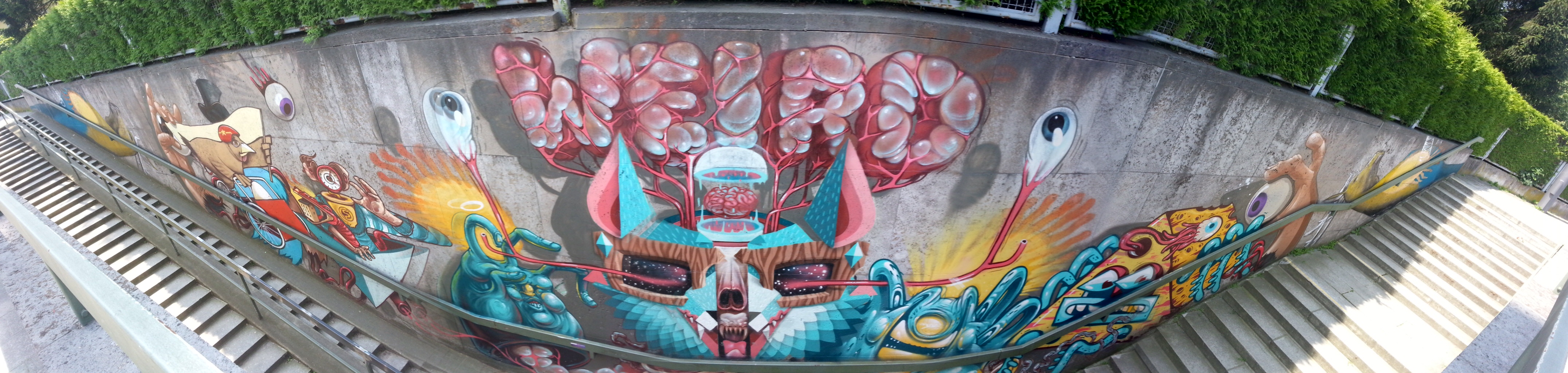
Once, I did see a pretty badass street mural,

But it was in München.

but it was in München, a mere 2,620 miles from Astana.

No, there is not much in the way of secretly donated street art here in Astana, and there’s generally little hope to see graffiti-grafted Osteology Everywhere. But this weekend, I noticed these four magical letters, quickly quietly scrawled on the side of my apartment building:

2015-01-17 14.34.37

DAKA.

Two disconcerting thoughts immediately come to mind reading this. First, why the hell is “DAKA” written in Latin instead of Cyrillic script characteristic of the FSU? Second, what does “DAKA” mean out here? Nothing in Russian so far as I know, but Google Translate claims it could mean “Dakar” in Kazakh, which if true raises even more questions.

No, the safest assumption is that this tagger, my streetwise and marker-wielding dopplegänger, was referring to the ~1 million year old Homo erectus partial skull from Ethiopia, dubbed “Daka” after the Dakanihylo site of its discovery.

The Daka calvaria (Figure 2. of Asfaw et al., 2002). Counterclockwise from the top left: view from the back, view from the top (front is to the left), view from the left, a mosquito net, view from the bottom (front is at the top), viewed from the front.

BOU-VP-2/66, the Daka calvaria* (Figure 2. of Asfaw et al., 2002). Counterclockwise from the top left: view from the back, view from the top (front is to the left), view from the left, a mosquito net, view from the bottom (front is at the top), and view from the front. *Calvaria is the fancy word for ‘bony skull without a face.’

Daka isn’t the first hominin fossil to be embraced outside of anthropology. A few years ago I noticed the 4.4 million year old Ardipithecus ramidus skeleton strutting across the label of a Dogfish Head beer bottle:

2011-11-12_14-41-32_247

GOODGRIEF, this was almost 5 years ago.

In downtown Tbilisi, Georgia I recently spotted a Dmanisi-based duo whose tech savvy belies the fact they’re based on 1.8 million year old fossils:

20141013_141725

(Let’s not forget this one, from before they got smartphones)

We’ll have to do some serious fossil-finding here in Kazakhstan before they’ll let anyone put up something this awesome on the side of anything here in Astana. (Or wait…)

eFfing #FossilFriday: Subfossil lemurs

Hard to resist the headline, “Enormous underwater fossil graveyard found,” from the National Science Foundation. The NSF posts a video detailing the discovery of an underwater cave system containing “hundreds of potentially 1,000-year-old [lemur] skeletons…” in Madagascar. As a paleontologist, hearing about the discovery large numbers of ancient skeletons is musical, like hearing Love This Giant or the new T Swift for the first time.

Two lemur crania in an underwater cave on Madagascar. Photo from nbcnews.com.

Two lemur crania in an underwater cave on Madagascar. Photo from nbcnews.com.

It’s a pretty remarkable discovery – hundreds if not thousands of bones representing many complete skeletons of various extinct lemur species. And toward the end of the clip is a skull of a pretty badass looking big cat. The video shows piles of loose bones dredged up from the cave. These will reveal lots of information about the biology of these recently extinct animals, especially if researchers can keep associated bones together.

So what are these animals? Lemurs are one of the most primitive living types of primates – although they are relatively closely related to us humans, they retain many characteristics of ancestral mammals. I know it’s hard to believe this aye-aye here is more closely related to you than to rodents, but it is:

An aye-aye (Daubentonia madagascarensis) using its narrow and elongated middle finger to fish for for grubs inside a tree that it’s opened up with its teeth.

Lemurs are found only on the island of Madagascar, and over the past several millions of years they have diversified into the roughly 100 species inhabiting the island today. But even just a few thousand years ago, there were more kinds of lemurs. This includes Megaladapis, the large-bodied “koala lemur,” and Hadropithecus, whose skull bears a striking resemblance to the extinct hominin Australopithecus boisei. As  Laurie Godfrey says in the video, “two thirds of the animals that lived there only a thousand years ago are gone.” Humans are probably largely responsible for the extinction of many Malagasy lemurs in both the past and especially the present.

Much of the ‘fossil’ record for lemurs is recent by fossil standards, and so most specimens haven’t become fully fossilized. As a result, lemur paleontology is besprinkled with the term “subfossil,” indicating bones that are really old and belong to extinct animals, but don’t fit the technical definition of fossils. The lemur subfossil record has taught us a lot about the evolutionary history, adaptations, and recently even genetics of this primitive group of primates, as well as about the ecological history of Madagascar. It will be very interesting to see what new insights will come from the recently discovered scores of underwater skeletons.

OH NO IT’S HADROPITHECUS

(Figure 3 from Ryan et al., 2008. Scale bar is 1 cm)

Another small Middle Pleistocene person

Last year I brought up the implications of the small female pelvis from Gona, Ethiopia for body size variation in Homo erectus (see previous post). This individual was much smaller than other Middle Pleistocene Homo fossils, indicating size variation comparable to highly sexually dimorphic gorillas and unlike recent human populations. Before this pelvis, most known Homo erectus fossils were fairly large (comparable to living people), with only a few hints of much smaller individuals (e.g., KNM-ER 427000, KNM-OL 45500). Now joining this petite party, this tiny troop, this little lot, this compact cadre, etc., is KNM-WT 51261, a 750,000 year old molar from Kenya (Maddux et al., in press).

Occlusal area for hominin first molars. The tooth is from Fig. 2 and the plot from Fig. 3 in the paper.

Occlusal area for first molars in the genus Homo. The tooth image is from Fig. 2 and the plot from Fig. 3 in Maddux et al. Lookit how tiny it is!

This ‘new’ specimen substantially increases the range of size variation among early African H. erectus molars, although the expanded range isn’t remarkable compared with later Homo samples such as from Zhoukoudian cave in China or Neandertals. What is different, though, is that most of the highly variable samples show a fairly continuous range of variation, while the WT 51261 molar is a considerable outlier from the rest of the African Middle Pleistocene sample (a lot like the situation with the Gona pelvis). So this tooth re-raises an important question: were smaller specimens like Gona and WT 51261 as rare in life as they are in the fossil record, or was such great size variation common in the Middle Pleistocene? How we reconstruct what kind of animal Homo erectus was differs depending on the answer to this question.