Quick thought on the Australopithecus deyiremeda maxilla

It will be lots of work to prep my Human Evolution course for the Fall. This past year has seen many major fossil discoveries, and adding to the list is the newly described species Australopithecus deyiremeda (Haile-Selassie et al., 2015). The fossils come from newly announced sites in Ethiopia (here it is on a map!), dating to around 3.4 million years ago. These new fossils are contemporaneous with Australopithecus afarensis, fossils attributed to Kenyanthropus platyops, and whatever the hell the Burtele foot belongs to.

The main specimens are a fairly complete half of a maxilla (upper jaw) and two decent mandibles (lower jaw bones). These fossils do not belong to the same individual (despite all the media pictures of the upper and lower jaws together). One of the most distinctive features of these fossils is how thick, both in absolute and relative terms, the mandibles are, especially given how short they are. What sticks out to me though, is that the upper jaw looks like it might have still had some growing to do. Why on earth would I think so? (The following is based off pictures from the publications, so I could be wrong!)

Extended Figure 1a from the paper. The type specimnen BRT-VP-3/1 maxilla. Front is to the left.

Extended Figure 1a from the paper, the type specimnen BRT-VP-3/1 maxilla viewed from the left side. I’ve added the M2 label for your reading pleasure.

The holotype maxilla (BRT-VP-3/1) is described as coming from a “young adult” in the Supplementary Information. However, it looks like the second molar tooth (M2) is not quite fully erupted and in occlusion, although this could be due to the natural arc of the tooth row. There is no visible wear on the tooth in the pictures, and indeed the Supplementary Information says the tooth is unworn. This means that the tooth is only recently emerged, and may not have passed the gum line, and therefore hasn’t seen much/any use yet. Authors note in the Supplementary Information that there is no M3 (a.k.a. “wisdom tooth”) wear facet on the back of M2 , meaning the last tooth hadn’t yet emerged yet either. So, this all points to a non-adult age by tooth eruption standards.

Extended Figure 1d from the paper. Same fossil, but from the bottom, like a dentist peering into its mouth. Back is to the bottom.

Extended Figure 1d from the paper. Same fossil, but from the bottom; pretend you’re a dentist peering into its mouth. Back is to the bottom.

In addition, the M2 roots don’t look fully formed. This is especially apparent in Extended Figure 1h, a CT section through the teeth:

Extended Figure 1h from the paper, with a Demirjian developmental stages, modifed from Table 2 from Kuykendall et al., 1996. Compare the M2 roots with  completed roots of the M1 (to the left).

Left side: Extended Figure 1h from the paper. From left to right, the teeth are P3, P4, M1, and M2. For comparison, to the right are Demirjian tooth development stages, modified from Table 2 of Kuykendall, 1996. Also compare the M2 roots with completed roots of the M1.


In many human populations, this stage of M2 development is reached (on average) between 11-13 years (Liversidge et al., 2006). In the wild Taï Forest chimpanzee sample, two individuals with M2 root completely formed (Stage H) are 10 and 11 years old (Smith et al., 2010). These apes would not be fully mature and their facial dimensions would likely have increased had they reached adulthood (Zihlman et al., 2007).

So what this suggests to me is that this maxilla may not accurately represent adult anatomy in this newly described species. In humans, the face continues to grow downwards from adolescence into adulthood, and in apes the face continues growing both forward and downward. In the differential diagnosis of A. deyiremeda, Haile-Selassie and team state, in layman’s terms, that the cheeks are positioned more toward the front than in A. afarensis, and that the front of the face doesn’t stick out as much as in A. garhi. If this specimen was not fully grown, it is likely that the true adult anatomy would have had a face that sticks out more and has less forward-positioned cheeks than in this specimen.

But, this is all speculative, and I’d like to reiterate that these observations of dental development are based only on the published pictures. Just a thought!

The stream-severed spine

I recently returned from Mangystau, a geologically captivating former seabed in West Kazakhstan. Places like this, or the Tien Shan mountains in the South and Altai mountains in the East, always make me wonder why anyone would decide to build a capital city in the wastes of Aqmola. Astana sprouts up from a sterile steppe, sparingly sprinkled with streams and lakes. Out west, though, are breathtaking landscapes and landforms, such as the giant rocky spheres of Torysh:

Traversing the

Traversing the “Valley of Balls.” It is not yet known what caused these rock formations.

Sherqala (“Lion City”), a rocky uplift that centuries ago hosted a defensive acropolis:

DSC01089

A flooded salt flat vertiginously reflecting an alternate reality:

DSC01226
A pile of earth that’s really an octopus waiting in ambush:

DSC01315

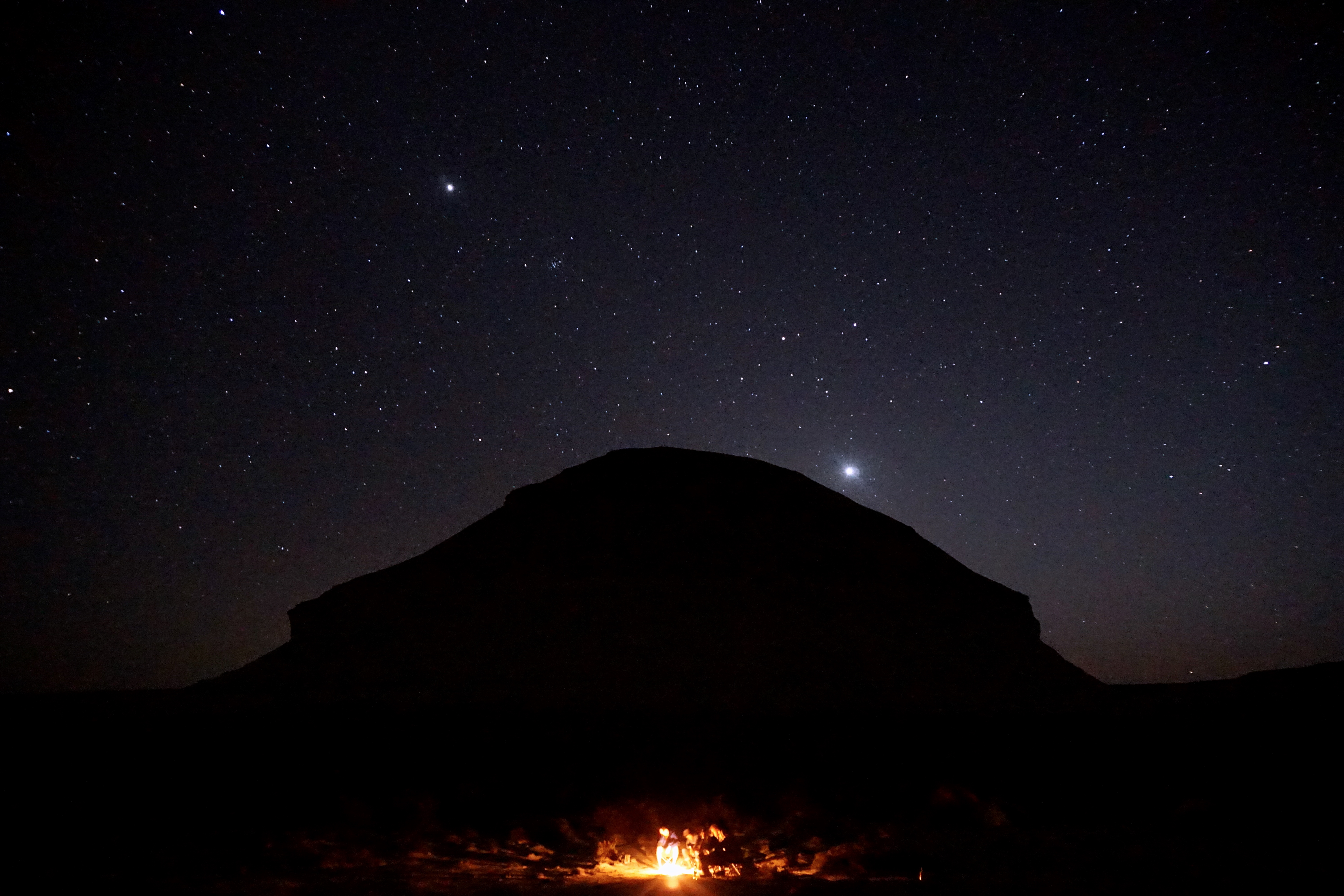
The perfect place to set up camp.

DSC01400

As I’d pointed out the first time I came out here last year, this rocky terrain is littered with lifeless remnants of the animals that used to call this place home. So many bones reflecting such biodiversity, just lying on the surface. This year, though, I found a subsurface skeleton, teaching an important lesson in taphonomy. Taphonomy (“burial law” from Ancient Greek) is the study of what happens to an animal’s remains from the moment it dies to when it is discovered eons later. This field examines geological and ecological processes that determine whether fossils are found intact or smashed to smithereens.

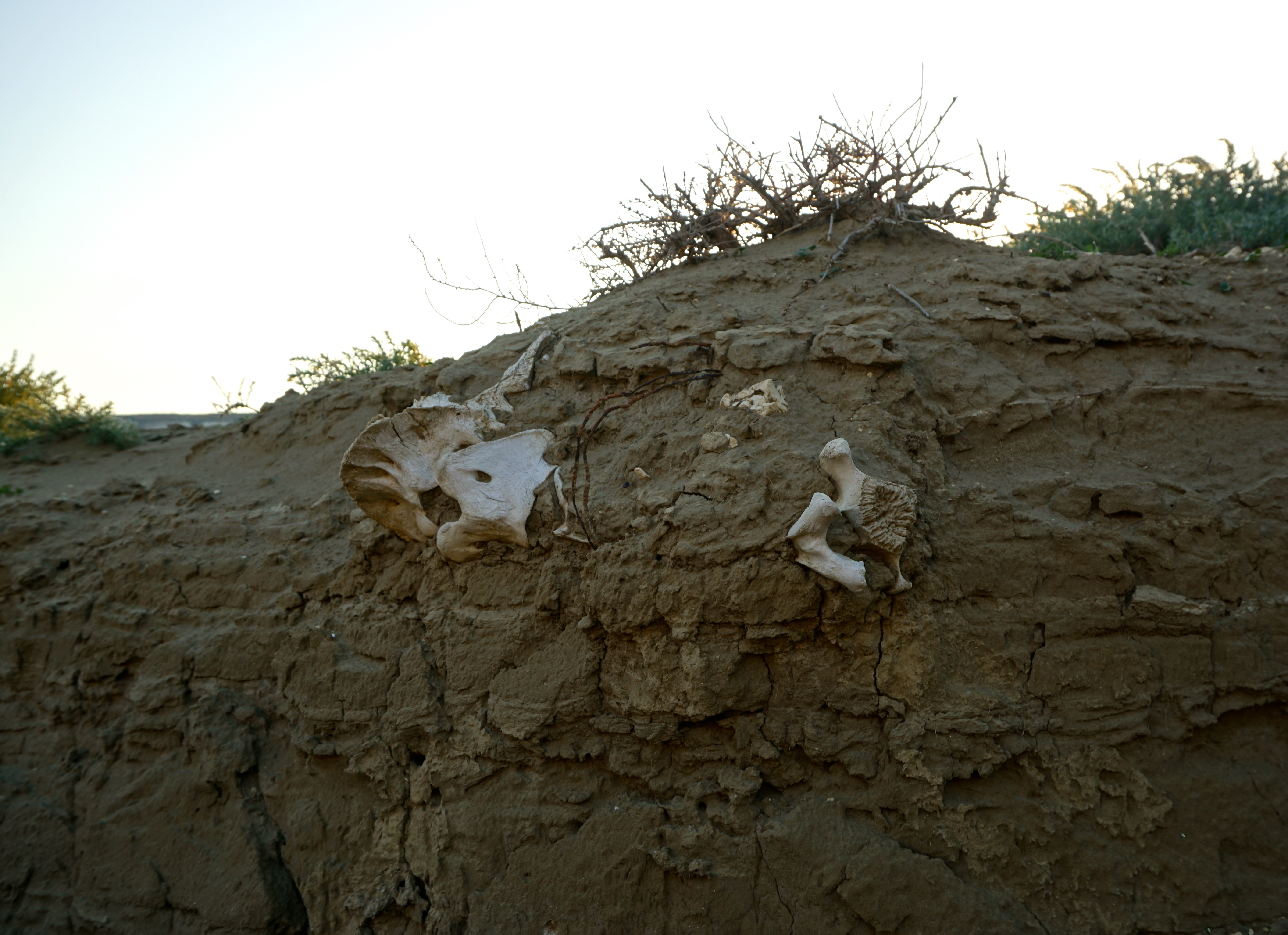
Walking down into a small gully by our campsite, I noticed some giant lumbar vertebrae eroding out of one side:

Waist-deep in mud. One vertebra is clearly visible, and to its right, beneath a rock, are the spinous processes of two more vertebrae.

Waist-deep in mud. One vertebra is clearly visible, and to its right, beneath a rock, are the spinous processes of two more vertebrae. Notice the differently colored stripes of soil – these are different layers (“strata”), reflecting different periods that soil was laid down on the earth.

I was elated to espy this spinous surprise, but I wasn’t expecting to see what was on the opposite side of the gully:

Died doing a misguided impression of an ostrich.

Died doing a misguided impression of an ostrich. On the left you can see the back of the skull and the first cervical vertebra, then the spine submerges and reemerges to the right.

Sure enough, this once complete carcass was drawn and quartered, pulled apart by the liberal application of time and life-saving water.

Digging out the skull on the west bank, right across from the lumber spine on the east face. The different soil layers (

Digging out the skull on the west bank, right across from the lumber spine on the east face (circled).

Getting our hands a little dirty, we found the face of a camel. It is hard to say how long ago it lived, how long it took to get buried by a few inches of dirt, but I would guess at most only a few decades (but I’m not a geologist, so who knows). It’s also unclear how this animal was bifurcated: Did the camel die and get covered over with soil, and then later a newly forming stream carried away the soil harboring its torso? Or did the carcass lie on the ground unburied for a while, its torso slowly picked apart or trampled, and then the stream formed? I would guess the first scenario is more likely, since the bones seem to run through several strata. But again I’m not an expert in taphonomy so I could be wrong.

DSC01023

People often wonder why the fossil record isn’t more complete, and why we get so excited about the discovery of even partially complete skeletons. This camel demonstrates one of myriad taphonomic processes, one of the many ways that earth, water and time conspire tear the past asunder.

Yi qi: Another fossil from The Dark Crystal

It was a good week for weird dinosaurs. On Monday scientists published Chilesaurus, “an enigmatic plant-eating [dino] from the Late Jurassic period of Chile” (from the paper title). Even more curious, Xing Xu and colleagues announced Yi qi, a Skeksis-like nightmare from the Jurassic of what is now China.

Yi qi on its deathbed, refusing to go quietly.

Here’s the fossil itself:

The Yi qi partial skeleton (Figure 1 from Xu et al.). Inset c is a closeup of the skull, and e a closeup of the elongated finger bones on the right side. Lookit that majestic mane of feathers flowing from the back of its head and down its neck.

The Yi qi partial skeleton (Figure 1 from Xu et al.). Inset c is a closeup of the skull, and e a closeup of the elongated finger bones. Lookit that majestic mane of feathers flowing from the back of its head and down its neck.

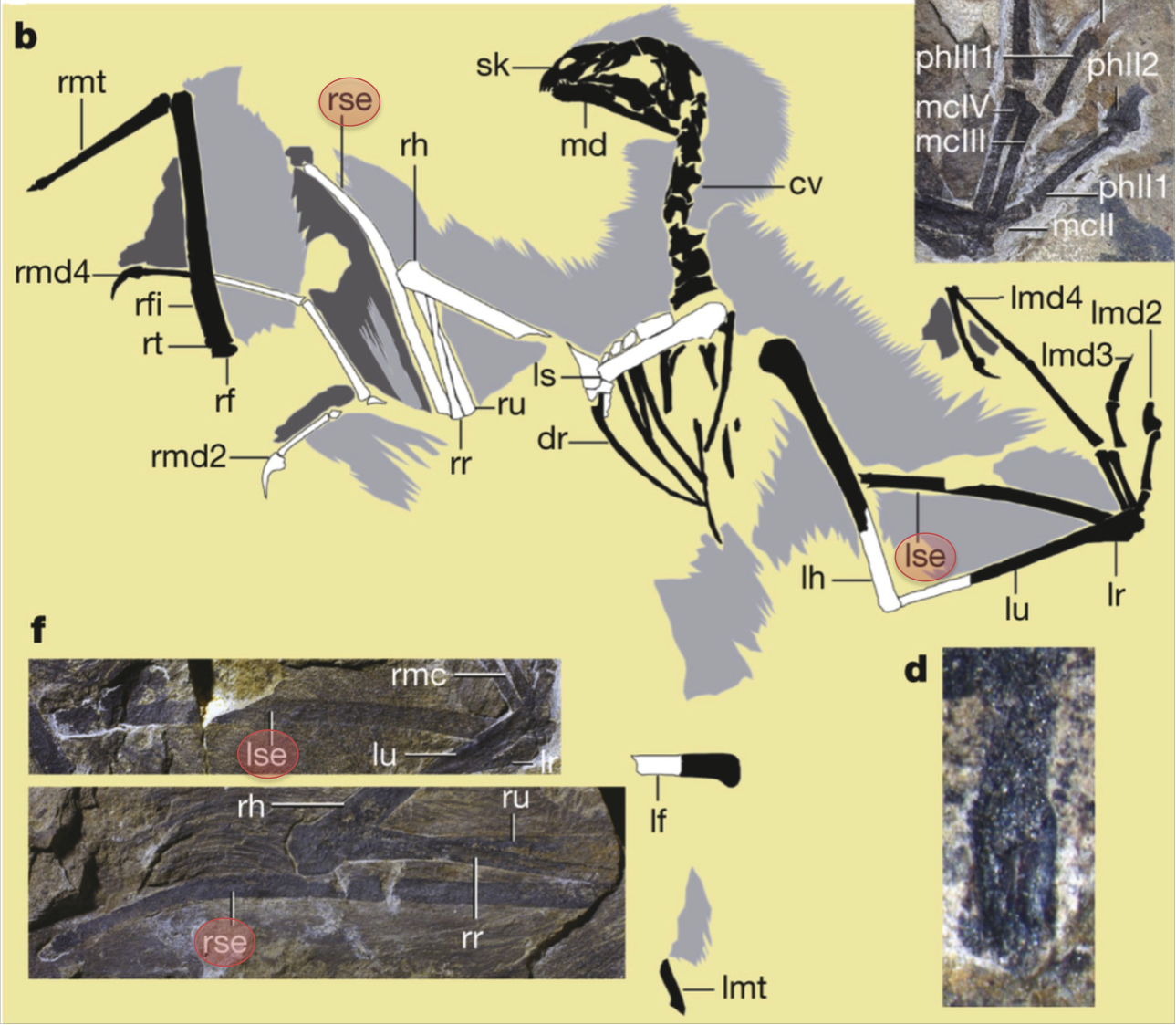
Yi qi is Mandarin for “strange wing.” Why “strange”? Here’s the cleaned up schematic of the fossil above:

The rest of Figure 1 from Xu et al. Important for flight are the structures labeled "ldm4/rdm4" and "lse/rse."

The rest of Figure 1 from Xu et al. Key wing structures are labeled “lmd4/rmd4” and “lse/rse.” Light gray shading represents feathers in the fossil, while dark gray appears to be some sort of membrane.

The right side of the figure, depicting the left side of this monster, shows the wing anatomy nicely. Bones with “md,” for “manual digit,” in the label are the homologues (or anatomical equivalents) of your fingers. Notice that the fourth one (“lmd4”) is drastically longer than other digits. This alone suggests some special function for this digit. Emanating from the wrist is another structure, “lse,” for “left styliform element.” In anatomy, “styl-” refers to a structure that sticks out; your skeleton is littered with “styloid processes.” Unlike digits, which are a line of several bones (“phalanges”), this styliform element is a single, rod-like structure made of bone. If you look at the “rse” above, beneath it you’ll see a dark patch running its length, which the researchers identified as “sheet-like soft tissue,” or membrane. These membranes are also found by the elongated md4s.

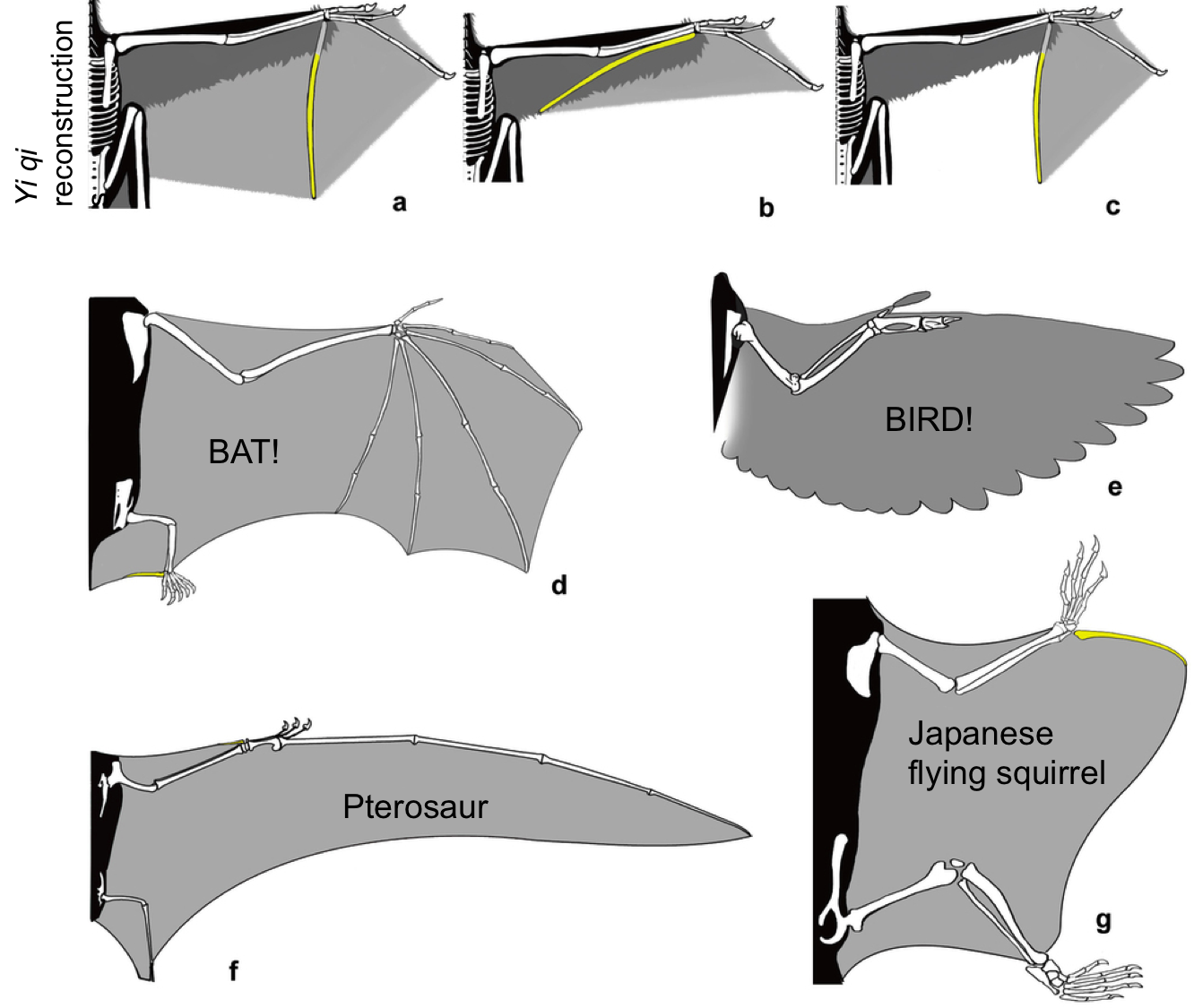
This all indicates an animal with a thin membrane (kind of like skin, I suppose?) between elongated fourth digits, styliform elements, and probably other parts of the body. Researchers then use the comparative anatomy to reconstruct and interpret the function of this unique wing. Here’s what homologous structures look like in flying animals:

Extended Data Figure 8 from Xu et al. Comparison of the wing structure of different flying/gliding animals.

Extended Data Figure 8 from Xu et al. Comparison of the wing structure of different flying/gliding animals. The yellow segment is the styliform element. Note it comes from the wrist in Yi qi and the Japanese giant flying squirrel, but from the ankle in the bat. Birds and pterosaurs apparently lacked such an accessory structure.

Although media generally report this animal’s wings were like bats’, the authors point out that the placement of this styliform element, at the base of the wrist, is actually most comparable to the Japanese giant flying squirrel (Petaurista leucogenys). Nevertheless, the the construction of the wing, with a membrane between long finger elements, is unlike the wings that other dinosaurs and later birds evolved for flight. This highlights the many ways that flight has evolved – independently – in different kinds of vertebrates over the past 200 million years.

Now, even though these were not giant animals, I think they still would have been terrifying. Not scary in the same way as building-sized theropods like T. rex or Spinosaurus.

No, there is just something a bit creepy about a creature like this. Here is the skeletal reconstruction from the paper:

The dinosaur version of Edward Scissorhands.

Like a dinosaur Edward Scissorhands

If Yi qi Scissorhands doesn’t drive home just how nightmarish this dinosaur was to behold, check out this uncanny resemblance:

YiQiSkeksis

Yi qi (top) and a Skeksis (bottom). Not the first time The Dark Crystal has predicted important fossils.

Yet again, paleontology shows that fact can be stranger than fiction.