Pre-publication: Brain growth in Homo erectus (plus R code!)

The annual meetings of the American Association of Physical Anthropologists were going on all last week, and I gave my first talk before the Association (co-authored with Jeremy DeSilva). The talk focused on using resampling methods and the abysmal human fossil record to assess whether human-like brain size growth rates were present in our >1 mya ancestor Homo erectus. This is something I’ve actually been sitting on for a while, and wanted to wait til after the talk to post for all to see. I haven’t written this up yet for publication, but before then I’d like to briefly share the results here.

Background: Humans’ large brains are critical for giving us our unique capabilities such as language and culture. We achieve these large (both absolutely, and relative to our body size) brains by having really high brain growth rates across several years; most notable are exceptionally high, “fetal-like” rates during the first 1-2 years of life. Thus, rapid brain growth shortly after birth is a key aspect of human uniqueness – but how ancient is this strategy?

Materials: We can plot brain size at birth in humans and chimpanzees (our closest living relatives) to visualize what makes humans stand out (Figure 1).
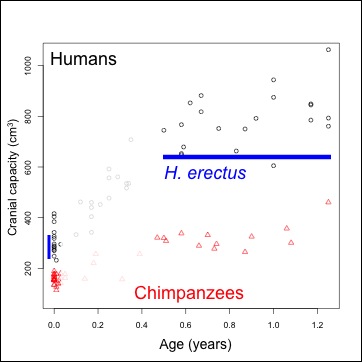
Figure 1. Brain size (volume) at given ages. Humans=black, chimpanzees=red. Ranges of brain size at birth, and the chronological age of the Mojokerto fossil, in blue.

Human data come from Cogueugniot and Hublin (2012), and chimpanzees from Herndon et al. (1999) and Neubauer et al. (2012). The earliest fossil evidence able to address this question comes from Homo erectus. Because of the tight relationship between newborn and adult brain size (DeSilva and Lesnik 2008), we can use adult Homo erectus brain volumes (n=10, mean = 916.5 cm^3) to predict that of the species’ newborns: mean = 288.9 cm^3, sd = 17.1). An almost-recent analysis of the Mojokerto Homo erectus infant calvaria suggests a size of 663 cm^3 and an age of 0.5-1.25 years (Coqueugniot et al. 2004; this study actually suggests an oldest age of 1.5 years, but the chimpanzee sample here requires us to limit the study to no more than 1.25 years). Because we have a H. erectus fossil less than 2 years of age, and we can estimate brain size at birth, we can indirectly assess early brain growth in this species.

Methods: Resampling statistics allow inferences about brain growth rates in this extinct species, incorporating the uncertainty in both brain size at birth, and in the chronological age of the Mojokerto fossil. We thus ask of each species, what growth rates are necessary to grow one of the newborn brain sizes to any infant between 0.5-1.25 years? And from there, we compare these resampled growth rates (or rather, ‘pseudo-velocities’) between species – is H. erectus more similar to modern humans or chimpanzees? There are 294 unique newborn-infant comparisons for humans and 240 for the chimpanzee sample. We therefore compare these empirical newborn-infant pairs from extant species to 7500 resampled H. erectus pairs, randomly selecting a newborn H. erectus size based on the parameters above, and randomly selecting an age from 0.5-1.25 years for the Mojokerto specimen. This procedure is used to compare both absolute size change (the difference between an infant and a newborn size, in cm^3/year), and and proportional size change (infant/newborn size).

Results: Humans’ high early brain growth rates after birth are reflected in the ‘pseudovelocity curve’ (Figure 2). Chimps have a similar pattern of faster rates earlier on, but these are ultimately lower than humans’. Using the Mojokerto infant’s brain size (and it’s probable ages) and the likely range of H. erectus neonatal brain sizes (mean = 288, sd = 17), it is fairly clear that H. erectus achieved its infant brain size with high, human-like rates in brain volume increase.

Figure 2. Brain size growth rates (‘pseudo-velocity’) at given ages. Humans=black, chimpanzees=red, and Homo erectus,=blue.

However, if we look at proportional size change, the factor by which brain size increases from birth to a given age, we see a great deal of overlap both between age groups within a species, and between different species. Cross-sectional data create a great deal of overlap in implied proportional size change between ages within a species; it is easier to consider proportional size change between taxa, conflating ages, then  (Figure 3). Humans show a massive amount of variation in potential growth rates from birth to 0.5-1.25 years, and chimpanzees also show a great deal of variation, albeit generally lower than in the human sample. Relative growth rates in Homo erectus are intermediate between the two extant species.

Figure 3. Proportional brain size increase (infant/newborn size).

Significance: Brain size growth shortly after birth is critical for humans’ adaptative strategy: growing a large brain requires a lot of energy and parental (especially maternal) investment (Leigh 2004). Plus, in humans this rapid increase may correspond with the creation of innumerable white-matter connections between regions of the brain (Sakai et al. 2012), important for cognition or intelligence. The H. erectus fossil record (1 infant and 10 adults) provides a limited view into this developmental period. However, comparative data on extant animals (e.g. brain sizes from birth to adulthood), coupled with resampling statistics, allow inferences to be made about brain growth rates in H. erectus over 1 million years ago.

Assuming the Mojokerto H. erectus infant is accurately aged (Coqueugniot et al. 2004), and that Homo erectus followed the same neonatal-adult scaling relationship as other apes and monkeys (DeSilva and Lesnik 2008), it is likely that H. erectus had human-like rates of absolute brain size growth. Thus, the energetic and parental requirements to raise such brainy babies, seen in modern humans, may have been present in Homo erectus some 1.5 million years ago or so. This may also imply rapid white-matter proliferation (i.e. neural connections) in this species, suggesting an intellectually (i.e. socially or linguistically) stimulating infancy and childhood in this species. At the same time, relative brain size growth appears to scale with overall brain size: larger brains require proportionally higher growth rates. This is in line with studies suggesting that in many ways, the human brain is a scaled-up version of other primates’ (e.g. Herculano-Houzel 2012).

ResearchBlogging.org
This study was made possible with published data, and the free statistical programming language R.

Contact me if you want the R code used for this analysis, I’m glad to share it!

References
Coqueugniot H, Hublin JJ, Veillon F, Houët F, & Jacob T (2004). Early brain growth in Homo erectus and implications for cognitive ability. Nature, 431 (7006), 299-302 PMID: 15372030

Coqueugniot H, & Hublin JJ (2012). Age-related changes of digital endocranial volume during human ontogeny: results from an osteological reference collection. American journal of physical anthropology, 147 (2), 312-8 PMID: 22190338

DeSilva JM, & Lesnik JJ (2008). Brain size at birth throughout human evolution: a new method for estimating neonatal brain size in hominins. Journal of human evolution, 55 (6), 1064-74 PMID: 18789811

Herculano-Houzel S (2012). The remarkable, yet not extraordinary, human brain as a scaled-up primate brain and its associated cost. Proceedings of the National Academy of Sciences of the United States of America, 109 Suppl 1, 10661-8 PMID: 22723358

Herndon JG, Tigges J, Anderson DC, Klumpp SA, & McClure HM (1999). Brain weight throughout the life span of the chimpanzee. The Journal of comparative neurology, 409 (4), 567-72 PMID: 10376740

Leigh SR (2004). Brain growth, life history, and cognition in primate and human evolution. American journal of primatology, 62 (3), 139-64 PMID: 15027089

Neubauer, S., Gunz, P., Schwarz, U., Hublin, J., & Boesch, C. (2012). Brief communication: Endocranial volumes in an ontogenetic sample of chimpanzees from the taï forest national park, ivory coast American Journal of Physical Anthropology, 147 (2), 319-325 DOI: 10.1002/ajpa.21641

Sakai T, Matsui M, Mikami A, Malkova L, Hamada Y, Tomonaga M, Suzuki J, Tanaka M, Miyabe-Nishiwaki T, Makishima H, Nakatsukasa M, & Matsuzawa T (2012). Developmental patterns of chimpanzee cerebral tissues provide important clues for understanding the remarkable enlargement of the human brain. Proceedings. Biological sciences / The Royal Society, 280 (1753) PMID: 23256194

Come hear me talk about brains on Tuesday

This coming Tuesday I’ll be giving a talk about the evolution and development of the human brain, as part of the seminar series of the School of Humanities and Social Sciences here at Nazarbayev University. My research doesn’t really fall neatly under the realms of ‘humanities and social sciences,’ so  the talk should be a neat change of pace for these SHSS seminars. I’ll be previewing something I’ve been working on with Dr. Jeremy DeSilva, and that I’ll be presenting at the AAPA conference in a few weeks. So if you can’t make it to Astana, maybe you can catch the shorter show in Knoxville!

Here’s info from the flier (sorry about the title, I’m new to this; also, I won’t be talking for 90 minutes):

Building the Most Powerful Computer: Evo-Devo of the Human Brain


4:20-5:50 pm
Tuesday, 26 March 2013

at Nazarbayev University, Block 7, Room 7-507
53 Kabanbay Batyr Ave.
Astana

Synopsis: Your brain is one of the most remarkable things to emerge in all the history of Life, and has been a critical part of humans’ adaptive success. This talk will examine how this machine came into existence. I will first describe how the brain grows and develops across an individual’s lifetime. Next I turn to the possible ways development was modified during the course of our evolution to result in our singularly powerful brains. Special attention is given to teasing out secrets of brain evolution from the dismal fossil record.

Evo-devo of the human shoulder?

It’s a new year, and while my mind should be marred by a hangover, instead all I can think about are fossils and scapulas.


A pretty cool study was published online in the Journal of Human Evolution last week, and I’ve finally gotten to peruse it. Fabio Di Vincenzo and colleagues analyzed the shape of the outline of the glenoid fossa on the scapula (not to be confused with the glenoid on your skull), from Australopithecus africanus to present day humans. The glenoid fossa is essentially the socket in the ball-and-socket joint of your shoulder. The authors found that there is pretty much a single trend of glenoid shape change from Australopithecus through the evolution of the genus Homo: from the fairly narrow joint in Australopithecus africanus and A. sediba, to the relatively wide joint in recent humans. The overall size and shape of the joint influences/reflects shoulder mobility, so presumably this shape change hints that more front-to-back arm motions became more important through the course of human evolution (authors suggest throwing in humans from the Late Pleistocene onward).


The finding of a single predominant trend in glenoid shape evolution is pretty interesting. On top of that, the authors add an ‘evo-devo’ twist by comparing species’ average “shapes” (first principle component scores, on the y-axis in the figure at right) with their estimated ages at skeletal maturity (which appears scaled to the modern human value, on the x-axis). Though it’s not an ideal dataset for running a linear regression, the figure at right shows that there appears to be a fairly linear relationship across human evolution, such that groups with an older age at skeletal maturity tend to have a more rounded (modern human-like) glenoid fossa (note that the individuals in the analysis were all adults). Overall size does not contribute to shape variation among these glenoids.


This work raises two issues, and ultimately leads to a testable evo-devo hypothesis. The first issue is to what extent we can trust their estimates of age at skeletal maturity. These estimates were allegedly taken from a chapter by Helmut Hemmer (2007) in the prohibitively expensive Handbook of Paleoanthropology. Cursorily glancing at this chapter, I can’t find age at skeletal maturation estimated for any hominids. It is possible that in my skimming I missed the estimates, or alternatively that Di Vincenzo and colleagues misinterpreted another variable as skeletal development. Either way, these estimates would still need to be taken with a grain of salt, given that it is almost impossible to know the true age at death of a fossil (but see Antoine et al. 2008), especially if there are no associated cranio-dental elements.


That said, it is perfectly reasonable to suppose that the age at skeletal maturation has increased over the course of human evolution; life-span increased through human evolution, and so all else being equal (which it almost certainly isn’t) we could expect that maturation would occur later over time, too. So this leads to a second issue: given the “evo-devo change” the authors hypothesize, what is the evo-devo mechanism? That is, how was development modified to effect the evolutionary changes we see in the hominid scapula? Because they found adult glenoid shape correlates with estimated age at skeletal maturity, this leads to the hypothesis that postnatal skeletal growth accounts for the shape difference. Indeed, they state:

“If functional and static allometric influences are unlikely, we…interpret the trend…as reflecting growth and developmental factors. A major, albeit gradual, trend of ontogenetic heterochrony occurred in the evolution of the genus Homo… and thus differences within and between taxa in overall growth rates may have produced the pattern of variation between samples, as well as the overall temporal trend observed. The regression of life history variables [they only looked at 1]… with PCA [principle components analysis] scores supports this ‘ontogenetic’ hypothesis.”

The authors suggest that humans’ slower growth rates but longer growth period “led to longer periods of bone deposition along the inferior-lateral edge of the [glenoid fossa]”  The heterochronic process they suggest is “peramorphosis” – the descendant reaches a shape that is ‘beyond’ that of the ancestor.

The figure above is from a seminal “heterochrony” paper by Pere Alberch and colleagues (1979), portraying how peramorphosis can occur. In each, the y-axis represents shape and the x-axis is age. A the descendant’s peramorphic shape (“Ya”) could result from accelerated growth (left graph) or from an extension of growth to later ages than in the ancestor (right graph).


And so this leads to a testable hypothesis. Di Vincenzo and colleagues cite (dental) evidence that humans’ overall body growth rates are slower than earlier hominids’, undermining the hypothesis that acceleration is responsible for humans’ glenoid peramorphosis. Rather, they hypothesize that humans’ slower growth rates coupled with a longer period of skeletal development, to result in a relatively wider glenoid, due to increased development of the secondary growth centers (e.g. the graph at right, above). This developmental scenario predicts that subadult human glenoids should resemble earlier hominid adults’, that “ontogeny recapitulates phylogeny” as far as glenoid shape is concerned. Analyzing glenoid growth can even be extended to include fossils – the >3 million year old human ancestor Australopithecus afarensis has glenoids preserved for an infant (DIK-VP-1; Alemseged et al. 2006) and 2 adults (AL 288 “Lucy” and KSD-VP-1; Johanson et al. 1982, Haile-Selassie et al. 2010). An alternate hypothesis is that species’ distinct glenoid shapes are established early during life (i.e. in utero), and/or that no simple heterochronic process is involved.


ResearchBlogging.orgDi Vincenzo’s and colleagues’ study points to the importance of development in understanding human evolution, and their hypothesized “evo-devo change” in glenoid shape is ripe for testing.


References
Pere Alberch, Stephen Jay Gould, George F. Oster, & David B. Wake (1979). Size and shape in ontogeny and phylogeny Paleobiology, 5 (3), 296-317


Alemseged, Z., Spoor, F., Kimbel, W., Bobe, R., Geraads, D., Reed, D., & Wynn, J. (2006). A juvenile early hominin skeleton from Dikika, Ethiopia Nature, 443 (7109), 296-301 DOI: 10.1038/nature05047


Antoine, D., Hillson, S., & Dean, M. (2009). The developmental clock of dental enamel: a test for the periodicity of prism cross-striations in modern humans and an evaluation of the most likely sources of error in histological studies of this kind Journal of Anatomy, 214 (1), 45-55 DOI: 10.1111/j.1469-7580.2008.01010.x


Di Vincenzo, F., Churchill, S., & Manzi, G. (2011). The Vindija Neanderthal scapular glenoid fossa: Comparative shape analysis suggests evo-devo changes among Neanderthals Journal of Human Evolution DOI: 10.1016/j.jhevol.2011.11.010


Haile-Selassie, Y., Latimer, B., Alene, M., Deino, A., Gibert, L., Melillo, S., Saylor, B., Scott, G., & Lovejoy, C. (2010). An early Australopithecus afarensis postcranium from Woranso-Mille, Ethiopia Proceedings of the National Academy of Sciences, 107 (27), 12121-12126 DOI: 10.1073/pnas.1004527107


Hemmer, Helmut (2007). Estimation of Basic Life History Data of Fossil Hominoids Handbook of Paleoanthropology, 587-619 DOI: 10.1007/978-3-540-33761-4_19


Johanson, D., Lovejoy, C., Kimbel, W., White, T., Ward, S., Bush, M., Latimer, B., & Coppens, Y. (1982). Morphology of the Pliocene partial hominid skeleton (A.L. 288-1) from the Hadar formation, Ethiopia American Journal of Physical Anthropology, 57, 403-451 DOI: 10.1002/ajpa.1330570403

Pictures worth thousands of words and dollars

ResearchBlogging.orgLooking into subdural empyema, which is a meningeal infection you don’t want, I stumbled upon a study from the roaring 1970s – the glorious Nixon-Ford-Carter years – using computerized axial tomography (hence, CAT scan) to visualize lesions within the skull (Claveria et al. 1976). Nowadays people refer to various similar scanning techniques simply as “CT” (for computed tomography, though this is not exactly the same as magnetic resonance imaging, MRI).

It’s pretty amazing how medical imaging has advanced in the 35 years since this study. For example, to the right is a CAT scan from Claveria et al. (1976, Fig. 4). These are transverse images (“slices”) through the brain case, the top of the images corresponding to the front of the face. You can discern the low-density (darker) brain from the higher density (lighter) bone – the sphenoid lesser wings and dorsum sellae, and petrous pyramids of the temporal bones are especially prominent in the top left image. In the bottom two images you can see a large, round abscess in the middle cranial fossa. Whoa.

What makes this medical imaging technique so great is that it allows a view inside of things without having to dissect into them. Of course, the downside is that it relies on radiation, so ethically you can’t be so cavalier as to CT scan just any living thing. If I’d been alive in 1976, CAT scanning would’ve blown my mind. Still, the image quality isn’t super great here, there’s not good resolution between materials of different densities, hence the grainy images.

But since then, some really smart people have been hard at work to come up with new ways to get better resolution from computerized tomography scans, and the results are pretty amazing. To the left is a slice from a synchrotron CT scan of the MH1 Australopithecus sediba skull (Carlson et al. 2011, Supporting on line material, Fig. S10). You’re basically seeing the fossil face-to-face … if someone had cut of the first few centimeters of the fossil’s face. Just like the movie Face Off.

Quite a difference from the image above. Here, we can distinguish fossilized bone from the rocky matrix filling in the orbit, brain case and sinuses. Synchrotron even distinguishes molar tooth enamel from the underlying dentin (see the square). The post-mortem distortion to the (camera right) orbit is clear. It also looks as though the hard palate is thick and filled with trabecular bone, as is characteristic of robust Australopithecus (McCollum 1999). Interesting…

Even more remarkable, the actual histological structure of bone can be imaged with synchrotron imaging. Mature cortical bone is comprised of these small osteons (or Haversian systems), that house bone cells and transmit blood vessels to help keep bone alive and healthy. Osteons are very tiny, submillimetric. To the right is a 3D reconstruction of an osteon and blood vessels, from synchrotron images (Cooper et al. 2011). The scale bar in the bottom right is 250 micrometers. MICROmeters! Note the scan can distinguish the Haversian canal (red part in B-C) from vessels (white part in B). Insane!

Not only has image quality improved over the past few decades, but CT scanning is being applied outside the field of medicine for which it was developed; it’s becoming quite popular in anthropology. What I’d like to do, personally, with such imaging is see if it can be used to study bone morphogenesis – if it can be used to distinguish bone deposition vs. resorption, and to see how these growth fields are distributed across a bone during ontogeny. This could allow the study the proximate, cellular causes of skeletal form, how this form arises through growth and development. If it could be applied to fossils, then we could potentially even see how these growth fields are altered over the course of evolution: how form evolves.

References
Carlson KJ, Stout D, Jashashvili T, de Ruiter DJ, Tafforeau P, Carlson K, & Berger LR (2011). The endocast of MH1, Australopithecus sediba. Science (New York, N.Y.), 333 (6048), 1402-7 PMID: 21903804

Claveria, L., Boulay, G., & Moseley, I. (1976). Intracranial infections: Investigation by computerized axial tomography Neuroradiology, 12 (2), 59-71 DOI: 10.1007/BF00333121

Cooper, D., Erickson, B., Peele, A., Hannah, K., Thomas, C., & Clement, J. (2011). Visualization of 3D osteon morphology by synchrotron radiation micro-CT Journal of Anatomy, 219 (4), 481-489 DOI: 10.1111/j.1469-7580.2011.01398.x

McCollum, M. (1999). The Robust Australopithecine Face: A Morphogenetic Perspective Science, 284 (5412), 301-305 DOI: 10.1126/science.284.5412.301

Teaching next summer

When I was working at Dmanisi this summer, I used a lot of my free time to develop a course on human evolutionary developmental biology, or evo-devo. I submitted this to my department, and I’m excited to announce that I’ll be teaching this class at U of M in Spring 2012. So if you’re at UM and want to take a badass class exploring the evolution and development of the human body, keep an eye out for this new anthropology offering (NB I need to come up with a catchy title for the class still).

The tentative textbook for the class will be Lewis Held’s Quirks of Human Anatomy: An Evo-Devo Look at the Human Body, which I just got in the mail yesterday. It got very good reviews and should be an interesting read, and with just under 3000 references it has a pretty useful bibliography, too. I’m really looking forward to reading this, and even the first page of the preface points to something promising:

“In Chapter 13 of Origin, Darwin asserted that the evidence from embryology alone was strong enough to convince him of the principle of common descent. Human embryos make many structures we don’t need, and we destroy others after we’ve gone to the trouble of making them. No engineer in his right mind would ever allow such idiocy.”

I can’t wait to read about these idiocies.

Teaching is an important part of my work, but I’ll admit that sometimes I’d rather be doing other things than preparing lessons, assignments and such. I have to say, though, I’ve had a lot of fun preparing this class so far. I’ll keep you posted about what I think of the book and how the course-planning comes along.

[insert clever quip about australopithecus hips]

A week and a half ago, Kibii and colleagues (2011) published reconstructions and re-analyses of two hips belonging to the 1.98 million-year old Australopithecus sediba. As with many fossil discoveries, these additions to the fossil record raise more questions than they answer. Unless the question was, “did A. sediba have a pelvis?” It did. Here’s a good summary from the paper itself:

Thus, Au. sediba is australopith-like in having a long superior pubic ramus and an anteriorly positioned and indistinctly developed iliac pillar…[and] Homo-like in having vertically oriented and sigmoid shaped iliac blades, more robust ilia, and a narrow tuberoacetabular sulcus…and the pubic body is upwardly rotated as in Homo. (p. 1410, emphases mine)

So far as I can tell, the main way the hips are ‘advanced’ toward a more human-like condition is that the iliac blades are more upright and sweep forward more than in earlier known hominid hips. Here’s the figure 2 from the paper (more sweet pics of the fossils are available here). NB that in both A. sediba hips much of the upper portions of the iliac blades are missing (reconstructed in white; this region is missing in lots of fossils), so it’s possible they were more flaring like the australopith in the center photo.

The authors’ bottom-line, take-home point is that the A. sediba pelvis has features traditionally associated with large-brained Homo – but belonged to a small-brained species (based solely on the ~430 cc MH1 endocast). They argue that this means that many of these unique pelvic features did not evolve in the context of birthing large-brained babies, as has often been thought. They state that these features are thus “most parsimoniously attributed to altered biomechanical demands on the pelvis in locomotion,” and suggest that this hypothetical locomotion was mostly bipedalism but with a good degree of climbing. Maybe, maybe not. This interpretation is consistent with the analysis of the A. sediba foot/ankle (Zipfel et al. 2011).

The weird mix of ancient (australopith-like) and newer (Homo-like) pelvic features in A. sediba really raises the question of how australopithecines moved around. More intriguing is that the A. sediba pelvis has different Homo-like features than the ~1 million year old Busidima pelvis (Simpson et al. 2008), which has been attributed to Homo erectus (largely in aspects of the iliac blades). This raises the question of whether A. sediba is really pertinent to the origins of the genus Homo, and whether the Busidima pelvis belongs to Homo erectus or a late-surviving robust australopithecus (e.g. boisei, Ruff 2010).

Also interesting is that the subpubic angle (in the pic above, the upside-down “V” created by the pubic bones just above the red labels) is pretty low in MH2. This is curious because modern human males and females differ in how large this angle is – females tend to have a large angle which contributes to an enlarged birth canal, whereas males have a low angle like MH2. But MH2 is considered female based on skeletal and dental size. This raises the additional questions of whether human-like sexual dimorphism had not evolved in hominids prior to 1.9 million years ago, and whether the sex of MH2 was accurately described.

Finally, though the authors did a great job comparing this pelvis with those from other hominids, I think a major, more comprehensive comparative review of hominid pelves is in order. How does the older A. afarensis hip from Woranso (Haile-Selassie et al. 2010) inform australopithecine pelvic evolution? What about the possibly-contemporary-maybe-later hip from the nearby site of Drimolen (Gommery et al. 2002)? Given the subadult status of the MH1 individual, it would be interesting to compare with the WT 15000 Homo erectus fossils, or A. africanus subadults from Makapansgat, to examine the evolution of pelvic growth.

ResearchBlogging.org

Lots of interesting questions arise from these fascinating new fossils. “The more you know,” right?

References
Gommery, D. (2002). Description d’un bassin fragmentaire de Paranthropus robustus du site Plio-Pléistocène de Drimolen (Afrique du Sud)A fragmentary pelvis of Paranthropus robustus of the Plio-Pleistocene site of Drimolen (Republic of South Africa) Geobios, 35 (2), 265-281 DOI: 10.1016/S0016-6995(02)00022-0

Haile-Selassie Y, Latimer BM, Alene M, Deino AL, Gibert L, Melillo SM, Saylor BZ, Scott GR, & Lovejoy CO (2010). An early Australopithecus afarensis postcranium from Woranso-Mille, Ethiopia. Proceedings of the National Academy of Sciences of the United States of America, 107 (27), 12121-6 PMID: 20566837

Kibii, J., Churchill, S., Schmid, P., Carlson, K., Reed, N., de Ruiter, D., & Berger, L. (2011). A Partial Pelvis of Australopithecus sediba Science, 333 (6048), 1407-1411 DOI: 10.1126/science.1202521

Ruff, C. (2010). Body size and body shape in early hominins – implications of the Gona Pelvis Journal of Human Evolution, 58 (2), 166-178 DOI: 10.1016/j.jhevol.2009.10.003

Simpson, S., Quade, J., Levin, N., Butler, R., Dupont-Nivet, G., Everett, M., & Semaw, S. (2008). A Female Homo erectus Pelvis from Gona, Ethiopia Science, 322 (5904), 1089-1092 DOI: 10.1126/science.1163592

Zipfel, B., DeSilva, J., Kidd, R., Carlson, K., Churchill, S., & Berger, L. (2011). The Foot and Ankle of Australopithecus sediba Science, 333 (6048), 1417-1420 DOI: 10.1126/science.1202703

And I thought I had it bad (or, "Toad terrors")

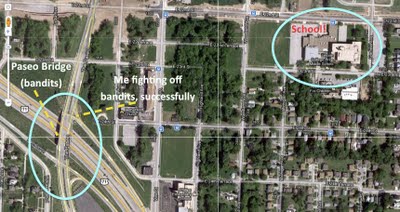
The world can be a terrible place. Sure, there are the finer things that make life worth living – puppies, spooning, hoppy beer, etc. – but there are also things that make you wonder, ‘Now why should anyone ever have to endure this?‘ I recall being a child, growing up on the mean streets of Kansas City, MO, it was a struggle just to get an education. There were bandits that set up a ‘toll’ to cross the bridge to get to the school, and if we didn’t have any pence to put in their pouches, well we’d have to fight our way into the classroom (see map below, of Lincoln College Prep middle school). Getting home in the afternoon was even worse. There was an Iron Maiden. And this thing.
I thought my midwest urban childhood was tough, until today when I read about “cane toads” (Rhinella marina) (below, right). Now, toads in general are odd animals. They’re vertebrates, with a sweet bony spine and skeleton, like us humans and wicked-pisser mammals. But they’re also not like us (“NLU,” as my sweet, politely diabolical grandma would say). Not like us at all. When a human is a baby, she or he looks more or less like an adult, albeit much smaller and cutely misproportioned. But a toad – well, amphibians just have a totally different life plan. Toad babies are these “tadpoles” (or “pollywogs” if you’re feeling especially cavalier and sassy) that don’t have a body with a head and four limbs that can be used for being awesome. Instead, pollywogs are these fat embryo-ish bodies trailing along a slithering tail. Limbs eventually form from tiny buds and the tail is lost. But superficially, the panning out of toad ontogeny looks like giant sperm deciding to become frog-like abomination unto something. So toads are already not quite right from the get go.
But this one species, the cane toad, has tadpoles that EAT THEIR EGG SIBLINGS and EMIT A CHEMICAL THAT STUNTS THE DEVELOPMENT OF THEIR BROTHERS and SISTERS. In the history of human society there have been a number of stories of family eating family, but there is nothing quite like this. It’s a mix between the child-eating Kronos (or Roman “Saturn”) or Thyestes (though his was accidental), and Cain and Abel from the Bible that’s such a smash with the Judeo-Christians, or Romulus and Remus from the mythic founding of Rome. [Hey I guess my Classics BA has come in handy after all!]
So next time you’re feeling down and out, upset with the hand the great Dealer has dealt you, just be glad you weren’t a cane toad. Because then you’d’ve either been eaten/murdered by your older sib, or you’d’ve eaten/murdered your siblings. Yikes.
Feelings aside, this toad presents a very interesting case study. It will be interesting to uncover the biochemistry and genetics behind how the older pollywogs stunt the development of their little brothers and sisters. I can see this really helping with an understanding of how growth and development are controlled and inhibited, and possibly even how they can be manipulated. It would also be interesting to see if in the evolution of these species, there arose any biochemical defenses expressed in eggs and young larvae against older sibs’ fratricidal fragrances, or if it was simply a 1-sided battle.
Life is a funny, funny thing.
Works Ci-toad [sorry for the terrible pun 😦 ]
PS

eFfing Fossil Friday (another late edition)

ResearchBlogging.orgI’m sitting at a cafe in Tbilisi, departing at 4:00 am tomorrow for America. Readers will notice that I’ve been MIA while working with the second annual Dmanisi Paleoanthropology Field School. I hate to say it but I’m glad I was too busy to blog all the goings-on (though sorry if it disappointed anyone). All in all it was another great year, and we found some great fossils (about which I don’t think I have permission to say anything at all). Here’s this year’s class with their certification of badassery at the site on the last day:
But Dmanisi won’t be the subject of this belated eFfing Fossil Friday. I’d like instead to turn to the question of just what fossils are good for. I’m told that in China, fossil teeth were once interpreted as dragons’ teeth, and so pulverized and sold as medicine. But what good are they to non-medical science? My recent research interests have come to focus on the relationship between evolution and development. Evolutionary developmental biology (“evo-devo”) research has been dominated by studies of genes, gene expression, and model organisms like fruit flies and mice. In such an environment, the question of the relevance of fossils is especially poignant.
But this morning, while planning a human evo-devo course I hope to teach next summer, I stumbled upon a review paper by Rudolf Raff, titled “Written in Stone: Fossils, genes and evo-devo” (2007). I think the abstract sums things up pretty well:

Fossils give evo-devo a past. They inform phylogenetic trees to show the direction of evolution of developmental features, and they can reveal ancient body plans. Fossils also provide the primary data that are used to date past events, including divergence times needed to estimate molecular clocks, which provide rates of developmental evolution. Fossils can set boundaries for hypotheses that are generated from living developmental systems, and for predictions of ancestral development and morphologies. Finally, although fossils rarely yield data on developmental processes directly, informative examples occur of extraordinary preservation of soft body parts, embryos and genomic information.

It seems often that fossils are falling by the wayside. There’s a sentiment that there’s not much information to be gotten from fossils – they’re too incomplete, too few, too inconvenient, at least as compared with extremely high-output data such as that coming from genomics. But Raff is right – we need fossils. Beyond the excellent points Raff raises in the review, I’m working on getting the most out of these seemingly data-poor fossil samples. Because modern computers are so powerful nowadays, I’m using their sheer processing power to test hypotheses about growth and development in fossil samples. These battered bunches of bones are too tiny to be analyzed by traditional methods. But one thing I think is important to take away from this computer-crazy Information Age, is that we now have machines that can handle almost any kind of question one can think to ask, and it’s really inspiring. The sequencing and analyses of ancient Neandertal and Denisova genomes (Green et al. 2010, Reich et al. 2010) are excellent examples of the amazing research that can be done with computers and creativity (and probably also a horde of hard-working math majors).
So this eFFF (or Sunday) is not dedicated to any specific fossil or set of fossils, but rather to all fossils, even the crappy fragments. Gaumarjos, fossils: your secrets are not safe from us.
Reference
Green, R., Krause, J., Briggs, A., Maricic, T., Stenzel, U., Kircher, M., Patterson, N., Li, H., Zhai, W., Fritz, M., Hansen, N., Durand, E., Malaspinas, A., Jensen, J., Marques-Bonet, T., Alkan, C., Prufer, K., Meyer, M., Burbano, H., Good, J., Schultz, R., Aximu-Petri, A., Butthof, A., Hober, B., Hoffner, B., Siegemund, M., Weihmann, A., Nusbaum, C., Lander, E., Russ, C., Novod, N., Affourtit, J., Egholm, M., Verna, C., Rudan, P., Brajkovic, D., Kucan, Z., Gusic, I., Doronichev, V., Golovanova, L., Lalueza-Fox, C., de la Rasilla, M., Fortea, J., Rosas, A., Schmitz, R., Johnson, P., Eichler, E., Falush, D., Birney, E., Mullikin, J., Slatkin, M., Nielsen, R., Kelso, J., Lachmann, M., Reich, D., & Paabo, S. (2010). A Draft Sequence of the Neandertal Genome Science, 328 (5979), 710-722 DOI: 10.1126/science.1188021


Raff, R. (2007). Written in stone: fossils, genes and evo–devo Nature Reviews Genetics, 8 (12), 911-920 DOI: 10.1038/nrg2225
Reich D, Green RE, Kircher M, Krause J, Patterson N, Durand EY, Viola B, Briggs AW, Stenzel U, Johnson PL, Maricic T, Good JM, Marques-Bonet T, Alkan C, Fu Q, Mallick S, Li H, Meyer M, Eichler EE, Stoneking M, Richards M, Talamo S, Shunkov MV, Derevianko AP, Hublin JJ, Kelso J, Slatkin M, & Pääbo S (2010). Genetic history of an archaic hominin group from Denisova Cave in Siberia. Nature, 468 (7327), 1053-60 PMID: 21179161

Atavisms: talk about old school

This month’s Current Biology has a “Quick Guide” segment by Brian Hall on atavisms: the occasional and random appearance of ancestral traits in individuals of species that no longer have that trait. Examples Hall provides are vestigial hindlimbs (legs or fins) occasionally found on dolphins or snakes, which evolved from animals that did have limbs.

This is wild, because it implies that part of the ancestor’s developmental program has been furtively retained in its descendants, but this program generally never gets carried out. But every now and again a mutation may arise that causes the ancestor’s developmental program come alive all Franken-style. Nuts!
Here’s a crazy hypothetical example: the axolotl is an evolutionary abomination, a salamander in a state of arrested development. It’s basically a salamander that terminates development in what would otherwise be the larval stage of any other salamander. This is a nice real-life example of heterochrony (changes in the timing and rates of developmental events). Here, it’s a adult descendant that resembles the juvenile form of the ancestor (“neoteny”). (photo credit: John Clare, axolotl.org)
Wouldn’t it be wild, then, if the there was an axolotl in whom the ancestral full-salamander developmental plan was completed, resulting in an accidental salamander?! And then you could try to select for this atavism, possibly breeding peramorphic-atavistic-salamander axolotls (“salamander axolotls” for short)! If grad school doesn’t work out, this’ll be my Plan B.
Poll: If you could have any atavism, what would it be?
Reference
Hall BK. 2010. Quick guide: Atavisms. Current Biology 20: R871.

Bridging the gap: Australopithecus from Woranso

Recently discovered Australopithecus fossils from the Ethiopian site of Woranso-Mille help fill a gap between parts of the early hominin fossil record (Haile-Selassie et al, in press). The fossils date to between 3.8-3.6 million years ago (Ma), and consist of several teeth and a jaw fragment. These specimens show a number of features that are intermediate in morphology between the earlier Au. anamensis (4.2-3.9 Ma) and later Au. afarensis from Laetoli (~3.7-3.5 Ma). As a result, the Woranso fossils lend support to the hypothesis that Au. anamensis and Au. afarensis represent a single evolving species (i.e. Kimbel et al. 2006).


I think this is exciting for two reasons. First, the fossils bridge the morphological gap between the older anamensis and younger afarensis fossils. As a result, we get to ‘see’ anagenetic evolution—changes within a single lineage. One topic in evolutionary biology is about the mode and tempo of evolution: are species fairly constant, then evolve into multiple ‘daughter’ species (“punctuated equilibrium”); or does evolutionary change tend to occur more within individual lineages (“anagenesis”)? Obviously neither is mutually exclusive, rather evolution is probably best characterized variously by both processes. Still, in the world of paleoanthropology, where many researchers argue for rapid and constant species turnover within the human lineage, it is cool to see a convincing argument for anagenesis. However, this ignores the meager (but intriguing) K. platyops material (Leakey et al. 2001), dating to around 3.5 Ma, possibly indicating the proliferation of at least two hominin species shortly after 4 Ma.


Second, the morphological intermediacy of the Woranso fossils allow a look at the patterns of evolutionary change within the anamensisafarensis lineage. The authors note that the teeth of the Woranso hominins are generally more similar to anamensis, but have some derived characters of the later afarensis teeth. If we truly have a glimpse of dental evolution within a single lineage, we can ask questions about the evolution and development (“Evo-Devo”) of teeth. Are changes in these teeth correlated in a way that could be predicted by certain developmental models? Or is selection acting independently on various tooth traits?


References

Haile-Selassie Y, Saylor BZ, Deino A, Alene M, and Latimer BM. New hominid fossils from Woranso-Mille (Central Afar, Ethiopia) and Taxonomy of Early Australopithecus. American Journal of Physical Anthropology, in press.

Kimbel WH, Lockwood CA, Ward CV, Leakey MG, Rak Y, and Johanson DC. 2006. Was Australopithecus anamensis ancestral to A. afarensis? A case of anagenesis in the hominin fossil record. Journal of Human Evolution 51: 134-152.

Leakey MG, Spoor F, Brown FH, Gathogo PN, Kiarie C, Leakey LN, and McDougall I. 2001. New hominin genus from eastern Africa shows diverse middle Pliocene lineages. Nature 410: 433-440.