Race is absolutely a human invention

Trump and his administration are actively dismantling our economy and democratic institutions. One of the most recent parts of this assault is an executive order issued last week, “Restoring Truth and Sanity to American History.” The title itself is Orwellian doublespeak since the order describes the rejection of truth and science, while it in fact aims to whitewash American history.

An entire section of the order is devoted to, “Saving our Smithsonian” Institution, the national complex of museums, education outreach programs, research facilities, and a large Zoo. The order singles out an exhibit at the American Art Museum because it, “promotes the view that race is not a biological reality but a social construct … ‘a human invention.'”

As noted in the New York Times, the exhibit displays many quotations from the Statement on Race & Racism published by the American Association of Biological Anthropologists a few years ago. The statement explains, “Humans are not divided biologically into distinct continental types or racial genetic clusters,” which I think gets at the fundamental misconception most Americans have about race. Whether uninformed or outright racist and malicious, many people conceive of race as an invisible, unchanging essence that determines an individual’s capacities and behaviors. In the olden days race was thought of as ancestral and ‘in the blood,’ but in the genomic age people began attributing racial essence to DNA. All of these biological data—from blood to whole genomes—for at least the past fifty fucking years have shown that, again, “Humans are not divided biologically into distinct continental types or racial genetic clusters.”

Now, some folks who call themselves “race realists” (you can’t spell “race realist” without “racist”) might point to scientific research about human genetic variation with graphs showing humans partitioned into statistically-inferred clusters corresponding roughly with geography. The problem that tends to arise from here is the over-interpretation this within-species variation. As Lewontin showed back in 1972, and subsequent studies have consistently confirmed with more and more data, the amount of genetic variation that distinguishes different populations is but a small proportion (less than 15%) of the overall variation within our species. What’s more, because this variation is scattered throughout all of our DNA, most of it should be “neutral” with regard to evolution, with little or no effect on how likely an individual is to survive or reproduce. Simply put, humans across the planet are more genetically similar than different, and the limited genetic differences between populations probably doesn’t really influence how they behave or what they are capable of. Even though geneticists have argued this for years, many Americans are still quick to over-interpret the biological significance of these minuscule genetic differences, often tragically so.

To the contrary, race as many people think of it today is a recent historical concept – a “Fatal Invention” as Dr. Dorothy Roberts explains in her 2012 book. This is the consensus among experts in both the natural and social sciences. Yet Trump’s executive order specifically rejects this well established knowledge that race is in fact “a human invention,” as the order quotes from the Smithsonian art exhibit. This is one of the many purposes of rejecting the science and claiming that race is a biological reality — it serves to naturalize social differences and social inequality. If you maintain that people’s qualities are genetically determined and that groups differ fundamentally in their inherited genetics, then you have justification for avoiding social interventions to racial (and other kinds of social) inequality. As Dr. Michael Blakey explained back in 1999, “Race is essentially a means of defining ethnic and social status groups as biological entities. … In a racist or White Supremacist society, such as the United States, this … will often become the basis for decisions about the allocation of social resources and the solutions to social problems.”

Trump and Musk are both known to harbor unscientific and racist views about genetics, and both have been associated with far right and often white supremacist groups. The recent executive order claims that by communicating the actual science of human variation and the history of racism in this country, the Smithsonian is “under the influence of a divisive, race-centered ideology.” But with this administration, every accusation is a confession. They are actively dismantling our institutions and efforts that aim to address and repair the damage from centuries of racism, in order to advance their own white supremacist agenda (see for example here, here, and here).

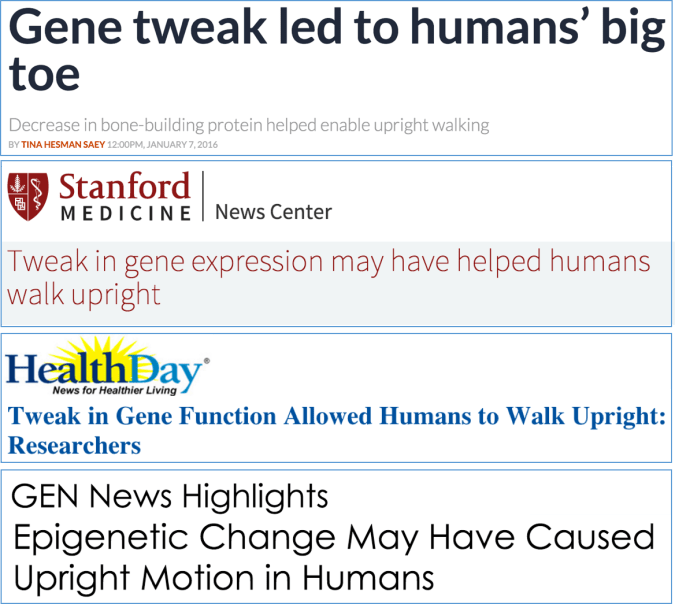
Did GDF6 “gene tweak” allow humans to become upright?

The short answer is, “Not really.” But as is often the case, the real story behind so many headlines last week is a bit more complicated.

smh.

smh. Links to the first, second, third, and fourth stories.

What are they talking about, Willis?

These headlines, each saying something slightly different, are referring to a study by Indjeian and colleagues published in Cell.  Researchers identified a stretch of DNA that is highly conserved across mammals, or in other words, it is very similar between very different organisms. In humans, however, this conserved region is actually missing (“hCONDEL.306”):

Fig. 4A from Indjeian et al. 2016. A stretch of DNA, "hCONDEL.306" is completely missing in humans (as is another stretch, hCONDEL.305) but otherwise very similar between chimpanzees, monkeys and mice.

Fig. 4A from Indjeian et al. 2016. A stretch of DNA on Chromosome 8, “hCONDEL.306,” is very similar between chimpanzees, macaque monkeys, and mice, but is completely missing in humans (as is another stretch, hCONDEL.305).

That a stretch of DNA should be highly conserved across diverse animal groups suggests purifying natural selection has prevented any mutations from occurring here – alterations to this stretch of DNA negatively affected fitness. But that humans should be missing such a highly conserved region suggests that this deletion came under positive natural selection at some point in human evolution. This strategy, of seeking stretches of DNA that are similar between many animals but very different in humans, has led to the identification of hundreds of genetic underpinnings of human uniqueness. Some of these, such as the case in question, involve deleted sequences and have been termed “hCONDELs,” for “regions with high sequence conservation that are surprisingly deleted in humans” (McLean et al., 2011: 216). Others involve the accumulation of mutations where other animals show few or none (e.g., HACNS1; Prabhakar et al. 2008). In many (most?) cases these are “non-coding” sequences of DNA.

How can “non-coding” DNA help make humans upright?

As was predicted 30 years ago (King and Wilson, 1975), what makes humans different from other animals isn’t so much in the protein-coding DNA (the classical understanding of the term, “genes”), but rather in the control of these protein-coding genes. “Non-coding” means that a stretch of DNA may get transcribed into RNA but is not then translated into proteins. But even though these sequences themselves don’t become anything tangible, many are nevertheless critical in regulating gene expression – when, where and how much a gene gets used. It’s wild stuff. Indeed, “Many human accelerated regions are developmental [gene] enhancers” (Capra et al., 2013).

In the present case, hCONDEL.306 refers to the human-specific deletion of a developmental enhancer located near the GDF6 gene, which is a bone morphogenetic protein. The major finding of the paper, as stated succinctly in the Highlights title page, is that “Humans have lost a conserved regulatory element [hCONDEL.306] controlling GDF6 expression…. Mouse phenotypes suggest that [this] deletion is related to digit shortening in human feet.”

How do they link this “gene tweak” to digit shortening?

Since humans have lost this gene enhancer that is highly conserved in other mammals, Indjeian and team reasoned that the chimpanzee DNA sequence associated with this deletion, retaining the enhancer sequence, is likely the ancestral condition from which the human version evolved. They inserted the chimpanzee version into mouse embryos and watched what happened as they developed. The enhancer was only active in the mice’s back legs, specifically in the cartilage that would later become the lateral toe bones and cells that would become a muscle of the big toe (abductor hallucis). These are areas where humans and chimpanzees differ: our lateral toes are shorter than chimps’, and we only have one abductor hallucis muscle whereas chimpanzees have an additional, longer abductor hallucis  (Aiello and Dean, 2002). So, we’re on our way to seeing how hCONDEL.306 might relate to our big toe or upright walking, as the headlines say.

But this still doesn’t explain how this deletion affects GDF6 gene expression, and therefore what this does for our feet. Pressing onward, the scientists compared the size of certain bones in mice with a normal Gdf6 gene, and those in which the Gdf6 gene was completely turned off (or “knocked out”).  The Gdf6 knock-out mice had shorter lateral toe bones than regular mice, but they also had shorter big toes as well – the previous experiment staining mouse embryos showed the ancestral enhancer was expressed more in the latter toes, not so much the big toe.

Figures 5-6 from Indjeian et al. (2016) sum up the findings. Figure 5 (left) shows that the ancestral version of the GDF6 enhancer (blue staining) is most strongly expressed in the lower limb, especially the fifth toe bone. Figure 6 (right) shows that a lack of GDF6 expression (black bars) results in shorter skull and toe bones. Combining these findings, humans lack a gene enhancer associated with the development of long lateral toes.

Figures 5-6 from Indjeian et al. (2016) sum up the findings. Figure 5 (left) shows that the ancestral version of the GDF6 enhancer (blue staining) is most strongly expressed in the lower half of the body, especially the fifth toe bone. Figure 6 (right) shows that a lack of Gdf6 expression (black bars) results in shorter skull and toe bones. Combining these findings, humans lack a gene enhancer associated with the development of long lateral toes.

hCONDEL.306 doesn’t completely turn off GDF6, so this second experiment doesn’t really tell us exactly what the hCONDEL does. But the results are highly suggestive. Indjeian and team showed that Gdf6 affects toe length, among other skeletal traits, in mice. The ancestral enhancer that humans are missing seems to affect GDF6 activity in the leg/foot only. This illustrates a mechanism of modularity – as the authors state, “Loss of this enhancer would thus preserve normal GDF6 functions in the skull and forelimbs, while confining any … changes to the posterior digits of the hindlimb.” In other words, developmental enhancers allow different parts of the body to evolve independently despite being made by some of the same genes (such as GDF6).

As with any good study, results are intriguing but they raise more questions for future studies. The researchers conducted two experiments to investigate the function of hCONDEL.306: first putting the chimp version in mouse embryos to see where the ancestral enhancer is expressed, and then turning off Gdf6 completely in mice to see what happens. A more direct way to see what hCONDEL.306 does might be to put a longer stretch of the human sequence surrounding GDF6 containing (or rather missing) the ancestral enhancer into mouse embryos. I’m not a molecular biologist so maybe this isn’t possible. But this is important because the ancestral (chimpanzee) enhancer appeared to be most strongly expressed in the little toe, but of course this isn’t our only toe that is short compared to chimps. Similarly, how hCONDEL.306 relates to the abductor hallucis muscle remains in question – does it reduce the size of the intrinsic muscle present in both humans and chimps, or does it prevent development of the longer muscle that chimps have but we lack? We can expect to find hCONDEL.306 in the genomes of Neandertals (and Denisovans?), since they also have short toes, but what would it mean if they retained the ancestral enhancer?

So how does this gene tweak help with upright walking?

This is a really cool paper with important implications for human evolution, but something seems to have been lost in translation between the paper and the headlines (the news pieces themselves are good, though). The upshot of the study is that humans lack a stretch of non-coding DNA, which in chimpanzees (or chimp-ified mice) promotes embryonic development of the lateral toes and a big toe muscle. This may be a genetic basis for at least some aspects of our unique feet that have evolved under natural selection for walking on two legs.

But the headlines misrepresent this result, with words like “led to,” “allowed,” and “caused,” especially when these are followed by “big toe” or “upright walking.” hCONDEL.306 doesn’t really have anything to the big toe bone itself, although it might relate to a muscle affecting our big toe. The only sense in which the “Gene tweak led to humans’ big toe” (first title above) is that hCONDEL.306 might be responsible for our short lateral toes, which make our first toe look big by comparison. The other headlines are misleading since we know from fossil evidence that hominins walked upright long before we have evidence for short toes:

These little piggies get none. Fourth toe bones of living apes and humans (left) and possible hominins from 3-5 million years ago (right).

These little piggies get none. Fourth toe bones of living apes and humans (left) and (probable) hominins from 3-5 million years ago (right). I did my best to get all images to scale.

“Epigenetic,” from the fourth article headline, is simply wrong. Modern day epigenetics is a field concerned with the chemical alterations to the structure of DNA. Even the broad concept of epigenetic as originally devised by Conrad Waddington was about how environments (cellular or outside the body) influence development.

ResearchBlogging.orgIt’s hard to fit all the important and interesting information from scientific papers into news headlines. Still, it would be good if headlines more accurately portrayed scientific findings, especially avoiding such definitive verbs as “caused.” Especially in the realm of biology, people should know that there’s a lot that we still don’t know, that there’s lots more important work left to be done.

References

Aiello and Dean, 2002. Human Evolutionary Anatomy. Academic Press.

Capra et al., 2013. Many human accelerated regions are developmental enhancers. Philosophical Transactions of the Royal Society B 368: 20130025.

Indjeian et al. 2016. Evolving new skeletal traits by cis-regulatory changes in bone morphogenetic proteins. Cell http://dx.doi.org/10.1016/j.cell.2015.12.007

King and Wilson, 1975. Evolution at two levels in humans and chimpanzees. Science 188: 107-116 DOI: 10.1126/science.1090005

McLean et al., 2011. Human-specific loss of regulatory DNA and the evolution of human-specific traits. Nature 471: 216-219.

Prabhakar et al., 2008. Human-specific gain of function in a developmental enhancer. Science 321: 1346-1350.
Is it worth seeking a genetic basis for math genius?

The topic this week in my Human Variation and Race class is intelligence. We’ve read about and discussed what intelligence is, how it is quantified, and the extent to which ‘intelligence,’ however defined, is biologically and/or environmentally determined. Intelligence (test score) has been shown to be heritable, meaning that a proportion of the variation in IQ test scores in a population can be explained by genetic variation. But that is not the same as saying that it is genetically determined. Similarly, complex traits such as intelligence, behaviors, and diseases almost never have a simple genetic basis – a common theme over at the Mermaid’s Tale, one that seems too rarely heeded. So you can imagine my surprise and delight at finding this news piece just published in Nature: “Root of maths genius sought: Entrepreneure’s ‘Project Einstein’ taps 400 top academics for their DNA.” Of course “roots” meant “genes.”

Apparently, bioinformatics entrepreneur and multimillionaire Jon Rothberg has set out to identify the genetic bases of peak mathletics, by analyzing the genomes of hundreds of mathematicians and physicists. Good luck, buddy! My initial reaction was to be appalled that an educated biologist these days could be such a flagrant biological determinist. What’s more, when approached about participating in the study, mathematician Curtis McMullen asked about the ethics of the project and its outcomes: “The uniform answer to my questions was that ‘we are not responsible for how the information is used after the study is completed.'” Ew. The project as briefly described reeked of some eugenics programme.

My prediction is that if this study takes off, Rothberg & buddies will be horribly disappointed. Assuming they are able to identify any genetic variants, these will probably only explain a small amount of variation in “maths genius.” Which itself is problematic, since there is probably not a single manifestation of math genius, and even if there were a single way to be a math genius, there may be several genetic pathways relating to the phenotype (not an uncommon finding of many genome-wide association studies). But hey, it seems to be Rothberg’s own money going into the study, so why not.

But then, if my prediction were to hold, this wouldn’t necessarily be a failure – it would point to an important role of society and learning environment in shaping individuals’ mathematic capability. And then maybe big money could begin to be diverted to more productive programs investigating and improving how people learn, rather than to large scale projects seeking simple answers when there isn’t necessarily any reason to expect them in the first place.

Speciation and reticulation

ResearchBlogging.org Hey, “all you lovers out there,” which is how Marvin Berry introduced “Earth Angel” at the Enchantment Under the Sea dance back in good-olde 1955. And by “lovers” I mean “geneticists.”

Poring over the recent Neandertal nuclear genome paper (Green et al. 2010) for seminars, we’re struck by two contradictory ideas. On the one hand, the authors demonstrate pretty convincingly that Neandertals and the more ‘anatomically modern’ humans of Europe and Asia interbred. This doesn’t come from genetic comparisons of Neandertal and contemporaneous human fossils, but of Neandertals with living humans traipsing modern soil. But on the other hand, the authors estimate the time of the divergence of Neandertal and living human populations.
Herein lies the rub:

“Population divergence [is] defined as the point in time when two populations last exchanged genes.” (Green et al. 2010: 717)

Which they estimate, based on genome sequence divergence and some other assumptions, to be anywhere from ~270,000 – 440,000 years ago. But then this:

“[The Out-of-Africa] model for modern human origins suggests that all present-day humans trace all their ancestry back to a small African population that expanded and replaced [Neandertals] without admixture. Our analysis of the Neandertal genome may not be compatible with this view because Neandertals are on average closer to individuals in Eurasia…” (Green et al. 2010: 721)

Though they say “may not” they probably should’ve just said “isn’t.” Either way, they estimate an ancient date at which the groups in question “last exchanged genes,” but also demonstrate that these populations last exchanged genes much more recently.
So what is “population divergence,” then? As a wise man asked, “what does divergence mean when there is reticulation?” (I’m assuming he would prefer to go nameless) Reticulation referring not to pythons or chipmunks, but to mating between individuals in different populations. Is “divergence” not so much the last time genes were exchanged, but rather the time when the genomes began to become different?
Reference
Green, R., Krause, J., Briggs, A., Maricic, T., Stenzel, U., Kircher, M., Patterson, N., Li, H., Zhai, W., Fritz, M., Hansen, N., Durand, E., Malaspinas, A., Jensen, J., Marques-Bonet, T., Alkan, C., Prufer, K., Meyer, M., Burbano, H., Good, J., Schultz, R., Aximu-Petri, A., Butthof, A., Hober, B., Hoffner, B., Siegemund, M., Weihmann, A., Nusbaum, C., Lander, E., Russ, C., Novod, N., Affourtit, J., Egholm, M., Verna, C., Rudan, P., Brajkovic, D., Kucan, Z., Gusic, I., Doronichev, V., Golovanova, L., Lalueza-Fox, C., de la Rasilla, M., Fortea, J., Rosas, A., Schmitz, R., Johnson, P., Eichler, E., Falush, D., Birney, E., Mullikin, J., Slatkin, M., Nielsen, R., Kelso, J., Lachmann, M., Reich, D., & Paabo, S. (2010). A Draft Sequence of the Neandertal Genome Science, 328 (5979), 710-722 DOI: 10.1126/science.1188021