We should not try to clone Neandertals

Interesting that right after I posted about fossils, genotypes and phenotypes, the Leakey Foundation (via Twitter) posts a link to a discussion about cloning Neandertals in order to learn about the genetic bases of human uniqueness. It begins innocently enough, stating that the genotype-phenotype comparisons between humans and the Neandertal Frankenstein could lead us to insights about our genetic predispositions to certain pathogens. Sure, why not. But then this happens (emphases mine): 

“Yet, further discussion with [Harvard geneticist Dr. George Church] revealed an even more interesting benefit. Dr. Church thinks the cloning of a Neanderthal would encourage us to have a greater appreciation for and sensitivity to what he terms “neural diversity.” He believes that by listening to the thoughts of a cloned Neanderthal, who might seem foreign and unusual to us, greater anti-discrimination and de-stigmatization efforts on behalf of those people whose actions are usually considered outside the range of “normal” human behavior might result. These would include individuals diagnosed with dyslexia, narcolepsy, autism, and bipolar disorders.”

Dr. Church belies his own statements of concern for ethics and people’s rights. “Neandertal” has historically been synonymous with ideas of what is ugly, stupid and an anthropological Other (i.e. unlike and less than human), and Church seems to follow this. However, decades of archaeology show us that Neandertals were probably just as capable of complex thinking as recent humans Neandertals buried their dead. Italian Neandertals over 40 thousand years ago appear to have made symbolic use of feathers (Peresani et al. 2011). We also know that the hearing range of the Sima de los Huesos hominids was probably tuned to frequencies used in human speech (Martinez et al. 2004). In addition, the presence of the human-derived FOXP2 gene in Neandertals (Krause et al. 2007) suggests (but of course does not prove) that they could, and probably did, speak to one another with language.

Neandertals were not dumb, so there’s no a priori reason to think that reanimating Neandertal consciousness would provide us with novel insights into a ‘neural other.’ Worse, by equating people who have forms of cognitive/neural impairment with Neandertals, Church (probably inadvertently) otherizes the people he hopes we stop otherizing. Why the hell would a Neandertal clone – a being whose existence is solely an experiment to show us what makes us human based on what’s not like the clone – make us treat differently-abled people better? Worse, what to do if Neandertal shows no cognitive impairments whatsoever? Have Eegah and Encino Man taught us nothing?!

And then there’s the icing on the cake:

“Chicago-Kent College Law Professor Lori Andrews has stated unequivocally that Neanderthals should be accorded all forms of human rights.”

Yes!

UPDATE: Obviously, “Prehistoric Ice Man” (1999), the last episode of the 2nd season of Southpark, provides further reasons not to bring cave-persons of the past into the present day.


ResearchBlogging.orgReferences
Krause, J., Lalueza-Fox, C., Orlando, L., Enard, W., Green, R., Burbano, H., Hublin, J., Hänni, C., Fortea, J., de la Rasilla, M., Bertranpetit, J., Rosas, A., & Pääbo, S. (2007). The Derived FOXP2 Variant of Modern Humans Was Shared with Neandertals Current Biology, 17 (21), 1908-1912 DOI: 10.1016/j.cub.2007.10.008


Martinez, I. (2004). Auditory capacities in Middle Pleistocene humans from the Sierra de Atapuerca in Spain Proceedings of the National Academy of Sciences, 101 (27), 9976-9981 DOI: 10.1073/pnas.0403595101


Peresani, M., Fiore, I., Gala, M., Romandini, M., & Tagliacozzo, A. (2011). Late Neandertals and the intentional removal of feathers as evidenced from bird bone taphonomy at Fumane Cave 44 ky B.P., Italy Proceedings of the National Academy of Sciences, 108 (10), 3888-3893 DOI: 10.1073/pnas.1016212108


Sterling, J. “Concerns over the cloning of a Neanderthal.” GEN News. 02 November 2011. http://bit.ly/uGAnRK
Leopard horse: Fossils, phenotypes and genotypes

I wish I were talking about some beastly horse-big-cat hybrid, or at least a carnivorous horse. Instead… a ton of anthropology-related papers came out today in PNAS, and possibly the coolest one is a study that compares the DNA of Pleistocene fossil and modern horses with different coat colors/patterns, and then ties this in with Paleolithic cave art. A crazy confluence of four-field anthropology right there.

Modern horses and their depictions in Late Pleistocene French caves (Pruvost et al. 2011)
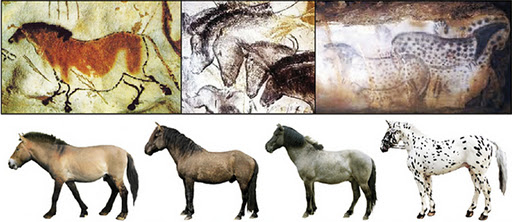
Melanie Pruvost and colleagues (in press) noted that the depiction of spotted horses at the site of Pech-Merle (they give 24 kya) could mean one of two things: (1) either the early human painters were depicting horses they actually saw on the landscape at the time, or (2) they were just being fanciful and frivolous, creative and carefree with their cavern canvas. Now, some modern horse breeds have a similar spotted, “leopard” phenotype, and a genetic basis for this is understood. So Pruvost and pals examined DNA from fossil horse bones from European sites dating to 20 – 2 kya to see if these mottled mares roamed the lands of the cave-painters. Sure enough, several samples show evidence for the mutation causing leopard spots.

This is pretty cool for evolutionary biology and paleontology. A major question in biology is how an individual’s genes (genotype) relate to overall appearance/behavior (phenotype). To a certain extent, physical variation between organisms arises from genetic variation, so when we see things evolve through the fossil record, this ought to correspond with some genetic changes as well. But linking genes to appearances isn’t so easy (especially for extinct animals). Pruvost and colleagues’ study is a step in this direction, though. Plus, the recent sequencing of the fossil Neandertal (Green et al. 2010) and Denisovan (Reich et al. 2010) genomes makes it possible to try to figure out if/how humans’ unique physical traits reflect our genes. In fact, even before these genomes were fully sequenced, Carles Lalueza-Fox and team (2007) identified a mutation on Neandertals’ MC1R gene, strongly suggesting the Neandertals sampled had light skin and red hair.

But the genetic basis for skeletal phenotypes is harder to discern. For example, Green et al. (2010) identified the unique human version of the RUNX2 gene as having come under strong natural selection since the disappearance of Neandertals. The authors noted that because mutations of RUNX2 in humans are associated with a cleidocranial dysplasia affecting the form of the skull and shoulders, and because humans and Neandertals differ in some aspects of their skulls and shoulders, then RUNX2 variation between humans and Neandertals is likely related to visible differences in their skeletons. But that’s about as much as could be said at the moment – RUNX2 is involved in bony development of the entire skeleton, interacting with other various genes in various places during ontogeny. So while it’s tempting, it’s still a little early to link RUNX2, or pretty much any other development-related gene, with physical differences between humans and our fossil relatives. But one day!

ResearchBlogging.org
A Neandertal’s ruddy locks have never preserved in the fossil record, but its bones are very well known. In an ironic twist, we may have a better understanding of the genetic basis of variation in a soft-tissue (for which there are no fossils), than we do for the skeleton (for which we have lots of fossils).

And maybe one day I’ll get that leopard horse I was hoping for.

References
Green, R., Krause, J., Briggs, A., Maricic, T., Stenzel, U., Kircher, M., Patterson, N., Li, H., Zhai, W., Fritz, M., Hansen, N., Durand, E., Malaspinas, A., Jensen, J., Marques-Bonet, T., Alkan, C., Prufer, K., Meyer, M., Burbano, H., Good, J., Schultz, R., Aximu-Petri, A., Butthof, A., Hober, B., Hoffner, B., Siegemund, M., Weihmann, A., Nusbaum, C., Lander, E., Russ, C., Novod, N., Affourtit, J., Egholm, M., Verna, C., Rudan, P., Brajkovic, D., Kucan, Z., Gusic, I., Doronichev, V., Golovanova, L., Lalueza-Fox, C., de la Rasilla, M., Fortea, J., Rosas, A., Schmitz, R., Johnson, P., Eichler, E., Falush, D., Birney, E., Mullikin, J., Slatkin, M., Nielsen, R., Kelso, J., Lachmann, M., Reich, D., & Paabo, S. (2010). A Draft Sequence of the Neandertal Genome Science, 328 (5979), 710-722 DOI: 10.1126/science.1188021

Pruvost, M., Bellone, R., Benecke, N., Sandoval-Castellanos, E., Cieslak, M., Kuznetsova, T., Morales-Muniz, A., O’Connor, T., Reissmann, M., Hofreiter, M., & Ludwig, A. (2011). Genotypes of predomestic horses match phenotypes painted in Paleolithic works of cave art Proceedings of the National Academy of Sciences DOI: 10.1073/pnas.1108982108

Reich, D., Green, R., Kircher, M., Krause, J., Patterson, N., Durand, E., Viola, B., Briggs, A., Stenzel, U., Johnson, P., Maricic, T., Good, J., Marques-Bonet, T., Alkan, C., Fu, Q., Mallick, S., Li, H., Meyer, M., Eichler, E., Stoneking, M., Richards, M., Talamo, S., Shunkov, M., Derevianko, A., Hublin, J., Kelso, J., Slatkin, M., & Pääbo, S. (2010). Genetic history of an archaic hominin group from Denisova Cave in Siberia Nature, 468 (7327), 1053-1060 DOI: 10.1038/nature09710

Inanimate fossils getting older still

Two reports came out last week in the journal Nature, re-dating some European human fossils to before 40 thousand years ago (kya), a few thousand years older than previous evidence for modern-looking people in the region. The media have been reporting these studies as revealing “the first Europeans,” but of course we all know that the first Europeans were the badass hominids, my favorites, from the 1.8 million year old site of Dmanisi.

KC4 maxilla (Higham et al. 2011)

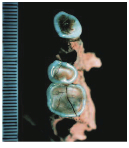
From Kent’s Cavern (United Kingdom) is a partial maxilla, now dated to 44 – 41 kya* (Higham et al. 2011; but see below). The jaw fragment with highly worn teeth was found just above some Aurignacian-like (Upper Paleolithic) blades in 1927. [NB below these 2 blades were 2 other blades of a tool “complex…tentatively associated with Neandertals] The laughable amount of bone makes it rather impossible to say whether the fossil represents a Neandertal or more modern-looking human. The authors examined what little of the morphology was left and concluded that the fossil shared the most similarities with recent humans but only a few with Neandertals. A more rigorous analysis of what this mix of traits means would have been nice (i.e. why would an individual have derived traits of both ‘modern’ humans and Neandertals?). The researchers tried to extract DNA for analysis, but apparently organic remains were too poorly preserved for a good analysis. Bummer.

Cavallo B and C (Benazzi et al. 2011)

A similar older-than-we-thought story is reported by Stefano Benazzi and buddies, who reanalyzed teeth from the Italian site of Grotta del Cavallo (left). After the site was excavated in 1967, the teeth were attributed to Neandertals and the lithics classified as “Uluzzian.” I would be a dirty liar if I said knew anything about the “Uluzzian” industry (try this other site which may be more informative), but apparently it’s seen as transitional between the Neandertal-associated Mousterian and ‘more advanced’ Upper Paleolithic toolkits. So this assemblage could be used to argue that Neandertals were smart enough to upgrade to a sexier stone tool industry shortly before their anatomy (but not their genes!) disappeared. BUT! also like in Kent’s Cavern paper, Benazzi and colleagues examined what little morphology is preserved in the fossil teeth, and (re)assigned them to modern-looking humans. The authors provided nice qualitative and quantitative arguments for the human status of the teeth, though again I have to raise caution that these are only teeth and we have no idea what the rest of the skeleton would have looked like. Researchers also analyzed shells associated with the now-human teeth and dated the site to around 44 kya, making them the oldest probably-human remains in Europe.

Now, according to conventional wisdom, the Neandertals were dullards who made and used the Mousterian stone tool industry. The Mousterian was nice and all, but not nearly as wicked-pisser as the smart and sassy modern-looking humans’ Aurignacian toolkit. The thing is, though, there really hasn’t been really a lot of evidence unequivocally linking modern-looking fossils with Aurignacian artifacts. So both of the recent studies in Nature lend support to the idea that maybe modern humans were the sole makers (and users) of an advanced stone tool industry. But it’s important to remember [1] that the blades ‘associated’ with the Kent’s Cavern jaw can’t really be definitively attributed to a stone tool industry; [2] the blades were deeper in the cave than the jaw, and so may actually be appreciably older than the jaw; and [3] while the teeth from Kent’s Cavern and Cavallo do look most comparable to those belonging to ‘anatomically’ modern humans, we don’t know what the skulls or skeletons containing the teeth looked like. All that said, it’s neat to see the possible appearance of certain anatomy and technology in Europe thousands of years earlier than previously thought. It also re-raises the issue of the degree to which modern-looking humans and Neandertals overlapped in space and time, and what these interactions would have been like (I’d guess terrifying, hilarious and/or sexy).

KC4 originally
(Higham et al. 2011)

A fun lesson also comes from the Kent’s Cavern study. Higham and colleagues report that the KC4 human maxilla was excavated in 1927 and analyzed by Sir Arthur Keith, a well-trained anatomist and paleoanthropologist famous in his day. Keith described the fossil as containing a canine, second premolar and first molar (right, compare with above). Higham and colleagues, however, noticed that what Keith described as a second premolar was in fact a first premolar. The teeth are so worn they mostly lack information about their form and features, so this mistake probably didn’t really mislead anatomists in any way. Still, it goes to show that even experts like Keith can make mistakes or overlook the things they know best, and this is not the first time I’ve seen this happen with fossils. So always (politely) question those giants whose shoulders you’re standing upon.

*Update (07 Nov): John Hawks points out that the KC4 maxilla itself was not used to obtain the older radiocarbon age estimate. In 1989 the maxilla was directly dated to around 30 kya, over 10 ky younger than the new estimates. Higham and friends thought this date was too young, based on methodological grounds. An attempt to redate the KC4 maxilla based on one of the teeth yielded too little collagen (organic material) to produce a date. Bummer again! The new estimate is instead based on radiocarbon dates obtained from animal bones that were excavated from above and below the human jaw. So this ‘redating’ of the Kent’s Cavern maxilla is very interesting, but should be taken with a grain of salt.

ResearchBlogging.org
See for yourself
Benazzi, S., Douka, K., Fornai, C., Bauer, C., Kullmer, O., Svoboda, J., Pap, I., Mallegni, F., Bayle, P., Coquerelle, M., Condemi, S., Ronchitelli, A., Harvati, K., & Weber, G. (2011). Early dispersal of modern humans in Europe and implications for Neanderthal behaviour Nature DOI: 10.1038/nature10617

Higham, T., Compton, T., Stringer, C., Jacobi, R., Shapiro, B., Trinkaus, E., Chandler, B., Gröning, F., Collins, C., Hillson, S., O’Higgins, P., FitzGerald, C., & Fagan, M. (2011). The earliest evidence for anatomically modern humans in northwestern Europe Nature DOI: 10.1038/nature10484

Neandertal terminal biogeography

How late did Neandertals persist in the Late Pleistocene? Two papers out this week discuss the dates of the latest Neandertals in western Asia.

Pinhasi and colleagues (2011) stress the importance of directly dating Late Pleistocene human-ish fossils. There are numerous techniques used to estimate the ages of the fun stuff we find underground. For fairly old fossils like australopithecines, perhaps the most reliable radiometric method is Argon-Argon, though this requires the fossils to be relatable to volcanic sediments whose argon levels can be measured. The point is that dates of burial are often not estimated from the fossil materials themselves, but rather the sediments and such surrounding the fossil of interest. But younger fossils (than say 50,000) preserve some of the bone’s original carbon -allowing age estimates of the fossils themselves by radiocarbon dating.

Pinhasi and colleagues note that while seven separate Neandertal specimens from across Europe and western Asia have been directly dated to be younger than 36 thousand years, these dates may be underestimates. In other words, Neandertals may not have lived after 40 thousand years. To this end, these researchers directly re-dated the infant Neandertal from Mezmaiskaya Cave in Russia, and estimate the poor lad to have died around 42-44 thousand years ago. The authors predict that future direct redating of other Neandertals will show Neandertals to have disappeared by 40 thousand years ago, and that they would have overlapped in time with more modern-looking humans either minimally or not at all. If only there were more information on the latest dates for Middle Paleolithic people!

Lucky me, in tomorrow’s Science, Ludovic Slimak and colleagues report on Mousterian tools dating to 32-34 thousand years ago, from the site of Byzovaya Cave “in the western foothills of the Polar Urals” (Slimak et al. 2011: 841). “POLAR!” The site is way further north than any site with Neandertal bones like Mezmaiskaya and Okladnikov, which is pretty impressive. But, there are no human remains associated with the tools, so we don’t know who made them. To what extent do these finds address Pinhasi’s and others’ contention of no Neandertals after 40 thousand years ago?

Slimak and colleagues carbon-dated animal bones that were butchered with the Mousterian tools, which were allegedly made only by Neandertals. There is a major problem with the wide-held assumption that Mousterian (Middle Paleolithic) tools were made only by Neandertals, whereas Upper Paleolithic industries beginning with the Aurignacian were made only by humans. This goes along with people’s wont to make a connection between stone tool ‘culture’ and biologically determined, phylogenetically significant behavioral capacities. But of course, we know biology doesn’t determine behavior, and so there’s no reason to assume [Mousterian:Neandertal::Aurignacian:’Modern’ Human]. Where Mousterian remains have been associated with diagnostic skeletal remains, they are Neandertal. But the Aurignacian, so far as I know, is not associated with diagnostic fossils – we can’t say for certain who made it. Plus we know Neandertals were doing something kooky, yet logical in some sort of cognitively complex way, with bird feathers in Italy 44 thousand years ago (Peresani et al. 2011). So the Byzovaya stone tools may demonstrate a late, northern holdout of Neandertals, but then they could simply mean that the new technology either hadn’t arrived or hadn’t been successful in the far reaches of sub-Artic Pleistocene humanity.

If the latter is the case and Pinhasi & team’s hypothesis that Neandertals didn’t coexist in time and space (or did only minimally) holds, then the old assumption of Mousterian = Neandertal becomes dubious for other sites with Mousterian tools but no diagnostic fossils. This would also beg the question of the role of modern humans in the Neandertal demise – did the Neandertals disappear and open a niche for other groups of people (‘moderns’)?

So how were Neandertal populations distributed through space and time in their latest days? I dunno! But for the moment I suppose I’d be surprised if no fossils with Neandertal morphology turn out to be younger than 40 thousand years as suggested by Pinhasi and co. But then I could be wrong.

ResearchBlogging.org
References
Hoffmann, A., Hublin, J., Hüls, M., & Terberger, T. (2011). The Homo aurignaciensis hauseri from Combe-Capelle – A Mesolithic burial Journal of Human Evolution DOI:10.1016/j.jhevol.2011.03.001

Peresani, M., Fiore, I., Gala, M., Romandini, M., & Tagliacozzo, A. (2011). Late Neandertals and the intentional removal of feathers as evidenced from bird bone taphonomy at Fumane Cave 44 ky B.P., Italy Proceedings of the National Academy of Sciences, 108 (10), 3888-3893 DOI:10.1073/pnas.1016212108

Pinhasi R, Higham TF, Golovanova LV, & Doronichev VB (2011). Revised age of late Neanderthal occupation and the end of the Middle Paleolithic in the northern Caucasus.Proceedings of the National Academy of Sciences of the United States of America PMID:21555570

Slimak, L., Svendsen, J., Mangerud, J., Plisson, H., Heggen, H., Brugere, A., & Pavlov, P. (2011). Late Mousterian Persistence near the Arctic Circle Science, 332 (6031), 841-845 DOI:10.1126/science.1203866

Speciation and reticulation

ResearchBlogging.org Hey, “all you lovers out there,” which is how Marvin Berry introduced “Earth Angel” at the Enchantment Under the Sea dance back in good-olde 1955. And by “lovers” I mean “geneticists.”

Poring over the recent Neandertal nuclear genome paper (Green et al. 2010) for seminars, we’re struck by two contradictory ideas. On the one hand, the authors demonstrate pretty convincingly that Neandertals and the more ‘anatomically modern’ humans of Europe and Asia interbred. This doesn’t come from genetic comparisons of Neandertal and contemporaneous human fossils, but of Neandertals with living humans traipsing modern soil. But on the other hand, the authors estimate the time of the divergence of Neandertal and living human populations.
Herein lies the rub:

“Population divergence [is] defined as the point in time when two populations last exchanged genes.” (Green et al. 2010: 717)

Which they estimate, based on genome sequence divergence and some other assumptions, to be anywhere from ~270,000 – 440,000 years ago. But then this:

“[The Out-of-Africa] model for modern human origins suggests that all present-day humans trace all their ancestry back to a small African population that expanded and replaced [Neandertals] without admixture. Our analysis of the Neandertal genome may not be compatible with this view because Neandertals are on average closer to individuals in Eurasia…” (Green et al. 2010: 721)

Though they say “may not” they probably should’ve just said “isn’t.” Either way, they estimate an ancient date at which the groups in question “last exchanged genes,” but also demonstrate that these populations last exchanged genes much more recently.
So what is “population divergence,” then? As a wise man asked, “what does divergence mean when there is reticulation?” (I’m assuming he would prefer to go nameless) Reticulation referring not to pythons or chipmunks, but to mating between individuals in different populations. Is “divergence” not so much the last time genes were exchanged, but rather the time when the genomes began to become different?
Reference
Green, R., Krause, J., Briggs, A., Maricic, T., Stenzel, U., Kircher, M., Patterson, N., Li, H., Zhai, W., Fritz, M., Hansen, N., Durand, E., Malaspinas, A., Jensen, J., Marques-Bonet, T., Alkan, C., Prufer, K., Meyer, M., Burbano, H., Good, J., Schultz, R., Aximu-Petri, A., Butthof, A., Hober, B., Hoffner, B., Siegemund, M., Weihmann, A., Nusbaum, C., Lander, E., Russ, C., Novod, N., Affourtit, J., Egholm, M., Verna, C., Rudan, P., Brajkovic, D., Kucan, Z., Gusic, I., Doronichev, V., Golovanova, L., Lalueza-Fox, C., de la Rasilla, M., Fortea, J., Rosas, A., Schmitz, R., Johnson, P., Eichler, E., Falush, D., Birney, E., Mullikin, J., Slatkin, M., Nielsen, R., Kelso, J., Lachmann, M., Reich, D., & Paabo, S. (2010). A Draft Sequence of the Neandertal Genome Science, 328 (5979), 710-722 DOI: 10.1126/science.1188021

Iron Chef: Middle Paleolithic

New evidence suggests Neandertals ate cooked foods, and plants at that.
Amanda Henry and colleagues (in press) extracted phytoliths – small mineralized parts from plants – and starch grains from dental calculus found on 2 Belgian (Spy) and 1 Iraqi (Shanidar) Neandertal fossils. I’ve never seen a study look at this kind of evidence before, I have to say it’s pretty neat. Calculus, not just a badass type of mathematics, is mineralized plaque that can build up on teeth. As the Neandertals chewed their foods, the small food particles got trapped in their plaque and this gross matrix hardened onto their teeth. So, if you want to obliterate traces of your diet, and otherwise conform to Western norms of dental hygiene, one thing you can do is be sure always to brush. And floss.

Microscopic barley grains. Top row are examples of grains from Shanidar calculus, and beneath each are examples of modern barley to which they are probably related. Fig. 1 from Henry et al. (in press)

Types of plants eaten by the Shanidar individual include relatives of modern wheat, barley (see figure), and rye, and what looked like beans and date palm, too. In addition, some of the starch grains bear strong resemblance to plant remains after cooking, probably either by boiling or baking. The Belgian samples provided less broad evidence, indicating presence mainly of some type of underground storage organ (like a tuber) and grass seeds. Many phytoliths and grains were unable to be identified, leaving open the chance that future research on these will uncover utilization of a greater breadth of plants.
This is pretty neat, since studies of the isotopes in Neandertal teeth indicated a strong meat component to the diet. In fact, Neandertals have often been referred to as ‘top carnivores.’ This new study supports other evidence of a large plant component as well. After all, isotope studies are only one form of evidence of diet. Neandertals weren’t just big game hunters, they were hunter-gatherers. What’s more, they improved the edibility and nutritive value of their plant (and probably also animal) foods by cooking them. So, this study presents another way in which Neandertals were probably no different from contemporaneous humans.
One has to wonder what these paleolithic meals would have been like. Especially what with claims of cannibalism in some Neandertal sites – perhaps “liver with some fava beans and a nice chiaaanti…fhfhfhfhfhfhfh,” to quote Hannibal Lecter. And who would win Iron Chef – the classic Neandertals, or their more ‘modern’ looking contemporaries?

ResearchBlogging.org
Reference
Henry, A., Brooks, A., & Piperno, D. (2010). Microfossils in calculus demonstrate consumption of plants and cooked foods in Neanderthal diets (Shanidar III, Iraq; Spy I and II, Belgium) Proceedings of the National Academy of Sciences DOI: 10.1073/pnas.1016868108