Dietary divergence of robust australopithecines

I’m writing a review of the “robust” australopithecines, and I’m reminded of how drastically our understanding of these hominins has changed in just the past decade. Functional interpretations of the skull initially led to the common wisdom that these animals ate lots of hard foods, and had the jaws and teeth to cash the checks written by their diets.

Screen Shot 2016-07-28 at 9.28.43 AM

Comparison of a “gracile” (left) and “robust” (right) Australopithecus face, from Robinson (1954).

While anatomy provides evidence of what an animal could have been eating, there is more direct evidence of what animals actually did eat. Microscopic wear on teeth reflects what kinds of things made their way into an animal’s mouth, presumably as food, and so provide a rough idea of what kinds of foods an animal ate in the days before it died. Microwear studies of A. robustus from South Africa had confirmed previous wisdom: larger pits and more wear complexity in A. robustus than in the earlier, “gracile” A. africanus suggested more hard objects in the robust diet (e.g., Scott et al., 2005). A big shock came a mere 8 years ago with microwear data for the East African “hyper robust” A. boisei: molars had many parallel scratches and practically no pitting, suggesting of a highly vegetative diet (Ungar et al. 2008).

robust microwear

Microwear in A. boisei (blue) and A. robustus (red). Although they overlap mostly for anisotropy (y-axis), they are completely distinct for complexity (x-axis). Data from Grine et al. (2012) and skull diagrams from Kimbel et al. (2004).

Stable carbon isotope analysis, which assesses what kinds of plant-stuffs were prominent in the diet when skeletal tissues (e.g. teeth) formed, further showed that the two classically “robust” hominins (and the older, less known A. aethiopicus) ate different foods. Whereas A. robustus had the carbon isotope signature of an ecological generalist, A. boisei had values very similar to gelada monkeys who eat a ton of grass/sedge. GRASS!

robust isotopes

Stable carbon isotope data for robust australopithecines. Data from Cerling et al. (2013) and skull diagrams from Kimbel et al. (2004). Note again the complete distinction between A. robustus (red) and A. boisei (blue).

ResearchBlogging.orgWhile microwear and isotopes don’t tell us exactly what extinct animals ate, they nevertheless are much more precise than functional anatomy and help narrow down what these animals ate and how they used their environments. This highlights the importance of using multiple lines of evidence (anatomical, microscopic, chemical) to understand life and ecology of our ancient relatives.

REFERENCES

Cerling TE, Manthi FK, Mbua EN, Leakey LN, Leakey MG, Leakey RE, Brown FH, Grine FE, Hart JA, Kaleme P, Roche H, Uno KT, & Wood BA (2013). Stable isotope-based diet reconstructions of Turkana Basin hominins. Proceedings of the National Academy of Sciences, 110 (26), 10501-6 PMID: 23733966

Grine FE, Sponheimer M, Ungar PS, Lee-Thorp J, & Teaford MF (2012). Dental microwear and stable isotopes inform the paleoecology of extinct hominins. American Journal of Physical Anthropology, 148 (2), 285-317 PMID: 22610903

Kimbel WH, Rak Y, & Johanson DC (2004). The Skull of Australopithecus afarensis. Oxford University Press.

Robinson, J. (1954). Prehominid Dentition and Hominid Evolution Evolution, 8 (4) DOI: 10.2307/2405779

Ungar PS, Grine FE, & Teaford MF (2008). Dental microwear and diet of the Plio-Pleistocene hominin Paranthropus boisei. PloS One, 3 (4) PMID: 18446200
The strange days of yore

Today is not like the good ol’ days. In many ways things have changed for the better. For instance, in the good ol’ days, many paleontologists would find fossils but let nary a soul examine them; today, you can download high quality 3D models of many important fossils from both East and South Africa, completely for free!

Robert Broom’s (1938) account of the discovery of the first Paranthropus (or Australopithecus) robustus is also a reminder of the strangeness of the bygone days of yore:

Screen Shot 2016-06-23 at 5.57.24 PM

Wait for it …

In June of this year a most important discovery was made. A schoolboy, Gert Terblanche, found in an outcrop of bone breccia near the top of a hill, a couple of miles from the Sterkfontein caves, much of the skull and lower jaw of a new type of anthropoid. Not realizing the value of the find, he damaged the specimen considerably in hammering it out of the rock. The palate with one molar tooth he gave to Mr. Barlow at Sterkfontein, from whom I obtained it. Recognizing that some of the teeth had recently been broken off, and that there must be other parts of the skull where the palate was found, I had to hunt up the schoolboy. I went to his home two miles off and found that he was at the school another two miles away, and his mother told me that he had four beautiful teeth with him. I naturally went to the school, and found the boy with four of what are perhaps the most valuable teeth in the world in his trouser pocket. He told me that there were more bits of the skull on the hillside. After school he took me to the place and I gathered every scrap I could find; and when these were later examined and cleaned and joined up, I found I had not only the nearly perfect palate with most of the teeth, but also practically the whole of the left side of the lower half of the skull and the nearly complete right lower jaw.

What a wild time – Broom hunts down poor Gert, barges into the school, then makes the kid show him where he hacked the skull out of the rock. Poor, poor Gertie.

Maybe it was a different Gertie, but surely the reaction was the same.

Maybe it was a different Gertie, but surely the reaction was the same.

Of course, there was a lot at stake. I mean, brazen Gert harbored not just “beautiful teeth,” but “the most valuable teeth in the world.” IN HIS TROUSERS! And of course Gert was also the soul possessor of priceless intel – the source of the fossils. So maybe Broom was justified in this zealous abduction. And O! such prose in a Nature paper! WAS IT WORTH IT, DR. BROOM?

At Sterkfontein, a bronzed Broom considers the weight of his actions.

At Sterkfontein, a bronzed Broom considers the weight of his actions.

Of course, Gert wasn’t the last kid to discover an important human fossil. The game-changing Australopithecus sediba  was discovered when Matthew Berger, son of famed Lee Berger and only 9 years old at the time, saw a piece of a clavicle sticking out of a block of breccia. Both Gert and Matthew show that you don’t have to be a doctor to make amazing discoveries. What future fossil discoveries will be made by kids, and making my adult accomplishments pale in comparison?!

Gracile & robust Australopithecus

Last week, I introduced my Human Evolution students to the “robust” australopiths. It was a very delicate time, when we had to have a grown up, mature conversation about adult things. I reminded the students that they’re only human, but they must resist urges that seem so natural. No matter how much they want to, even if their friends are doing it, they must not act on the deep, dark desire to say that “robust” vs. “gracile” Australopithecus differ in their body build.

Don't do it, Homo naledi. Don't talk about body size when you mean to talk about jaw and tooth size. Illustration by Flos Vingerhoets.

Don’t do it, Homo naledi. Don’t talk about body size when you mean to talk about jaw and tooth size. Illustration by Flos Vingerhoets.

Every semester, students (who don’t read and/or pay attention to lecture) think that the difference between these two groups has to do with the species’ body sizes. This is a misconception that has reached the highest echelons of reference:

At least one person is not citing their source here. F-.

Apple and Google, at least one person here is not citing their source: F-. Also, is no one else surprised that this term is allegedly specific to anthropology?

No. In the case of australopiths, “gracile” and “robust” refer to the relative size of the jaws, teeth and chewing muscles (all contributing to the “masticatory apparatus”). Traditionally,  graciles include the ≥2 million year old Australopithecus afarensis and africanus, and robusts include the later A. boisei and robustus. The discovery of an A. aethiopicus cranium (Walker et al. 1986) somewhat blurred the lines between the two groups but it is usually included with the robusts (who are often collectively called Paranthropus). John Fleagle’s classic textbook (1999) illustrates the gracile-robust dichotomy very nicely:

Comparison of gracile (left) and robust (right) craniodental traits. From Fleagle, 1999.

So to recap: Jaws and teeth, people! To the best of my knowledge, there’s little or no evidence that the various australopithecines differed appreciably in body size (McHenry and Coffing, 2000), stoutness, or muscularity. Although the OH 80 partial skeleton, attributed to Australopithecus boisei  based on tooth size and proportions, includes a humerus with very thick cortical bone and a radius with a crazy big insertion for the biceps muscle—it was a very large and muscular A. boisei (Domínguez-Rodrigo et al., 2013). Nevertheless, gracile and robust australopithecine species differ most notably in their jaws and teeth, not bodies. Maybe this is why Liz Lemon was so confused about the term “robust”?

Today, these are somewhat antiquated terms. Back when the only early hominins known to science were the species listed above, it was easy to make a distinction. However, as the fossil record has expanded of late, the gracile-robust dichotomy becomes blurry. Australopithecus garhi (Asfaw et al., 1999) has overall tooth proportions comparable to graciles, but absolute tooth sizes and sagittal cresting like robusts. The recently described Australopithecus deyiremeda has tooth sizes and proportions like graciles but lower jaws that are very thick, like those of robust australopiths (Haile-Selassie et al., 2015).

So in light of all the confusion and blurring distinctions, maybe it’s time to scrap “gracile” vs. “robust”?

Further reading:  The “robust” australopiths (Constantino, 2013). I also wrote up a short reference chapter here.

ResearchBlogging.org

References
Asfaw B, White T, Lovejoy O, Latimer B, Simpson S, & Suwa G (1999). Australopithecus garhi: a new species of early hominid from Ethiopia. Science (New York, N.Y.), 284 (5414), 629-35 PMID: 10213683

Domínguez-Rodrigo, M., Pickering, T., Baquedano, E., Mabulla, A., Mark, D., Musiba, C., Bunn, H., Uribelarrea, D., Smith, V., Diez-Martin, F., Pérez-González, A., Sánchez, P., Santonja, M., Barboni, D., Gidna, A., Ashley, G., Yravedra, J., Heaton, J., & Arriaza, M. (2013). First Partial Skeleton of a 1.34-Million-Year-Old Paranthropus boisei from Bed II, Olduvai Gorge, Tanzania PLoS ONE, 8 (12) DOI: 10.1371/journal.pone.0080347

Haile-Selassie Y, Gibert L, Melillo SM, Ryan TM, Alene M, Deino A, Levin NE, Scott G, & Saylor BZ (2015). New species from Ethiopia further expands Middle Pliocene hominin diversity. Nature, 521 (7553), 483-8 PMID: 26017448

Walker, A., Leakey, R., Harris, J., & Brown, F. (1986). 2.5-Myr Australopithecus boisei from west of Lake Turkana, Kenya Nature, 322 (6079), 517-522 DOI: 10.1038/322517a0

Calotte or Carapace?

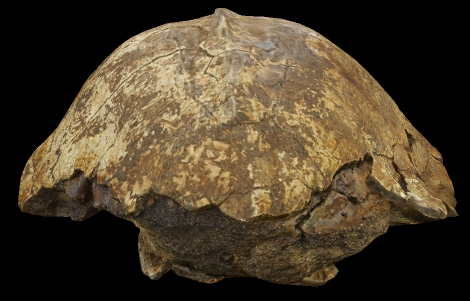
Is this the top of a hominin skull, replete with sagittal crest running down the middle, or is it the top of a tortoise shell?

This image comes from great resource I just found (thanks to Louise Leakey on Twitter) for paleoanthropology students – africanfossils.org. I won’t answer here whether this is hominin or turtle, you’ll have to find it at the African Fossils site.

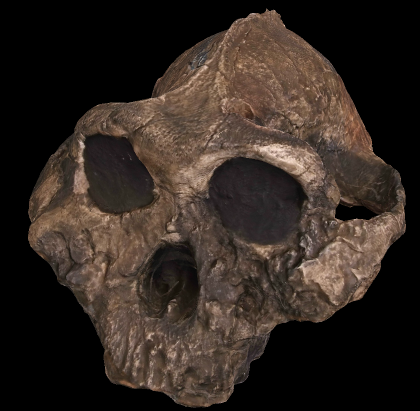
The site has 3D, manipulable images of fossil hominins and other animals from Kenya and Tanzania. The Smithsonian Museum of Natural History also has a very nice 3D collection, similarly manipulable. Resolution isn’t always what you might want it to be (for instance, you won’t be able to tell if the basi-occipital suture is fused in the Homo erectus cranium KNM-ER 42700), but you still get good overall view of some neat and bizarre animals. Like this robust australopithecus! (KNM-ER 406) Hey, its brain case does look kinda like the pic above…

New beef with boisei – maybe the dingo ate their babies?

ResearchBlogging.orgUnfortunately, the title is not in reference to a study demonstrating that early hominids fell prey to wild dogs. But Elaine Benes would have appreciated it.

As part of my Latitudes Tour, I’m in Nairobi for a couple of days, hoping to spend some quality time with the young Australopithecus boisei kids at the Nairobi National Museum. Recall (that is, if I’ve mentioned it here?) that my dissertation research is on growth of the lower jaw, in Australopithecus robustus as compared to modern humans. The study of growth obviously requires analyzing individuals across different age groups (an “ontogenetic series” is the fancy term). Admittedly, then, the focus on A. robustus is chiefly because this species has the largest ontogenetic sample of any early hominid (tho at nearly 15 subadults, it’s still not as large as one could hope). Also because A. robustus was totally badass.

Australopithecus boisei makes an important comparison for A. robustus, because the two species are allegedly evolutionary ‘sisters’ – the “robust” australopithecines (though I’m personally not convinced that these two are each other’s closest relative). So their growth should be pretty similar. At the same time, though, A. boisei shows much greater adaptations to heavy chewing – they’ve been referred to as “hyper-robust.” So comparing growth in these species should elucidate how their differences arise.
Problem is, there just aren’t enough kids! It’s like that song by Arcade Fire. Wood and Constantino (2007) published a pretty comprehensive review of A. boisei, including a 1.5-page table of the skulls and teeth attributed to the species. So far as I know, only 4 specimens in this table are subadult mandibles, and so far as I can tell, they’re all about the same age (right around the age that the first permanent molar comes in). There are so many jaws of adult A. boisei (although many of these are abraded mandibular bodies lacking teeth) – so how can there be fewer subadults?!?!


A very preliminary observation of infant-child pairs in the two species suggests they both increase in size fairly dramatically between when they only have baby (a.k.a. “deciduous” or “milk”) teeth and when the first permanent molar comes in. But this is just a preliminary observation based on 2 specimens of each species! Take with a grain of salt!
On second thought, maybe I’ll propose the nearly untestable hypothesis that bone-eating hyenas ate the boisei babes, and that’s why we don’t have their jaws. What could have been nicely preserved subadult boisei bones are instead coprolites (fossilized poops). A little spectacular, yes, but it’s also been hypothesized that many of the A. robustus fossils we know and love came to us as carnivores’ scraps.
further reading:
Wood, B., & Constantino, P. (2007). Paranthropus boisei: Fifty years of evidence and analysis American Journal of Physical Anthropology, 134 (S45), 106-132 DOI: 10.1002/ajpa.20732

Culinary trends in an extinct hominid

A few weeks ago I discussed a recent paper that analyzed the carbon and oxygen isotope ratios from Australopithecus boisei molars (Cerling et al. 2011). The major finding here was that an enlarged sample (n=24 more) corroborated earlier isotopic (van der Merwe et al. 2008) and tooth wear evidence (Ungar et al. 2008) that A. boisei probably did not subsist on as much hard foods as previously thought. Although this strange hominid probably ate mostly grass/aquatic tubers, some researchers think it may have looked something like this:
Left, A. boisei reconstructed skull, from McCollum (1999, Fig. 1). Right, artist’s reconstruction of what the individual on the left may have looked like during life.
But looking at the numbers I’m wondering if the carbon isotopes reveal anything more about this curious hominid. If we plot boisei‘s carbon 13 values against the fossils’ estimated ages, there’s a small hint of a temporal trend, of increasing carbon 13 levels over time (more C4 plant consumption). Fitting a line to these data does indicate an increasing C4 component over time, but the slope of the line is not significantly different from zero. The early, high value could be an outlier (not eating the same stuff as his/her peers?), although the lowest carbon 13 value of all that would support this trend is also much lower than the other values; it could be a more anomalous one. So while it’s tempting to hypothesize dietary change over time in A. boisei, at the moment it looks like you can’t reject the hypothesis that diet is consistent throughout the Pleistocene until the A. boisei’s demise.  Supporting dietary stasis, Ungar and colleagues (2008) reported similar molar tooth wear in specimens from 2.27-1.4 million years ago.
In addition, Cerling and colleagues sampled at least one of each of the cheek teeth. Because teeth form in the jaws in a sequence (not all at the exact same time), the isotopic signatures from given teeth represent the dietary intake of carbon at various different points in an individual’s childhood. In the figure below I lumped upper and lower teeth together; the un-numbered “M” indicates molars unassigned to a specific position.

The first molar crown starts to form right around birth, and note here that it’s carbon 13 values are slightly higher than the other molars. The premolars and second molar start to form around the same time, so it is curious that each of these teeth show distinctly different ranges of carbon 13 levels. The sole P3 is also the lowest value (eating fewer C4 plants) in the entire sample, but the P4 has less negative values (eating more C4 plants). Not sure what’s going on here, but maybe later analyses of more specimens will clarify the situation.

ResearchBlogging.org
Our australopithecine ancestors and cousins have proven to be a rag-tag bunch of funny bipeds, and A. boisei has proven to be one of the weirder ones, in my opinion. Of course descriptions of Ardipithecus ramidus and Australopithecus sediba skeletons have been recent reminders that we have lots left to learn about Pleistocene hominids. For my part, I’m interested in working out the deal with the group of “robust” Australopithecus.
References
Cerling, T., Mbua, E., Kirera, F., Manthi, F., Grine, F., Leakey, M., Sponheimer, M., & Uno, K. (2011). Diet of Paranthropus boisei in the early Pleistocene of East Africa Proceedings of the National Academy of Sciences DOI: 10.1073/pnas.1104627108
McCollum, M. (1999). The Robust Australopithecine Face: A Morphogenetic Perspective Science, 284 (5412), 301-305 DOI: 10.1126/science.284.5412.301
Ungar PS, Grine FE, & Teaford MF (2008). Dental microwear and diet of the Plio-Pleistocene hominin Paranthropus boisei. PloS one, 3 (4) PMID: 18446200
van der Merwe NJ, Masao FT and Bamford MK. 2008. Isotopic evidence for contrasting diets of early hominins Homo habilis and Australopithecus boisei of Tanzania. South African Journal of Science 104: 153-155

What the hell was Australopithecus boisei doing?

A little over 2 million years ago there a major divergence of hominins, leading on the one hand to our earliest ancestors in the genus Homo, and on the other hand to a group of ‘robust’ australopiths, the latter group a failed evolutionary experiment in being human. In our ancestors, parts of the skull associated with chewing began to get smaller and more delicate, while the robust australopiths increased the sizes of their crushin’-teeth and chewin’-muscle attachments.

Cartoon of a “robust” australopith face, Fig. 1 from McCollum (1999). Note the very tall face, flaring cheeks, and massive lower jaw which would have facilitated wicked-pissah chewing power.

Weirder, there is a South African form (Australopithecus robustus) and an East African form (A. boisei, the figure here looks like it’s based off this species) of robust. These two may have inherited their robust adaptations from a common ancestor, or they may be unrelated lineages that evolved these features in parallel. The East African A. boisei has been referred to as ‘hyper-robust,’ its face and teeth generally larger than those of A. robustus.

For a while it’s been supposed that these ‘robust’ chewing adaptations in our weird, extinct evolutionary cousins (every family has those, right?) reflected a diet of hard objects requiring powerful crushing and grinding – things like hard fruits, seeds, Italian bread, etc. But a few years ago Peter Ungar and others (2008) examined the microscopic wear patterns on the surfaces of molar teeth of A. boisei and noted that they lacked the characteristic pits of a hard-object feeder. A. robustus on the other hand does have wear patterns more like an animal that ate hard foods. Why such a difference? Why the hell wasn’t boisei behaving robustly?

Also in 2008 Nikolaas van der Merwe and colleagues analyzed the carbon isotopes preserved in the teeth of A. boisei and some other fossils. Briefly, plants utilize two isotopes of carbon (C12 and C13), but ‘prefer’ the lighter-weight C12. Some groups of plants like grasses have thrived because they’re less picky and can get by just as well with C13. Different kinds of plants, then, incorporate different amounts of these two carbon isotopes into their tissues, then when animals eat it, these isotopes get incorporated into the animal’s developing tissues, including tooth enamel. So by looking at the relative amounts of these two carbon isotopes in teeth, researchers can get a rough idea of whether an animal was eating more of the C13-loving or C13-loathing plants (or the animals eating the plants). van der Merwe and others found A. boisei to have a way higher percentage of the plants that don’t discriminate against C13 as much, possibly things like grass, sedges or terrestrial flowering plants. GRASS?!

Last week, Thure Cerling and colleagues expanded on the earlier study led by van der Merwe, including a larger set of boisei teeth spanning 500 thousand years of the species’ existence. Lo and behold, they got similar results: the isotopic signature in A boisei is similar to grass-feeding pigs and horses in its habitat — was the badass “hyper robust” A boisei just a hominin version of a horse? Now, the silica in grass make it extremely wearing on tooth enamel, and while A. boisei had crazy thick molar enamel, I would be a little surprised if the boisei dentition could withstand a lifetime of a grassy diet. Nevertheless, boisei‘s diet clearly differed from robustus, based on both dental wear and carbon isotopes.

This raises interesting questions about the evolution of the robust group. Does their shared ‘robust’ morphology reflect common ancestry, with the subtle differences the result of their divergent diets? Or do the subtle differences indicate that they evolved separately but their diets for whatever reasons resulted in similar mechanical loading on their jaws and faces? It should also be noted that while the dates for South African cave sites are always a bit uncertain, it is possible that A. robustus persisted alongside genus Homo until around 1 million years ago, whereas the fossil record for A. boisei craps out around 1.4 million years ago – was A. boisei too specialized on crappy grass, resulting in its evolutionary demise?

A horse-ish human-ish hominin, Australopithecus boisei, rest in peace. 2.1 – 1.4 mya

References
Cerling TE, Mbua E, Kirera FM, Manthi FK, Grine FE, Leakey MG, Sponheimer M, & Uno KT (2011). Diet of Paranthropus boisei in the early Pleistocene of East Africa. Proceedings of the National Academy of Sciences of the United States of America PMID: 21536914
McCollum, M. (1999). The Robust Australopithecine Face: A Morphogenetic Perspective Science, 284 (5412), 301-305 DOI: 10.1126/science.284.5412.301
Ungar PS, Grine FE, & Teaford MF (2008). Dental microwear and diet of the Plio-Pleistocene hominin Paranthropus boisei. PloS one, 3 (4) PMID: 18446200
van der Merwe NJ, Masao FT, & Bamford MK (2008). Isotopic evidence for contrasting diets of early hominins Homo habilis and Australopithecus boisei of Tanzania. South African Journal of Science 104: 153-155 (link)

New twist from teeth

Peter Ungar, Fred Grine and Mark Teaford recently reported in PLoS ONE on their results of studying the microwear on Australopithecus boisei molars. Their study showed that the microwear differs from that of A. robustus, arguably boisei‘s South African counterpart, and from A. africanus. Here’s the abstract:

The Plio-Pleistocene hominin Paranthropus boisei had enormous, flat, thickly enameled cheek teeth, a robust cranium and mandible, and inferred massive, powerful chewing muscles. This specialized morphology, which earned P. boisei the nickname “Nutcracker Man”, suggests that this hominin could have consumed very mechanically challenging foods. It has been recently argued, however, that specialized hominin morphology may indicate adaptations for the consumption of occasional fallback foods rather than preferred resources. Dental microwear offers a potential means by which to test this hypothesis in that it reflects actual use rather than genetic adaptation. High microwear surface texture complexity and anisotropy in extant primates can be associated with the consumption of exceptionally hard and tough foods respectively. Here we present the first quantitative analysis of dental microwear for P. boisei. Seven specimens examined preserved unobscured antemortem molar microwear. These all show relatively low complexity and anisotropy values. This suggests that none of the individuals consumed especially hard or tough foods in the days before they died. The apparent discrepancy between microwear and functional anatomy is consistent with the idea that P. boisei presents a hominin example of Liem’s Paradox, wherein a highly derived morphology need not reflect a specialized diet.

Note that they refer to boisei and robustus as “Paranthropus,” whereas I (and others) refer to them as Australopithecus. A. boisei and robustus are two “robust” australopithecines, described as such because their skulls and teeth suggest these guys were adapted for prolonged, powerful bouts of mastication (it means chewing, get your mind out of the gutter). Some people argue that these two taxa form a monophyletic group; that is, they share a last common ancestor that is not shared by any other taxon. If this is the case, the generic distinction (Paranthropus) can be made, separating them from the other australopithecines. Though I tend to lump groups, I really think that these taxa do not form a monophyletic group, that they have different ancestors (that their superficially similar masticatory apparati were independently evolved), and that they should stay in the genus Australopithecus. Right now, this issue (wherein I am very interested) has yet to be resolved.
Anywho, what’s important here is that the two robust australopithecines differ in their microwear patterns, which suggests that the two subsisted on different diets. Similarly, Wood and Constantino (2007) report that the stable carbon isotope signal from boisei (yet unpublished, but communicated to them personally by Matt Sponheimer) is different from the A. robustus and africanus. Together, these two data indicate that the robust australopitheciens (not to speak about A. aethiopicus…) were quite different in their diets (and possibly lifestyles?). Interestingly, A. robustus‘s molar microwear and stable isotope signals are very similar to that of A. africanus, who was present in the same regions as robustus but a bit earlier in time. This bolsters the scenario in which A. robustus is evolved from A. africanus, or something like it. Could this suggest also that A. boisei is not descendant from A. africanus? Or, is it simply that there were different foods available in the Plio-Pleistocene of South and East Africa?
Another important note that the authors bring up is the fact that of the seven specimens examined, none appeared to have eaten tough or hard foods that might necessitate the use of their (we assume) powerful masticatory muscles. Now why the hell would they have such a derived face, jaws and teeth if they were not eating things that would have required such an apparatus? One proposed scenario about the “hyper-robust” masticatory apparatus of A. boisei is that it is an adaptation for only the toughest of times, when survival might have hinged upon the ability to process and ingest the lowest quality (and hardest to eat) foods. Ungar et al.’s data suggest that this may well be the case, that the powerful masticatory apparatus came in handy only very rarely, and so the dietary signal from microwear reflects what these critters usually ate (and preferred to eat).
If this is really the case, then it might suggest that the robust face of boisei was almost completely genetically acquired, that epigenetic factors did not contribute greatly to produce boisei‘s face. This could be important for teasing out criteria (i.e. skeletal, craniofacial traits) useful in phylogenetic reconstruction. For example, it could be that certain robust features of boisei‘s face indicate a shared genetic ancestry, whereas those of robustus were more epigenetic in nature, acquired over a lifetime of experiencing high chewing forces. Contrariwise, these traits might be the result of these two taxa’s shared ancestry.
Either way, this paper presents interesting new information about the most bizarre hominin evolutionary dead-end, the robust australopithecines.

References

Ungar PS, Grine FE, and Teaford MF. 2008. Dental Microwear and Diet of the Plio-Pleistocene Hominin Paranthropus boisei. PLoS ONE 3(4):e2044.

Wood B, and Constantino P. 2007. Paranthropus boisei: Fifty years of evidence and analysis. American Journal of Physical Anthropology 134(S45):106-132.