Blood spattered Easter eggs from Raymond Dart

Some of the more colorful ideas and text in the anthropological literature are courtesy of Raymond Dart.

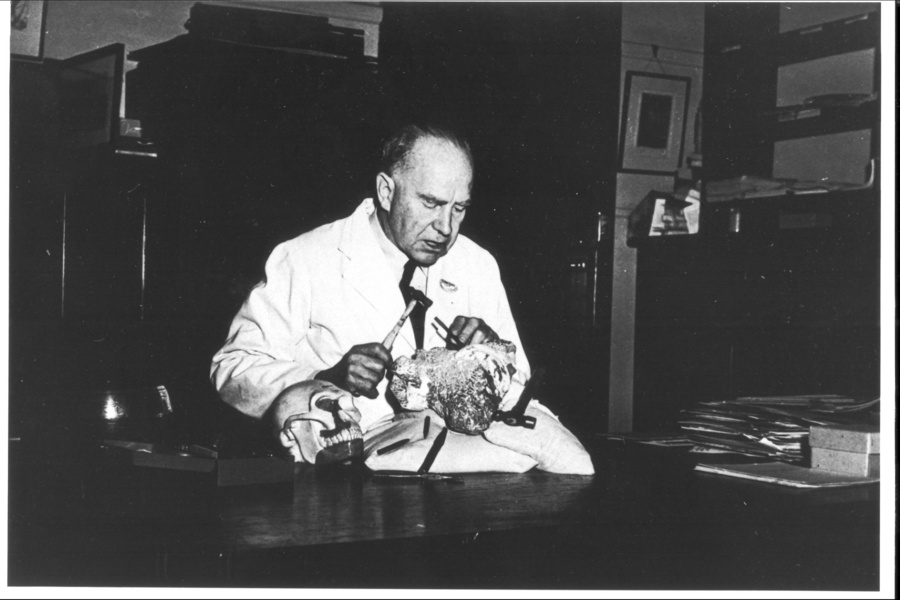
Dart, hammering away to remove a fossil from some breccia. I hope. Image credit.

Dart, hammering away at some breccia to remove a fossil. I hope. Image credit.

In 1925, Dart identified the Taung fossil as a close relative of humans, and coined the scientific name, Australopithecus africanus. This was a pretty good idea, as Taung was the first in what is now a large collection of fossils attributed to this species.

Taung was such an important discovery, you can now walk across it as you enter the fossil collections at Wits University.

Taung was such an important discovery, you can now walk across it not once, not twice, but thrice! as you enter the fossil collections at the Evolutionary Studies Institute at Wits University

Some of Dart’s ideas that made it into print, though, were a bit more fanciful. Aside from his description of Taung, he is probably most famous for hypothesizing the “osteodontokeratic” culture, the idea that the myriad broken animal bones in Makapansgat cave were in fact tools used by australopiths for hunting and murder. MURDER! It was a neat idea at the time, but his vision of bloodthirsty, bone-dagger-wielding australopithecines is not accepted today (nor back when he was writing).

Dart was trained as an anatomist, and much of his work was devoted to writing up australopithecine fossils discovered at site of Makapansgat in South Africa. These are probably the best descriptive papers I’ve found in all the literature, as Dart’s whimsical visions of violence and bloodshed occasionally made their way into otherwise dry scientific prose.

In 1948 he very casually put it out there, that the front teeth of the MLD 2 mandible were lost in “fatal combat . . . presumably by a bludgeon” (emphasis added). Of course, the teeth were probably lost long after the poor kid died, rather than being knocked out “at the hands of a kinsman more expert than himself in the accurate application of directed implements” (Dart, 1948: 393-394). But Dart’s version is certainly more interesting than the more likely taphonomic explanation.

MLD 2

The MLD 2 mandible, poor kid, as illustrated in Dart (1948). Note that the incisor tooth sockets are empty, likely the result of taphonomy rather than bloodsport.

Dart (1958) later described the MLD 7 ilium, which he’d presumed to be a female, from the same site as MLD 2. Dart recounted the violent demise of MLD 2, raising the possibility of a similar death for the MLD 7 individual: “The adolescent boy [MLD 2] … was killed by a bone-smashing blow on the chin from a club or fist. Did brother and sister share here in death the same cannibalistic fate?” (emphasis added) Bloodshed, cannibalism, Australopithecus according to Dart had it all. Although these are unlikely characterizations of australopithecines, there is evidence of cannibalism in later fossil humans.

These gruesome Easter Eggs come to mind as I’m reading his 1956 paper about brain evolution. Here, Dart (1956: 28) says that hominins began walking on two legs after a dietary shift: “The forest-loving vegetarian anthropoids clung to their four-handed climbing and fruit while the terrestrial predaceous australopithecines, depending on their speed of foot and deftness of hand, lusted after flesh!” (emphasis added) Today, this idea would simply be written as, monkeys and apes live in trees and eat fruits while australopithecines lived on the ground and ate meat. But Raymond Dart wouldn’t stand for this. Oh no.

My grad school advisor, Milford Wolpoff, used to lament that students today don’t want to read anything older than the past 5-10 years. But Dart is a shining example of some of the rewarding Easter Eggs that await those who dig deeper into the literature. [I’m reminded also of Don Cousins describing “the colossal poundage of the lowland gorilla ‘Phil,’ who lived in the St. Louis Zoo from 1941-1958″ (1972: 269, emphasis added].

ResearchBlogging.org
Some good, older stuff

Cousins D (1972). Body measurements and weights of wild and captive gorillas, Gorilla gorillaZoologische Garten NF Leipzig 41, 261-277.

Dart, RA (1925). Australopithecus africanus: The Man-Ape of South Africa Nature, 115 (2884), 195-199 DOI: 10.1038/115195a0

Dart, RA (1948). The adolescent mandible of Australopithecus prometheus American Journal of Physical Anthropology, 6 (4), 391-412 DOI: 10.1002/ajpa.1330060410

Dart RA (1956). The relationships of brain size and brain pattern to human status. The South African Journal of Medical Sciences, 21 (1-2), 23-45 PMID: 13380551

Dart, RA (1958). A further adolescent australopithecine ilium from Makapansgat American Journal of Physical Anthropology, 16 (4), 473-479 DOI: 10.1002/ajpa.1330160407

Osteology Everywhere: Vertebeer Fest

This past weekend was witness to the Summer Beer Festival, the annual showcase of Michigan’s brewing splendor. Dozens of breweries brought out batches of beer, from classics we know and love, to inspired innovations meriting a MacArthur Fellowship. There was an embeerrassment of boozes. Dark Horse Brewing Company, from Marshall, MI, put on quite the show:

Dark  Horse Brewing Co. pumping out the brews and blasting t-shirts into the crowd.

Dark Horse Brewing Co. pumping out the brews and blasting t-shirts into the crowd.

Besides towering over the bacchanal hordes, the Dark Horse beer fort also offered IPAs infused with pretty much anything that might pair well with hops. They even steeped habañero peppers in one, and it was maximally boss.

Beer still my heart.

Beer still my heart.

Having sampled only a small part of rich the smorgasbord on tap, a rest by the river was in order. The Festival was on the banks of the mighty Huron River, an excellent place to sit and sip Arcadia‘s scotch ale, taking in the evening under cloud-peppered, cerulean skies. Such a calm and relaxing setting would surely offer respite for a brain besieged by bones. Right?

Every year for the Festival they replace the river water with beer.

Every year for the Festival they replace the river water with beer.

Wrong! Peering through beer goggles over the shimmer of the river, seeking signs of Bigfoots lurking on the opposite shore, I locked eyes with a large, wooden vertebral body.

No ordinary tree stump

An eyeless frown marks the ventral surface of this centrum.

The human spine is composed of anywhere from 31-34 vertebrae (not counting the coccyx or tail bone). The body or “centrum” is the large, blocky portion of the bone, which is separated from other such bodies by intervertebral discs; it is literally a pile of bodies, stacked one on top of the other. And the intervertebral discs are remnants of the notochord, the embryonic structure that unites you and me and all other humans with all other animals known as chordates. Anyway, kiss my grits if this old tree stump across the mighty Huron River here doesn’t look like a lower thoracic or upper lumbar vertebral body, the metaphoric shark fin of a giant trunkless human waiting to pounce from the placid waters.

a) Our mystery vertebra. b) a lumbar vertebra from White et al. (2012). c) views of the right and front side of the Australopithecus africanus fossil StW H41, from Sanders (1998, Fig. 1).

a) Our mystery river vertebra. b) a lumbar vertebra from White et al. (2012). c) views of the right and front side of the Australopithecus africanus fossil StW H8/H41, modified from Fig. 1 of Sanders (1998).

Thinking on it, our mystery river vertebra doesn’t just look like any old human centrum, it is a ringer for the second lumbar vertebra of StW H8/H41, a series of the 11th thoracic to 4th lumbar vertebrae of Australopithecus africanus from Sterkfontein (see the red arrow in c, above). Sanders (1998) notes that this short segment of an early hominin spine shows clear adaptation to walking upright like we humans do today, although the size of the vertebral bodies is both absolutely and relatively small compared to ours, just as is seen in other Australopithecus fossils.

And what better way to celebrate this monumental discovery than returning to the Beer Festival – hooray beer!

Osteology Everywhere: Ilium Nublar

Jurassic Park is objectively the greatest film ever made, so I don’t need to explain why I recently watched it for the bajillionth time. Despite having seen this empirically excellent movie countless times, I finally noticed something I’d never seen before.

Hold on to your butts. What's that on the screen in front of Ray Arnold?

Hold on to your butts – what’s that on the screen in front of John Arnold? (image credit)

The film takes place on the fictitional island “Isla Nublar,” a map of which features prominently in the computer control room when s**t starts to go down. Here’s a clearer screenshot of one of Dennis Nedry‘s monitors:

Isla Nublar from the JP control room. Quiet, all of you! They’re approaching the tyrannosaur paddock…. (image credit)

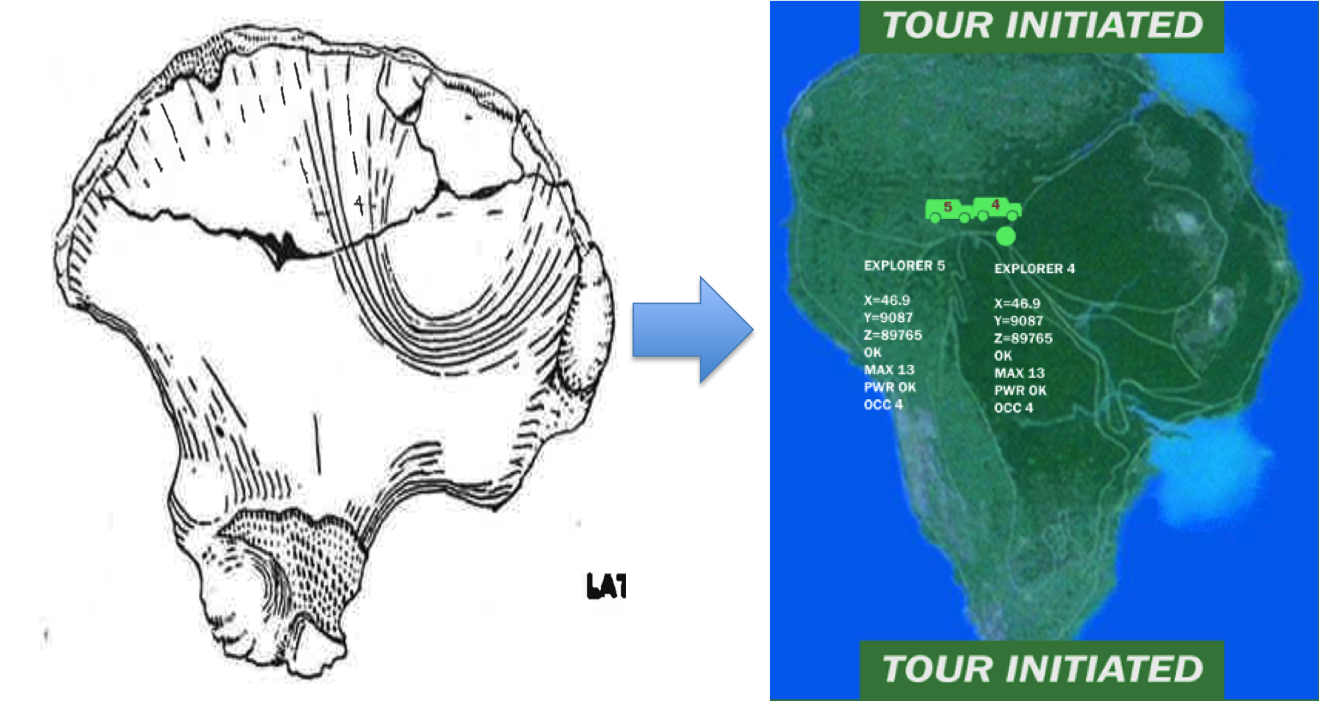
It dawned on me that the inspiration for this island is none other than MLD 7, a juvenile Australopithecus africanus ilium from the Makapansgat site in South Africa:

Figure 1 from Dart, 1958. Left side is MLD 7 and right is MLD 25. Top row is the lateral view (from the side) and bottom row is the medial view (from the inside).

Figure 1 from Dart, 1958. Left side is MLD 7 and right is MLD 25. Top row is the lateral view (from the side) and bottom row is the medial view (from the inside). These two hip bones are from the left side of the body (see the pelvis figure in this post). Note the prominent anterior inferior iliac spine on MLD 7, a quintessential feature of bipeds.

Isla Nublar is basically MLD 7 viewed at an angle so that appears relatively narrower from side to side:

MLD at a slightly oblique view (or stretched top to bottom) magically transforms into Isla Nublar.

MLD 7 at a slightly oblique view (or stretched top to bottom) magically transforms into Isla Nublar.

It’s rather remarkable that some of the most complete pelvic remains we have for australopithecines are two juveniles of similar developmental ages and sizes from the same site. In both, the iliac crest is not fused, and joints of the acetabulum (hip socket) hadn’t fused together yet. The immaturity of these two fossils matches what is seen prior to puberty in humans and chimpanzees. Berge (1998) also noted that MLD 7, serving as an archetype for juvenile Australopithecus, is similar in shape to juvenile humans, whereas adult Australopithecus (represented by Sts 14 and AL 288) are much flatter and wider side to side. Berge took this pattern of ontogenetic variation to match an ape-like pattern of ilium shape growth. This suggests a role of heterochrony in the evolution of human pelvic shape, or as Berge (1998: 451) put it, “Parallel change in pelvic shape between human ontogeny and hominid phylogeny.” In layman’s terms, ‘similar changes in both pelvic growth and pelvis evolution.’

Osteology Everywhere: Barcade bone biology

I’ve fled the Central Asian steppe to visit my childhood home, Kansas City, Missouri.

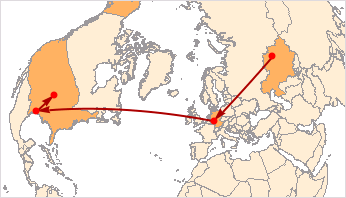
The tortuous path from the center of Eursia to the center of the US, a mere 8500 miles since there are no direct flights. Map made by Wolfram Alpha.

The tortuous path from the center of Eursia to the center of the US, a mere 8500 miles since there are no direct flights. Map made by Wolfram Alpha.

It would be a lie to say I don’t miss life in this Midwest metropolis. Kansas City is sprawling, with diverse cultures, foods and festivities in far-flung neighborhoods. It’s always a trip to revisit the people and places of my formative years.

Of course, there are differences between now and when I was growing up. A whole new world of experiences became available to me here once I was old enough to drink (legally; this is long ago now). The bar scene itself has evolved over the past decade or so, arguably culminating in Up-Down, a grown-up video game arcade that will confusingly make you both happy and sad to have become an adult.

Be still my heart. Image credit.

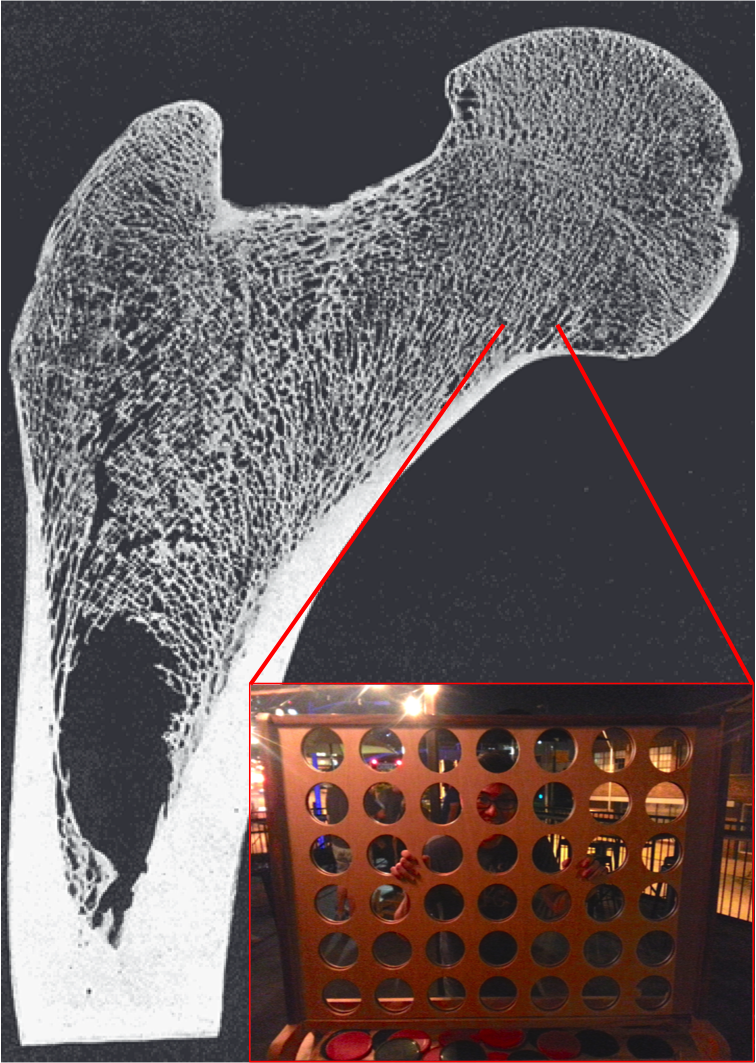
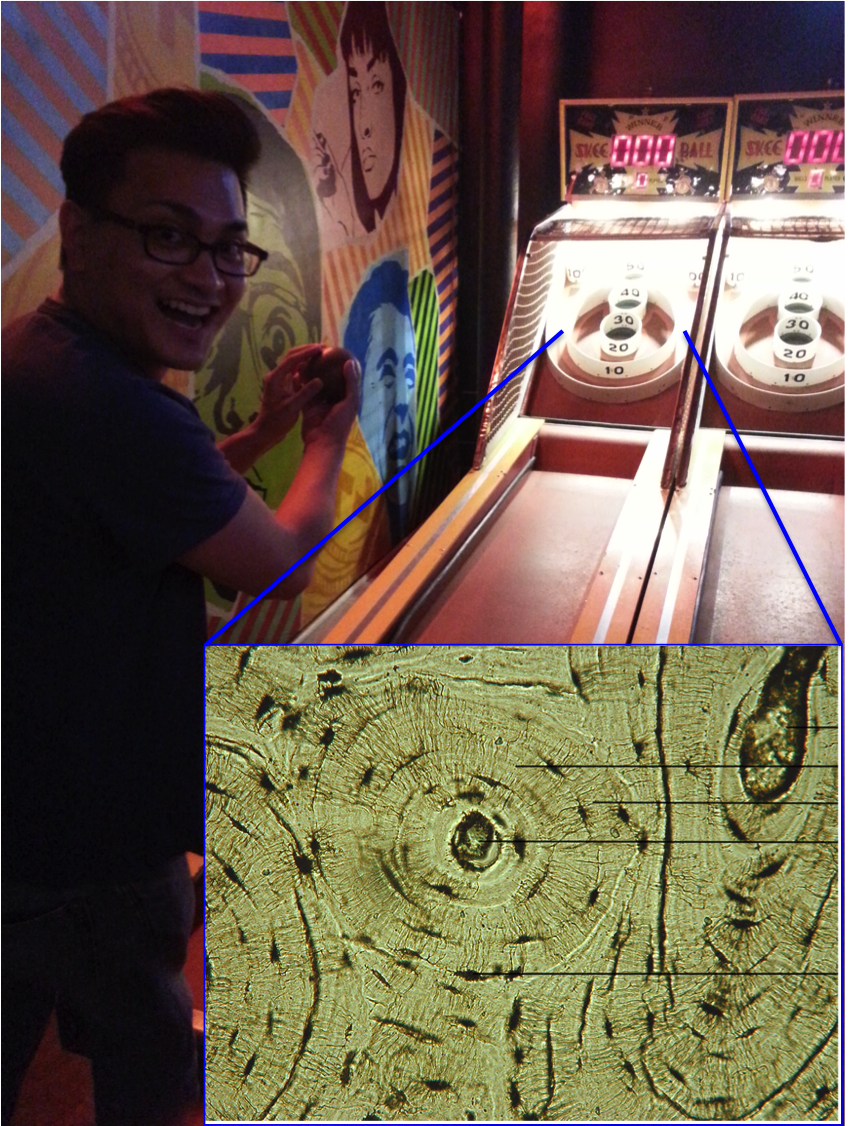
I’ve never seen anything like this before. But even in this novel environment, I still couldn’t help but notice Osteology Everywhere. What appears at first glance to be an oversized Connect Four contraption . . .

Go for the bottom, go for the top.

Go for the bottom, go for the top.

. . . is in fact a closeup of trabecular bone (with my friend creepily peering through):

Section through a human proximal femur (hip joint). Note the trabecular or "spongy" bone filling the top, in comparison with the thick and dense cortical bone of the shaft in the bottom left. Image credit.

Vertical section through a human proximal femur (hip joint). Note the trabecular or “spongy” bone filling the top, in comparison with the thick and dense cortical bone of the shaft in the bottom left. Image credit.

And here, we’re not playing Skee Ball . . .

20150618_003612. . . we’re hurling wooden balls into Haversian canals and lacunae of osteons. For Science.

Cross section through cortical bone, magnified to highlight an osteon. The big hole in the center is the Haversian canal, and the smaller satellite holes are lacunae housing osteocytes.

Cross section through cortical bone, magnified to highlight an osteon. The big hole in the center is the Haversian canal, and the smaller satellite holes are lacunae housing osteocytes. Image credit.

So if you’re in the KC area, I highly recommend you check out Up-Down, where you can review osteology while also playing games and sipping a refreshing beer. Who knew learning could be so fun?

Kazakhstan on #EarthCapture

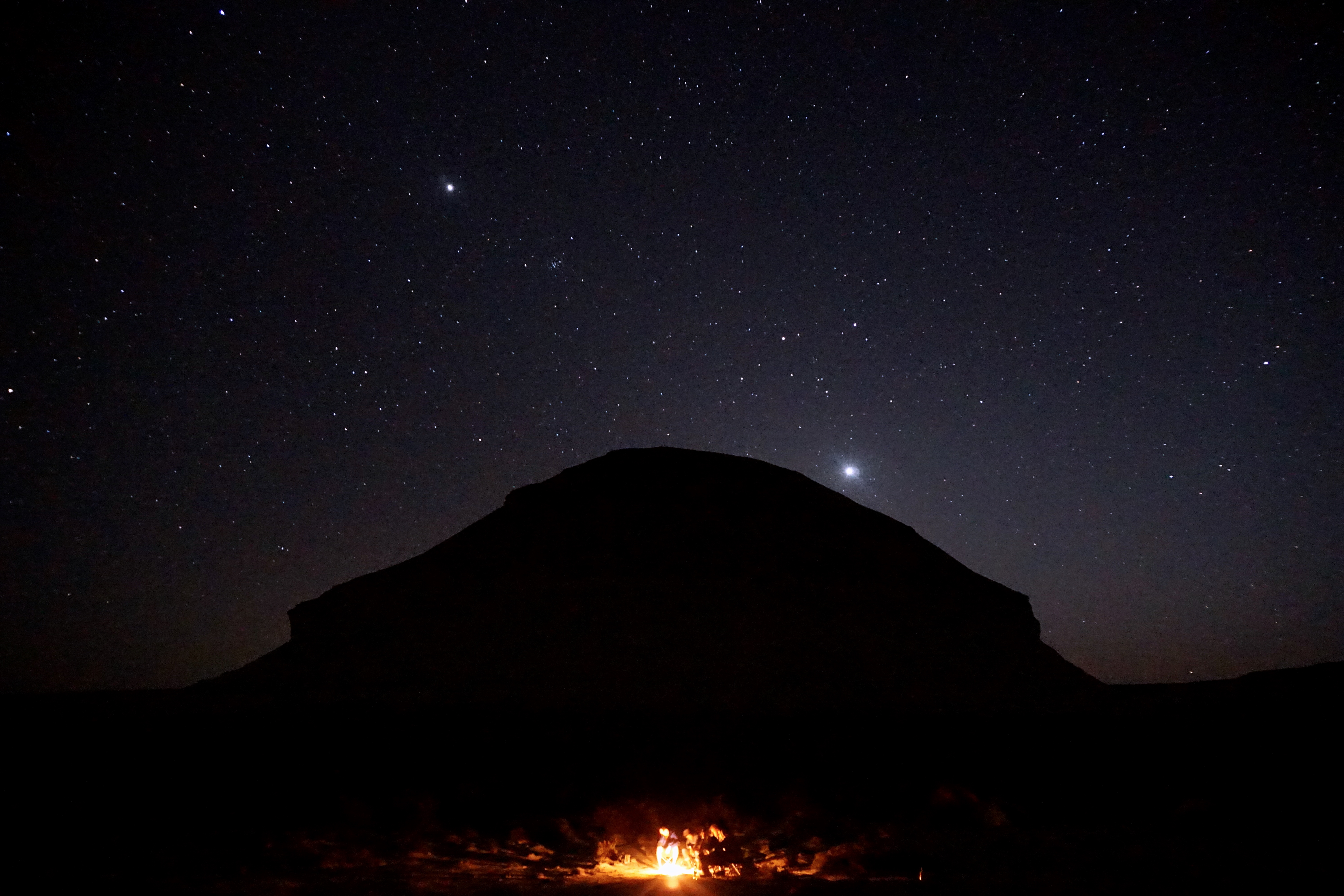
BBC Earth – one of the greatest inventions of all time – has a “Big Earth” series, showcasing our planet’s awesome sights as captured by BBC readers and viewers. I submitted some pics from my recent trip to West Kazakhstan, and two are featured on the website:

Kazakhstan is an amazing place poorly known to most, and there is lots of great stuff to see in both the cities and the vast, open wilderness. You should come out and see it!

Til you make it out here, here are some more shots of the fun stuff I’ve seen here since I got a decent camera a few months ago.

Spilt milk.

Spilt milk over Mangystau, Kazakhstan.

eFfing #FossilFriday: Rekindling an old friend’s hip

Sorry for the crappy pun. Carol Ward and colleagues recently reported an associated hip joint, KNM-ER 5881, attributable to the genus Homo (1.9 million years old). Fossils coming from the same skeleton are pretty rare, but what’s more remarkable is that portions of this bone were discovered 29 years apart: a femur fragment was first found in 1980, and more of the femur and part of the ilium were found at the same location when scientists returned in 2009:

Figure 3 from Ward et al. 2015.

Figure 3 from Ward et al. 2015. A little distal to the hip, yes, but the pun still works. Views are, going clockwise starting at the top the top left, from above, from below, from the back, from the side, and from the front.

There’s also a partial ilium associated with the femur – that makes a pretty complete hip!

Figure 5 from Ward et al. shows the fossil. Jump for joy that it's complete enough for us to tell it comes from the left side!

Figure 5 from Ward et al. shows the fossil. Jump for joy that it’s complete enough for us to tell it comes from the left side!

Despite how fragmentary the femur and ilium are, the researchers were able to estimate the diameter of the femur head and hip socket reliably. The hip joints are smaller than all Early Pleistocene Homo except for the Gona pelvis. Comparing ER 5881 the large contemporaneous KNM-ER 3228 hip bone, the authors found these two specimens to be more different in size than is usually seen between sexes of many primate species. The size difference best matches male-female differences in highly dimorphic species like gorillas.

Ward et al. find that the specimen generally looks like early Homo but that the inferred shape of the pelvic inlet is a little different from all other Early and Middle Pleistocene human fossils. The authors take this discrepancy to suggest that there was more than one “morphotype” (‘kind of shape’), and therefore possibly species, of Homo around 1.9 million years ago. While I wouldn’t just yet go so far as to say this anatomy is due to species differences, I do agree that KNM ER 5881 helps our understanding and appreciation of anatomical variation in our early ancestors. Like all great fossil discoveries, the more we find, the more we learn that we don’t know. Here’s to more Homo hips in the near future!

Quick thought on the Australopithecus deyiremeda maxilla

It will be lots of work to prep my Human Evolution course for the Fall. This past year has seen many major fossil discoveries, and adding to the list is the newly described species Australopithecus deyiremeda (Haile-Selassie et al., 2015). The fossils come from newly announced sites in Ethiopia (here it is on a map!), dating to around 3.4 million years ago. These new fossils are contemporaneous with Australopithecus afarensis, fossils attributed to Kenyanthropus platyops, and whatever the hell the Burtele foot belongs to.

The main specimens are a fairly complete half of a maxilla (upper jaw) and two decent mandibles (lower jaw bones). These fossils do not belong to the same individual (despite all the media pictures of the upper and lower jaws together). One of the most distinctive features of these fossils is how thick, both in absolute and relative terms, the mandibles are, especially given how short they are. What sticks out to me though, is that the upper jaw looks like it might have still had some growing to do. Why on earth would I think so? (The following is based off pictures from the publications, so I could be wrong!)

Extended Figure 1a from the paper. The type specimnen BRT-VP-3/1 maxilla. Front is to the left.

Extended Figure 1a from the paper, the type specimnen BRT-VP-3/1 maxilla viewed from the left side. I’ve added the M2 label for your reading pleasure.

The holotype maxilla (BRT-VP-3/1) is described as coming from a “young adult” in the Supplementary Information. However, it looks like the second molar tooth (M2) is not quite fully erupted and in occlusion, although this could be due to the natural arc of the tooth row. There is no visible wear on the tooth in the pictures, and indeed the Supplementary Information says the tooth is unworn. This means that the tooth is only recently emerged, and may not have passed the gum line, and therefore hasn’t seen much/any use yet. Authors note in the Supplementary Information that there is no M3 (a.k.a. “wisdom tooth”) wear facet on the back of M2 , meaning the last tooth hadn’t yet emerged yet either. So, this all points to a non-adult age by tooth eruption standards.

Extended Figure 1d from the paper. Same fossil, but from the bottom, like a dentist peering into its mouth. Back is to the bottom.

Extended Figure 1d from the paper. Same fossil, but from the bottom; pretend you’re a dentist peering into its mouth. Back is to the bottom.

In addition, the M2 roots don’t look fully formed. This is especially apparent in Extended Figure 1h, a CT section through the teeth:

Extended Figure 1h from the paper, with a Demirjian developmental stages, modifed from Table 2 from Kuykendall et al., 1996. Compare the M2 roots with  completed roots of the M1 (to the left).

Left side: Extended Figure 1h from the paper. From left to right, the teeth are P3, P4, M1, and M2. For comparison, to the right are Demirjian tooth development stages, modified from Table 2 of Kuykendall, 1996. Also compare the M2 roots with completed roots of the M1.


In many human populations, this stage of M2 development is reached (on average) between 11-13 years (Liversidge et al., 2006). In the wild Taï Forest chimpanzee sample, two individuals with M2 root completely formed (Stage H) are 10 and 11 years old (Smith et al., 2010). These apes would not be fully mature and their facial dimensions would likely have increased had they reached adulthood (Zihlman et al., 2007).

So what this suggests to me is that this maxilla may not accurately represent adult anatomy in this newly described species. In humans, the face continues to grow downwards from adolescence into adulthood, and in apes the face continues growing both forward and downward. In the differential diagnosis of A. deyiremeda, Haile-Selassie and team state, in layman’s terms, that the cheeks are positioned more toward the front than in A. afarensis, and that the front of the face doesn’t stick out as much as in A. garhi. If this specimen was not fully grown, it is likely that the true adult anatomy would have had a face that sticks out more and has less forward-positioned cheeks than in this specimen.

But, this is all speculative, and I’d like to reiterate that these observations of dental development are based only on the published pictures. Just a thought!

The stream-severed spine

I recently returned from Mangystau, a geologically captivating former seabed in West Kazakhstan. Places like this, or the Tien Shan mountains in the South and Altai mountains in the East, always make me wonder why anyone would decide to build a capital city in the wastes of Aqmola. Astana sprouts up from a sterile steppe, sparingly sprinkled with streams and lakes. Out west, though, are breathtaking landscapes and landforms, such as the giant rocky spheres of Torysh:

Traversing the

Traversing the “Valley of Balls.” It is not yet known what caused these rock formations.

Sherqala (“Lion City”), a rocky uplift that centuries ago hosted a defensive acropolis:

DSC01089

A flooded salt flat vertiginously reflecting an alternate reality:

DSC01226
A pile of earth that’s really an octopus waiting in ambush:

DSC01315

The perfect place to set up camp.

DSC01400

As I’d pointed out the first time I came out here last year, this rocky terrain is littered with lifeless remnants of the animals that used to call this place home. So many bones reflecting such biodiversity, just lying on the surface. This year, though, I found a subsurface skeleton, teaching an important lesson in taphonomy. Taphonomy (“burial law” from Ancient Greek) is the study of what happens to an animal’s remains from the moment it dies to when it is discovered eons later. This field examines geological and ecological processes that determine whether fossils are found intact or smashed to smithereens.

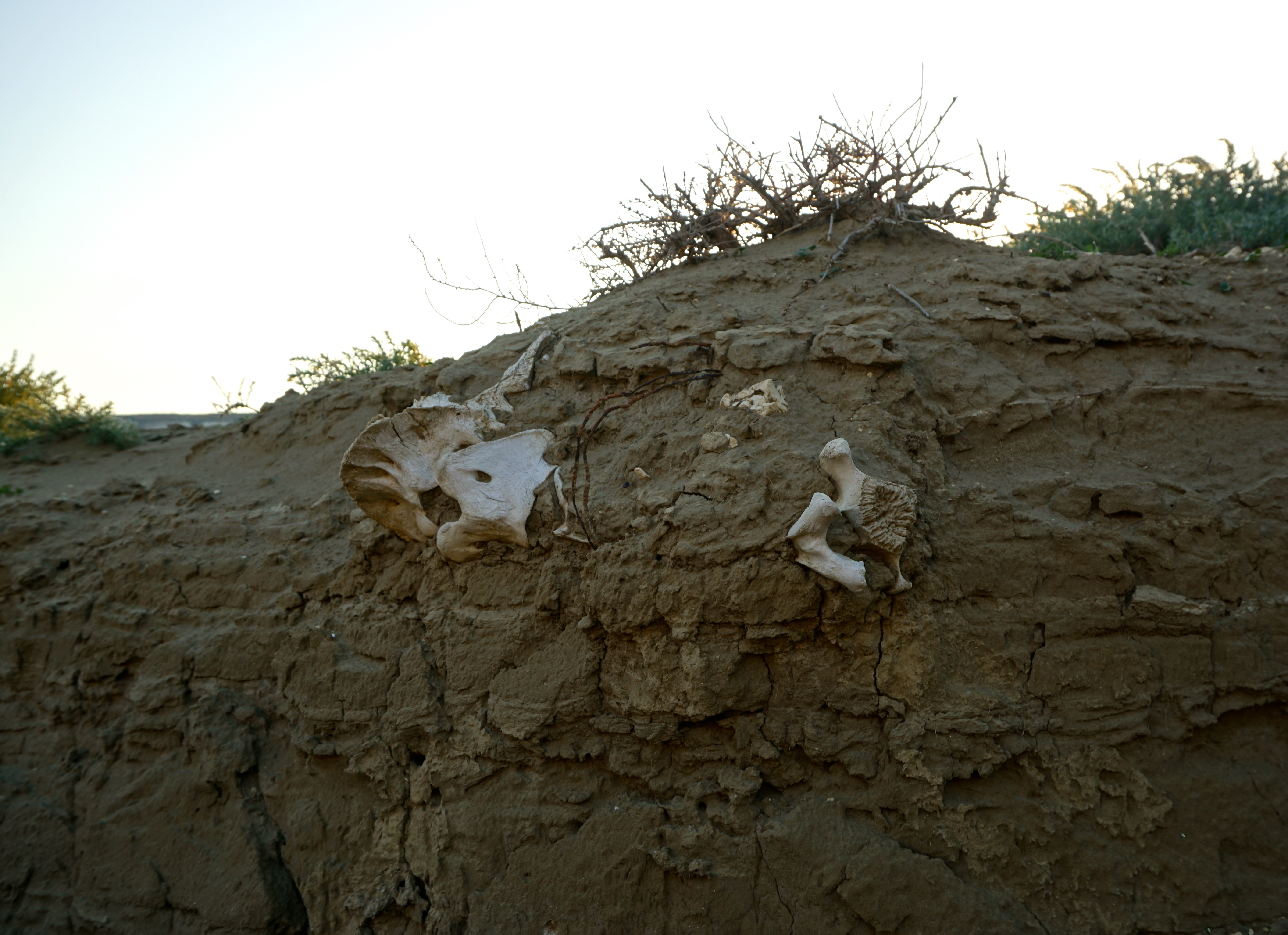
Walking down into a small gully by our campsite, I noticed some giant lumbar vertebrae eroding out of one side:

Waist-deep in mud. One vertebra is clearly visible, and to its right, beneath a rock, are the spinous processes of two more vertebrae.

Waist-deep in mud. One vertebra is clearly visible, and to its right, beneath a rock, are the spinous processes of two more vertebrae. Notice the differently colored stripes of soil – these are different layers (“strata”), reflecting different periods that soil was laid down on the earth.

I was elated to espy this spinous surprise, but I wasn’t expecting to see what was on the opposite side of the gully:

Died doing a misguided impression of an ostrich.

Died doing a misguided impression of an ostrich. On the left you can see the back of the skull and the first cervical vertebra, then the spine submerges and reemerges to the right.

Sure enough, this once complete carcass was drawn and quartered, pulled apart by the liberal application of time and life-saving water.

Digging out the skull on the west bank, right across from the lumber spine on the east face. The different soil layers (

Digging out the skull on the west bank, right across from the lumber spine on the east face (circled).

Getting our hands a little dirty, we found the face of a camel. It is hard to say how long ago it lived, how long it took to get buried by a few inches of dirt, but I would guess at most only a few decades (but I’m not a geologist, so who knows). It’s also unclear how this animal was bifurcated: Did the camel die and get covered over with soil, and then later a newly forming stream carried away the soil harboring its torso? Or did the carcass lie on the ground unburied for a while, its torso slowly picked apart or trampled, and then the stream formed? I would guess the first scenario is more likely, since the bones seem to run through several strata. But again I’m not an expert in taphonomy so I could be wrong.

DSC01023

People often wonder why the fossil record isn’t more complete, and why we get so excited about the discovery of even partially complete skeletons. This camel demonstrates one of myriad taphonomic processes, one of the many ways that earth, water and time conspire tear the past asunder.

Yi qi: Another fossil from The Dark Crystal

It was a good week for weird dinosaurs. On Monday scientists published Chilesaurus, “an enigmatic plant-eating [dino] from the Late Jurassic period of Chile” (from the paper title). Even more curious, Xing Xu and colleagues announced Yi qi, a Skeksis-like nightmare from the Jurassic of what is now China.

Yi qi on its deathbed, refusing to go quietly.

Here’s the fossil itself:

The Yi qi partial skeleton (Figure 1 from Xu et al.). Inset c is a closeup of the skull, and e a closeup of the elongated finger bones on the right side. Lookit that majestic mane of feathers flowing from the back of its head and down its neck.

The Yi qi partial skeleton (Figure 1 from Xu et al.). Inset c is a closeup of the skull, and e a closeup of the elongated finger bones. Lookit that majestic mane of feathers flowing from the back of its head and down its neck.

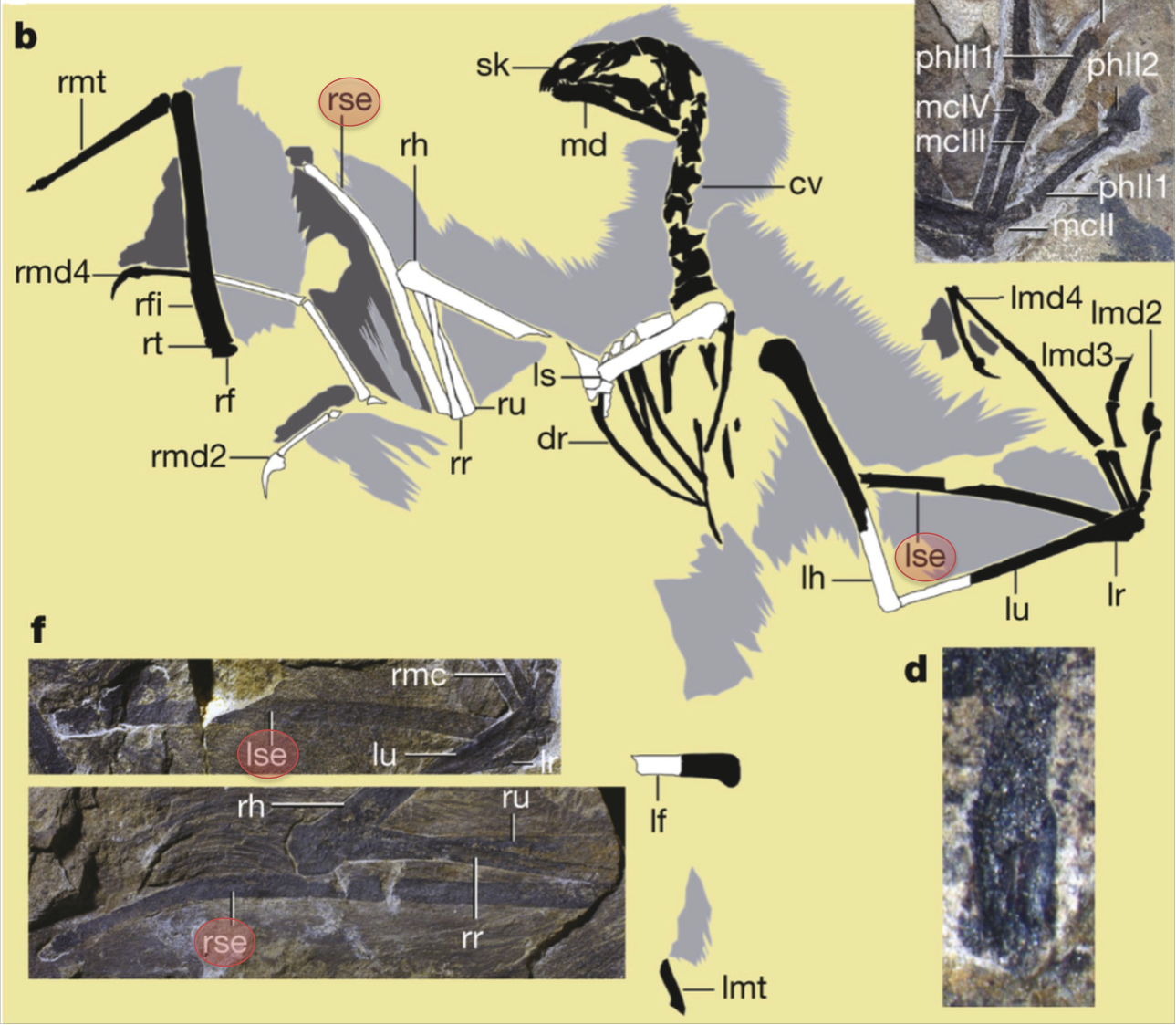
Yi qi is Mandarin for “strange wing.” Why “strange”? Here’s the cleaned up schematic of the fossil above:

The rest of Figure 1 from Xu et al. Important for flight are the structures labeled "ldm4/rdm4" and "lse/rse."

The rest of Figure 1 from Xu et al. Key wing structures are labeled “lmd4/rmd4” and “lse/rse.” Light gray shading represents feathers in the fossil, while dark gray appears to be some sort of membrane.

The right side of the figure, depicting the left side of this monster, shows the wing anatomy nicely. Bones with “md,” for “manual digit,” in the label are the homologues (or anatomical equivalents) of your fingers. Notice that the fourth one (“lmd4”) is drastically longer than other digits. This alone suggests some special function for this digit. Emanating from the wrist is another structure, “lse,” for “left styliform element.” In anatomy, “styl-” refers to a structure that sticks out; your skeleton is littered with “styloid processes.” Unlike digits, which are a line of several bones (“phalanges”), this styliform element is a single, rod-like structure made of bone. If you look at the “rse” above, beneath it you’ll see a dark patch running its length, which the researchers identified as “sheet-like soft tissue,” or membrane. These membranes are also found by the elongated md4s.

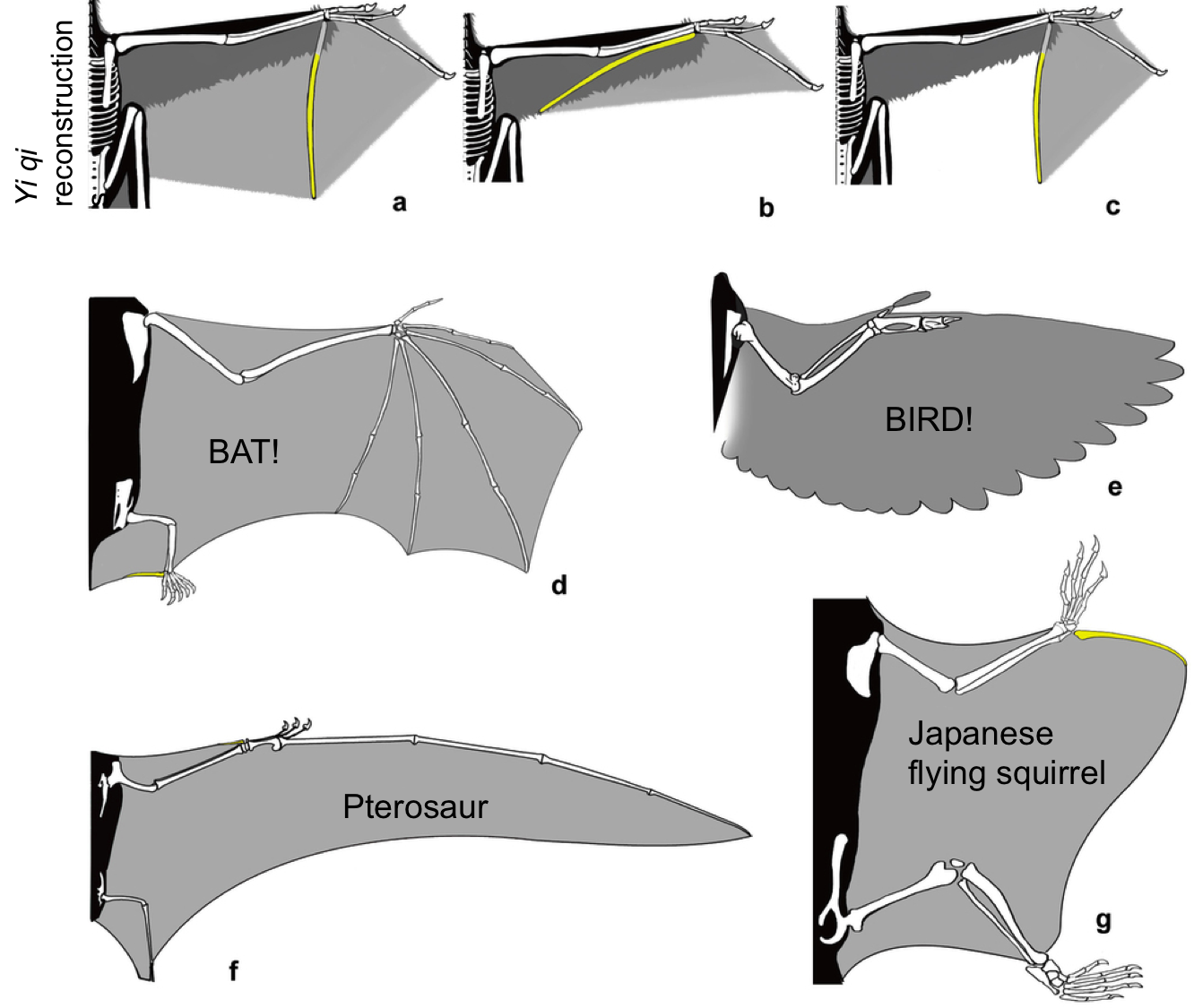
This all indicates an animal with a thin membrane (kind of like skin, I suppose?) between elongated fourth digits, styliform elements, and probably other parts of the body. Researchers then use the comparative anatomy to reconstruct and interpret the function of this unique wing. Here’s what homologous structures look like in flying animals:

Extended Data Figure 8 from Xu et al. Comparison of the wing structure of different flying/gliding animals.

Extended Data Figure 8 from Xu et al. Comparison of the wing structure of different flying/gliding animals. The yellow segment is the styliform element. Note it comes from the wrist in Yi qi and the Japanese giant flying squirrel, but from the ankle in the bat. Birds and pterosaurs apparently lacked such an accessory structure.

Although media generally report this animal’s wings were like bats’, the authors point out that the placement of this styliform element, at the base of the wrist, is actually most comparable to the Japanese giant flying squirrel (Petaurista leucogenys). Nevertheless, the the construction of the wing, with a membrane between long finger elements, is unlike the wings that other dinosaurs and later birds evolved for flight. This highlights the many ways that flight has evolved – independently – in different kinds of vertebrates over the past 200 million years.

Now, even though these were not giant animals, I think they still would have been terrifying. Not scary in the same way as building-sized theropods like T. rex or Spinosaurus.

No, there is just something a bit creepy about a creature like this. Here is the skeletal reconstruction from the paper:

The dinosaur version of Edward Scissorhands.

Like a dinosaur Edward Scissorhands

If Yi qi Scissorhands doesn’t drive home just how nightmarish this dinosaur was to behold, check out this uncanny resemblance:

YiQiSkeksis

Yi qi (top) and a Skeksis (bottom). Not the first time The Dark Crystal has predicted important fossils.

Yet again, paleontology shows that fact can be stranger than fiction.

Virtual paleontology activity

Last week Nazarbayev University hosted an Instructional Technology Showcase, in which professors demonstrated some of the ways we use technology in the classroom. This was the perfect venue to show off the sweet skeletal stuff we study in Biological Anthropology, through the use of pretty “virtual” fossils. In the past year I’ve started using CT and laser scans of skeletal remains to make lab activities in a few classes (I’ve posted two here and here). Such virtual specimens are especially useful since it is hard to get skeletal materials and casts of fossils here in the middle of the Steppe. These scans are pretty accurate, and what’s more, 3D printing technology has advanced such that physical copies of surface scans can be created from these virtual models. So for the Showcase, I had a table where passersby could try their hand at measuring fossils both in hand and in silico.

Lower jaw of an infant Australopithecus boisei (KNM ER 1477). Left is the plastic cast printed from the laser scan on the right.

Lower jaw of an infant Australopithecus boisei (KNM ER 1477). Left is the plastic cast printed from the laser scan on the right.

The Robotics Department over in the School of Science and Technology was kind enough to print out two fossils: KNM ER 1477, an infant Australopithecus boisei mandible, and KNM KP 271 a distal humerus of Australopithecus anamensis. They used a UP Plus 2 printer, a small desktop printer that basically stacks layers of melted plastic to create 3D models; they said it took about 9 hours to print the pair. Before the Showcase, I measured the computer and printed models on my own for comparison with published measurements taken on the original fossils (KP 271 from Patterson and Howells, 1967; ER 1477 from Wood, 1991). The virtual fossils were measured using the free program Meshlab, while basic sliding calipers were used to measure the printed casts.

I was pleasantly surprised at how similar my measurements were to the published values (usually within 0.1 mm), since it means that the free fossil scans provided by the National Museums of Kenya are useful not only for teaching, but potentially also for research.

The Virtual Paleontology Lab

The Virtual Paleontology Lab. The Kanapoi distal humerus is held in the foreground while the A. bosei jaw rests on the table. Yes, those are real palm trees.

Knowing that these models are pretty true to life (well, true to death, since they’re fossils), I was curious how students, faculty and staff would do. I picked two fairly simple measurements for each fossil. None of the people that came by to participate had any experience with bones or fossils, or measuring these in person or on a computer. Here are their results:

Boxplots showing participants' data, for two measurements on each of the fossils. The blue stars mark the published values. The red rugs on either side indicate measurements taken on the scans (left side) or printed casts (right).

Boxplots showing participants’ data, for two measurements on each of the fossils. The blue stars mark the published values. The red rugs on either side indicate measurements taken on the scans (left side) or printed casts (right).

For the most part, the inexperienced participants’ measurements are not too far off from the published values. There’s not really an apparent tendency for either cast or computer measurements to be more accurate, although measurements of the Kanapoi humerus are closer than the computer measurements (third and fourth boxes above). In my personal opinion, nothing beats handling fossils (or casts of them) directly, but this little activity suggests students can still make reliable observations using 3D scans on a computer.

Sweet free stuff:
Meshlab software
3D scans of fossils from the National Museums of Kenya