Osteology Everywhere: Head for the hills

Last week I was exploring central England with the brilliant Jess Beck, an archaeology PhD student at the University of Michigan. Both of us avid (nay, rabid) connoisseurs of everything skeletal, we espied the likes of a specific human bone in the scenic landscape of the the Cotswolds. Check out JB’s blog, Bone Broke, for her take on this geographical/geological/skeletal formation (as well as for lots of killer osteology and bioarchaeology tips and tricks). Do it now! NOW!

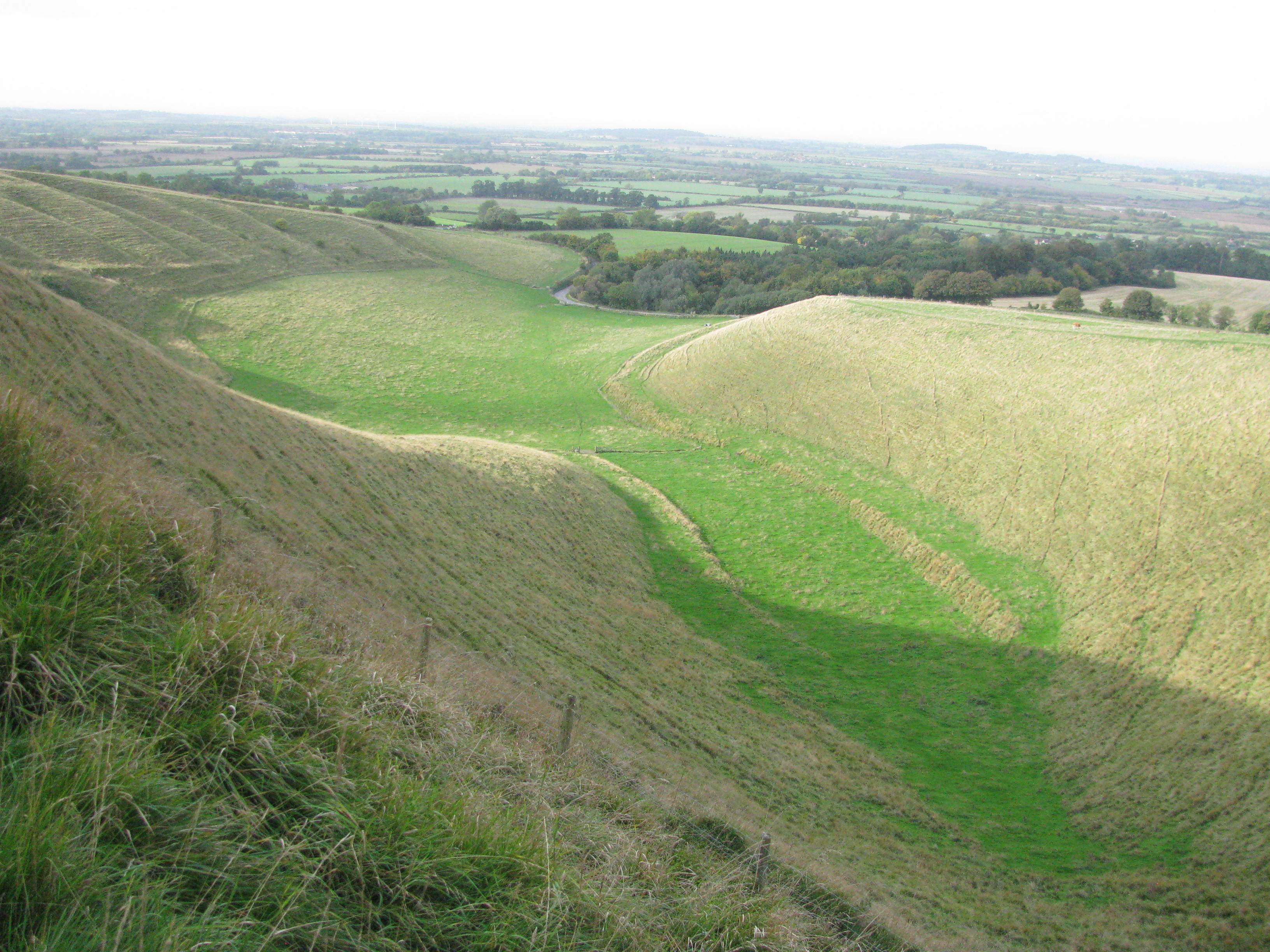
After you’ve checked out her site, behold this sight – what bone is lurking in the landscape?

osteourrywhere Cotswolds

As with Rorschach inkblots, probably lots of bones could be seen in this image. But what Jess & I saw was a hamate, the greener hue hewn into the hills, whose sizable hamulus runs from the bottom right to join the rest of the carpal around the center of the image.

The hamulus of the hamate is an attachment point for the flexor retinaculum, the band of fascia stretching across your wrist to hold your extrinsic digital flexor muscles (or rather, their tendons) in place; you could think of it as the bridge covering the carpal tunnel. Now, comparing the grassy hamulus with an actual human one, you’ll spot two important differences: first, the grassy one isn’t blunt like the humans’, but ends in a long point. Oops! Just pretend it’s rounded off. Second, the grassy hamulus is huge relative to the overall size of the bone (or valley) compared with the human form. The size of the hamulus partially reflects the size of the carpal tunnel: chimpanzees, with powerful wrists and forearms, have long hamuli.

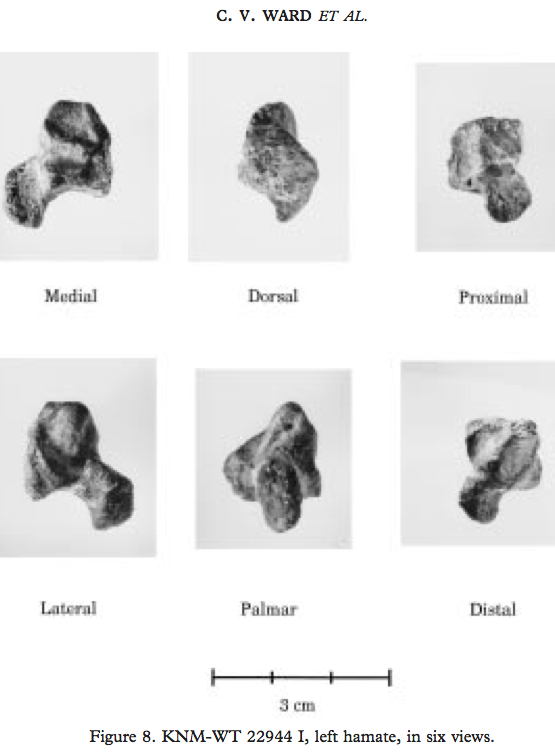
A huge nerd, I didn’t just see any hamate in this Cotswold vale. I also immediately thought of KNM-WT 22944, an Australopithecus afarensis hamate from the 3.5 million year old site of South Turkwel in Kenya (Ward et al., 1997):

WT 22944-Ward &al 1997

From Ward et al., 1999. Sorry it’s not in the same orientation as the above image. Hamulus is the projection pointing to the bottom left corner of the “medial” image.

An absolutely and relatively massive hamulus in WT 22944 suggests whoever this bone belonged to had some powerful gripping capabilities, while a geologically younger A. afarensis hamate from Hadar (AL 333-50) had a smaller, more human-like hamulus. Maybe (some) A. afarensis were still using their arms a lot for tree-climbing, in spite of being more than capable bipeds (I’ve talked about this before here)….

One final thought: People do like the way she says, “hamate.”

Ward et al., 1999. South Turkwel: a new pliocene hominid site in Kenya. Journal of Human Evolution 36: 69-95. link

White et al., 2012. Human Osteology 3rd Edition. link

The small, big new Dmanisi skull

The 5th skull early Homo skull from the site of Dmanisi was announced last week. The skull was discovered nearly 10 years ago, but is finally (and very comprehensively) published in Science (Lordkipanidze et al. 2013). The ‘new’ D4500 cranium goes with the massive D2600 mandible, making this the earliest and most complete skull of Homo that I know of. It’s really a remarkable specimen, for a number of reasons beyond its age and completeness. I’ve been busy traveling, teaching and writing lately, so I haven’t yet gotten to pore over the details as much as I’d like. So I hope to sporadically post thoughts on this badass new skull as they come to me. In the mean time, several of what I’d consider the top biology/anthropology blogs*** have discussed the skull, so do check those out if you haven’t already.

The first thing I noted about D4500 is its small brain size, estimated at a mere 546 cubic centimeters. For perspective, D4500 is the green point in the following plot showing brain size in early human evolution:

Endocranial volume for various fossil hominin fossils. 1: Australopithecus afarensis, africanus & boisei; 2: Dmanisi specimens; 3: "habilines" 4: early African Homo erectus; 5: Indonesian and Chinese Homo erectus

Endocranial volume for various fossil hominin fossils. 1: Australopithecus afarensis, africanus & boisei; 2: Dmanisi specimens; 3: “habilines” 4: early African Homo erectus; 5: Indonesian and Chinese Homo erectus. D4500 is green with envy.

I got to see (but not study) the cranium a few years ago when I was helping with the Dmanisi Paleoanthropology field school, and I remember noting just how “robust” the specimen was – big mastoid processes, prominent and thick brow ridge, huge attachments for the neck muscles. In humans, and presumably our fossil forebears, these features are more developed in males than females, and so presumably D4500 was a male (consistent with the huge, associated D2600 mandible). In many primates, and 4 to ~1 mya hominins so far as we can tell, males are larger than females. So it is surprising that a robust probable male cranium is in fact not only the smallest in the Dmanisi sample, but also at the low end of early African Homo (i.e. habilis or rudolfensis), comparable to the largest australopiths. Of course, the only other faces known from Dmanisi are either not fully grown (D2700 and D2282) or old and decrepit (D3444), so perhaps the larger-brained specimens would have been at least as robust as D4500. An untestable hypothesis!

The new skull really highlights the overlap, or continuous variation between later australopiths and early Homo known also from eastern Africa. In association with the postcranial remains known from Dmanisi, the authors the paper posit that early Homo may have been distinguished from Australopithecus not so much in brain size as in body size. We could probably add body shape (limb proportions) and tool use to that list of distinguishing features, and to be sure there are Oldowan tools and small but human-like body size and shape indicated by postcrania at Dmanisi. But then, evidence for body proportions and for/against tool use in Australopithecus, especially later in the record, is somewhat equivocal…

More thoughts to follow.

*** https://blogs.wellesley.edu/vanarsdale/2013/10/17/uncategorized/the-new-wonderful-dmanisi-skull/; http://johnhawks.net/weblog/fossils/lower/dmanisi/d4500-lordkipanidze-2013.html; http://ecodevoevo.blogspot.com/2013/10/how-many-human-species-are-there-is-it.html

Reference: David Lordkipanidze, Marcia S. Ponce de León, Ann Margvelashvili, Yoel Rak, G. Philip Rightmire, Abesalom Vekua, and Christoph P. E. Zollikofer. 2013. A Complete Skull from Dmanisi, Georgia, and the Evolutionary Biology of Early Homo. Science: 342 (6156), 326-331.

More FREE badass bioanthro science resources!

Hark! There’s been quite a long silence here, as I’ve been busy preparing manuscripts related to this post and this post. Also teaching; my new Intro to Biological Anthropology students are writing posts over at nazarbioanthro.blogspot.com – check them out!

Anyway, some more FREE DATA have come to my attention that I figured people may find useful (I’ve posted links to other great resources here and here).

First, my buddy and advisor Milford Wolpoff has helped compile an open online dental dataset. This consists of length and breadth measurements for teeth from humans, fossil humans and non-human apes. And promises of more to come! You can read about the data, and online data-sharing more generally, in this paper at the Paleoanthropology Society website.

Secondably, Herman Pontzer has put together a website, Australopithecus, with lots of great information about human evolution for teachers and students, as well as a datamine of links and metrics and pictures of fossil hominins and apes. Pretty boss.

Third, announced in the American Journal of Physical Anthropology just yesterday is a database of cranial non-metric data, pioneered by Nancy Ossenberg. This is a very comprehensive dataset, with info about up to 84 non-metric traits on over 8,000 individual crania from all over the world. Ossenberg also links to the WW Howells craniometric dataset (thousands of cranial measurements of individuals all over dodge); I’m not sure if/how much Ossenberg’s and Howells’ datsets overlap, but the covariance of size, shape and non-metric traits could be a very interesting investigation (if it hasn’t been done already; sorry for my ignorance!).

Finally, if you’re looking to analyze these or any other tantalizing data, you’ll want to download and learn to use R. This free statistical computing program will let you analyze pretty much anything with either traditional statistics, or you can be a badass and make up your own custom tests. I’ve been blabbing incessantly about how awesome this program is since at least 2009, but here’s the link just in case. takes some time to figure out how to use, but its help files are all online, and you can probably find out how to do anything else your dreams can concoct on the Internets.

Now you are ready to take on the world. Go forth!

Mandible as a measure of overall body size?

I’m currently in Kent, United Kingdom, examining African ape jaws to follow up on my dissertation research comparing jaw growth in humans and Australopithecus robustus (having a tough time writing this stuff up for journal publication, but hopefully things’ll start coming out soon). One thing I’d assumed (with evidence, of course), was that aspects of mandibular size could serve as a proxy for body size, to make inferences about body growth. Now that I’m in Kent, I’m hoping to get good evidence of this in the non-human African apes.

The Powell Cotton Museum in Kent has an awesome collection of chimpanzees and gorillas (see the Human Origins Database by Adam Gordon and Bernard Wood for more information on these samples). This collection was accumulated during a time last century when explorers would go out and collect specimens from the wild, usually by finding and killing them. Now, when Major Percy Powell-Cotton was out doing this, he or some of his assistants actually collected measurements on some of the corpses – arm span, height, head+body length, and chest girth. This means we can see which aspects of the mandible correlate with body size, which is important since the fossil record usually affords us mandibles more than any other part of the skeleton.

Length of the back of the ramus to the P4, plotted against measures of body size.

Length of the back of the ramus to the P4, plotted against measures of body size. Colors/shapes represent 1 of 5 dental eruption age groups.

There aren’t body size measurements for all individuals, and I’ve been biasing my own sampling toward subadults. So I only have body size data for up to 15 of the 70+ gorillas I’ve been able to look at. From this meager sample, though, it looks like many aspects of mandible size may well end up correlating with aspects of body size. For instance, the distance from the back of the mandibular ramus to the front of the P4 is highly correlated with all 4 of Powell-Cotton’s bodily measures (right).

Will an expanded sample size uphold these high correlations? Will we see major differences between the sexes, or between different age groups? Will chimpanzees follow the same rules as gorillas? Hopefully I’ll be able to let you know by the time I’m done working in the museum!

Molar? I hardly even know her!

I was recently at the State Zoology Museum of Munich, studying their amazing plethora of orangutan bones. Jaw bones are especially useful skeletal remains when you study growth, because different teeth come in at different points in one’s life. Remember when your 1st permanent molar teeth came in? You were probably 5 or 6 years old at the time. It was a big deal, your first permanent teeth! What about your 4th permanent molars, after your wisdom teeth, remember those?

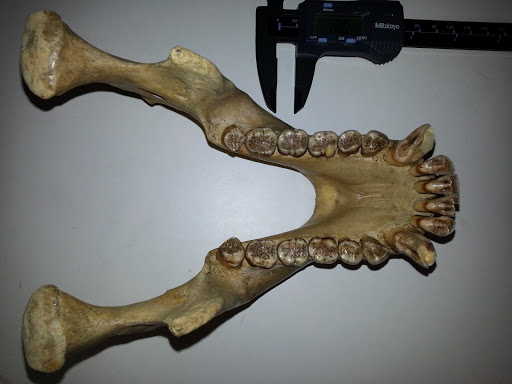
An adult male orangutan mandible, with bilateral supernumerary molars. Or more simply, “an extra molar on both sides of the jaw.”
I hope not. As a good eutherian, you should never have more than 3 molars in each half of each jaw. And as a modern human, there’s a good chance you’ve only got 2 in each half (but that’s a whole other story). So when I was looking at orangutan skulls to get an idea of individuals’ ages, I was shocked to find skull after skull with at least one extra molar. So far as I could tell, 27 out of 181 (14.9%) adult orangutans in this collection had extra molars.
Supernumerary (fancy word for “extra”) molars manifest a number of ways in this collection. Sometimes there’s only one extra tooth. Sometimes there are extra teeth in both upper and lower jaws but only on one side. Sometimes there’s a full set (4). Et cetera. One poor lil guy even had a 5th molar lurking behind one of his four 4ths! That’s too many extra molars.
An adult male with a fairly normal 4th (blue arrow) and even a weird, unerupted 5th (red arrow) molar. Gross!
This is rather strange, such a regular occurrence of supernumerary teeth – what gives? A starting clue is the fact that all skulls with extra molars are of the species Pongo pygmaeus from Borneo (173 of 181 skulls). The remaining eight skulls, with a normal dental formula, are Pongo abelii from the island of Sumatra. But how much of this difference in frequency is due to the fact we’re looking at 181 Bornean, vs. only eight Sumatran orangutans?
One way to address this with a Chi-squared test (χ2), but why be normal (pun!) when you could play around with resampling in R? Is it weird that 27/181 (15%) Bornean orangutans have extra teeth, while 0/8 Sumatran orangs do not? Another way to ask the question is, what are the chances of sampling 8 Bornean orangs, none of which have extra molars? This is very easy to program and test in R:
Set up a vector (basically, a string of numbers) to represent your Bornean orangs, each entry representing an individual, assigning “0” for no extra teeth and “1” for at least one (this admittedly oversimplifies the nature of extra teeth). Then simply randomly sample – lots and lots of times –  eight individuals from this Bornean vector, to see how often you get a set in which 0/8 have extra molars.
“b” is our vector of Bornean orangutans, consisting of 0s and 1s for whether there are extra teeth. “n” tells us how many individuals had extra teeth in that subsample. The “(i in 1:10000)” means for each of 10,000 resamplings.
Following this resampling procedure, there’s about a 25.5% chance that none of them will have extra molars. That means the remaining 74.5% of the time, a random subsample of the Bornean orangutans will contain at least one individual with at least one extra tooth.
A number of interesting questions arise from this – if we were to examine more Sumatran orangutans, would we eventually find one with an extra molar? After all, the 25.5% chance of sampling 0/8 suggests maybe we just missed some Sumatrans with extra molars. Regardless, within the Bornean orangs, why is the frequency so high? Does one pattern of extra teeth (say, just in the lower jaw, or on both sides, etc.) predominate? Are there differences between the sexes? These are questions for another day….

Update: Brain growth in Homo erectus, and the age of the Mojokerto fossil

The Mojokerto calvaria. You’re looking at the left side of the
 skull: the face would be to the left. Check it out in 3D here.

A few months ago I posted an abridged version of the presentation I gave at this year’s meetings of the American Association of Physical Anthropologists, about brain growth in Homo erectus. This study, co-authored with Jeremy DeSilva, adopts a novel approach (see “Methods” in that earlier post) to analyze the Mojokerto fossil (right). The specimen is the only H. erectus non-adult complete enough to get a decent estimate of brain size (or rather, the overall volume of the brain case) – probably 630 to 660 cubic centimeters (Coqueugniot et al. 2004; Balzeau et al., 2004). So to study brain growth in the extinct species, we just have to connect a range of estimated brain sizes at birth (around 290 cubic centimeters, based on predictive equations by DeSilva and Lesnik, 2008) to that of Mojokerto. But, the speed of brain growth implied by this comparison depends on how old poor Mojokerto was when s/he died.

Most recently, Hélen Coqueugniot and colleagues (2004) used CT scans of the fossil to examine the fusion of its various bones, to suggest the poor kid died between six months to 1.5 years, if not even younger. Antoine Balzeau and team (2005) also studied scans of the fossil, and their analysis of its virtual endocast presented conflicting age estimates, but they argued the poor kid was probably no older than 4 years. Earlier studies had suggested the kid was up to 8 years. Now, for my previous post/conference presentation, we assumed the Coqueugniot estimate was correct – but what if we consider a full range of ages for Mojokerto, from 0.03-6.00 years?

Brain size, relative to newborns’ values, at different ages in humans (black circles) and chimpanzees (red triangles). Homo erectus median and mean are the thick solid and dashed blue lines, respectively, and the 90% and 95% confidence intervals are indicated by the thinner, dotted blue lines. Data are the same as in the previous post.

The plot above depicts brain size relative to newborns: each circle (humans) and triangle (chimpanzees) represents the proportional size difference between a newborn (less than 1 week) and an older individual, up to 6 years. Obviously, relative brain size gets bigger in humans and chimpanzees over time. Interestingly, even though humans and chimps have very different brain sizes, the proportional brain size changes overlap a lot between species, especially at younger ages. Ah, the joys of cross-sectional samples.

But what’s especially interesting here are the blue lines on the graph, indicating estimates of proportional size change in Homo erectus, assuming Mojokerto’s skull could hold 630 cc of delicious brain matter, and that the species’ skulls at birth could hold about 290 cc, give or take several cc. The thick solid and dashed lines just above 2 on the y-axis are the mean and median of our estimates – Mojokerto’s brain averages around 2.2 times larger than predicted newborns. Such a proportion is most likely to be found in humans between 6 months to a year of age, and in chimpanzees between around 6 months and 2 years. The confidence intervals, the highest and lowest bounds of our estimates for Homo erectus proportional size change, are the thinner dashed lines on the graph. They help us constrain our estimates, and further suggest that the proportional difference found for H. erectus is most likely to be found in either chimpanzees or humans around 1 year of age – just like Coqueugniot and colleagues predicted!!!

Thus, independent evidence – brain size of Mojokerto and estimated brain size at birth in Homo erectus – corroborates a previously estimated age at death for the Mojokerto fossil, the poor little Homo erectus baby. This further supports our estimates of brain growth rates in this species, as described in the previous post.

ResearchBlogging.orgSo to summarize, fairly scant fossil evidence compared with larger extant species samples using randomization statistics, argue for high, human-like infant brain growth rates in Homo erectus by around 1 million years ago. Our ancestors were badasses.

Remember, if you want the R code I wrote to do this study, just lemme know!

Those references
Balzeau A, Grimaud-Hervé D, & Jacob T (2005). Internal cranial features of the Mojokerto child fossil (East Java, Indonesia). Journal of human evolution, 48 (6), 535-53 PMID: 15927659

Coqueugniot H, Hublin JJ, Veillon F, Houët F, & Jacob T (2004). Early brain growth in Homo erectus and implications for cognitive ability. Nature, 431 (7006), 299-302 PMID: 15372030

DeSilva JM, & Lesnik JJ (2008). Brain size at birth throughout human evolution: a new method for estimating neonatal brain size in hominins. Journal of human evolution, 55 (6), 1064-74 PMID: 18789811

We like turtles (‘s genomes)

June 2013, Volume 45 No 6 pp 579-714

Jonathan the zombie isn’t the only one who likes turtles. These heroes-in-a-half-shell adorn the cover of the current Nature Genetics, as two species of turtle have just joined the Genome Club (Wang et al. 2013; paper’s free!).

This definitely not one of those genome sequencing studies alluded to recently by John Hawks, that’s “too boring for journals.” Wang and colleagues didn’t just sequence the genomes of soft-shell and green sea turtles ‘just cuz.’ Rather, they use these copious data to address several questions, most interesting of which relate to embryonic development.

First, analysis of gene expression during embryonic development supports what the authors refer to as a “nested hourglass model” of development and gene expression. The hourglass shape serves as analogy for variation across related species over developmental time: there is great variation (in both morphology and gene expression) in the earliest stages of development, then species are more similar at a given developmental stage (the “phylotypic period”), and thereafter variation increases again. This phylotypic period (which I don’t believe is unanimously agreed upon) is arguably the most conserved developmental stage in evolution – all vertebrates, for example, simply must pass through this stage to become good vertebrates. Plus, several studies have found that evolutionarily younger genes tend to be expressed before and after this amorphous phylotypic stage, while more ancient genes are expressed during this time. As the authors state

“According to the recently supported developmental hourglass model … the changes underlying major adult morphological evolution occurred primarily in the developmental stages after the period … that serves as the basic vertebrate body plan.”

So the turtle data generally support this model. However they mention a nested hourglass, because they found evidence of an additional bottleneck, a second hourglass, of conserved gene expression when comparing turtles with their close relative the chicken. In other words, “the most conserved developmental stage changes depending on distantly related species are that are being compared.” So since turtles and chickens are more closely related to one another than to many other vertebrates, they might share another conserved developmental stage. Incidentally, both also make for good soup.

Wang and colleagues also looked for genes relating to some of the unique aspects of turtle anatomy, examining what parts of the genome seem to get kicked up after the phylotypic period. It doesn’t take a trained eye to see that these animals are kinda weird in that their bodies are encased in a flagrant shell, with a carapace on top and plastron on the bottom. Now it turns out this carapace is actually formed from what should, in most other vertebrates, become vertebrae and ribs. So by studying the earliest development of these structures, Wang and colleagues could examine the molecular bases of this carapacial deviation.

Fig. 5 from Wang et al., showing Wnt protein expression in turtle embryos. In a), only Wnt5a is expressed in the ‘carapacial ridge’ during its earliest development. Fig c) is a cross-section indicated in b) showing this expression. NT=neural tube, NC=  notochord. The scale bar is 0.5 mm. Tiny!
The authors were able to identify over 200 miRNAs, and implicate the signalling protein Wnt5a, in the development of the “carapacial ridge” (see the arrows in fig. c above), the embryonic precursors to the carapace. Interestingly, Wnt5a is involved in the development of limb buds (e.g, those big purple circles in the red square in a) above). The precise role of Wnt5a and the miRNAs in turtle shell development has yet to be determined, so this study really sets the stage for future investigations.
ResearchBlogging.orgSo there you have it, a pretty cool paper combining genomics with developmental biology, among other things. And so to close, for your bemusement, here’s a video I shot last week at the awesome Kansas City Zoo, of a turtle attempting to make embryos like in the figure above (sorry for the poor quality). Hang in there, little buddy!
They like tuhtles!
Wang Z, Pascual-Anaya J, Zadissa A, Li W, Niimura Y, Huang Z, Li C, White S, Xiong Z, Fang D, Wang B, Ming Y, Chen Y, Zheng Y, Kuraku S, Pignatelli M, Herrero J, Beal K, Nozawa M, Li Q, Wang J, Zhang H, Yu L, Shigenobu S, Wang J, Liu J, Flicek P, Searle S, Wang J, Kuratani S, Yin Y, Aken B, Zhang G, & Irie N (2013). The draft genomes of soft-shell turtle and green sea turtle yield insights into the development and evolution of the turtle-specific body plan. Nature genetics, 45 (6), 701-6 PMID: 23624526

Kazakhstan Paleolithic fieldwork: Valikhanova

Last week, I left my home in Astana for southern Kazakhstan, to rendezvous with researchers based in Kazakhstan, the United States and Germany. This is the beginning of a collaborative effort to understand the underappreciated importance of Kazakhstan in hominin evolution.

Post-fieldwork meal. From foreground clockwise: Zhaken Taimagambetov (1), Tyler (2), Saya (1), Jason (2), Adam (3), Radu (4), Mica (2), Kat (5), Katie (2), and Rinato (1). Not pictured: Me (6) and Jean-Marc (1). Numbers indicate school affiliations, at the end of the post.

We just returned from a brief stint of soil sampling at, and site surveying around, the Paleolithic site of Valikhanova, near the town of Zhanatas. This site was excavated decades ago, and has yielded a number of stone tools interpreted as transitional between Middle and Upper Paleolithic industries. This is a fascinating period for ‘modern’ human origins, but unfortunately the site has not yielded any human fossils to the best of my knowledge.

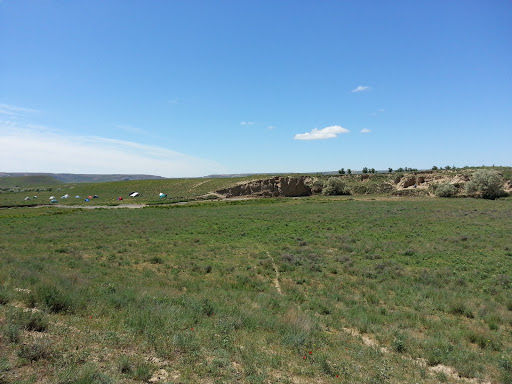
Valikhanova. The excavation site is the layered earth exposure on the right, our camp site on the left.

But there are other important questions that can be asked about the nature of the site and its inhabitants. First, the geological layers (“strata”) of the site have not been reliably dated, so soil samples were collected to be analyzed by a dating technique called optically stimulated luminescence (this is the work of Dr. Kat Fitzsimmons). Second, aspects of climate and ecology can be inferred from soil chemistry, which is the focus of team members from Colorado State University. Combining this information, we can begin to understand when and why humans (Neandertal and/or more ‘modern’ looking) inhabited the area – e.g., was it only between major glacial periods, how much time does the site span, etc?

And it’s a pretty amazing area. The site is nestled in a depression, creating an ecosystem somewhat protected from harsh winds and temperatures blowing around surrounding the mountains. That said, the night we arrived we were welcomed by extremely high-speed winds and heavy rains. My tent was the only casualty of the storm, forcing me to flee to the comforting confines of our sturdy truck and cups of vodka. The storm was short lived, and soon the sky opened up to a panoramic harlequin sunset.

Palette after the storm. Left to right covers from West to East. The excavation and North are at the center.

Also there was a rainbow.

My main activity here was survey, the search for other places that could potentially yield fossil and additional cultural materials. Survey basically involves a fairly targeted scouring of a landscape, searching for specific features. Our survey took us over and across gorgeous landscapes. We found a number of possible fossil/artifact accumulations and possible caves/rock shelters for future investigation, but no human fossils turned up (this was not terribly surprising, as human fossils are quite rare).

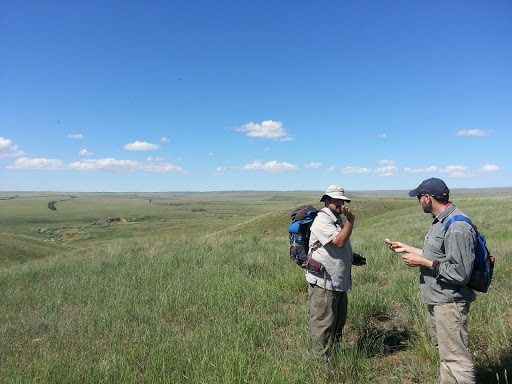
Atop one big hill, Drs. Jason LaBelle and Adam Van Arsdale discuss one of many stone tools we found littering the area around Valikhanova.

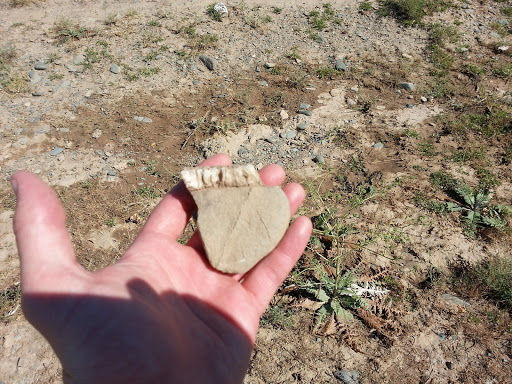
One neat surprise did come when scanning the ground above a rocky outcrop over a filled-in cave. At first glance, I seem to be holding some kind of a jaw bone fragmentwith two teeth. Close inspection shows this just to be a rock with a coincidentally-molar-like calcification. Bummer. However, we were able to trick one expert into thinking for a minute that we found some kind of pig or other mammal fossil.

Fossil bovid, equid or suid? Meganthropus?! Just a rock? Osteology students & paleontologists, beware faux-ssils…

We’re briefly back in Almaty to recharge, and on Tuesday we’ll head out to explore Charyn Canyon for a few days. Stay tuned for more about our adventures!

*Affiliations from Fig. 1 above:
1. Kazakh National University, 2. Colorado State University, 3. Wellesley College, 4. Römisch-Germanisches Zentralmuseum, 5. Max Planck Institute. 6. Nazarbayev University.

One more great bioanthro resource

Following up on yesterday’s post containing links to various online data and resources, Dr. Rebecca Jabbour brought the Human Origins Database to my attention today. As stated on the database’s home page:

Currently the Human Origins Database contains the measurements and skeletal element information present in the Koobi Fora Research Project. Volume 4: Hominid Cranial Remains by Bernard Wood (1991). In addition, a complete inventory of skeletal elements present for the chimpanzee and gorilla collections at the Powell-Cotton Museum is included, along with annotated data sheets providing information on epiphyseal fusion, element condition, etc.

Here’s a taste of the Powell-Cotton chimpanzee catalog & maturation info:

You have to register to access the database – which you should do since it’s free and appears immensely useful. Enjoy!

Online skeletal and dental datasets (links links links!)

The TM 1517a fossil, from here

Jean Jacques Hublin has a commentary [1] in the current issue of Nature, about making fossils available for scanning, digital replication, and ultimately hopefully open dissemination. As Hublin points out, it’s a bit ridiculous that a fossil is a rare enough thing as it is, but even after their discovery, fossils “can become unreachable relics once they are in storage.” Fortunately, Hublin goes on to point to online collections that are available to anyone interested. Somewhat ironically, the article about free-ish data is behind a paywall, so here are the resources Hublin describes:

  • The Ditsong CT Archive, created by the collaboration of Hublin’s group at Max Planck and the Ditsong (formerly Transvaal) Museum in South Africa, which contains digitized hominin fossils from the site of Kromdraai (see also [ref 2]). Check out the type specimen of Paranthropus robustus, from this site, above!
  • You can download CT scans of the Skhul V early human fossil, thanks to the Harvard Peabody Museum.
  • Wanna see the the oldest possible animal embryos, early humans, insects, and other crazy fossils? Check out the European Synchrotron Radiation Facility’s microCT database.
  • Get free CT scans of 2 human skulls, thanks to the Virtual Anthropology program at the University of Vienna.
  • Finally, the NESPOS initiative is a large repository of Pleistocene hominin fossil scans, which I somehow don’t know enough about.

In addition to these sources, here are 2 other datasets that are pretty badass:

ResearchBlogging.orgI haven’t had much opportunity to look into these datasets Hublin pointed out, but they look promising. If you know of other good resources, please do share!

References
[1] Hublin, J. (2013). Palaeontology: Free digital scans of human fossils Nature, 497 (7448), 183-183 DOI: 10.1038/497183a

[2] Skinner MM, Kivell TL, Potze S, & Hublin JJ (2013). Microtomographic archive of fossil hominin specimens from Kromdraai B, South Africa. Journal of human evolution, 64 (5), 434-47 PMID: 23541384