Neandertal terminal biogeography

How late did Neandertals persist in the Late Pleistocene? Two papers out this week discuss the dates of the latest Neandertals in western Asia.

Pinhasi and colleagues (2011) stress the importance of directly dating Late Pleistocene human-ish fossils. There are numerous techniques used to estimate the ages of the fun stuff we find underground. For fairly old fossils like australopithecines, perhaps the most reliable radiometric method is Argon-Argon, though this requires the fossils to be relatable to volcanic sediments whose argon levels can be measured. The point is that dates of burial are often not estimated from the fossil materials themselves, but rather the sediments and such surrounding the fossil of interest. But younger fossils (than say 50,000) preserve some of the bone’s original carbon -allowing age estimates of the fossils themselves by radiocarbon dating.

Pinhasi and colleagues note that while seven separate Neandertal specimens from across Europe and western Asia have been directly dated to be younger than 36 thousand years, these dates may be underestimates. In other words, Neandertals may not have lived after 40 thousand years. To this end, these researchers directly re-dated the infant Neandertal from Mezmaiskaya Cave in Russia, and estimate the poor lad to have died around 42-44 thousand years ago. The authors predict that future direct redating of other Neandertals will show Neandertals to have disappeared by 40 thousand years ago, and that they would have overlapped in time with more modern-looking humans either minimally or not at all. If only there were more information on the latest dates for Middle Paleolithic people!

Lucky me, in tomorrow’s Science, Ludovic Slimak and colleagues report on Mousterian tools dating to 32-34 thousand years ago, from the site of Byzovaya Cave “in the western foothills of the Polar Urals” (Slimak et al. 2011: 841). “POLAR!” The site is way further north than any site with Neandertal bones like Mezmaiskaya and Okladnikov, which is pretty impressive. But, there are no human remains associated with the tools, so we don’t know who made them. To what extent do these finds address Pinhasi’s and others’ contention of no Neandertals after 40 thousand years ago?

Slimak and colleagues carbon-dated animal bones that were butchered with the Mousterian tools, which were allegedly made only by Neandertals. There is a major problem with the wide-held assumption that Mousterian (Middle Paleolithic) tools were made only by Neandertals, whereas Upper Paleolithic industries beginning with the Aurignacian were made only by humans. This goes along with people’s wont to make a connection between stone tool ‘culture’ and biologically determined, phylogenetically significant behavioral capacities. But of course, we know biology doesn’t determine behavior, and so there’s no reason to assume [Mousterian:Neandertal::Aurignacian:’Modern’ Human]. Where Mousterian remains have been associated with diagnostic skeletal remains, they are Neandertal. But the Aurignacian, so far as I know, is not associated with diagnostic fossils – we can’t say for certain who made it. Plus we know Neandertals were doing something kooky, yet logical in some sort of cognitively complex way, with bird feathers in Italy 44 thousand years ago (Peresani et al. 2011). So the Byzovaya stone tools may demonstrate a late, northern holdout of Neandertals, but then they could simply mean that the new technology either hadn’t arrived or hadn’t been successful in the far reaches of sub-Artic Pleistocene humanity.

If the latter is the case and Pinhasi & team’s hypothesis that Neandertals didn’t coexist in time and space (or did only minimally) holds, then the old assumption of Mousterian = Neandertal becomes dubious for other sites with Mousterian tools but no diagnostic fossils. This would also beg the question of the role of modern humans in the Neandertal demise – did the Neandertals disappear and open a niche for other groups of people (‘moderns’)?

So how were Neandertal populations distributed through space and time in their latest days? I dunno! But for the moment I suppose I’d be surprised if no fossils with Neandertal morphology turn out to be younger than 40 thousand years as suggested by Pinhasi and co. But then I could be wrong.

ResearchBlogging.org
References
Hoffmann, A., Hublin, J., Hüls, M., & Terberger, T. (2011). The Homo aurignaciensis hauseri from Combe-Capelle – A Mesolithic burial Journal of Human Evolution DOI:10.1016/j.jhevol.2011.03.001

Peresani, M., Fiore, I., Gala, M., Romandini, M., & Tagliacozzo, A. (2011). Late Neandertals and the intentional removal of feathers as evidenced from bird bone taphonomy at Fumane Cave 44 ky B.P., Italy Proceedings of the National Academy of Sciences, 108 (10), 3888-3893 DOI:10.1073/pnas.1016212108

Pinhasi R, Higham TF, Golovanova LV, & Doronichev VB (2011). Revised age of late Neanderthal occupation and the end of the Middle Paleolithic in the northern Caucasus.Proceedings of the National Academy of Sciences of the United States of America PMID:21555570

Slimak, L., Svendsen, J., Mangerud, J., Plisson, H., Heggen, H., Brugere, A., & Pavlov, P. (2011). Late Mousterian Persistence near the Arctic Circle Science, 332 (6031), 841-845 DOI:10.1126/science.1203866
If imitation is the sincerest form of flattery

Life as we know it has taken some strange courses. Of all the things an animal could do with its time, pretending to be an ant is apparently pretty popular. According to a review article in the latest Current Biology, there are probably over 2000 abhorrent species of myrmecomorphs (ant impersonators), including spiders, caterpillars, mites, beetles, and other types of arthropod biodiversity I’m not familiar with, that have come to resemble ants in some form or another.
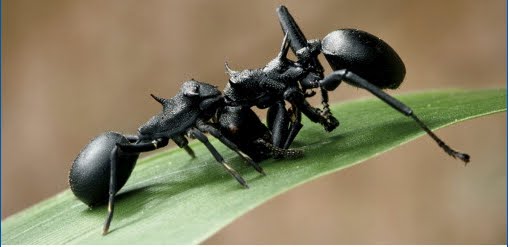
It’s interesting how and why different life forms have come to p-ant-omime. For example, in the picture above, (Maderspacher & Stensmyr 2011, Fig. 3) on the left side is the crab spider (Aphantochilus rogersi) mimicking ant species in the genus Cephaloteswhich the spider comes upon unawares and then feeds upon (getting pwned on the right side of the photo). If imitation is the sincerest form of flattery, then mimicry must be the most malevolent means of creepy.
Or here’s a treehopper (Cyphonia clavata, an insect and not a spider like above) that doesn’t just disguise itself as an ant, but rather has a whole ant-shaped appendage bursting from its back in a disgusting perversion of alien birth in the Alien series (Maderspacher & Stensmyr 2011, Fig. 1). It is quite remarkable that a surprisingly common yearning to be perceived as an ant has resulted in convergent evolution of an ant-ish figure in myriad of nature’s more disgusting creations, not to mention in ants themselves.
Reference
Florian Maderspacher & Marcus Stensmyr (2011). Myrmecomorphomania Current Biology, 21 (9) : R291-293. doi:10.1016/j.cub.2011.04.006
ResearchBlogging.org

What the hell was Australopithecus boisei doing?

A little over 2 million years ago there a major divergence of hominins, leading on the one hand to our earliest ancestors in the genus Homo, and on the other hand to a group of ‘robust’ australopiths, the latter group a failed evolutionary experiment in being human. In our ancestors, parts of the skull associated with chewing began to get smaller and more delicate, while the robust australopiths increased the sizes of their crushin’-teeth and chewin’-muscle attachments.

Cartoon of a “robust” australopith face, Fig. 1 from McCollum (1999). Note the very tall face, flaring cheeks, and massive lower jaw which would have facilitated wicked-pissah chewing power.

Weirder, there is a South African form (Australopithecus robustus) and an East African form (A. boisei, the figure here looks like it’s based off this species) of robust. These two may have inherited their robust adaptations from a common ancestor, or they may be unrelated lineages that evolved these features in parallel. The East African A. boisei has been referred to as ‘hyper-robust,’ its face and teeth generally larger than those of A. robustus.

For a while it’s been supposed that these ‘robust’ chewing adaptations in our weird, extinct evolutionary cousins (every family has those, right?) reflected a diet of hard objects requiring powerful crushing and grinding – things like hard fruits, seeds, Italian bread, etc. But a few years ago Peter Ungar and others (2008) examined the microscopic wear patterns on the surfaces of molar teeth of A. boisei and noted that they lacked the characteristic pits of a hard-object feeder. A. robustus on the other hand does have wear patterns more like an animal that ate hard foods. Why such a difference? Why the hell wasn’t boisei behaving robustly?

Also in 2008 Nikolaas van der Merwe and colleagues analyzed the carbon isotopes preserved in the teeth of A. boisei and some other fossils. Briefly, plants utilize two isotopes of carbon (C12 and C13), but ‘prefer’ the lighter-weight C12. Some groups of plants like grasses have thrived because they’re less picky and can get by just as well with C13. Different kinds of plants, then, incorporate different amounts of these two carbon isotopes into their tissues, then when animals eat it, these isotopes get incorporated into the animal’s developing tissues, including tooth enamel. So by looking at the relative amounts of these two carbon isotopes in teeth, researchers can get a rough idea of whether an animal was eating more of the C13-loving or C13-loathing plants (or the animals eating the plants). van der Merwe and others found A. boisei to have a way higher percentage of the plants that don’t discriminate against C13 as much, possibly things like grass, sedges or terrestrial flowering plants. GRASS?!

Last week, Thure Cerling and colleagues expanded on the earlier study led by van der Merwe, including a larger set of boisei teeth spanning 500 thousand years of the species’ existence. Lo and behold, they got similar results: the isotopic signature in A boisei is similar to grass-feeding pigs and horses in its habitat — was the badass “hyper robust” A boisei just a hominin version of a horse? Now, the silica in grass make it extremely wearing on tooth enamel, and while A. boisei had crazy thick molar enamel, I would be a little surprised if the boisei dentition could withstand a lifetime of a grassy diet. Nevertheless, boisei‘s diet clearly differed from robustus, based on both dental wear and carbon isotopes.

This raises interesting questions about the evolution of the robust group. Does their shared ‘robust’ morphology reflect common ancestry, with the subtle differences the result of their divergent diets? Or do the subtle differences indicate that they evolved separately but their diets for whatever reasons resulted in similar mechanical loading on their jaws and faces? It should also be noted that while the dates for South African cave sites are always a bit uncertain, it is possible that A. robustus persisted alongside genus Homo until around 1 million years ago, whereas the fossil record for A. boisei craps out around 1.4 million years ago – was A. boisei too specialized on crappy grass, resulting in its evolutionary demise?

A horse-ish human-ish hominin, Australopithecus boisei, rest in peace. 2.1 – 1.4 mya

References
Cerling TE, Mbua E, Kirera FM, Manthi FK, Grine FE, Leakey MG, Sponheimer M, & Uno KT (2011). Diet of Paranthropus boisei in the early Pleistocene of East Africa. Proceedings of the National Academy of Sciences of the United States of America PMID: 21536914
McCollum, M. (1999). The Robust Australopithecine Face: A Morphogenetic Perspective Science, 284 (5412), 301-305 DOI: 10.1126/science.284.5412.301
Ungar PS, Grine FE, & Teaford MF (2008). Dental microwear and diet of the Plio-Pleistocene hominin Paranthropus boisei. PloS one, 3 (4) PMID: 18446200
van der Merwe NJ, Masao FT, & Bamford MK (2008). Isotopic evidence for contrasting diets of early hominins Homo habilis and Australopithecus boisei of Tanzania. South African Journal of Science 104: 153-155 (link)

Is eugenics really dead?

My advisor passed along a USA Today story about the eugenics origins of the journal Annals of Human Genetics. Eugenics was a popular movement in the early 20th century, in which people thought it wise to take the onus of natural selection upon themselves, to encourage smart wealthy people to breed and ‘dullard’ poor folk to be sterilized. The movement was based on a misunderstanding of evolution, heredity and the genetic basis for complex traits like ‘intelligence’ (whatever the hell that term really means). Not to mention a sense of intellectual and moral superiority among moneyed white people. Eugenic thinking is what underlay the reprehensibly regrettable misgivings of the Holocaust.

I think it’s great that the Annals of Human Genetics is public about the journal’s off-color origins. Anthropology itself was borne of Western countries going off to figure out why the lands they were colonizing and exploiting contained humans that differed from themselves (as well as how to deal with ‘inferior races’). It’s important to know of your field’s past mistakes, lest history repeat itself.
Is it repeating itself? Nowadays, people can get ‘genetic counseling’ if they’re contemplating pregnancy, to learn their purportedly genetically predisposed risks for having a child with certain conditions like Down Syndrome. With such knowledge, people can elect not to have kids together. Is this a blessing from medical genetics, or are we seeing a resurgence of biological determinism and old school eugenics?

Evolution: What it is and why humans aren’t immune to it

An alternate title for this post could be “BigThink Too Big For Own Britches.”

Physicist Michio Kaku (via John Hawks via Pharyngula) has re-brought my attention to the fact that a great deal of people (smart people like Kaku included) misunderstand the mechanics of biological evolution. Quite simply, evolution is change in a gene pool over time. This pool could be an entire species or a small population within that species.

There are a number of ways evolution can happen. A mutation is a new genetic variant that arises in an individual, which can then be spread to later generations when that individual reproduces. A single strand of human DNA is like a string of some 3 billion letters. When a person replicates their DNA for it to be passed on to their offspring (meiosis), having to reproduce such a long strand ensures that a mistake is made at least once in a while. Hence mutations increase variation in a gene pool.
But the frequencies of genes in a population can change, that is they may become more or less common within the gene pool. This could happen by genetic drift, which is the random loss of genes. If a gene is neither adaptive nor harmful, it could simply be lost over time due to sheer chance. In contrast to mutation, drift reduces genetic variation.
If genes are adaptive or harmful, their frequency in a gene pool becomes subject to natural selection. If a gene (or set of genes) is adaptive, that means the possessor of those genes will be more likely to survive and reproduce than others, i.e., the individual will be more likely to pass on these genes. Over time, the adaptive genes will increase in frequency in a population. Conversely, genes that lower the likelihood of surviving and reproducing will become less frequent in subsequent generations. Either of these scenarios means selection is reducing genetic variation. But sometimes different forms of a gene can be adaptive in different situations or combinations, so selection will act to maintain both of these in the gene pool. So in contrast to mutation and drift, selection can reduce or maintain genetic variation.
Finally, gene flow refers to genes being introduced into a gene pool from another source. This could occur when someone from one population reproduces with an individual from another population, and so new genes may enter one of the groups. Like mutation, this will increase genetic variation in a gene pool.
Common misconceptions
It may seem counterintuitive, but evolution does not equate with progress. This is a common misconception, probably due to the social ideologies under which evolutionary theory developed. Because of selection, evolution often means that a population becomes better-suited to its environment over time, which seems like progress. But as we’ve seen above, not all evolution is selection; mutation and drift are fairly random processes of evolution that don’t necessarily bear on adaptation. In addition, environments and circumstances change, so that even if something evolved in a place where it was adaptive, it may be harmful in a new context. For example, as the earliest humans lost their body hair, they probably evolved to have darker skin: adaptive in the tropics where humans originated. But later, when early humans moved into more northerly latitudes with less ultraviolet exposure from the sun, the dark skin that was adaptive for a hairless human in a tropical environment came to hinder the body’s vitamin D synthesis: maladaptive!
Also contra popular opinion, individuals do not evolve, populations do. Trojan brand condoms recently had an ad campaign in which they encouraged men to “evolve” by using Trojan condoms when having promiscuous sex. This is in line with the incorrect idea above that ‘evolving’ means ‘becoming better’ or ‘more sophisticated.’ Of course, condoms may actually help a population to evolve: those who use condoms to prevent pregnancy are ensuring they do not pass on their genes. And if there’s any genetic predisposition to make one more likely to use condoms (and there’s not), these genes would certainly become less common in future generations. [I am NOT encouraging people not to use protection, by the way]
So this brings us to a final point: the main misconception expressed in Dr. Kaku’s video is that humans are not evolving. Technology and urbanization, he tells us, have circumvented natural selection on human features (well, the “gross” or visible ones). This is very wrong and shortsighted. In fact, this is one of the bases of the eugenics movement of the early 20th century. Eugenicists thought, ‘Nature is no longer ensuring some people don’t pass on their genes, so we ought to do it ourselves for the good of humankind.’ This first thought, about the insufficiency of Nature, is echoed by Dr. Kaku (though surely he does not think the second).
Simply put, HUMANS ARE STILL EVOLVING. Remember, not all evolution = natural selection. The genetic composition of humankind is still subject to the random forces of mutation and drift. In fact, because the human population size has increased exponentially of late, the fact that there are way more people than ever means that there are more mutations entering the population, and at a faster rate, than ever! But selection is still at work, too. There are still diseases that kill people before they can pass on their genes. There are still environmental situations – even in ‘civilized’ places! – that prevent people from passing on their genes.
We humans are still evolving because we are still subject to the forces of evolution, and we always will be. Now what physicist could’ve told you that?!

Neoteny in literature

I’m trying something new: recreational reading, non-academic literature to get my mind of work at the end of the day. My Platonic soulmate recommended, almost a decade ago now, Still Life With Woodpecker by Tom Robbins. I was very surprised, then, to run into this passage:

“Neoteny” is “remaining young,” and it may be ironic that it is so little known, because human evolution has been dominated by it. Humans have evolved to their relatively high state by retaining the immature characteristics of their ancestors. Humans are the most advanced of mammals – although a case could be made for the dolphins – because they seldom grow up. Behavioral traits such as curiosity about the world, flexibility of response, and playfulness are common to practically all young mammals but are usually rapidly lost with the onset of maturity in all but humans. Humanity has advanced, when it has advanced, not because it has been sober, responsible, and cautious, but because it has been playful, rebellious, and immature.

Why Lucy, what sweet kicks you had

For decades people have debated whether Australopithecus afarensis was an obligate biped like us, or whether our ancestor was a little less lithe in life on land. They asked, sort of, “Would Lucy have rocked some sweet Air Jordans, or would she have put some flat-foot orthotics in her new kicks?”

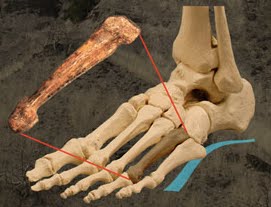
Carol Ward and colleagues report on a new fourth metatarsal of Australopithecus afarensis from Hadar in Ethiopia, over 3.2 million years old. The foot bone shows that A. afarensis had the two foot arches that we humans enjoy today.
Metatarsals are the longbones comprising much of the foot right before your silly-looking toes. One exceptional thing about our metatarsals compared to our ape cousins is that they contribute to two arches, one running front-to-back and another side-to-side. The arches provide critical support to our foot for bipedal stance, and a little Fred-Astaire-springiness as our foot hits the ground and then lifts off again when walking and running and sashaying.
The new A. afarensis metatarsal (AL 333-160, right) shows that by 3.2 million years ago, our ancestors had these arches, too. The twisting and angulation of the shaft relative to the base show these arches are similar to humans and our later fossil ancestors, whereas apes’ MT4s tend to be less twisted and angled. Such morphology was hinted at by the famous Laetoli footprints from Tanzania, around 3.7 million years ago, also attributed to A. afarensis. Other evidence from the skeleton suggested Lucy was a biped and nothing else, and so this new find from Hadar further solidifies the idea that some of our skeletal adaptations to bipedalism are ancient indeed.
UPDATE: Thinking about this finding in the shower this morning, I recalled that buddies Jerry DeSilva and Zach Throckmorton recently published a study where they concluded, based on the morphology of the end of the tibia, that A. afarensis probably had at least a rear-foot arch. Interestingly, though, they found some hominid specimens probably had “asymptomatic flatfoot.” Lucy (AL 288) was among these, so maybe she’d be sporting orthoticized Jordans after all.
ResearchBlogging.org
The Papers
DeSilva JM, & Throckmorton ZJ (2010). Lucy’s flat feet: the relationship between the ankle and rearfoot arching in early hominins. PloS one, 5 (12) PMID: 21203433

Ward, C., Kimbel, W., & Johanson, D. (2011). Complete Fourth Metatarsal and Arches in the Foot of Australopithecus afarensis Science, 331 (6018), 750-753 DOI: 10.1126/science.1201463

Statistics: Friend or Foe?

ResearchBlogging.org

In this week’s Science, Greg Miller describes recent uproar about a study that claims to have scientific support for the existence of extrasensory perception (ESP). Of course, ESP being in the realm of the paranormal, it ought to be somewhat outside the purview of Big Science.

But who cares about ESP?! What comes under scrutiny is statistics, the mathematical theory underlying hypothesis testing. And inference. The brief story is worth a read, as it cites statisticians on what these statistical tests actually tell us, as well as the ups and downs of Bayesian stats.
An important thing to keep in mind is that no matter how mathematical, statistics is nevertheless like everything else in science – a human endeavor. No matter how creative and insightful humans can be, there’s always a limit to our ability to decipher the world around us. I’m certainly not decrying statistics, but it’s important to keep in mind that these aren’t just handed down to us from on high. We human beings play a critical (and often subjective) hand in how we apply statistics to address our research questions.
Along these lines, just last night I was reading about body mass variation in the Gombe chimpanzees (Pusey et al. 2005), and the authors provide a very insightful quote from statistician George Box:

All models are wrong; some models are useful.

References
Miller G (2011). Statistics. ESP paper rekindles discussion about statistics. Science (New York, N.Y.), 331 (6015), 272-3 PMID: 21252321
Pusey, A., Oehlert, G., Williams, J., & Goodall, J. (2005). Influence of Ecological and Social Factors on Body Mass of Wild Chimpanzees International Journal of Primatology, 26 (1), 3-31 DOI: 10.1007/s10764-005-0721-2

Dobzhanksy on Posh Hybrids

Long-time readers may recall that one thing I wish I did active research on is hybridization: the crossing of divergent species or lineages, the developmental abnormalities arising from hybridization, and the potential role of hybridization in human evolution. One such developmental abnormality is “heterosis,” a.k.a. ‘hybrid vigor.’ In general, heterosis refers to any trait in hybrids that is larger than the average of the two parents’ (or the parents’ species) values for that trait. The phenomenon was recognized in plant domestication as far back as the 19th century – crosses between different plant (namely corn) strains produced hybrid strains with much greater yield than their parent species.

Implicit in the term is that heterosis, or larger size, is a more adaptive condition than found in the parents. Here’s what the late, brilliant Theodosius Dobzhansky (1950: on hybrids: 557) had to say on the matter.

The advisability of applying the term “heterosis” to cases in which heterozygotes are larger in body size, or show “increases” in any “traits,” but no evidence of higher adaptive value compared to the corresponding homozygotes, is open to question. Perhaps the word “luxuriance” would be a better designation for such cases, the word “heterosis” or “euheterosis” to be used for adaptive superiority of heterozygotes to homozygotes. . . . it is clear that the mechanisms underlying euheterosis and luxuriance are quite different.

I wonder if these luxuriant (not heterotic) hybrids also love diamonds, yoga and kopi luwak coffee?
Reference
DOBZHANSKY T (1950). Genetics of natural populations. XIX. Origin of heterosis through natural selection in populations of Drosophila pseudoobscura. Genetics, 35 (3), 288-302 PMID: 15414931
ResearchBlogging.org

Speciation and reticulation

ResearchBlogging.org Hey, “all you lovers out there,” which is how Marvin Berry introduced “Earth Angel” at the Enchantment Under the Sea dance back in good-olde 1955. And by “lovers” I mean “geneticists.”

Poring over the recent Neandertal nuclear genome paper (Green et al. 2010) for seminars, we’re struck by two contradictory ideas. On the one hand, the authors demonstrate pretty convincingly that Neandertals and the more ‘anatomically modern’ humans of Europe and Asia interbred. This doesn’t come from genetic comparisons of Neandertal and contemporaneous human fossils, but of Neandertals with living humans traipsing modern soil. But on the other hand, the authors estimate the time of the divergence of Neandertal and living human populations.
Herein lies the rub:

“Population divergence [is] defined as the point in time when two populations last exchanged genes.” (Green et al. 2010: 717)

Which they estimate, based on genome sequence divergence and some other assumptions, to be anywhere from ~270,000 – 440,000 years ago. But then this:

“[The Out-of-Africa] model for modern human origins suggests that all present-day humans trace all their ancestry back to a small African population that expanded and replaced [Neandertals] without admixture. Our analysis of the Neandertal genome may not be compatible with this view because Neandertals are on average closer to individuals in Eurasia…” (Green et al. 2010: 721)

Though they say “may not” they probably should’ve just said “isn’t.” Either way, they estimate an ancient date at which the groups in question “last exchanged genes,” but also demonstrate that these populations last exchanged genes much more recently.
So what is “population divergence,” then? As a wise man asked, “what does divergence mean when there is reticulation?” (I’m assuming he would prefer to go nameless) Reticulation referring not to pythons or chipmunks, but to mating between individuals in different populations. Is “divergence” not so much the last time genes were exchanged, but rather the time when the genomes began to become different?
Reference
Green, R., Krause, J., Briggs, A., Maricic, T., Stenzel, U., Kircher, M., Patterson, N., Li, H., Zhai, W., Fritz, M., Hansen, N., Durand, E., Malaspinas, A., Jensen, J., Marques-Bonet, T., Alkan, C., Prufer, K., Meyer, M., Burbano, H., Good, J., Schultz, R., Aximu-Petri, A., Butthof, A., Hober, B., Hoffner, B., Siegemund, M., Weihmann, A., Nusbaum, C., Lander, E., Russ, C., Novod, N., Affourtit, J., Egholm, M., Verna, C., Rudan, P., Brajkovic, D., Kucan, Z., Gusic, I., Doronichev, V., Golovanova, L., Lalueza-Fox, C., de la Rasilla, M., Fortea, J., Rosas, A., Schmitz, R., Johnson, P., Eichler, E., Falush, D., Birney, E., Mullikin, J., Slatkin, M., Nielsen, R., Kelso, J., Lachmann, M., Reich, D., & Paabo, S. (2010). A Draft Sequence of the Neandertal Genome Science, 328 (5979), 710-722 DOI: 10.1126/science.1188021