Bonobos and the ultimate hidden truth of the world

A recent study finds that bonobos are no less aggressive than chimpanzees, but levels of aggression also vary across different groups in either species.

Chimpanzees and bonobos are humans’ closest living relatives, their ancestors having diverged from ours around 6 million years ago, before our two evolutionary cousins started becoming separate species over a million years ago (Yoo et al., 2025). Chimpanzees have long been depicted as violent, with males especially “warlike” — see for instance the recent documentary Rise of the Warrior Apes (which is excellent, although it doesn’t pass the Bechdel Test). Early studies of bonobos, on the other hand, revealed different social dynamics: females dominate males, all individuals use sexual contact for establishing and maintaining social bonds, and individuals are generally less aggression compared to chimpanzees.

Because these two species are equally related to humans, they provided starkly different models for the possible ancestral conditions out of which humans evolved (Parish et al., 2000). People often look to the animal world to support their ideas of what constitues ‘human nature.’ If either chimpanzees or bonobos are selected as the proxy for our last shared ancestor millions of years ago, one could argue that humans are ‘naturally’ aggressive or peaceful.

However, reports of violent aggression among bonobos in the wild have emerged in recent years, including a likely case in which several females attacked (and probably killed) a male in their group (Pachevskaya et al., 2025). So, are chimpanzees and bonobos that different after all?

Yesterday, Emile Bryon & colleagues reported the results of a systematic comparison between chimpanzees and bonobos in terms of their aggression toward others. The researchers studied 22 groups of chimpanzees (9 groups) and bonobos (13 groups) living in zoos, examining who antagonized whom and whether this involved more of a threat or came to physical contact that could cause bodily harm. The comparison among apes living in captivity as opposed to the wild provides greater sample sizes and reduces some of the variance that could be attributed to habitat differences.

Bryon and team found that, as their article title succinctly reports, “chimpanzees are not more aggressive than bonobos but target sexes differently.” Their results support earlier observations from wild-living apes in that among chimpanzees males are extremely aggressive toward females, while among bonobos females direct more aggression toward males. Overall rates of aggression did not differ between the two species, however, and within each species different groups varied extensively; wild-living apes vary between groups in similar ways.

This variability between groups of the same species is really important. Some groups had more aggressive encounters than others, and both chimpanzees and bonobos had groups with lower rates than expected from the species-wide patterns. It is easy to overgeneralize and essentialize animals based on limited observations—in this case, that ‘bonobos make love while chimpanzees make war.’ In contrast, the study shows that there’s no one way to form a bonobo or chimpanzee society. Our closest living relatives are more flexible in their behavior than we tend to give them credit for.

The animal kingdom and especially our ape cousins are frequently invoked in order to naturalize or justify violence and inequality in the human world, and I think this study illustrates that we shouldn’t overgeneralize about other animals or ourselves. Many people including Donald Trump use naïve evolutionary reasoning to argue that ‘might makes right,’ that being a selfish asshole is a natural state molded by our evolutionary history. But as the late, great David Graeber (2015) has argued (admittedly, about bureaucracies), “The ultimate hidden truth of the world is that it is something that we make, and could just as easily make differently.” This study by Bryon and colleagues suggests that the ability to choose or avoid conflict and aggression may well be the ancestral condition out of which humanity evolved—that despite the violence and warmongering making headlines today, there’s nothing in nature that says it has to be this way.

References

Bryon, E. et al. (2026). Chimpanzees are not more aggressive than bonobos but target sexes differently. Science Advances 12, eadz2433. doi:10.1126/sciadv.adz2433

Graeber, D. (2015). The Utopia of Rules: On Technology, Stupidity, and the Secret Joys of Bureaucracy. Melville House.

Parish, A. et al., (2000), The Other “Closest Living Relative”: How Bonobos (Pan paniscus) Challenge Traditional Assumptions about Females, Dominance, Intra- and Intersexual Interactions, and Hominid Evolution. Annals of the New York Academy of Sciences, 907: 97-113. https://doi.org/10.1111/j.1749-6632.2000.tb06618.x

Pashchevskaya, S et al. (2025) Coalitionary intra-group aggression by wild female bonobos. Current Biology 35, Issue 19, R912 – R913. https://doi.org/10.1016/j.cub.2025.08.010

Yoo, D., Rhie, A., Hebbar, P. et al. (2025) Complete sequencing of ape genomes. Nature 641, 401–418. https://doi.org/10.1038/s41586-025-08816-3

Bioanthro lab activity: Estimating Miocene ape body mass

We’ve arrived at the Planet of the Apes, also known as the Miocene, in my “Bones, Stones and Genomes” course. The living apes are but a small remnant of what was a pretty successful radiation starting around 20 million years ago. There were so many apes that it can be a bit confusing for students, but it’s important for setting up the biological and ecological contexts of hominin origins.

Possible evolutionary relationships of myriad Miocene apes and subsequent hominins. From Harrison (2010)

Possible evolutionary relationships of myriad Miocene apes and subsequent hominins. From Harrison (2010)

This week also marks my students’ first lab assignment, analyzing CT scans of bones. Here, we looked at how we estimate body size in extinct animals, using the KUPRI database and the free CT analysis software InVesalius. Because some of the KUPRI primates have body masses recorded, students can examine the relationship between animals’ weight and skeletal dimensions. The purpose of the assignment is to help familiarize students with skeletal anatomy, CT data and principles of linear regression.

One of the KUPRI specimens, an old female gorilla, with known weight.

One of the KUPRI specimens, an old female gorilla, with known weight.

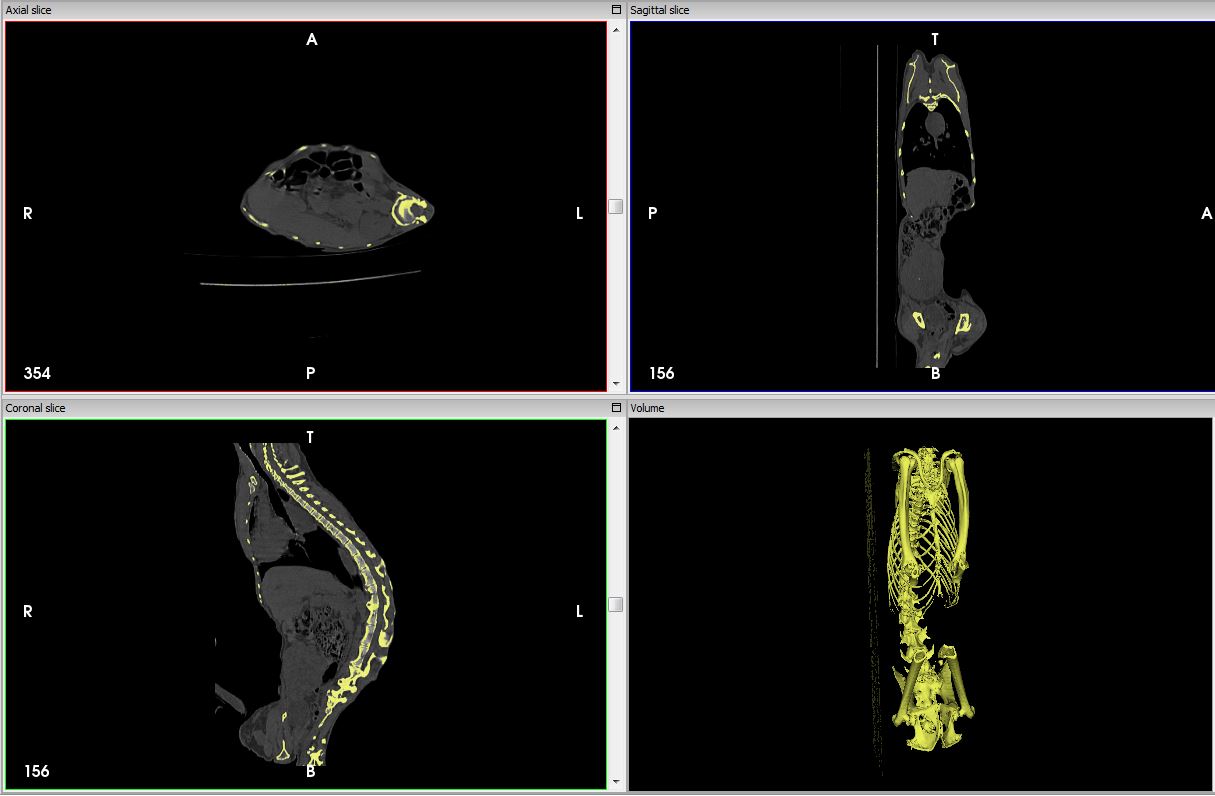
I selected a few specimens for students to examine. After students download the massive files, they can load them into InVesalius for analysis. This program allows students to easily identify bone versus other tissues, and to create a 3D surface rendering of a highlighted region (tissue) of interest.

A grivet, Chlorocebus aethiops, with bone highlighted in 2D sections and as a 3D model.

A grivet, Chlorocebus aethiops, with bone highlighted in 2D sections and as a 3D model. This little guy weighs only 4 kg!

It’s pretty easy to take simple linear measurements (and angles), assuming students can get oriented within the skeleton and identify the features they need to measure. It can be a little tricky to measure a femur head if it’s still in the acetabulum (below). Luckily, InVesalius lets you take measurements on both 2D slices or the 3D volume.

Let's measure that femur head diameter.

Let’s measure that femur head diameter.

So students do this for a few specimens and enter the data into Excel, which can then easily plot the data and provide a regression equation. They then use this equation to estimate masses of the specimens – if there’s a good relationship between mass and skeletal measures, then the estimates should be close to the observed values. Students use their equation to predict body mass of some Miocene apes based on femur head diameter and femur midshaft diameter, noting how confident they feel in their estimates given how well their regression performed on the training dataset. They also compare their mass estimates to those using another equation generated by Christopher Ruff (2003).

It might be a little intense for students totally unfamiliar with apes, bones and CT scans, but it should be a good way for them to learn lots of concepts we’ll revisit over the semester.

Here’s the lab assignment, in case you want to use it in your own class: Lab 1-Miocene masses

What do you call a Middle Miocene hominoid that doesn’t belong to you?

Nacholapithecus kerioi.

Oh man, that was a bad joke. N. kerioi is an ape known from the site of Nachola in Kenya, dating to 17-14 million years ago. There is a fairly complete skeleton, KNM-BG 35250, and completeness is always exciting for the paleontologist. It seems to have had a fairly large and robust forelimb compared to its hindlimb, possibly indicating locomotor behavior unlike anything modern primate. Based on evidence from the skull and teeth it was likely a hard-object feeder, a characteristic in many Miocene hominoids starting with the 17 million year-old Afropithecus. Here’s a picture of the skeleton (Nakatsukasa and Kunimatsu 2009, Fig. 1):
This specimen is the holotype for N. kerioi. A nice contrast to my last post griping about specimens that have been selected as holotypes.

Reference
Nakatsukasa M and Kunimatsu Y. 2009. Nacholapithecus and its importance for understanding hominoid evolution. Evolutionary Anthropology 18: 103-119.

A New African Late Miocene Ape

Martin Pickford and colleagues recently announced the discovery of a fossil ape from Niger. Fauna from the site suggest an age of anywhere from 11 – 5 million years ago. The fossil is just a fragment of the right mandible, containing the roots of the first molar. The form of the molar roots show its affinities with hominoid primates. Aside from that, little can be said about the fragment. It is very slender, unlike any hominin. The authors note that the size of the jaw and aspects of the root ally it closely with modern chimpanzees, but it does not preserve any diagnostic features that link it specifically to any living or fossil ape.

This is an exciting new find that addresses two big questions in paleoanthropology. First, the African late Miocene has a poor hominoid fossil record. Exceptions to this are the potential hominins Sahelanthropus, Orrorin, and Ardipithecus kadabba; and the ape-like Chororapithecus, Nakalipithecus, and Samburupithecus. So this new specimen, whether it represents one of the already-known fossil apes or is a new taxon, provides further evidence that apes were present in Africa in this time period. This bears on the debate about whether the living African apes (gorillas and chimpanzees/bonobos) originated in Eurasia or Africa, though certainly more fossils are needed to address this.

Second, most African fossil hominoids are known only from Eastern Africa. As such, it has looked like much of hominoid and hominin evolution have taken place there. At the moment, the only other non-East-African fossil hominoids I can think of are the 13 million year old Otavipithecus mandible from Namibia, and the 7 million year old Sahelanthropus fossils from Chad. So it is clear that hominoids (and hominins) existed in places other than East and South Africa. As the authors note, it is not unlikely that more hominoids (and hominins?) will be discovered in western and central Africa. Who knows, we might even get some (more?) chimpanzee ancestors out of it, a shift in the spotlight from our lineage to that of our closest living relatives.

Source:

Pickford M, Coppens Y, Senut B, Morales J, and Braga J. Late Miocene hominoid from Niger. Comptes Rendus Palevol In Press, Corrected Proof.