Bioanthro lab activity: Sexual dimorphism

A few weeks ago we examined sexual dimorphism – characteristic differences between males and females – in my Intro to Bioanthro class. Sexual dimorphism roughly correlates with aspects of social behavior in animals, and so we compared dimorphism in our class with what is seen in other primates. For the lab, we collected our body masses, heights, and lengths of our 2nd and 4th fingers, then I plotted the data and we went over it together.

When collecting data on your students, make sure to get permission from your institution and let students know they can opt out of sharing their personal data. I’ve also assigned students randomized ID numbers to help keep their data private and as anonymous as possible.

This activity builds on the first lab we did this year, measuring our head circumferences to estimate brain size and examining how this varies within the classroom. We saw then that our class’s males have  larger brain (well, head) sizes than females. We hypothesized that this was simply due to body size differences – all else being equal, larger people should have larger brains. Now that we collected body mass data, we could test this hypothesis – in fact, when body mass is taken into account, our class’s females have larger brains than males:

Sexual dimorphism in brain size (left), body size (center), and brain/body size.

Sexual dimorphism in brain size (left), body size (center), and brain size relative to body size (right).

These are sex differences based on raw numbers. Another way to look at dimorphism is to se the extent to which sexes deviate from a scaling relationship (“allometry”). Looking to the left plot below, there is a positive linear relationship between body and brain size: as body size increases, so does brain size. As we saw above, male values are elevated above females’ but there is overlap. Importantly, the right plot shows that deviations from this linear trend, quantified as residuals, are not significantly different for the two sexes. So even though females have large brains relative to their body size in absolute terms, this is not exceptional given how brain size scales with body size.

Brain-body allometry in our classroom. Males and females in our classroom do not seem to deviate appreciably from a common pattern of allometry.

Brain-body allometry in our classroom. Males and females in our classroom do not seem to deviate appreciably from a common pattern of allometry.

While lab activities help students to understand patterns in data, this lab also shows students the importance of comparing patterns of variation.  Students learn from readings and lectures that humans show relatively low levels of dimorphism, and this activity helps them see why we say that. Situating our data within the context of primate dimorphism and mating systems, they can ask if there is an adaptive or evolutionary significance behind our level of dimorphism.

Sexual dimorphism in our classroom compared with what is seen in primates with different mating systems and levels male-male competition. Our class values are the stars, and in the right plot blue is males and green is females. Figures from Plavcan (2012) and Nelson & Schultz (2010).

Sexual dimorphism in our classroom compared with what is seen in primates with different mating systems and levels male-male competition. Our class values are the stars, and in the right plot blue is males and green is females. Figures from Plavcan (2012) and Nelson & Schultz (2010).

In this broader comparative context, students tackle what it means for human dimorphism, and ratios of the 2nd digit/4th digit, to be intermediate between what we see in monogamous vs. non-monogamous primates. This can lead some interesting class discussion.

Handout: Lab 3-Sexual dimorphism (Instructions and questions)

ResearchBlogging.orgReferences
 Nelson E, & Shultz S (2010). Finger length ratios (2D:4D) in anthropoids implicate reduced prenatal androgens in social bonding. American Journal of Physical Anthropology, 141 (3), 395-405. PMID: 19862809

Plavcan JM (2012). Sexual size dimorphism, canine dimorphism, and male-male competition in primates: where do humans fit in? Human Nature, 23 (1), 45-67. PMID: 22388772

eFfing #FossilFriday: Rekindling an old friend’s hip

Sorry for the crappy pun. Carol Ward and colleagues recently reported an associated hip joint, KNM-ER 5881, attributable to the genus Homo (1.9 million years old). Fossils coming from the same skeleton are pretty rare, but what’s more remarkable is that portions of this bone were discovered 29 years apart: a femur fragment was first found in 1980, and more of the femur and part of the ilium were found at the same location when scientists returned in 2009:

Figure 3 from Ward et al. 2015.

Figure 3 from Ward et al. 2015. A little distal to the hip, yes, but the pun still works. Views are, going clockwise starting at the top the top left, from above, from below, from the back, from the side, and from the front.

There’s also a partial ilium associated with the femur – that makes a pretty complete hip!

Figure 5 from Ward et al. shows the fossil. Jump for joy that it's complete enough for us to tell it comes from the left side!

Figure 5 from Ward et al. shows the fossil. Jump for joy that it’s complete enough for us to tell it comes from the left side!

Despite how fragmentary the femur and ilium are, the researchers were able to estimate the diameter of the femur head and hip socket reliably. The hip joints are smaller than all Early Pleistocene Homo except for the Gona pelvis. Comparing ER 5881 the large contemporaneous KNM-ER 3228 hip bone, the authors found these two specimens to be more different in size than is usually seen between sexes of many primate species. The size difference best matches male-female differences in highly dimorphic species like gorillas.

Ward et al. find that the specimen generally looks like early Homo but that the inferred shape of the pelvic inlet is a little different from all other Early and Middle Pleistocene human fossils. The authors take this discrepancy to suggest that there was more than one “morphotype” (‘kind of shape’), and therefore possibly species, of Homo around 1.9 million years ago. While I wouldn’t just yet go so far as to say this anatomy is due to species differences, I do agree that KNM ER 5881 helps our understanding and appreciation of anatomical variation in our early ancestors. Like all great fossil discoveries, the more we find, the more we learn that we don’t know. Here’s to more Homo hips in the near future!

My ESHE poster is Gona blow your mind

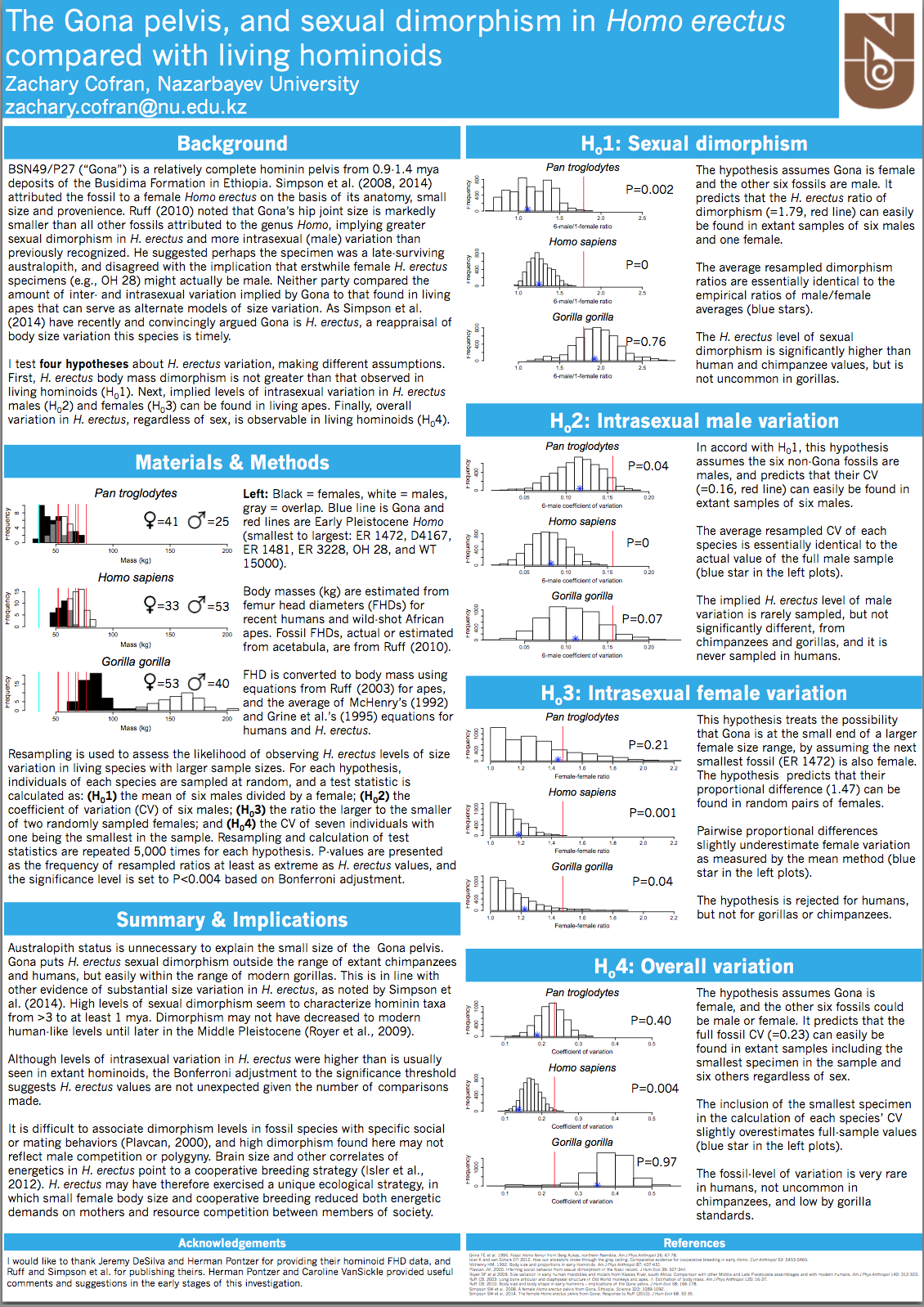
I’m in Italy for the annual meeting of the European Society for the Study of Human Evolution. It’s been a great conference, seeing interesting talks (check out #eshe2014 on Twitter), meeting old friends and meeting new ones, and enjoying excellent food and espresso. Here’s the poster I presented yesterday (download pdf):Screen Shot 2014-09-20 at 9.33.38 AM

It’s a follow-up to posts here and here. The long and short of it is, there was a substantial amount of body size variation (i.e., between males and females) in Homo erectus, on par with levels seen in modern day gorillas. This is interesting because H. erectus brain size (and brain size growth) would have required massive amounts of energy, so some have hypothesized a cooperative breeding strategy; sexually dimorphic species generally do not engage in such cooperative behavior. So I suggest that body size variation in H. erectus is an ecological strategy, with small female body size reducing the metabolic burden on mothers.

Ima Gona follow up on that last post

Last week, I discussed the implications of the Gona hominin pelvis for body size and body size variation in Homo erectus. One of the bajillion things I have been working on since this post is elaborating on this analysis to write up, so stay tuned for more developments!

Now, when we compared the gross size of the hip joint between fossil Homo and living apes (based on the femur head in most specimens but the acetabulum in Gona and a few other fossils), the range of variation in Homo-including-Gona was generally elevated above variation seen in all living great apes. This is impressive, since orangutans and gorillas show a great range of variation due sexual dimorphism (normal differences between females and males). However, I noted that the specimens I used were unsexed, and so the resampling strategy used to quantify variation within a species – randomly selecting two specimens and taking the ratio of the larger to smaller – probably underestimated sexual dimorphism.

Shortly after I posted this, Dr. Herman Pontzer twitterated me to point out he has made lots of skeletal data freely available on his website (a tremendous resource). The ape and human data I used for last week’s post did not have sexes (my colleague has since sent me that information), but Pontzer’s data are sexed (no, not “sext“). So, I modified and reran the original resampling analysis using the Pontzer data, and it nicely illustrates the difference between using a max/min vs. male/female ratio to compare variation:

Hip joint size variation in living African apes (left and right) compared with fossil humans (genus Homo older than 1 mya, center). Each plot is scaled to show the same y-axis range. On the left are ratios of max/min from resampled pairs from each species (sex not taken into account). On the right are ratios of male/female from resampled pairs from each species. The red dots on this plot are the medians for max/min ratios (the thick black bars in the left plot). The center plot shows ratios of Homo/Gona.

Hip joint size variation in living African apes (left and right) compared with fossil humans (genus Homo older than 1 mya, center). Each plot is scaled to show the same y-axis range. On the left are ratios of max/min from resampled pairs from each species (sex not taken into account). On the right are ratios of male/female from resampled pairs from each species. The red stars on this plot are the medians for max/min ratios (the thick black bars in the left plot). The center plot shows ratios of Homo/Gona.

The left plot shows resampled ratios of max/min in humans, chimpanzees and gorillas, while the right shows ratios of male/female in these species. If no assumption is made about a specimen’s sex (left plot), it is possible to resample a pair of the same sex, and so it is likelier to sample two individuals similar in size. Note that the ratio of max/min can never be less than 1. However, if sex is taken into account (right plot), we see two key differences. First, because of size overlap between males and females in humans and chimpanzees, ratios can fall below 1. Adult gorilla males are much larger than females, and so the ratio is never as low as 1 (minimum=1.08). Second, in more dimorphic species, the male/female ratio is elevated above the max/min ratio (red stars in the right plot). In chimpanzees, the median male/female ratio is actually just barely lower than the median max/min ratio. If you want numbers: the median max/min ratios for humans, chimpanzees and gorillas are 1.09, 1.06 and 1.16, respectively. The corresponding median male/female ratios are 1.15, 1.06 and 1.25.

Regarding the fossils, if we assume that Gona is female and all other ≥1 mya Homo hips are male, the range of hip size variation can be found within the gorilla range, and less often in the human range.

But the story doesn’t end here. One thing I’ve considered for the full analysis (and as Pontzer also pointed out on Twitter) is that the relationship between hip joint size and body weight is not the same between humans and apes. As bipeds, we humans place all our upper body weight on our hips; apes aren’t bipedal and so relatively less of their weight is transmitted through this joint. As a result, human hip joint size increases faster with increasing body mass than it does in apes.

So for next installment in this fossil saga, I’ll consider body mass variation estimated from hip joint size. Based on known hip-body size relationships in humans vs. apes, we can predict that male/female variation in humans and fossil hominins will be relatively higher than the ratios presented here – will this put fossil Homo-includng-Gona outside the gorilla range of variation? Stay tuned to find out!

Variation 2: The female with the flamboyant and massive male

Continuing my investigation into stages of individual development, I’ve stumbled upon a study of the maturation of semi-wild mandrills (Mandrillus sphinx). Mandrills are one of the most visually striking species of Primates (check out this beastly male to the right), and exemplars of the power of Sexual Selection.

Sexual selection is a special subtype of Natural Selection, where the within-species competition here isn’t so much for survival (as in natural selection) but more specifically for reproduction. Sexual selection is believed to be responsible for many differences between the sexes: male primates often (but not always!) have much larger bodies and canine teeth than females, traits that can be beneficial when competing with other males for access to female mates. And/or females may prefer larger-bodied or -canined males for whatever reason. In accord with the power of female preferences, sexual selection is invoked to explain why males of many species are so wildly colored or ornamented.

So mandrills are perhaps the best example of sexual selection in primates. Males’ faces, butts and genitals are brightly colored, spanning the spectrum from blood-red to nearly bioluminescent blue. Conceivably, at some point in mandrills’ evolutionary history most males were drab-colored, but then who comes riding into town on a silver stallion but a mutant male who was more colossal and colorful than the rest, and females were like, “OMG did you see that variegated guy? I want him so bad,” and as a result, this male reproduced more, and the rest of the story writes itself. Coloration may actually communicate information to females about the health or dominance status of the male (e.g. Setchell 2004). I wish I had the time to investigate the physiological bases of how their hair and skin can produce such colors. To revolutionize the tattoo industry.

Mandrills are also remarkable in how much larger males are than females, in terms of canines (Plavcan and van Schaik 1992), molars (Scott et al. 2009) and body size (Wickings and Dixson 1992). And this brings me to my original thought.

The plot to the right tracks growth in body mass (in kilograms) of male and female mandrills (Wickings and Dixson 1992: 132, fig. 1). The male is the top line and the females the bottom one. The arrows indicate timing of sexual maturity. Holy crap, by the time males are sexually mature, they are about 3 times the body mass of females.

The union of the ~25 lb female with the seemingly-paint-splattered, 75 lb male must be a truly terrifying sight.

Things I cited ResearchBlogging.org

Plavcan, J., & van Schaik, C. (1992). Intrasexual competition and canine dimorphism in anthropoid primates American Journal of Physical Anthropology, 87 (4), 461-477 DOI: 10.1002/ajpa.1330870407

Scott JE, Schrein CM, & Kelley J (2009). Beyond Gorilla and Pongo: alternative models for evaluating variation and sexual dimorphism in fossil hominoid samples. American journal of physical anthropology, 140 (2), 253-64 PMID: 19358294

Setchell, J. (2005). Do Female Mandrills Prefer Brightly Colored Males? International Journal of Primatology, 26 (4), 715-735 DOI: 10.1007/s10764-005-5305-7

Wickings, E., & Dixson, A. (1992). Development from birth to sexual maturity in a semi-free-ranging colony of mandrills (Mandrillus sphinx) in Gabon Reproduction, 95 (1), 129-138 DOI: 10.1530/jrf.0.0950129