Results teaser

I’ve been hiding out under a rock for the past two months. Part of the quietude here is because I’ve been working hard to write up my dissertation, which compares patterns of jaw growth in humans and the our extinct relative Australopithecus robustus. Even though I presented some extremely preliminary results last year, I’ve generally been hesitant to talk about my work here on Lawnchair.

But in an effort to break my dissertation silence, and to begin thinking about starting to consider crawling out from under my rock, here’s a pretty pretty picture I made:

The green box and whiskers are humans, and the blue boxes A. robustus. Each box and whiskers represent all the individual mandible “sizes” that can be calculated for each species in each dental stage (stage 1 has only baby teeth erupted, stage 5 has nearly all its teeth erupted). It’s sort of like a mandible growth curve for each species, but not exactly.

The problem is I want to see whether I can distinguish patterns size change, from infancy to just before adulthood, in humans and A. robustus. But fossils don’t preserve well, and not all specimens share all the same measurable parts. So I devised a special test that measures a mandible’s “size” based on the traits it compares with other individuals.

Now, clearly from the figure A. robustus and human mandibles differ in mandible size throughout childhood. But questions arise: given the range of size variation within each species (especially stage 4), what are the chances of seeing the same amount of size change between dental stages in each sample? What traits or measurements on the mandible are contributing to these differences? Do these ‘sizes’ reflect the development of each species’ unique mandible shape? Well you’ll just have to stay tuned to find out…

…Or you could check this poster I presented at this year’s annual meeting of the American Association of Physical Anthropologists.
It’s quiet…

Although things have been silent here at Lawnchair Anthropology, this isn’t because there’s nothing going on. Rather, there’s a tonne going on right now and I haven’t had the time to write here. A few weeks ago I accepted a job, starting in August, in the burgeoning anthropology department of Nazarbayev University in Kazakhstan. It’s a brand new school and I’ll be the first biological anthropologist there (I believe), which is exciting. But, this means I need to book it to finish my dissertation by August. Also I’m teaching a Human Evo-Devo class (Anthrbio 297) here at the University of Michigan in the Spring (May-June) which will be awesome but will definitely make it challenging to get this thesis finished. I’ll do it, though.

So things’ve been pretty crazy lately, and I don’t foresee that changing any time soon. I’ll do my best to keep things up to date here at Lawnchair. The annual meetings of the American Association of Physical Anthropologists are happening in Portland in a few weeks, so I’ll probably have stuff to report on from there (if not here on lawnchair, then at least as soundbites on Twitter).

Osteology Everywhere

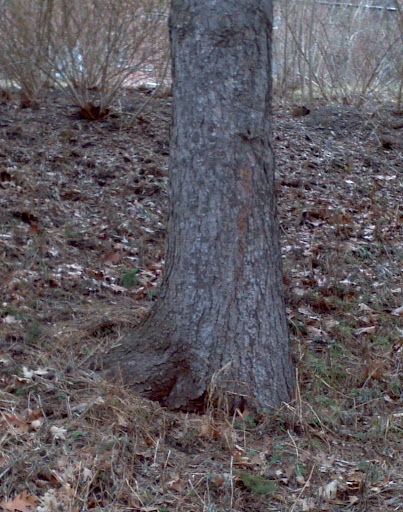
I saw a humerus bone sticking out of the ground on my walk home today.

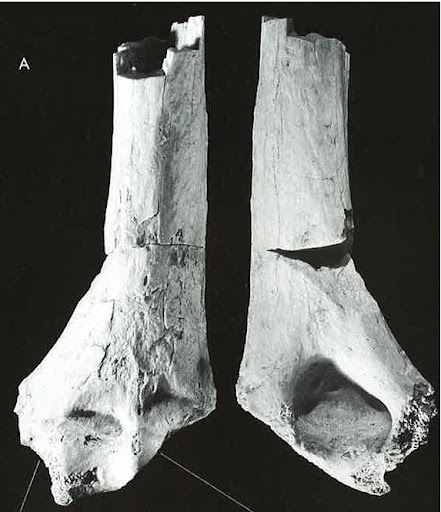
Just kidding. It was just a stupid tree (left). But it does look a lot like a reversed back-side view of thASK-VP-3/78 distal humerus of Ardipithecus kadabba (right-most of the right pic; Haile-Selassie 2001). It’s like someone blew up and unacceptably interred it, exposing only the top of the olecranon fossa (the big pit in the pic on the right, where the roots bifurcate on the tree at left). “ARE YOU A HOMINID OR NOT?” I almost yelled at the tree.
When you spend so much of your time working with bones, well you start seeing bones everywhere. And you’d be surprised how often you’ll find something when you’re looking for it, even inadvertently.
ResearchBlogging.orgWhat nature reminded me of: Haile-Selassie Y (2001). Late Miocene hominids from the Middle Awash, Ethiopia. Nature, 412 (6843), 178-81 PMID: 11449272

Ameloblast from the past

I’ve posted a couple times about the prospects of using high-resolution computed tomography imaging to assess cellular-level processes of growth and development. Today, Paul Tafforeau and colleagues present a synchrotron-based visualization of the adventurous paths that individual enamel-forming cells'(ameloblasts) take to form tooth crowns. I’ve been focusing more on using these techniques for studying bone growth, but I got the idea of that from previous studies of teeth (see Macchiarelli et al. 2006 and Smith et al. 2010).

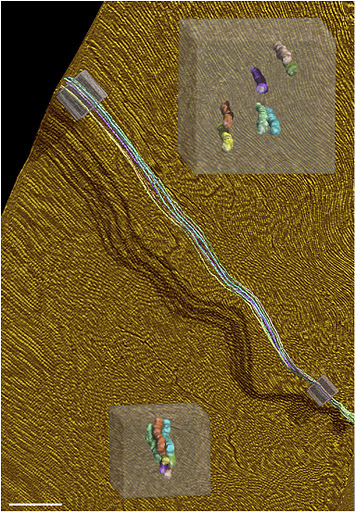
Tafforeau et al 2012, Fig 3. Scale bar = 0.25 mm

Time was, the internal microstructure and growth of enamel could only be examined using sectioned (either cut or naturally fractured) tooth crowns. Synchrotron imaging of teeth allowed Tafforeau and colleagues to get at this internal information in complete teeth whose insides are unexposed.

To the left is a “virtual” section of a molar tooth, the ‘base’ of the enamel (at the enamal-dentine junction) is at the bottom right, and the external surface of the tooth is at the top left. The lines radiating from the EDJ to the crown surface are enamel prisms, the mineralized paths of cells called “ameloblasts” that form tooth crowns. This is the cellular process by enamel is deposited to form a rock-hard tooth.

Note that the prisms start off packed closely together as they start their journey from the EDJ, but slowly diverge along roughly-parallel paths to be a bit further apart from one another (cross-sections in the cubes). The prisms’ shadow on projected onto the exposed crown shows how non-linearly ameloblasts course to their final destination in some dimensions – I for one don’t know why the path contains these kinks.

As with any awesome method, there are nevertheless limitations. Tafforeau and team say that enamel closer to the inside of the tooth is somewhat muddled, due to differences in the extent to which prisms had mineralized. And I don’t know any numbers, but I’d guess that scanning a lot of teeth would get pretty expensive. But ultimately is a pretty badass research tool. This fine-scale internal view of tooth microstructure can allow researchers to reconstruct how a tooth grew, and from there to examine the cellular growth processes involved in certain crown shapes, mechanical properties of teeth, and how enamel hypoplasias (markers of health stress) are created by affecting the behavior of cells. Very cool stuff.

ResearchBlogging.orgThose papers
Macchiarelli, R., Bondioli, L., Debénath, A., Mazurier, A., Tournepiche, J., Birch, W., & Dean, M. (2006). How Neanderthal molar teeth grew Nature, 444 (7120), 748-751 DOI: 10.1038/nature05314

Smith, T., Tafforeau, P., Reid, D., Pouech, J., Lazzari, V., Zermeno, J., Guatelli-Steinberg, D., Olejniczak, A., Hoffman, A., Radovcic, J., Makaremi, M., Toussaint, M., Stringer, C., & Hublin, J. (2010). Dental evidence for ontogenetic differences between modern humans and Neanderthals Proceedings of the National Academy of Sciences, 107 (49), 20923-20928 DOI: 10.1073/pnas.1010906107

Tafforeau, P., Zermeno, J., & Smith, T. (2012). Tracking cellular-level enamel growth and structure in 4D with synchrotron imaging Journal of Human Evolution DOI: 10.1016/j.jhevol.2012.01.001