Arm and leg modelling

No, I’m not looking for people with lithe limbs to be photographed for money. Much more sexily, I’m referring to a recent paper (Pietak et al., 2013) that’s found that the relative length of the segments of human limbs can be modeled with a log-periodic function:

Figure 2 from Pietak et al. 2013. Human within-limb proportions are such that the length of each segment (e.g., H1-6) of a limb, from  fingertip to shoulder (A) and to to hip (B), can be predicted by a logarithmic periodic function (C).

In other words, within a limb, the length of each segment is mathematically fairly predictable on the basis of the segment(s) before and after it. As the authors state, “Being able to describe human limb bone lengths in terms of a log-periodic function means that only one parameter, the wavelength λ, is needed to explain the proportional configuration of the limb.”

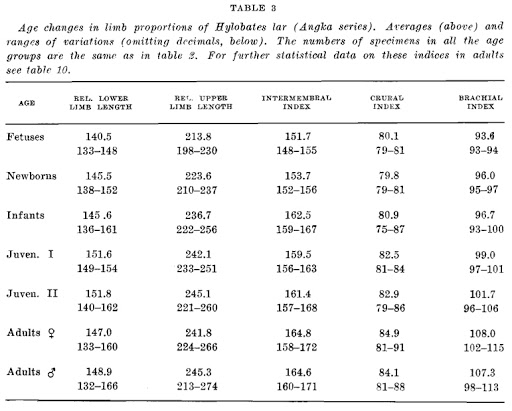
The biological significance of this pattern is difficult to discern. The length of a limb segment is determined by a number of factors, including the spacing between the initial limb condensations embryonically, and thereafter the growth rates and duration of growth at proximal and distal epiphyses. As a result, limb proportions aren’t static throughout life, but change from embryo to adult. For instance, here are limb proportion data for the coolest animal ever – gibbons! – from the great anatomist Adolph Schultz.

ResearchBlogging.orgAn important question, and follow-up to Pietak et al’s study, is whether human limb proportions can be described by such log-periodic functions throughout ontogeny, and if so how these change. Plus, it’s also not clear to what extent human proportions might happen to be describable by log periodic functions, simply because each segment is shorter than the one preceding it proximally. In short, this study raises really interesting and pursuable questions about how and why animal limbs grow to the size and proportions that they do.

References
Pietak A, Ma S, Beck CW, & Stringer MD (2013). Fundamental ratios and logarithmic periodicity in human limb bones. Journal of anatomy, 222 (5), 526-37 PMID: 23521756

Schultz, A. (1944). Age changes and variability in gibbons. A Morphological study on a population sample of a man-like ape American Journal of Physical Anthropology, 2 (1), 1-129 DOI: 10.1002/ajpa.1330020102

Pre-publication: Brain growth in Homo erectus (plus R code!)

The annual meetings of the American Association of Physical Anthropologists were going on all last week, and I gave my first talk before the Association (co-authored with Jeremy DeSilva). The talk focused on using resampling methods and the abysmal human fossil record to assess whether human-like brain size growth rates were present in our >1 mya ancestor Homo erectus. This is something I’ve actually been sitting on for a while, and wanted to wait til after the talk to post for all to see. I haven’t written this up yet for publication, but before then I’d like to briefly share the results here.

Background: Humans’ large brains are critical for giving us our unique capabilities such as language and culture. We achieve these large (both absolutely, and relative to our body size) brains by having really high brain growth rates across several years; most notable are exceptionally high, “fetal-like” rates during the first 1-2 years of life. Thus, rapid brain growth shortly after birth is a key aspect of human uniqueness – but how ancient is this strategy?

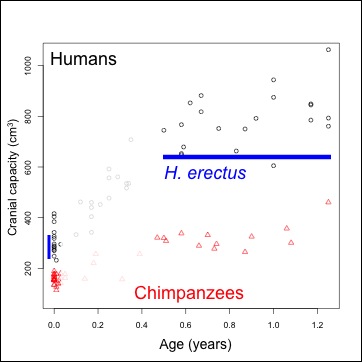
Materials: We can plot brain size at birth in humans and chimpanzees (our closest living relatives) to visualize what makes humans stand out (Figure 1).

Figure 1. Brain size (volume) at given ages. Humans=black, chimpanzees=red. Ranges of brain size at birth, and the chronological age of the Mojokerto fossil, in blue.

Human data come from Cogueugniot and Hublin (2012), and chimpanzees from Herndon et al. (1999) and Neubauer et al. (2012). The earliest fossil evidence able to address this question comes from Homo erectus. Because of the tight relationship between newborn and adult brain size (DeSilva and Lesnik 2008), we can use adult Homo erectus brain volumes (n=10, mean = 916.5 cm^3) to predict that of the species’ newborns: mean = 288.9 cm^3, sd = 17.1). An almost-recent analysis of the Mojokerto Homo erectus infant calvaria suggests a size of 663 cm^3 and an age of 0.5-1.25 years (Coqueugniot et al. 2004; this study actually suggests an oldest age of 1.5 years, but the chimpanzee sample here requires us to limit the study to no more than 1.25 years). Because we have a H. erectus fossil less than 2 years of age, and we can estimate brain size at birth, we can indirectly assess early brain growth in this species.

Methods: Resampling statistics allow inferences about brain growth rates in this extinct species, incorporating the uncertainty in both brain size at birth, and in the chronological age of the Mojokerto fossil. We thus ask of each species, what growth rates are necessary to grow one of the newborn brain sizes to any infant between 0.5-1.25 years? And from there, we compare these resampled growth rates (or rather, ‘pseudo-velocities’) between species – is H. erectus more similar to modern humans or chimpanzees? There are 294 unique newborn-infant comparisons for humans and 240 for the chimpanzee sample. We therefore compare these empirical newborn-infant pairs from extant species to 7500 resampled H. erectus pairs, randomly selecting a newborn H. erectus size based on the parameters above, and randomly selecting an age from 0.5-1.25 years for the Mojokerto specimen. This procedure is used to compare both absolute size change (the difference between an infant and a newborn size, in cm^3/year), and and proportional size change (infant/newborn size).

Results: Humans’ high early brain growth rates after birth are reflected in the ‘pseudovelocity curve’ (Figure 2). Chimps have a similar pattern of faster rates earlier on, but these are ultimately lower than humans’. Using the Mojokerto infant’s brain size (and it’s probable ages) and the likely range of H. erectus neonatal brain sizes (mean = 288, sd = 17), it is fairly clear that H. erectus achieved its infant brain size with high, human-like rates in brain volume increase.

Figure 2. Brain size growth rates (‘pseudo-velocity’) at given ages. Humans=black, chimpanzees=red, and Homo erectus,=blue.

However, if we look at proportional size change, the factor by which brain size increases from birth to a given age, we see a great deal of overlap both between age groups within a species, and between different species. Cross-sectional data create a great deal of overlap in implied proportional size change between ages within a species; it is easier to consider proportional size change between taxa, conflating ages, then  (Figure 3). Humans show a massive amount of variation in potential growth rates from birth to 0.5-1.25 years, and chimpanzees also show a great deal of variation, albeit generally lower than in the human sample. Relative growth rates in Homo erectus are intermediate between the two extant species.

Figure 3. Proportional brain size increase (infant/newborn size).

Significance: Brain size growth shortly after birth is critical for humans’ adaptative strategy: growing a large brain requires a lot of energy and parental (especially maternal) investment (Leigh 2004). Plus, in humans this rapid increase may correspond with the creation of innumerable white-matter connections between regions of the brain (Sakai et al. 2012), important for cognition or intelligence. The H. erectus fossil record (1 infant and 10 adults) provides a limited view into this developmental period. However, comparative data on extant animals (e.g. brain sizes from birth to adulthood), coupled with resampling statistics, allow inferences to be made about brain growth rates in H. erectus over 1 million years ago.

Assuming the Mojokerto H. erectus infant is accurately aged (Coqueugniot et al. 2004), and that Homo erectus followed the same neonatal-adult scaling relationship as other apes and monkeys (DeSilva and Lesnik 2008), it is likely that H. erectus had human-like rates of absolute brain size growth. Thus, the energetic and parental requirements to raise such brainy babies, seen in modern humans, may have been present in Homo erectus some 1.5 million years ago or so. This may also imply rapid white-matter proliferation (i.e. neural connections) in this species, suggesting an intellectually (i.e. socially or linguistically) stimulating infancy and childhood in this species. At the same time, relative brain size growth appears to scale with overall brain size: larger brains require proportionally higher growth rates. This is in line with studies suggesting that in many ways, the human brain is a scaled-up version of other primates’ (e.g. Herculano-Houzel 2012).

ResearchBlogging.org
This study was made possible with published data, and the free statistical programming language R.

Contact me if you want the R code used for this analysis, I’m glad to share it!

References
Coqueugniot H, Hublin JJ, Veillon F, Houët F, & Jacob T (2004). Early brain growth in Homo erectus and implications for cognitive ability. Nature, 431 (7006), 299-302 PMID: 15372030

Coqueugniot H, & Hublin JJ (2012). Age-related changes of digital endocranial volume during human ontogeny: results from an osteological reference collection. American journal of physical anthropology, 147 (2), 312-8 PMID: 22190338

DeSilva JM, & Lesnik JJ (2008). Brain size at birth throughout human evolution: a new method for estimating neonatal brain size in hominins. Journal of human evolution, 55 (6), 1064-74 PMID: 18789811

Herculano-Houzel S (2012). The remarkable, yet not extraordinary, human brain as a scaled-up primate brain and its associated cost. Proceedings of the National Academy of Sciences of the United States of America, 109 Suppl 1, 10661-8 PMID: 22723358

Herndon JG, Tigges J, Anderson DC, Klumpp SA, & McClure HM (1999). Brain weight throughout the life span of the chimpanzee. The Journal of comparative neurology, 409 (4), 567-72 PMID: 10376740

Leigh SR (2004). Brain growth, life history, and cognition in primate and human evolution. American journal of primatology, 62 (3), 139-64 PMID: 15027089

Neubauer, S., Gunz, P., Schwarz, U., Hublin, J., & Boesch, C. (2012). Brief communication: Endocranial volumes in an ontogenetic sample of chimpanzees from the taï forest national park, ivory coast American Journal of Physical Anthropology, 147 (2), 319-325 DOI: 10.1002/ajpa.21641

Sakai T, Matsui M, Mikami A, Malkova L, Hamada Y, Tomonaga M, Suzuki J, Tanaka M, Miyabe-Nishiwaki T, Makishima H, Nakatsukasa M, & Matsuzawa T (2012). Developmental patterns of chimpanzee cerebral tissues provide important clues for understanding the remarkable enlargement of the human brain. Proceedings. Biological sciences / The Royal Society, 280 (1753) PMID: 23256194

Go home, RNA, you’re drunk

(Alternate title: “circRNA censors the RNA censors?”)
When I was a kid, RNA played second fiddle to DNA. RNA was a mere intermediary between the ‘book of life’ (DNA) and the stuff the book coded for (proteins). But in the years since, RNA has shown itself to be a key player in the regulation of gene expression (shut up, DNA!). We now know of lots of kinds of non-coding RNA (ncRNA) that do lots of important things in cells, such as maintaining genomic integrity in the germ line (piRNA) and preventing messenger-RNA from being translated into protein (mi-, si- and lncRNA). Keeping track of these non-coding RNAs is tough (for me at least; I focused on fossils). Now, two in-press reports (Hansen et al., 2013; Memczak et al. 2013) show things aren’t getting any easier – apparently there’s also circular RNA (circRNA; reviewed by Kosik 2013).

Why is circRNA special? Well, for one thing, it’s two ends are joined together, forming a circle; the other types are just plain, boring, open-ended strands. Lame. Also, whereas miRNAs are involved in inhibiting gene expression (e.g., RNA interference) by binding to & helping destroy messenger RNA, circRNAs act as miRNA “sponges,” binding certain miRNA to alter their function. WHAT?!

Dammit, go home RNA; you’re drunk.

ResearchBlogging.orgSomeone smarter explaining it
Kosik, K. (2013). Molecular biology: Circles reshape the RNA world Nature DOI: 10.1038/nature11956

The papers
Hansen, T., Jensen, T., Clausen, B., Bramsen, J., Finsen, B., Damgaard, C., & Kjems, J. (2013). Natural RNA circles function as efficient microRNA sponges Nature DOI: 10.1038/nature11993

Memczak, S., Jens, M., Elefsinioti, A., Torti, F., Krueger, J., Rybak, A., Maier, L., Mackowiak, S., Gregersen, L., Munschauer, M., Loewer, A., Ziebold, U., Landthaler, M., Kocks, C., le Noble, F., & Rajewsky, N. (2013). Circular RNAs are a large class of animal RNAs with regulatory potency Nature DOI: 10.1038/nature11928

The shale revolution & lying with statistics

Is U.S. energy independence, based in part on ‘fracking’ shale deposits to access oil and gas reservoirs, just a pipe dream? A comment by JD Hughes in this week’s Nature posits just this, pointing out that production at most of these deposits declines steeply in just a few years – the industry is simply not sustainable. But why all the hype around such an unsustainable resource?

In my view, the industry practice of fitting hyperbolic curves to data on declining productivity, and inferring lifetimes of 40 years or more, is too optimistic. Existing production histories are a few years at best, and thus are insufficient to substantiate such long lifetimes for wells. Because production declines more steeply than these models typically suggest, the method often overestimates ultimate recoveries and economic performance (see go.nature.com/kiamlk). The US Geological Survey’s recovery estimates are less than half of those sometimes touted by industry.

In short, yes you can fit a line to data points (i.e. production over time; do check out the link in Hughes’ quote) to model or predict how predict how production will change over time. But this does not necessarily make these predictions valid or accurate! These ‘hyperbolic curves’ (see bottom graph from the above link) are often calculated from only five years of data, but used to predict production some 40 years down the line. And what’s more, these predicted values (i.e. points on the fitted line) are not spot-on, but have a confidence interval, a range of uncertainty in which a predicted value could be found. This interval increases drastically the further off in time you are predicting.
The point: we shouldn’t be so confident in fracking and shale reserves to help solve the U.S.’s energy problems. In fact, we should be confident (and conservative) assuming they won’t solve anything for anyone except people making money off them (and even then, only in the short term).
ResearchBlogging.orgI’ve commented on this blog before about the importance of understanding the statistical methods one employs. In the present case, industry ‘specialists,’ whether they understood line fitting or not, erroneously used statistics to predict optimistic outcomes for US energy production. And the US government and public were eager to swallow this up hook, line and sinker.
The comment (sorry it’s behind a paywall)
Hughes, J. (2013). Energy: A reality check on the shale revolution Nature, 494 (7437), 307-308 DOI: 10.1038/494307a

The "human" genome?

The topic this week in my Intro to Bioanthro course is genetics, with the subtheme being the mechanisms getting us from a genotype to “the” human phenotype (next week is variation and population genetics). Of course we talked about things like DNA, simple Mendelian inheritance (even though many traits/diseases probably aren’t really Mendelian), and even epigenetics and genomic imprinting. But I also wanted to point out the many ways that our very existence relies on life extrinsic to that encoded by our personal genomes (this was inspired by the intriguingly titled, “A symbiotic view of life: We have never been individuals,” [Gilbert et al., 2012; free pdf]).

Mitochondria are classic examples. These “powerhouses of the cell” or “cellular powerplants” (thanks, Wikipedia!) seem to have once been, at least a billion years ago, their own unicellular organisms that somehow came under the employ of early enterprising eukaryotes. These little organelles are indispensable players in cell metabolism, implicated also in ageing and certain diseases.

In addition, there’s been a lot of research lately on the human ‘microbiome‘ – the specific set of bacteria living in and on our bodies, which aren’t incorporated into our individual cells like mitochondria, but are nevertheless requisite for us to thrive. Analyses of poop, of all things (a scatological lecture is always a good one), have revealed that the bacterial composition of human digestive tracts varies between geographical regions, but also that age-related changes in the microbiome are similar between regions (Yatsunenko et al., 2012; see the review by Ed Yong). These bacteria are crucial to our ability to digest certain foods, and some variation in gut flora probably underlies some diseases (Smith et al., 2013); this is why you may have read about a rise in poop transplants lately (van Nood et al., 2013).

Finally, and I think perhaps most intriguingly, there is evidence that our own genes may be commandeered by the the RNA produced by the things we eat. Now, the regulation of gene expression is bewilderingly complex, and one important player in this are various types of non-coding RNA, including micro RNA (miRNA), piwi-interacting RNA, etc. (I grew up under the paradigm ‘a gene codes for a protein and our genomes contain all this “junk” DNA,’ so RNA-interference and the like blow my mind). Recently, Lin Zhang and colleagues (2012) have found that some miRNA produced by plants can not only survive cooking and digestion, but that these miRNAs can actually interact with, and alter the expression of, at least one human gene (involved in removing bad cholesterol in this case). WHAT?!

ResearchBlogging.orgOne of the most exciting areas of modern biology is the discovery of the various genetic and developmental mechanisms and processes that literally make us human. Of course the genetics of human uniqueness and variation are, to use a phrase I hate, ‘much more complex than previously thought’ (such a pervasive mantra in any field of research…). Not only that, but being human, arguably the most successful complex organism in recent history, is something we cannot even do on our own.

References
Gilbert, S., Sapp, J., & Tauber, A. (2012). A Symbiotic View of Life: We Have Never Been Individuals The Quarterly Review of Biology, 87 (4), 325-341 DOI: 10.1086/668166

Smith MI, Yatsunenko T, Manary MJ, Trehan I, Mkakosya R, Cheng J, Kau AL, Rich SS, Concannon P, Mychaleckyj JC, Liu J, Houpt E, Li JV, Holmes E, Nicholson J, Knights D, Ursell LK, Knight R, & Gordon JI (2013). Gut Microbiomes of Malawian Twin Pairs Discordant for Kwashiorkor. Science PMID: 23363771

van Nood E, Vrieze A, Nieuwdorp M, Fuentes S, Zoetendal EG, de Vos WM, Visser CE, Kuijper EJ, Bartelsman JF, Tijssen JG, Speelman P, Dijkgraaf MG, & Keller JJ (2013). Duodenal infusion of donor feces for recurrent Clostridium difficile. The New England Journal of Medicine, 368 (5), 407-15 PMID: 23323867

Yatsunenko T, Rey FE, Manary MJ, Trehan I, Dominguez-Bello MG, Contreras M, Magris M, Hidalgo G, Baldassano RN, Anokhin AP, Heath AC, Warner B, Reeder J, Kuczynski J, Caporaso JG, Lozupone CA, Lauber C, Clemente JC, Knights D, Knight R, & Gordon JI (2012). Human gut microbiome viewed across age and geography. Nature, 486 (7402), 222-7 PMID: 22699611

Zhang L, Hou D, Chen X, Li D, Zhu L, Zhang Y, Li J, Bian Z, Liang X, Cai X, Yin Y, Wang C, Zhang T, Zhu D, Zhang D, Xu J, Chen Q, Ba Y, Liu J, Wang Q, Chen J, Wang J, Wang M, Zhang Q, Zhang J, Zen K, & Zhang CY (2012). Exogenous plant MIR168a specifically targets mammalian LDLRAP1: evidence of cross-kingdom regulation by microRNA. Cell Research, 22 (1), 107-26 PMID: 21931358

Open wide for open access: chimpanzee tooth eruption

Two anthropology papers came out yesterday in advance print at the Proceedings of the National Academy of Sciences. I’d like first to draw your attention to the fact that they’re open access – normally such scientific papers are behind a paywall, but these two can be obtained by anyone (well, anyone with internet). One is about the chronology and nature of Acheulean technology at the 1.7-1.0 mya site of Konso in Ethiopia. The other, and the subject of this post, is about life history in wild chimpanzees from Uganda.

Tanya Smith and colleagues analyzed behavior of chimps and photographs of chimps’ erupting first molars (“M1”) to determine a] the age at which these events happen in the wild (in this population at least), and b] whether M1 eruption is tightly linked with other important life history variables, such as the adoption of adult foods, as had previously been claimed. What an adorable study – check out figure 1 from the paper (right):

Figuring out age at M1 eruption in wild, healthy chimps is important because there has been debate about whether wild chimps actually erupt their teeth at as young of ages as they do in captivity – not natural conditions. This question has recently been investigated in a skeletal sample of wild chimps of known age, from Tai forest in Cote d’Ivoire (Zihlman et al. 2004, T Smith et al. 2010), but somehow these studies raised more questions than they answered (e.g. BH Smith and Boesch 2011). So TM Smith and colleagues decided to further address this question with photographic evidence of living, arguably healthy chimps.

They found that M1 eruption occurred anywhere from 2.8-3.3 years of age in their sample of 5 cuddly infants, consistent with estimates from captivity. I have to say I’m a bit surprised it wasn’t later (but what fun is science if it’s not surprising?). Of course, this is based on 5 infants from one population, so it could stand to be reinvestigated in other chimp populations as the authors note.

Smith et al’s second task was to see how well age at M1 eruption coincided with other life history variables – this is supposed to be an important event, alleged to coincide with cessation of weaning and the adoption of adult foods. Moreover, since a mother is no longer nursing her infant, M1 eruption “should” also be roughly contemporaneous with a mother’s return to estrus cycling and subsequent reproduction. Many infants were observed to begin eating adult-like foods prior to M1 eruption, around 3 years. Unexpectedly however, infants also nursed for a while even after M1 eruption. In fact, time spent nursing actually increased for a brief period around 3 years of age, possibly because their mothers’ milk was not as nutritious as at younger ages.

Now, what interests me most about this are possible implications for the evolution of growth and life history. Many researchers have argued that extinct hominids, like the australopithecines, would have grown up relatively rapidly like apes, rather than slowly like humans. This claim has been based pretty much entirely on dental development, until my dissertation research. There, I’ve shown that one hominid, Australopithecus robustus, probably experienced greater jaw growth than humans prior to eruption of the M2. Now, if this hominid erupted its teeth as fast as apes, and grew more than humans, this implies really really high growth rates for A. robustus (that is, if we can extrapolate from the jaw to the overall body size).

ResearchBlogging.orgI’ll be working a bit more on this latter point in the near future. In the mean time, let’s hear it for open access bioanthro Continue reading

Introducing a biological anthropology student blog in Kazakhstan

I’m excited to announce a new blog authored by students in my Introduction to Biological Anthropology course here at Nazarbayev University in Astana, Kazakhstan. The goals of this project are manifold, namely: [1] to familiarize students with the blogosphere, and open their eyes to the vast amounts of academic material available – much of it good but lots of it junk – through this and other social media; [2] to help them develop skills in scientific/academic literacy, and more importantly writing and communication; and [3] to show off to the rest of the internet how talented our students are here at NU.

The site is called “Biological Anthropology @ NU.edu.kz,” and can be found at nazarbioanthro.blogspot.com. You can follow the class on Twitter, too (@BioAnthNUeduKZ) to stay up to date on students’ posts. Assuming this pilot semester goes well, I hope to continue the blog and twitter feed for future semesters of this, and other, bio anthro courses at NU.

The first set of posts are going up as we speak: students’ first impressions and expectations for the course, sort of a literary ‘before’ half of a ‘before-and-after’ segment. This semester-long series will culminate in a set of abstracts for mini-grant proposals for research projects that students will devise and write themselves. So stay tuned over the next four months, as these incipient anthropologists post their thoughts, reactions and research on a wide range of topics in this highly interdisciplinary field!

I’m planning on doing a similar blogging project with another course this term, too (Critical Issues in the Humanities and Social Sciences). Details to follow…

A new method for analyzing growth in extinct animals (dissertation summary 1)

The last year and a half was a whirlwind, and so I never got around to blogging about the fruits of my dissertation: Mandibular growth in Australopithecus robustus… Sorry! So this post will be the first installment of my description of the outcome of the project. The A. robustus age-series of jaws allowed me to address three questions: [1] Can we statistically analyze patterns of size change in a fossil hominid; [2] how ancient is the human pattern of subadult growth, a key aspect of our life history;  and [3] how does postnatal growth contribute to anatomical differences between species? This post will look at question [1] and the “zeta test,” new method I devised to answer it.

Over a year ago, and exactly one year ago, I described some of the rational for my dissertation. Basically, in order to address questions [2-3] above, I had to come up with a way to analyze age-related variation in a fossil sample. A dismal fossil record means that fossil samples are small and specimens fragmentary – not ideal for statistical analysis. The A. robustus mandibular series, however, contains a number of individuals across ontogeny – more ideal than other samples. Still, though, some specimens are rather complete while most are fairly fragmentary, meaning it is impossible to make all the same observations (i.e. take the same measurements) on each individual. How can growth be understood in the face of these challenges to sample size and homology?

Because traditional parametric statistics – basically growth curves – are ill-suited for fossil samples, I devised a new technique based on resampling statistics. This method, which I ended up calling the “zeta test,” rephrases the question of growth, from a descriptive to a comparative standpoint: is the amount of age-related size change (growth) in the small fossil sample likely to be found in a larger comparative sample? Because pairs of specimens are likelier to share traits in common than an entire ontogenetic series, the zeta test randomly grabs pairs of differently-aged specimens from one sample, then two similarly aged specimens from the second sample, and compares the 2 samples’ size change based only on the traits those two pairs share (see subsequent posts). Pairwise comparisons maximize the number of subadults that can be compared, and further address the problem of homology. Then you repeat this random selection process a bajillion times, and you’ve got a distribution of test statistics describing how the two samples differ in size change between different ages. Here’s a schematic:

1. Randomly grab a fossil (A) and a human (B) in one dental stage (‘younger’), then a fossil and a human in a different dental stage (‘older’). 2. Using only traits they all share, calculate relative size change in each species (older/younger): the zeta test statistic describes the difference in size change between species. 3. Calculate as many zetas as you can, creating a distribution giving an idea of how similar/different species’ growth is.

The zeta statistic is the absolute difference between two ratios – so positive values mean species A  grew more than species B, while negative values mean the opposite. If 0 (zero, no difference) is within the great majority of resampled statistics, you cannot reject the hypothesis that the two species follow the same pattern of growth. During each resampling, the procedure records the identity and age of each specimen, as well as the number of traits they share in common. This allows patterns of similarity and difference to be explored in more detail. It also makes the program run for a very long time. I wrote the program for the zeta test in the statistical computing language, R, and the codes are freely available. (actually these are from April, and at my University of Michigan website; until we get the Nazarbayev University webpage up and running, you can email me for the updated codes)

The zeta test itself is new, but it’s based on/influenced by other techniques: using resampling to compare samples with missing data was inspired by Gordon et al. (2008). The calculation of ‘growth’ in one sample, and the comparison between samples, is very similar to as Euclidean Distance Matrix Analysis (EDMA), devised in the 1990s by Subhash Lele and Joan Richtsmeier (e.g. Richtsmeier and Lele, 1993). But since this was a new method, I was glad to be able to show that it works!

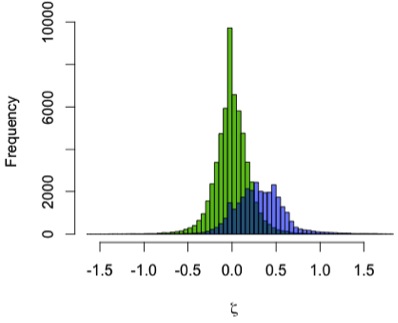
I used the zeta test to compare mandibular growth in a sample of 13 A. robustus and 122 recent humans. I first showed that the method behaves as expected by using it to compare the human sample with itself, resampling 2 pairs of humans rather than a pair of humans and a pair of A. robustus. The green distribution in the graph to the left shows zeta statistics for all possible pairwise comparisons of humans. Just as expected, that it’s strongly centered at zero: only one pattern of growth should be detected in a single sample. (Note, however, the range of variation in the green zetas, the result of individual variation in a cross-sectional sample)

In blue, the human-A. robustus statistics show a markedly different distribution. They are shifted to the right – positive values – indicating that for a given comparison between pairs of specimens, A. robustus increases size more than humans do on average.

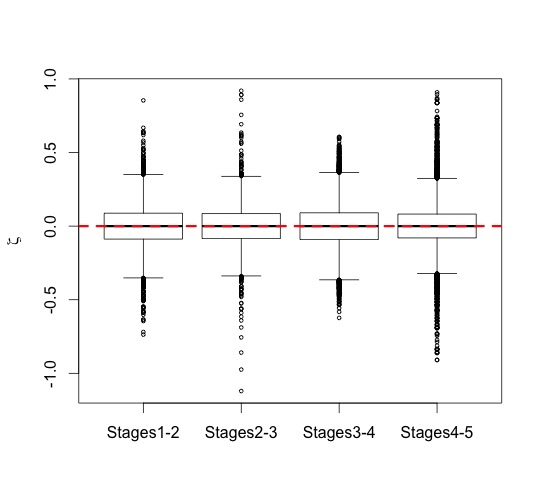
We can also examine how zeta statistics are distributed between different age groups (above). I had broken my sample into five age groups based on stage of dental eruption – the plots above show the distribution of zeta statistics between subsequent eruption stages, the human-only comparison on the left and the human-A. robustus comparison on the right. As expected, the human-only statistics center around zero (red dashed line) across ontogeny, while the human-A. robustus statistics deviate from zero markedly between dental stages 1-2 and 3-4. I’ll explain the significance of this in the next post. What’s important here is that the zeta test seems to be working – it fails to detect a difference when there isn’t one (human-only comparisons). Even better, it detects a difference between humans and A. robustus, which makes sense when you look at the fossils, but had never been demonstrated before.

So there you go, a new statistical method for assessing fossil samples. The next two installments will discuss the results of the zeta test for overall size (important for life history), and for individual traits (measurements; important for evolutionary developmental biology). Stay tuned!

ResearchBlogging.org Several years ago, when I first became interested in growth and development, I changed this blog’s header to show this species’ subadults jaws – it was only last year that I realized this would become the focus of my graduate career.

References
Gordon AD, Green DJ, & Richmond BG (2008). Strong postcranial size dimorphism in Australopithecus afarensis: results from two new resampling methods for multivariate data sets with missing data. American journal of physical anthropology, 135 (3), 311-28 PMID: 18044693

Richtsmeier JT, & Lele S (1993). A coordinate-free approach to the analysis of growth patterns: models and theoretical considerations. Biological Reviews, 68 (3), 381-411 PMID: 8347767

Osteology everywhere: Muffin tops

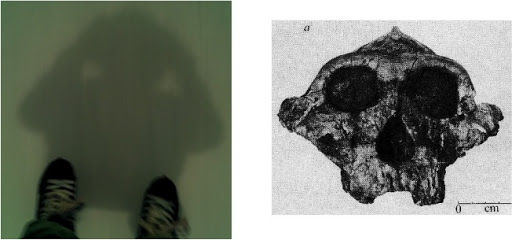
It’s become challengingly chilly here in Astana and my days of running outdoors are fading into memories redshifting into oblivion, so last weekend I went ice skating instead. Pulling off certifiably Scott Hamiltonian moves, I espy my silhouette and what hominid face is staring back?

That’s, right, Australopithecus boisei (right). Of course they’re not identical, but then they don’t really have to be when you see Osteology Everywhere.

But then again, when you’ve been doing this too long, you start to see Paleontology Everywhere, too. The shadow also reminded me of a time a few years ago, when we were picking through bags of backdirt at Dmanisi, foraging for micromammals, passing pachmelia and time with trivia. Someone posed the riddle, “What did one muffin say to the other muffin?” To which I responded: