#AAPA2014

I’ve jumped across some continents, to Calgary for the 83rd annual meeting of the American Association of Physical Anthropologists. It’s a frenetic few days to catch up with close friends and colleagues, and to discuss upcoming projects. Also hopefully there will be poutine. You can follow the conference goings-on on Twitter with the hashtag #AAPA2014.

I’ll be presenting some work I began last summer (first blogged here), as part of a symposium in honor of Alan Mann. Mann was one of the first researchers to point out the similarities in dental development between humans and australopithecines, and his book Some Paleodemographic Aspects of the South African Australopithecines (1975) was an important resource in my dissertation research. In my current project, I try to identify traits in the lower jaw that follow a similar pattern of size growth as the rest of the body, to reconstruct growth in extinct species that are represented mostly by jaw fossils.

If you’re interested in what I’ve found, come and find me at my poster Saturday afternoon. If you can’t make it, here’s the poster I’ll be presenting:

AAPA 2014 Poster

AAPA 2014 Poster


Ima Gona follow up on that last post

Last week, I discussed the implications of the Gona hominin pelvis for body size and body size variation in Homo erectus. One of the bajillion things I have been working on since this post is elaborating on this analysis to write up, so stay tuned for more developments!

Now, when we compared the gross size of the hip joint between fossil Homo and living apes (based on the femur head in most specimens but the acetabulum in Gona and a few other fossils), the range of variation in Homo-including-Gona was generally elevated above variation seen in all living great apes. This is impressive, since orangutans and gorillas show a great range of variation due sexual dimorphism (normal differences between females and males). However, I noted that the specimens I used were unsexed, and so the resampling strategy used to quantify variation within a species – randomly selecting two specimens and taking the ratio of the larger to smaller – probably underestimated sexual dimorphism.

Shortly after I posted this, Dr. Herman Pontzer twitterated me to point out he has made lots of skeletal data freely available on his website (a tremendous resource). The ape and human data I used for last week’s post did not have sexes (my colleague has since sent me that information), but Pontzer’s data are sexed (no, not “sext“). So, I modified and reran the original resampling analysis using the Pontzer data, and it nicely illustrates the difference between using a max/min vs. male/female ratio to compare variation:

Hip joint size variation in living African apes (left and right) compared with fossil humans (genus Homo older than 1 mya, center). Each plot is scaled to show the same y-axis range. On the left are ratios of max/min from resampled pairs from each species (sex not taken into account). On the right are ratios of male/female from resampled pairs from each species. The red dots on this plot are the medians for max/min ratios (the thick black bars in the left plot). The center plot shows ratios of Homo/Gona.

Hip joint size variation in living African apes (left and right) compared with fossil humans (genus Homo older than 1 mya, center). Each plot is scaled to show the same y-axis range. On the left are ratios of max/min from resampled pairs from each species (sex not taken into account). On the right are ratios of male/female from resampled pairs from each species. The red stars on this plot are the medians for max/min ratios (the thick black bars in the left plot). The center plot shows ratios of Homo/Gona.

The left plot shows resampled ratios of max/min in humans, chimpanzees and gorillas, while the right shows ratios of male/female in these species. If no assumption is made about a specimen’s sex (left plot), it is possible to resample a pair of the same sex, and so it is likelier to sample two individuals similar in size. Note that the ratio of max/min can never be less than 1. However, if sex is taken into account (right plot), we see two key differences. First, because of size overlap between males and females in humans and chimpanzees, ratios can fall below 1. Adult gorilla males are much larger than females, and so the ratio is never as low as 1 (minimum=1.08). Second, in more dimorphic species, the male/female ratio is elevated above the max/min ratio (red stars in the right plot). In chimpanzees, the median male/female ratio is actually just barely lower than the median max/min ratio. If you want numbers: the median max/min ratios for humans, chimpanzees and gorillas are 1.09, 1.06 and 1.16, respectively. The corresponding median male/female ratios are 1.15, 1.06 and 1.25.

Regarding the fossils, if we assume that Gona is female and all other ≥1 mya Homo hips are male, the range of hip size variation can be found within the gorilla range, and less often in the human range.

But the story doesn’t end here. One thing I’ve considered for the full analysis (and as Pontzer also pointed out on Twitter) is that the relationship between hip joint size and body weight is not the same between humans and apes. As bipeds, we humans place all our upper body weight on our hips; apes aren’t bipedal and so relatively less of their weight is transmitted through this joint. As a result, human hip joint size increases faster with increasing body mass than it does in apes.

So for next installment in this fossil saga, I’ll consider body mass variation estimated from hip joint size. Based on known hip-body size relationships in humans vs. apes, we can predict that male/female variation in humans and fossil hominins will be relatively higher than the ratios presented here – will this put fossil Homo-includng-Gona outside the gorilla range of variation? Stay tuned to find out!

Toe-tally easy virtual lab activity: Ardipithecus kadabba

UPDATE: sadly, the KUPRI Digital Morphology Museum website, which was the basis for this activity, is no longer online 😦 If I can find a comparable resource I will be sure to update this post.

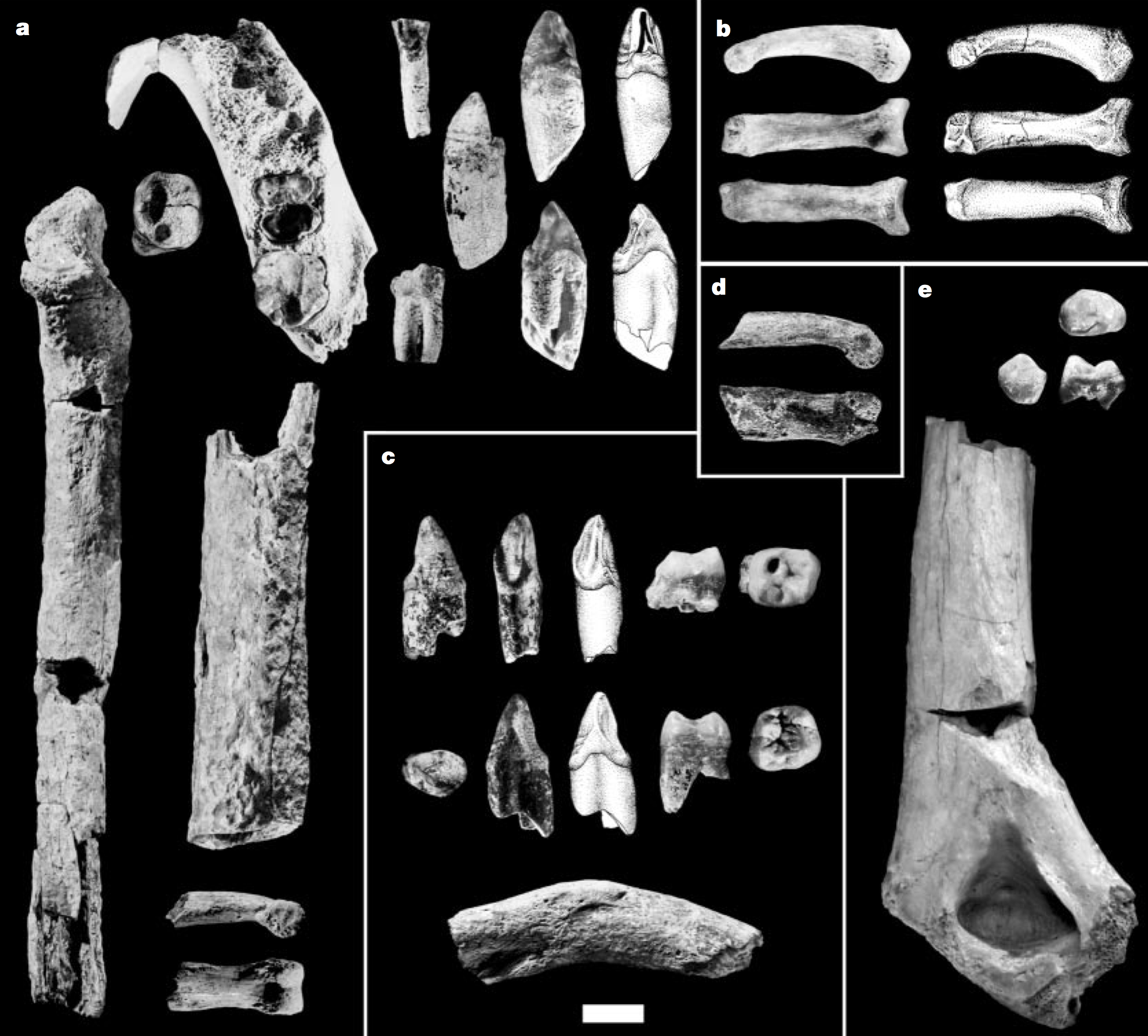
The focus of my human evolution class the past few weeks has been uncovering the earliest human ancestors. The main adaptation distinguishing our first forebears from other animals is walking on two legs (“bipedalism”), so researchers try to identify features reflective of bipedalism in fossils over 4 million years ago. But this isn’t so easy – not all fossils will tell us how an animal walked around, and even with the right bones, it’s not always clear what the earliest bipeds “should” look like. Take the case of Ardipithecus kadabba: there are a handful of seemingly nondescript fossils (below) from a number of Ethiopian sites dating 5.2-5.8 million years ago. Can we really tell if this species was bipedal? LET YOUR STUDENTS DO SCIENCE TO DECIDE FOR THEMSELVES!
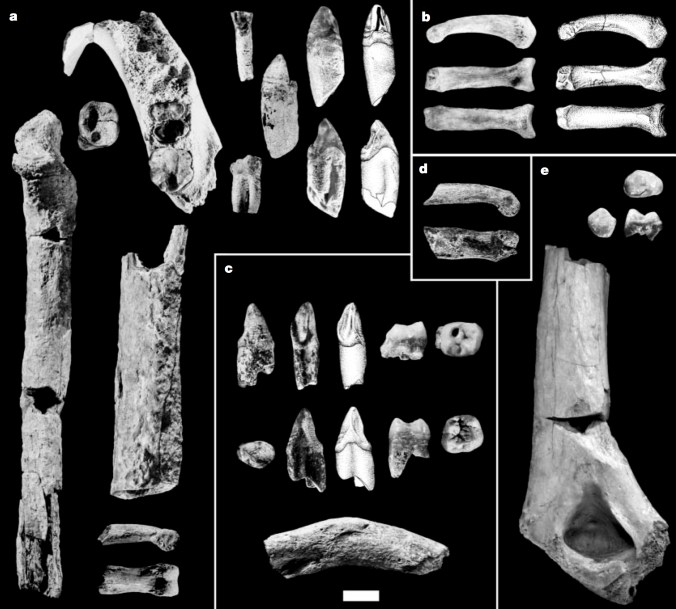
Can you spot a biped? Ardipithecus kadabba fossils (Fig. 1 from Haile-Selassie, 2001).

Can you spot a biped? Ardipithecus kadabba fossils. Scale bar is 1 cm (Fig. 1 from Haile-Selassie, 2001).

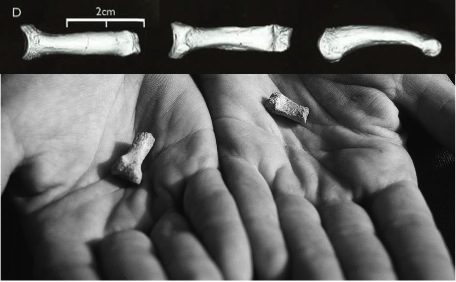
In the jumble of fragments pictured above, the key bone possibly revealing a bipedal animal is in square b, a toe bone shown in several views. This is a fourth proximal pedal phalanx (PPP4), where a wedding ring would sit if people put rings on their feet instead of their hands. Ew. Anyway, here’s closer view, from the Ar. kadabba monograph (Haile-Selassie and WoldeGabriel, 2009):

AME-VP 1/71, the sciencey name of the toe bone in question. The proximal end, toward the foot, is to the left and the distal end, toe-tipward, is to the right. Modified from plates 7.8 and 7.21 in the monograph.

Top: AME-VP 1/71, the sciencey name of the toe bone in question. The proximal end (toward the foot) is to the left and the distal end (toward the tip of the toe), is to the right. Bottom: Lookit how tiny it is! Modified from plates 7.8 and 7.21 in the monograph.

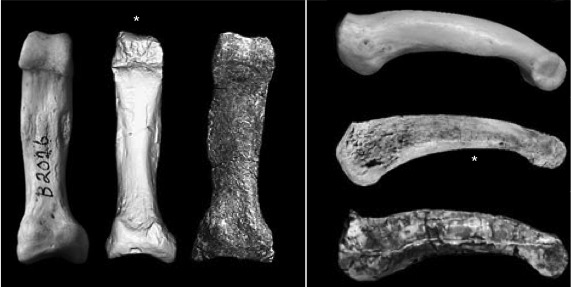
Although absolutely small, the kadabba PPP4 is relatively long, narrow and curved, like an ape’s and unlike a human’s. Haile-Selassie and colleagues (monograph chapter) compared this fossil with chimpanzee and the bipedal Australopithecus afarensis‘s PPP4s (below I have scaled them to the same length). As you can see, kadabba and the chimp are fairly narrow compared to the stout afarensis toe, although they are all curved:

Comparison of 4th proximal pedal phalanges, scaled to same length. Left to right, and top to bottom: Chimp, Ar. kadabba and Au. afarensis. Modified from plates 7.24-7.25 in the kadabba monograph)

Comparison of PPP4s, scaled to same length. Left to right, and top to bottom: Chimp, Ar. kadabba and Au. afarensis. The left box is a bottom view (proximal at the bottom) and the right box from the side (proximal to the left). Modified from plates 7.24-7.25 in the kadabba monograph.

These gross shape comparisons don’t make kadabba‘s toe look that like of a bipedal animal. However, one thing we can’t see in these views – and that you can have your students examine in virtual lab – is the orientation of the proximal joint surface. In humans (Griffin and Richmond, 2010) and the later Ardipithecus ramidus and australopithecines (Latimer and Lovejoy 1990; Lovejoy et al., 2009; Haile-Selassie et al., 2012), this joint surface angles upward, a result of the great force this joint experiences as it hyper-dorsiflexes during walking. Apes and other animals are not bipedal, and they do not dorsiflex their toes to the degree that we do, so this joint does not usually angle upward as much.
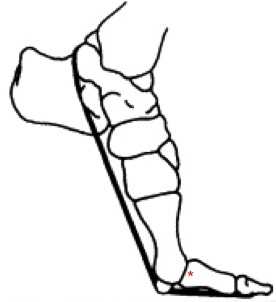
Schematic of a hyper-dorseflexed proximal toe joint (indicated by red star).

Schematic of a hyper-dorseflexed proximal toe joint (indicated by red star).

Now here’s that joint in the kadabba PPP4. The kadabba monograph has a nice midsagittal CT scan revealing this joint’s orientation, the angle of which I have measured using the free image analysis software ImageJkadabba‘s angle of ‘dorsal canting’ is 102.2 degrees. A mild fever.

Measuring the dorsal canting of the AME-VP-1/71 proximal joint surface, using ImageJ.

Measuring the dorsal canting (the angle theta) of the AME-VP-1/71 proximal joint surface, using ImageJ.

This measurement is at the low end of the human range (averaging around 110 degrees for the 2nd, not 4th, digit), and above all but just a few apes analyzed by Griffin and Richmond (2010). Now, these authors looked at PPP2s, but PPP4s would be more appropriate for comparison with kadabba. LUCKY YOU – your students can collect these data, using CT scans from the KUPRI digital morphology museum. This collection has dozens of apes and monkeys (and even some other mammals), presumably none of which were habitually bipedal, and which should have relatively low angles of canting. (many of these specimens are from zoos, however, so their activity patterns and anatomies may not be the same as wild animals’; lookit the gorilla below) Your students can isolate and section proximal pedal phalanges as I have below, and measure the angle of canting with ImageJ. SCIENCE!
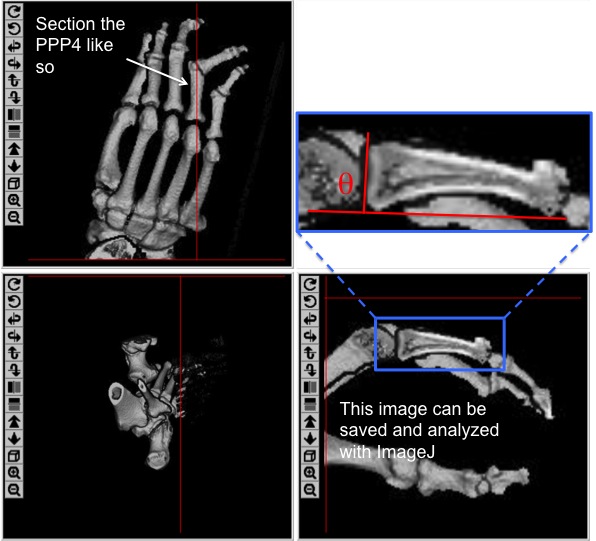
Easy image acquisition on the KUPRI database (this is a gorilla, with a pretty messed up fourth digit). Have your students save the sectioned image as above, which can then be analyzed as illustrated in the previous figure.

Easy image acquisition on the KUPRI database (this is a gorilla, with a pretty messed up fourth digit beyond the distal PPP). Have your students save the sectioned image as above, then measure the angle theta.

This activity is simple way for your students to set up a hypothesis, collect quality data and analyze them – essentially for free!

Some light weekend reading

Griffin and Richmond (2010). Joint orientation and function in great ape and human proximal pedal phalanges. American Journal of Physical Anthropology 141: 116-123.

Haile-Selassie (2001). Late Miocene hominids from the Middle Awash, Ethiopia. Nature 412: 178-181.

Haile-Selassie and WoldeGabriel, eds. (2009) Ardipithecus kadabba: Late Miocene Evidence from the Middle Awash, Ethiopia. Chapter 7.

Haile-Selassie et al. (2012). A new hominin foot from Ethiopia shows multiple Pliocene bipedal adaptations. Nature 483: 565-570.

Latimer and Lovejoy (1990). Metatarsophalangeal joints of Australopithecus afarensisAmerican Journal of Physical Anthropology 83: 13-23.

Lovejoy et al. (2009). Combining prehension and propulsion: The foot of Ardipithecus ramidusScience 326: 72e1-72e8

Paleogenomics is crushing it right now

It’s only Valentine’s Day, and already early 2014/late 2013 have provided several fascinating, high profile studies of ancient DNA (all been published in Nature). Forecasting this deluge, last year closed with the announcement of sequenced mtDNA from a ≥400,000 year old human fossil from Sima de los Huesos, Spain (Meyer et al., 2013). This is the oldest DNA obtained for any human fossil, and among the oldest of any animal.Meyer title copy 2

Shortly thereafter, Prüfer and pals (2014) published the complete genome of a Neandertal from the infamous Denisova cave. This study revealed extensive inbreeding in Siberian Neandertals; the fossil individual’s high level of homozygosity is consistent with their parents being half-siblings.  Furthermore, comparison of the genome of this inbred Neandertal with modern humans’ allowed researchers to identify many mutations that have become fixed (shared by all people) by natural selection since the divergence of our and Neandertals’ ancestors. Uncovering these human-specific variants can help us understand the genetic bases for many of humans’ remarkable traits.Prufer title

In January, Olalde y coautores published a genomic analysis of a 7,000 hunter-gatherer from Spain. This ancient genome contained ancestral variants for genes relating to skin pigmentation (SLC45A2, SLC45A5MC1R, TYR, and KILTG), meaning this Mesolithic European most probably had dark skin. This individual also had a derived variant of the HERC-OCA2 locus, associated with blue eye color in present day people. This suggests that the relatively novel phenotype of non-brown eyes may have increased in frequency more quickly than light skin color in ancient Europe. This guy also had many derived loci associated with immune function, indicating that the rise of agriculture is not solely responsible for the evolution of immune function in present day Europeans.

Olalde title

Around the same time, Sankararamen and team published an analysis of the distribution of Neandertal genes in living people. Whereas previous studies had already shown that Neandertals contributed ≤4% on average to the genomes of living people, this study examined where in modern people’s genomes this Neandertal ancestry tends to be located. One of the most interesting findings is that Neandertal genes are not uniformly or randomly distributed across the modern human genome. Rather, some regions appear to be especially devoid of Neandertal ancestry, implying natural selection acted strongly against Neandertal genes. These Neander-nude areas are preferentially found on the the X chromosome and in genes expressed in the testes, a finding consistent with reduced fertility in hybrid males. Although the genetic contribution of Neandertals to modern humans means that the two belonged to the same species, Sankararaman et al’s findings suggest the two groups were on their way to becoming different species.sanakararaman

Finally, this past week Rasmussen and rascals have published an analysis of a 12,000 year old human from the Anzick site in Montana, associated with the Clovis stone tool culture. I don’t know much about this time period save for what I learned in a class on North American archaeology taught by Dr. John Speth, back when I was a young, bright-eyed graduate student. One thing I recall from this class, when we were going over Clovis, was that this tool industry was found all over the United States at the beginning of the Holocene, but I was always disappointed by the dearth of bones complementing the copious lithics. Turns out, the DNA analyzed by Rasmussen et al. comes from the only known burial from this time period. This lone burial provides compelling genetic evidence that indigenous Americans have descended largely from a single ancestral population that separated into the North and South American populations prior to the Clovis period. This ancestral population was definitely not from Europe, as a minority of researchers have argued. Check out the SEAC Underground blog for more on the archaeology and ethics of the Anzick analyses.rasmussen

So, paleogenomics is really crushing it right now. There have been many of recent advances in sampling and sequencing poorly-preserved ancient DNA, and as we’re seeing now, lots of ancient bones (and teeth) are bringing awesome new, genetic insights into recent human evolution. If this is how well we’re doing so early in 2014, you can bet that the rest of the year promises many more exciting discoveries.

This human DNA is old as hell

If hell were around 400,000 years old. The people who salvaged ancient DNA from fossil Neandertals and “Denisovans” now present mitchondrial DNA (mtDNA) from a human-ish fossils from the Spanish site of Sima de los Huesos (SH; this translates as “pit of bones,” by the way, which is pretty badass). DNA-bearing Neandertal sites and Denisova cave date anywhere from around 30-100 kya, while Sima de los Huesos has been dated by various methods to 300-600 thousand years ago. So the newly announced mtDNA is the oldest human DNA ever recovered…

YET!

Now, we know what Neandertals look like, since they are perhaps the best known group of fossil humans. We don’t really know what Denisovans look like, as their unique DNA came from fossils that are anatomically ambiguous (a large molar and the end of a tiny fragment of the bone at the end of your pinky finger) – they could look like anyone. Even you! The SH fossils predate Neandertals by a few hundred thousand years, but their skulls look pretty similar; quite possibly the SH populations were ancestors of Neandertals, and you’d expect the DNA to be similar in the two groups.

So researchers were surprised to find this SH mtDNA to be more similar to Denisovan than to human or Neandertal mtDNAs. But this actually shouldn’t be that surprising, since we saw the same twist when Denisovan mt and nuclear DNA was sequenced – mtDNA first made it look like humans and Neandertals were more closely related, and the ancestors of Denisovans separated from the human+Neandertal lineage in the deep past. However, mtDNA essentially acts as a single genetic locus – a gene tree isn’t necessarily a species tree – and the more informative nuclear DNA later showed Neandertals and Denisovans to be more closely related to one another than either was to living humans (yet each of these ancient populations contributed some genes to some living people today). Denisovans held on to a very ancient mtDNA lineage, and apparently so did the people represented at Sima de los Huesos. And let’s not forget, we don’t know what Denisovans looked like – maybe they looked just like the older SH fossils.

Hopefully we’ll be able to get human nuclear DNA from Sima de los Huesos. When we do, I predict we’ll see the same kind of twist as with the Denisova DNA, with SH being more similar to Neandertals. But if I’m wrong, maybe we’ll be a step closer to knowing what the bones of the the mysterious “Denisovans” looked like…

Here’s that paper: Meyer et al. in press. A mitochondrial genome sequence of a hominin from Sima de los Huesos. Nature. doi:10.1038/nature12788

The shale revolution & lying with statistics

Is U.S. energy independence, based in part on ‘fracking’ shale deposits to access oil and gas reservoirs, just a pipe dream? A comment by JD Hughes in this week’s Nature posits just this, pointing out that production at most of these deposits declines steeply in just a few years – the industry is simply not sustainable. But why all the hype around such an unsustainable resource?

In my view, the industry practice of fitting hyperbolic curves to data on declining productivity, and inferring lifetimes of 40 years or more, is too optimistic. Existing production histories are a few years at best, and thus are insufficient to substantiate such long lifetimes for wells. Because production declines more steeply than these models typically suggest, the method often overestimates ultimate recoveries and economic performance (see go.nature.com/kiamlk). The US Geological Survey’s recovery estimates are less than half of those sometimes touted by industry.

In short, yes you can fit a line to data points (i.e. production over time; do check out the link in Hughes’ quote) to model or predict how predict how production will change over time. But this does not necessarily make these predictions valid or accurate! These ‘hyperbolic curves’ (see bottom graph from the above link) are often calculated from only five years of data, but used to predict production some 40 years down the line. And what’s more, these predicted values (i.e. points on the fitted line) are not spot-on, but have a confidence interval, a range of uncertainty in which a predicted value could be found. This interval increases drastically the further off in time you are predicting.
The point: we shouldn’t be so confident in fracking and shale reserves to help solve the U.S.’s energy problems. In fact, we should be confident (and conservative) assuming they won’t solve anything for anyone except people making money off them (and even then, only in the short term).
ResearchBlogging.orgI’ve commented on this blog before about the importance of understanding the statistical methods one employs. In the present case, industry ‘specialists,’ whether they understood line fitting or not, erroneously used statistics to predict optimistic outcomes for US energy production. And the US government and public were eager to swallow this up hook, line and sinker.
The comment (sorry it’s behind a paywall)
Hughes, J. (2013). Energy: A reality check on the shale revolution Nature, 494 (7437), 307-308 DOI: 10.1038/494307a

Osteology Everywhere: Zubi

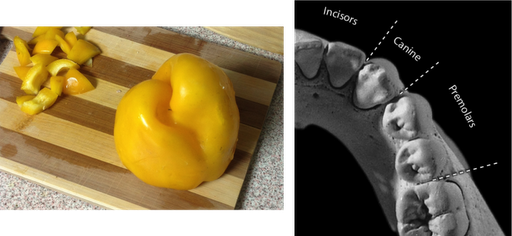
We’re going over bone biology and bioarchaeology this week in my Intro to Bio class, and so I thought I’d open the unit with my patent-pending Osteology Everywhere series. I showed the students the various real-life objects from the series, and they kicked buttocks at seeing the bones in quotidian things. They even got this new one:

That yellow pepper is a ringer for a premolar crown, which hopefully was not as yellow. So I’m very proud of my students. I figure if I can make people see bones everywhere they look, well then I’ve done my job. But hopefully they don’t get as bad as me: a few months ago my friend bought one of those Kinder chocolate eggs with a prize inside. Shaking it, you could hear something rattling in there. It’s disconcerting that my mind immediately guessed, “Legos, or teeth.” At least legos came before teeth.

Also “zubi,” from the title, is the Croatian word for ‘teeth’ (and apparently also slang for ‘breasts’).

Osteology Everywhere: I’ve been doing this too long

I was trying to squeeze a nice picture of the African continent into the Gall-Peters projection, and I suddenly saw something I hadn’t seen there before:

The image at right is the fossil, KNM-ER 3228 a 1.9 million year old right pelvic (innominate) bone of Homo (erectus?) from Kenya. Not 100% identical, maybe rotate ER 3228 medially a bit. You know you’ve been doing it too long when you start to see Osteology Everywhere.

The most wonderful teeth ever seen

I came across an interesting quote from Dr. Robert Broom (quoted in Brain’s Hunters or Hunted? monograph), a great South African paleontologist of the first half of the 20th century. He’s recounting how he came upon the Kromdraai site, which produced the very first Australopithecus (a.k.a. Paranthropus) robustus fossils:

I went off to the school. About a mile of the way was so rocky that it was impossible to go by car. It was playtime, about 12.30 pm., when I arrived. I saw the principal, and told him what I had come about. Gert was found, and drew from his trouser pocket four of the most wonderful teeth ever seen in the world’s history. [emphasis added]

Lots of funny things about that story, most notably that Broom basically took this kid, Gert, from school  to show him where Kromdraai was. And Broom’s so excited by these teeth! I don’t know the last time I was that excited about anything.