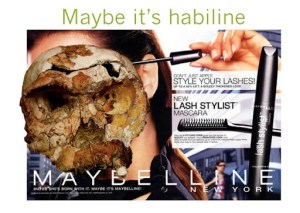
Osteology Everywhere: Zubi

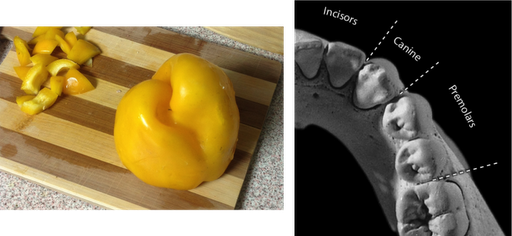
We’re going over bone biology and bioarchaeology this week in my Intro to Bio class, and so I thought I’d open the unit with my patent-pending Osteology Everywhere series. I showed the students the various real-life objects from the series, and they kicked buttocks at seeing the bones in quotidian things. They even got this new one:

That yellow pepper is a ringer for a premolar crown, which hopefully was not as yellow. So I’m very proud of my students. I figure if I can make people see bones everywhere they look, well then I’ve done my job. But hopefully they don’t get as bad as me: a few months ago my friend bought one of those Kinder chocolate eggs with a prize inside. Shaking it, you could hear something rattling in there. It’s disconcerting that my mind immediately guessed, “Legos, or teeth.” At least legos came before teeth.

Also “zubi,” from the title, is the Croatian word for ‘teeth’ (and apparently also slang for ‘breasts’).

The beardless White House: Part I

Something’s been bothering me about this election. No, it’s not the silence from both major parties on climate change. It’s the fact that neither Obama nor Romney (I accidentally just typed “RMoney”… accidentally?) sports facial hair. A friend and I were talking about this the other day, and a quick google search showed us there hasn’t been an appreciable furface sleeping at 1600 Pennsylvania Ave. since the mustachioed WH Taft (of butter and bathtub fame), 100 years ago. That is, unless any of these recent presidents was a closet homosexual (different meaning of “beard”).

This is hairy dearth is deplorable. Just look at this pic of portraits of past presidents:

You’re probably thinking, “Where’s all the virile scruff?” Well, no, you’re probably thinking, “There’s a lot of dudes / white ppl there.” But your next thought is probably, “Where’s all the virile scruff?” However, from Abe Lincoln through Bill Taft there’s a fairly flagrant concentration of beards, mustaches and whatever you call the thing hiding Chester A. Arthur’s charming smile (squared off in red); only W McKinley and A Johnson dared rain on this badass parade. Yes, there are some audacious sideburns on John Q. Adams and Martin Van Buren, but otherwise all Executive facial hair is concentrated between 1860 and 1913. What gives?

It looks like there’s a fairly clear pattern: voters loathed and distrusted facial hair for the first nearly 100 years of American history, followed by a brief period in which facial hair was loved and trusted, which may then have been ruined by Taft and after which there’s been nary a stache nor goat sitting in the oval office to the present day. Is this a real pattern, or could some other random process produce this same distribution of scruff? (for simplicity’s sake, we’ll pretend no president served more than 1 term…) Could random sampling of 43 (mostly white) men give us a clump of 9/13 with facial hair? (side burns don’t count) If there’s a 50/50 chance of a man growing facial hair, is 9/43 Prezes unusually high or low? I’ll let you know after I write and run some tests!

microRNAs punch Plasmodium parasites in the face

This is the first time I’m teaching Introduction to Biological Anthropology here at Nazarbayev University. It’s exciting and curious that for nearly every class session, I’m able to find a very recent outside article or blog post that’s relevant to the field and/or something we’re talking about at the moment. For instance, the 30-paper barrage of the ENCODE project came out right as we were beginning the unit focused on evolution and genetics. Serendipity!

Recently in this first unit, we covered one of the classic anthro examples illustrating principles of both genetics and evolution: sickle-cell anemia and malaria resistance. And right on cue, a brief review about the actual molecular basis for this phenomenon was just published in Nature Genetics (Feliciano, 2012, reviewing LaMonte et al., 2012).

Briefly, sickle-cell anemia is an iron deficiency caused by having aberrant hemoglobin, and characterized by sickle-shaped red blood cells (“erythrocytes”). The sickle cell trait is caused by a simple point mutation on the 11th chromosome, at a locus termed the hemoglobin S (or HbS) allele; the ‘normal’ allele is designated A (or HbA). If you have two A alleles you have normal hemoglobin, whereas two S alleles result in sickle cell, which is generally fatal. You don’t want to have two S alleles. The deleterious S allele is nevertheless maintained in the population because heterozygous individuals (AS genotype) have basically normal red blood cells and resistance to malaria, a disease caused by the parasite Plasmodium falciparum. P. falciparum loves red blood cells, and so in populations where malaria is endemic, having normal hemoglobin can actually be a health risk because of stupid smelly P. falciparum. Natural selection therefore maintains both the normal A and sickle S alleles in malarial areas because of a heterozygote advantage.

The outstanding question, however, is how having both an A and an S allele confers resistance to malaria. The textbook explanation (e.g. Larsen, 2010) is that sickle cells are poor in oxygen, and therefore poor hosts for stupid smelly P. falciparum. A recent study, however, points to a much more badass mechanism of resistance.

LaMonte and colleagues (2012) show a role for microRNAs (miRNA) in sickle cell-mediated resistance to malaria. miRNAs are small strands of RNA (21-25 base pairs long) that do not get translated into proteins, but are nevertheless important in regulating gene expression. This mechanism is called RNA interference (RNAi) – check out this sweet slideshow and animation from Nature for more info. What LaMonte and colleagues found was that SS and AS red blood cells had higher concentrations of certain variants of miRNA, which were then transferred into P. falciparum parasitizing these cells. These miRNA-enriched parasites, in turn, showed reduced growth compared to those parasitizing normal cells. It remains to be seen, however, just how these human miRNAs are disrupting development of Plasmodium, since these parasites do not produce the same genetic machinery that utilizes the miRNA used in human RNAi (Feliciano, 2012).

ResearchBlogging.orgNot being a geneticist, I’m really enjoying how complicated the genome is proving to be. The example here illustrates not only our increased appreciation for RNA and especially non-protein-coding elements, but also the dynamic genetic interactions between different species.

Better explanations than I was able to give
Feliciano P (2012). miRNAs and malaria resistance. Nature genetics, 44 (10) PMID: 23011225

Lamonte G, Philip N, Reardon J, Lacsina JR, Majoros W, Chapman L, Thornburg CD, Telen MJ, Ohler U, Nicchitta CV, Haystead T, & Chi JT (2012). Translocation of Sickle Cell Erythrocyte MicroRNAs into Plasmodium falciparum Inhibits Parasite Translation and Contributes to Malaria Resistance. Cell host & microbe, 12 (2), 187-99 PMID: 22901539

Bonobo survival strategy

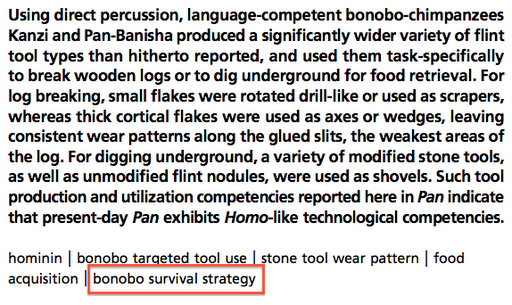
A paper was just released that showcases the technological prowess of two captive bonobos (Pan paniscus), the famous Kanzi and the less famous Pan-Banisha (Roffman & al. in press). It’s a neat paper, and I don’t really have much to say about it, but I will pass on what I enjoyed most about it (abstract and keywords):

It sounds like a rock band or something. You don’t see key words/phrases like that every day!

ResearchBlogging.org
Read for yourself
Itai Roffman, Sue Savage-Rumbaugh, Elizabeth Rubert-Pugh, Avraham Ronen, & Eviatar Nevo (2012). Stone tool production and utilization by bonobo-chimpanzees (Pan paniscus) Proceedings of the National Academy of Sciences, in press DOI: 10.1073/pnas.1212855109

These new fossils are intriguing as hell

Some big changes here at Lawnchair Anthropology. I just successfully defended my dissertation (Mandibular Growth in Australopithecus robustus, more info on that to come), and moved to Kazakhstan to begin my new job in the School of Humanities and Social Sciences at Nazarbayev University. I landed in Astana about 22 hours ago, so I should be asleep, battling (or succumbing to) jetlag, but some friends have pointed me to newly published early Homo fossils from Kenya, dating to between 1.9-1.6 million years ago (Leakey et al., 2012). See Adam Van Arsdale’s blog, the Pleistocene Scene, for great historical background and perspective on these new fossils.

Now, one of the themes of my dissertation is that there is lots of interesting information to be gleaned from fossils that we’ve known about for a long time (many of the A. robustus mandibles featured in my research have been known for decades). But dammit if some of these much more recently discovered fossils point to tantalizing variation in hominids just later than 2 million years ago (note I’m careful to say “variation” rather than “diversity”). In light if this variation, Adam discusses the similarities between one of these Kenyan fossils (KNM-ER 60000) and the large mandible from Dmanisi, which was discovered in only in the year 2000 (Gabunia et al., 2002).

Piggy-backing off Adam, I’d like to point out similarities between another of the new fossils, the KNM-ER 62000 face of a juvenile, and the recently discovered A. sediba juvenile face (Berger et al., 2010). These two fossils are at the same stage of dental development, so they’re roughly at the same stage of life. They are close in geological age, but A. sediba is from South Africa. Below are figures of A. sediba (left) and the ER 62000 face (right). The pics should be to scale, modified from the original publications. (sorry I couldn’t remove the background from the top left one)

What do you think? Pretty different, right? WRONG! Below I’ve superimposed the ER 62000 face onto A. sediba (slightly recolored and transparented for contrast). Remember that these are to scale.

In front view (left), the ER 62000 face is almost identical to A. sediba, right down to the positions of the teeth. THIS DOES NOT MEAN THAT I THINK THESE TWO FOSSILS REPRESENT THE SAME SPECIES. In side view, however, some differences do become apparent. Notably, the front of the A. sediba maxilla projects a bit further forward than ER 62000, and the nasal and orbital anatomy are also fairly different. THIS DOES NOT MEAN THAT I THINK THESE ARE DIFFERENT SPECIES. (although I would be surprised if these fossils turned out to be the same animal)

Leakey et al. liken these new Kenyan fossils to the cranium KNM-ER 1470, from the same region and at 1.9 million years old. But what’s weird to me is that ER 1470 actually looks a bit more like the juvenile A. sediba in the side view (as reconstucted; the face and braincase of ER 1470 are actually separated, leaving it unclear just how the two parts fit together). Here are all three specimens, to scale:

From left to right: ER 62000, A. sediba, ER 1470

Now, the ER 1470 comparison isn’t really fair – ER 1470 is an adult and it is much larger: the bottom of ER 1470’s eye socket is about the same height as the top of A. sediba‘s. The size difference is probably the main reason why its face below the nose sticks out as much as A. sediba‘s, even though the latter is smaller. (I should note, too, that the adult A. sediba mandible is superficially very similar in gonial and ramus anatomy to another of the recently published Kenyan specimens, ER 60000).

The point of all these comparisons is not to say whether these fossils are the same species, but rather to point out that there are actually striking similarities between fragmentary fossils, and it’s not clear what exactly these similarities (or differences, for that matter) mean. Maybe my eye was drawn to the ER 62000-A. sediba comparison not because of any evolutionary relationship, but because these fossils are in similar stages of growth and development – if it weren’t waaaaay past my bedtime I’d love to compare these fossils with other similarly-aged fossils (like D2700 from Dmanisi and KNM-WT 15000, also from Kenya).

All of these fossils (except ER 1470) were discovered in the past few years. I’ve said it before and I’ll repeat it now: this is a great time to study paleoanthropology.

ResearchBlogging.orgRead more NOW
Berger L, de Ruiter DJ, Churchill SE, Schmid P, Carlson KJ, Dirks PHGM, and Kibii JM. 2010. Australopithecus sediba: A New Species of Homo-like Australopith from South Africa. Science 328: 195 – 204.

L. Gabounia, M.-A. de Lumley, A. Vekua, D. Lordkipanidze, and H. Lumley. 2002. Découverte d’un nouvel hominidé à Dmanissi (Transcaucasie, Géorgie). Comptes Rendus Palevol 1(4):243-253

Meave G. Leakey, Fred Spoor, M. Christopher Dean, Craig S. Feibel, Susan C. Antón, Christopher Kiarie, & Louise N. Leakey (2012). New fossils from Koobi Fora in northern Kenya confirm taxonomic diversity in early Homo Nature, 408, 201-204 DOI: 10.1038/nature11322
Osteology Everywhere: I’ve been doing this too long

I was trying to squeeze a nice picture of the African continent into the Gall-Peters projection, and I suddenly saw something I hadn’t seen there before:

The image at right is the fossil, KNM-ER 3228 a 1.9 million year old right pelvic (innominate) bone of Homo (erectus?) from Kenya. Not 100% identical, maybe rotate ER 3228 medially a bit. You know you’ve been doing it too long when you start to see Osteology Everywhere.

The most wonderful teeth ever seen

I came across an interesting quote from Dr. Robert Broom (quoted in Brain’s Hunters or Hunted? monograph), a great South African paleontologist of the first half of the 20th century. He’s recounting how he came upon the Kromdraai site, which produced the very first Australopithecus (a.k.a. Paranthropus) robustus fossils:

I went off to the school. About a mile of the way was so rocky that it was impossible to go by car. It was playtime, about 12.30 pm., when I arrived. I saw the principal, and told him what I had come about. Gert was found, and drew from his trouser pocket four of the most wonderful teeth ever seen in the world’s history. [emphasis added]

Lots of funny things about that story, most notably that Broom basically took this kid, Gert, from school  to show him where Kromdraai was. And Broom’s so excited by these teeth! I don’t know the last time I was that excited about anything.

Results teaser

I’ve been hiding out under a rock for the past two months. Part of the quietude here is because I’ve been working hard to write up my dissertation, which compares patterns of jaw growth in humans and the our extinct relative Australopithecus robustus. Even though I presented some extremely preliminary results last year, I’ve generally been hesitant to talk about my work here on Lawnchair.

But in an effort to break my dissertation silence, and to begin thinking about starting to consider crawling out from under my rock, here’s a pretty pretty picture I made:

The green box and whiskers are humans, and the blue boxes A. robustus. Each box and whiskers represent all the individual mandible “sizes” that can be calculated for each species in each dental stage (stage 1 has only baby teeth erupted, stage 5 has nearly all its teeth erupted). It’s sort of like a mandible growth curve for each species, but not exactly.

The problem is I want to see whether I can distinguish patterns size change, from infancy to just before adulthood, in humans and A. robustus. But fossils don’t preserve well, and not all specimens share all the same measurable parts. So I devised a special test that measures a mandible’s “size” based on the traits it compares with other individuals.

Now, clearly from the figure A. robustus and human mandibles differ in mandible size throughout childhood. But questions arise: given the range of size variation within each species (especially stage 4), what are the chances of seeing the same amount of size change between dental stages in each sample? What traits or measurements on the mandible are contributing to these differences? Do these ‘sizes’ reflect the development of each species’ unique mandible shape? Well you’ll just have to stay tuned to find out…

…Or you could check this poster I presented at this year’s annual meeting of the American Association of Physical Anthropologists.

Humans still subject to natural and sensual selection (again)

The above headline is nothing new, but something still important to remind people about. (also we say ‘sensual’ instead of ‘sexual selection’ to keep this a family place. Crap, I just said ‘sexual.’) A little over a year ago a popular physicist got in some trouble for saying that humans were impervious to evolution because natural selection was no longer able to act on us smart creatures. Right after the scientist put a big smelly foot in his mouth I explained why this statement was incorrect (at best), and why you should learn biology from biologists rather than theoretical physicists.

I was reminded of this when I came across a study by Alexandre Courtiol and colleagues, out in PNAS yesterday, that examined whether natural and sexual selection were acting on an 18th-19th century Finnish population, based on local church records of births, marriages, etc. Natural selection refers to the differential survival and reproduction of individuals in a population, a disparity that generally arises because individuals may be better- or worse-adapted to their circumstances than others. Sexual (aka sensual) selection is a special type of natural selection, referring to how well individuals are able to acquire mates. Sure enough, Courtiol et al. found such differences between individuals in their Finnish sample. I have only gotten to glance at the paper, so I still need to check how they measured their variables (like fitness or mating success), but the last line of the abstract is what really stuck out at me:

Our results emphasize that the demographic, cultural, and technological changes of the last 10,000 y[ears] did not preclude the potential for natural and sexual selection in our species.

The fat lady in the opera of Human Evolution has yet to sing (this show’s motto would be, “No fat chicks,” if such a statement weren’t sexist and offensive).

ResearchBlogging.orgRead for yourself!
Courtiol, A., Pettay, J., Jokela, M., Rotkirch, A., & Lummaa, V. (2012). Natural and sexual selection in a monogamous historical human population Proceedings of the National Academy of Sciences DOI: 10.1073/pnas.1118174109