New course: “Is the Human Brain Special?”

For the first time in many years, I’m offering a new advanced undergrad seminar here at Vassar. When I arrived here 8 years ago, I was mainly thinking about Homo naledi and ontogeny, so those were the foci of my seminars. But my research has begun looking more at brain evolution and especially the evidence from fossil endocasts, and there is a lot of literature I need to catch up on.

So I’ve invited students along for this brainstorm, using the question “Is the human brain special?” as a starting point to learn about how the beautifully congealed soup sloshing around inside our skull makes us such quirky animals. In the first half of the semester we’ll read up on brain anatomy and structure, and students will use some of the fossil endocast data I’ve accrued over the years to learn more about a given brain region and extinct hominin. In the second half of the semester we’ll read about the brains, behavior, and endocast fossils of very distant relatives — invertebrates, birds, whales, and dogs — that have been celebrated for their own ‘advanced intelligence.’ We’ll also read about how the evolution of our brains may have predisposed us to certain conditions like addiction and Alzheimer’s, and how brain science has been exploited toward racist and sexist ends (increasingly relevant in America today, sadly).

It will be a lot of work (I’m a very slow, distractible reader) but I’m excited to delve into this literature and see what insights our super sharp students here at Vassar come up with in discussions and projects. The course syllabus (ANTH 323) is available on my Teaching page — I’d be keen to hear suggestions for readings and assignments from folks who know more about brains than I do!

Krapina endocast update (open data & code)

In the Summer of 2019 I worked with some great Vassar undergrads to make virtual endocasts and generate new brain size estimates for the Neandertals from the site of Krapina, which we then published in 2021 (discussed in this blog post). The virtual approach to endocast reconstruction uses 3D landmark-based geometric morphometrics methods, and so in the spirit of open science we also published all the landmark data used for the study (as well as a bunch of other fossil human brain size estimates) in the Zenodo repository (here).

Neandertal fossil specimens Krapina 3 (purple/green) and Krapina 6 (yellow/red) with preserved landmarks and virtually reconstructed endocasts.

Something major and global happened around that time — who can even remember what? — and so I never got around to posting R code to accompany the study. So, I’ve finally gotten around to adding some very basic code to the Zenodo entry (better late than never). The code simply reads in the landmarks, estimates missing data for fossils, and does some very basic shape analysis and visualization. It’s doesn’t get into all the nuts and bolts of our study, but it should be enough to help folks check our data or get started with shape analysis in R.

R code includes ways to visualize the landmark data. Left: Principal components analysis graph of endocast shape for humans (red) and Neandertals (blue). Right: Triangle meshes of the average human and Neandertal endocast shapes, viewed from the right, bottom, and back.

Original article
Cofran Z, Boone M, Petticord M. 2021. Virtually estimated endocranial volumes of the Krapina Neandertals. American Journal of Physical Anthropology 174: 117–128. (link)

What do brain endocasts tell us?

What makes the human brain special, and how did it change throughout our evolutionary history? One way to answer this question by comparing actual brains or MRI scans of living animals. But only fossils can show what changed and when over the past several million years, and sadly brains are basically an elaborately congealed soup that doesn’t stay fresh upon death, so they never fossilize (well, almost never). Happily, though, bones can preserve for millions of years, and they are literally molded by their soft and squishy surroundings. As the brain grows, it pushes outward against the inner surface of the skull, which can save the scars of the submerged cerebrum: nerds like me call these impressions an “endocast.”

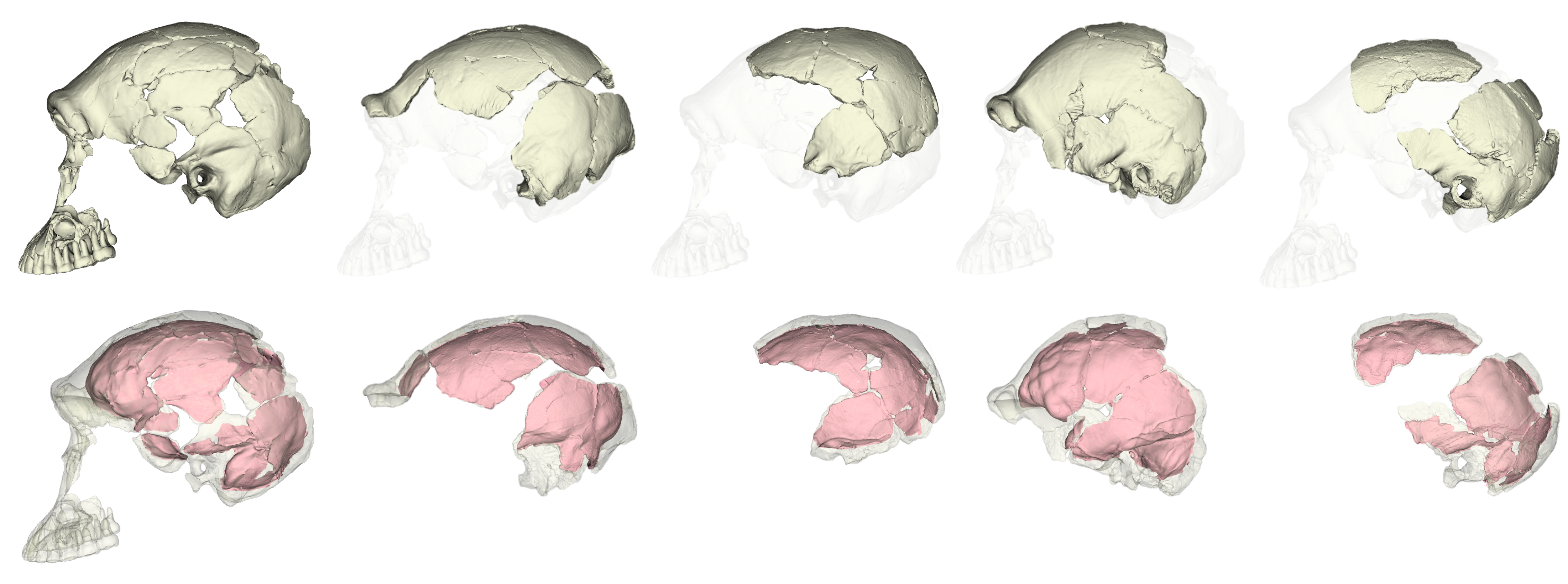
Endocasts of Homo naledi (pink) and Homo erectus (yellow). Fossils are viewed from the left side and are variably preserved.

Nicole Labra and Antoine Balzeau have led a cool study, hot off the press, examining what such endocasts can tell us about the underlying brain anatomy. Importantly, they show how difficult it is to clearly and consistently identify many brainy boundaries. This is very salient in “paleoneurology,” the study of brain evolution especially based off endocasts: the problem probably best illustrated by the nearly century-long debate about the natural endcoast of the “Taung child” fossil (Australopithecus africanus).

Labra & colleagues used a clever approach to address this paleontological and epistemological problem. They first generated an endocast directly associated with its brain from an MRI scan of a living human, allowing them see precisely where specific brain grooves (“sulci”) lay relative to the endocast surface. They then asked a bunch of researchers—myself included—to try to identify sulci on the endocast, and then looked at how our responses compared to both one another’s and to the actual, known sulcus positions.

Figure 1 from Labra et al. (in press) showing how the brain and endocast were obtained and analyzed.

Their analysis showed that we varied quite a bit in our identifications on the endocast. As Emiliano Bruner (who also participated) discusses in his blog post, we tended to identify the stronger impressions toward the bottom and sides of the endocast better and more consistently. Some of this variability and uncertainty among researchers is due to the faintness and incompleteness of many brain impressions, and some due to biased expectations about where a given sulcus “should” be based on our previous experiences and published references.

When Antoine Balzeau first contacted me about this project, I was just beginning to dabble in paleoneurology, learning some brain anatomy for the first time for a description of an old Australopithecus endocast called “MLD 3.” I initially thought MLD 3 would be a quick and simple study—boy was I spectacularly disappointed!

Figure 3 from Cofran et al. 2023, comparing two different chimpanzee brains, and two corresponding interpretations of the MLD 3 endocast.

Probably reflecting observer bias and desire for definitive results, we initially interpreted the endocast impressions on MLD 3 as representing a ‘human-like’ anatomy that is super rare in living chimpanzees (namely the “LS” depicted in the right half of the figure above). The researchers who peer-reviewed the first draft of our paper, though, suggested we be more cautious in our interpretations; one reviewer outright disagreed with us in support of a more ‘ape-like’ interpretation (left half of the figure above). The review process alone underscored the subjectivity and uncertainty in analyzing endocasts. In the end we presented both interpretations, and I honestly don’t know which (if either) is most likely to be correct. So the study by Labra and colleagues provides a nice empirical illustration of this cranial conundrum.

Fortunately, researchers are developing methods to help identify brain structures on endocasts. Amélie Beaudet, Jean Dumoncel, and Edwin de Jager among others have done some really impressive work looking at variability in both brains (for instance here) and endocasts (for instance here). By using computer-based 3D data and methods, these researchers have shown where many brain sulci tend to be located (see here). By developing a better understanding of variation in where sulci sit on an endocast, we can have a better idea of which sulci might be represented on fossil endocasts, which in turn can tell us about the brains of our extinct relatives. Edwin and Amélie presented a very cool new analysis of Australopithecus/Paranthropus boisei endocasts, building off this digital approach, at the recent ESHE conference. And as noted in our MLD 3 paper, I think machine learning and other ‘artificial intelligence’ approaches could also help us identify ambiguous features from frustrating fossil fragments.

Did Homo naledi have big babies?

I’m working on a project analyzing infant remains of Homo naledi, a species of human that lived in South Africa around 300,000 years ago. In order to paint a full picture of infancy in this species, we need to estimate how big (or small) naledi newborns were. But without fossil neonates that could provide direct evidence of body size at birth, this is a tricky task.

Ideally, we could simply use adult body size estimates for Homo naledi to predict its body size at birth, using the scaling relationship in other primates as a guide. For example, using an average adult body size of 44 kg for Homo naledi (Garvin et al., 2017) yields an estimated newborn size of around 1.5 kg, based on published primate dataset (Barton and Cappellini, 2011). But this approach necessarily overlooks variation within each species, not to mention variation and uncertainty in Homo naledi adult size. In addition, the 95% prediction interval for this estimate ranges from under 1 kg (smaller than an average baboon baby) to almost as large as a human neonate.

Primate body size scaling (Barton & Cappellini, 2011). The black line is the regression for catarrhines (purple squares and blue circles), and the shaded grey area is the 95% prediction interval for newborns at a given adult catarrhine size.

And this gets at the other issue with the regression-based approach to estimating newborn body size in fossil hominins: humans are bad at being primates in some ways, as illustrated here by the fact that we don’t fit the newborn-adult body size relationship that characterizes other catarrhines (apes and monkeys of Africa and Eurasia).

Humans give birth to collosal kids. In contrast, gorillas are the largest living primates as adults, but their newborns are only a little over half the size of human neonates. Why do we have such giant babies? The most proximate reason is that humans are born with adult-ape-sized brains and quite a bit of baby fat as far as mammals go (Kuzawa, 1998). This tells us how babies are big, but it still begs the ultimate question of why—an enduring puzzle that you may have read about in the New York Times last week.

In order to land on a reasonable estimate of newborn body size in extinct humans, we need to figure out when evolution blew up the kid. Unfortunately, the only fossil hominin neonates are two Neandertals from France and Russia dating to under 100,000 years ago­­­—pretty remarkable, but they don’t necessarily tell us about earlier species like Homo naledi.

My colleague Jerry Desilva (2011) worked out a potential solution to this conundrum. He argued that one could work from adult brain size to newborn body size through the following steps. First, in contrast to newborn-adult body size scaling, humans are good catarrhines when it comes to newborn-adult brain size scaling. This means that we can reasonably estimate newborn brain size based on adult brain sizes, which are aplenty in the human fossil record. Second, humans and many other primate newborns have brains roughly 12% of their overall body mass, while the great ape newborns stand out with brains around 10% of their adult size. Putting these two pieces together, one could estimate newborn body size: Adult brain ➡️ newborn brain ➡️ 10–12% newborn body size

DeSilva showed that regardless of whether you use an ape or human model of newborn brain/body size, hominin babies from Australopithecus afarensis 3 million years ago onward were probably large relative to maternal body size, estimated independently using skeletal remains. It’s a bit of a tortuous approach to estimating body size at birth, but the assumptions are reasonable and it’s probably the best way to figure out this important life history variable given the fossil evidence. What does this mean for Homo naledi?

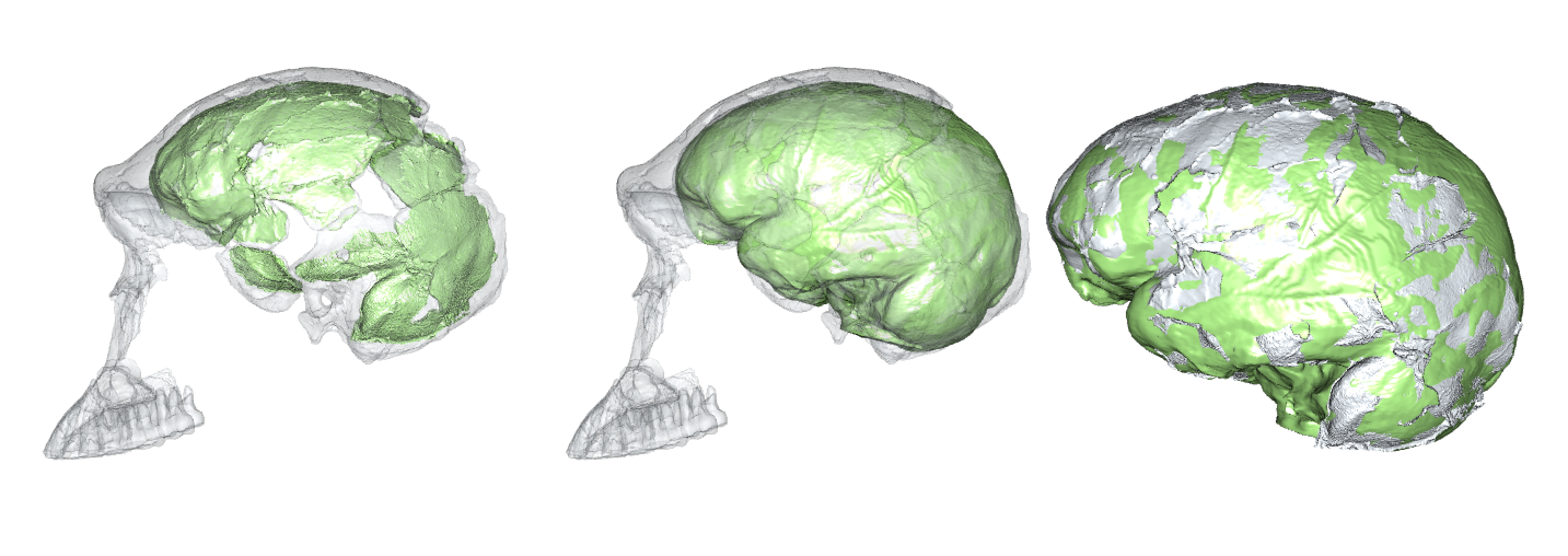
Virtual reconstruction of brain size and shape of the Homo naledi cranium “Neo” (work in progress). At 610 cm3, this is the largest and most complete Homo naledi endocast.

There are a few reliable adult brain size estimates for naledi, ranging from 465–610 cm3 (Berger et al., 2015; Garvin et al., 2017; Hawks et al., 2017), which based on catarrhine scaling would predict newborn brain size of around 170–210 cm3 (DeSilva and Lesnik, 2008). These brain sizes would then predict newborn body sizes of around 1.4–2.1 kg: the smol estimate is based on the smallest naledi adult brain size and a human model of newborn brain/body size; the chonk estimate is based on the largest naledi brain size and an ape brain/body model (pinkish stars in the boxplot below, left).

Boxplots of newborn body size in great apes. Gorilla, Chimpanzee, and Bonobo data from the Primate Aging Database (Kemnitz, 2019).

So, did Homo naledi have big babies? On the one hand, no: these 1.4–2.1 kg naledi newborns are outside the human range, and within the range of living great apes.

On the other hand, maybe Homo naledi babies were relatively large, though this depends on the size of Homo naledi adults. Recall from earlier that Garvin and colleagues arrived at an average estimated adult size of 44.2 kg. But this is an average of estimates for 20 separate naledi fossils, and each of these estimates has its own range of uncertainty. Garvin and team reported that the extremes of the prediction intervals for these estimates ranged from 28–62 kg. The second boxplot above shows newborn size relative to the adult average (sexes combined) for each species: for naledi, the six labels compare the smol and large newborn sizes (1.4 and 2.1 kg) with the adult average and extremes (28, 44, and 62 kg). Assuming the ‘true’ naledi sizes are somewhere in the middle of the range of estimates, naledi likely gave birth to babies 3–5% of adult body size, somewhat ‘intermediate’ between chimpanzees and humans (and bonobos…?) and similar to what DeSilva found for other hominins.

This is just a preliminary look at infancy in Homo naledi. There is a lot of uncertainty in these size estimates, but we should still be able to make some interesting inferences about growth and life history in our extinct evolutionary cousin.

REFERENCES

Barton, R. A., & Capellini, I. (2011). Maternal investment, life histories, and the costs of brain growth in mammals. Proceedings of the National Academy of Sciences, 108(15), 6169–6174. https://doi.org/10.1073/pnas.1019140108

Berger, L. R., Hawks, J., de Ruiter, D. J., Churchill, S. E., Schmid, P., Delezene, L. K., … Zipfel, B. (2015). Homo naledi, a new species of the genus Homo from the Dinaledi Chamber, South Africa. ELife, 4, e09560. https://doi.org/10.7554/eLife.09560

DeSilva, J. M. (2011). A shift toward birthing relatively large infants early in human evolution. Proceedings of the National Academy of Sciences, 108(3), 1022–1027. https://doi.org/10.1073/pnas.1003865108

DeSilva, J. M., & Lesnik, J. J. (2008). Brain size at birth throughout human evolution: A new method for estimating neonatal brain size in hominins. Journal of Human Evolution, 55(6), 1064–1074. https://doi.org/10.1016/j.jhevol.2008.07.008

Garvin, H. M., Elliott, M. C., Delezene, L. K., Hawks, J., Churchill, S. E., Berger, L. R., & Holliday, T. W. (2017). Body size, brain size, and sexual dimorphism in Homo naledi from the Dinaledi Chamber. Journal of Human Evolution, 111, 119–138. https://doi.org/10.1016/j.jhevol.2017.06.010

Hawks, J., Elliott, M., Schmid, P., Churchill, S. E., Ruiter, D. J. de, Roberts, E. M., … Berger, L. R. (2017). New fossil remains of Homo naledi from the Lesedi Chamber, South Africa. ELife, 6, e24232. https://doi.org/10.7554/eLife.24232

Kemnitz, J. W. (2019). Database for indices of aging in nonhuman primates. Innovation in Aging, 3(Suppl 1), S957. https://doi.org/10.1093/geroni/igz038.3472

Kuzawa, C. W. (1998). Adipose tissue in human infancy and childhood: An evolutionary perspective. American Journal of Physical Anthropology, 107(S27), 177–209. https://doi.org/10.1002/(SICI)1096-8644(1998)107:27+<177::AID-AJPA7>3.0.CO;2-B

Brain size & scaling – virtual lab activity

Each year in my intro bio-anthro class, we start the course by asking how our brains contribute to making us humans such quirky animals. Our first lab assignment in the class uses 3D models of brain endocasts, to ask whether modern human and fossil hominin brains are merely primate brains scaled up to a larger size. In the Before Times, students downloaded 3D meshes that I had made, and study and measure them with the open-source software Meshlab. But since the pandemic has forced everyone onto their own personal computers, I made the activity all online, to minimize issues arising from unequal access to computing resources. And since it’s all online, I may as well make it available to everyone in case it’s useful for other people’s teaching.

The lab involves taking measurements on 3D models on Sketchfab using their handy measurement tool, and entering the data into a Google Sheets table, which then automatically creates graphs, examines the scaling relationship between brain size (endocranial volume, ECV) and endocast measurements, and makes predictions about humans and fossil hominins based off the primate scaling relationship. Here’s the quick walk-through:

Go to the “Data sources” tab in the Google Sheet, follow the link to the Sketchfab Measurement Tool, and copy the link to the endocast you want to study (3D models can only be accessed with the specific links).

Following the endocast Sketchfab link (column D) will bring you to a page with the 3D endocast, as well as some information about how the endocast was created and includes its overall brain size (ECV in cubic cm). Pasting the link when prompted in the Measurement Tool page will allow you to load, view, and take linear measurements on the endocast.

Hylobates lar endocast, measuring cerebral hemisphere length between the green and red dots.

Sketchfab makes it quite easy to take simple linear measurements, by simply clicking where you want to place the start and end points. The 3D models of the endocasts are all properly scaled, and so all measurements that appear in the window are in millimeters.

The assignment specifies three simple measurements for students to take on each endocast (length, width, and height). In addition, students get to propose a measurement for the size of the prefrontal cortex, since our accompanying reading (Schoenemann, 2006) explains that it is debated whether the human prefrontal is disproportionately enlarged. All measurements are then entered into the Google Sheet — I wanted students to manually enter the ECV for each endocast, to help them appreciate the overall brain size differences in this virtual dataset (size and scale are often lost when you have to look at everything on the same-sized 2D screen).

Feel free to use or adapt this assignment for your own classes. The assignment instructions can be found here, and the data recording sheet (with links to endocast 3D models) can be found here — these are Google documents that are visible, but you can save and edit them by either downloading them or making a copy to open in Docs or Sheets.

Ah, teaching in the pandemic 🙃

New (old) Australopithecus anamensis cranium

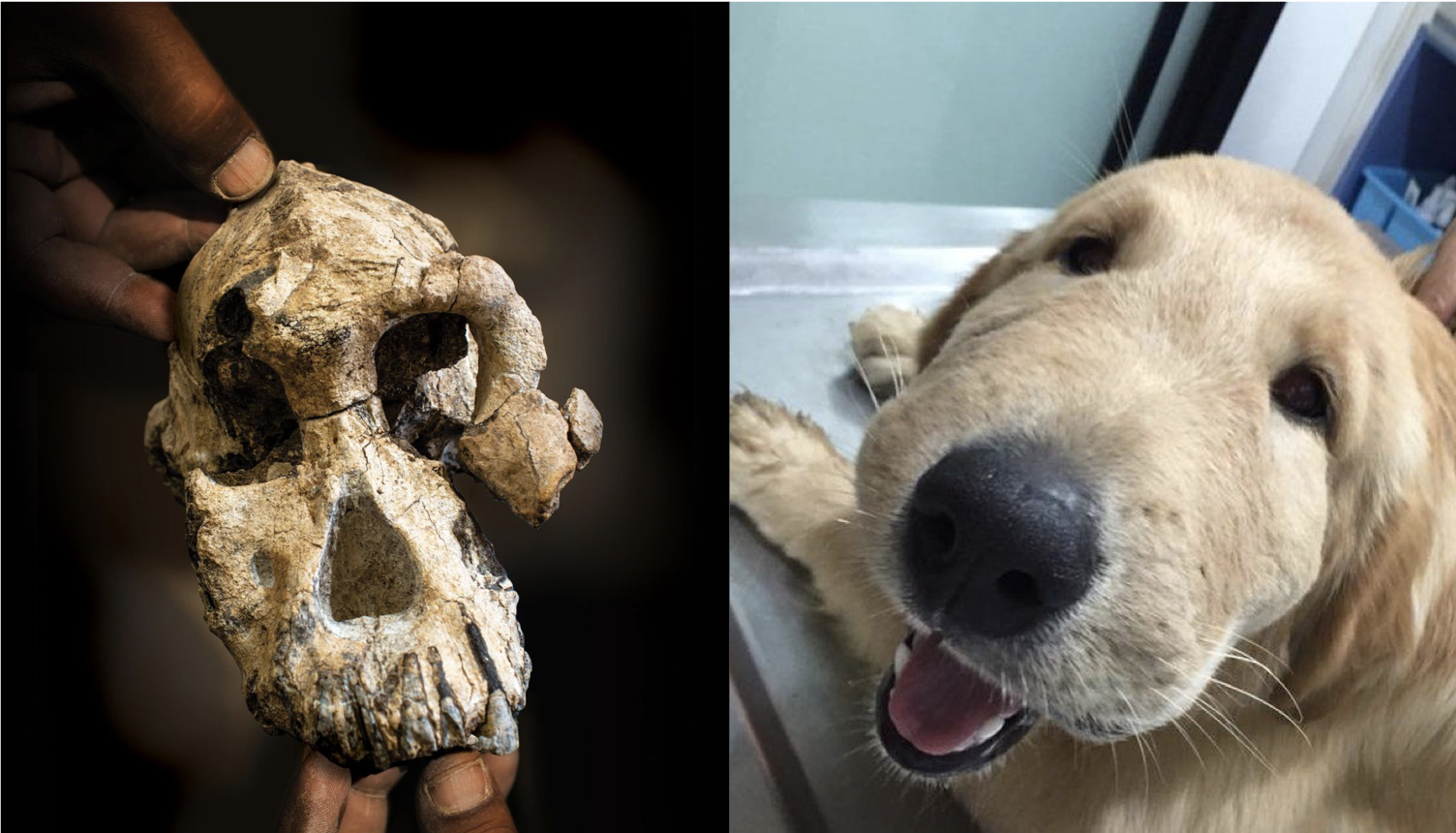
The Fall semester here at Vassar kicks off next week, and so of course a new fossil discovery is published this week that threatens to upend my course plans and throw my syllabi into disarray. Haile-Selassie and colleagues report a very well-preserved hominin cranium, from the Woranso-Mille region of Ethiopia and dating to 3.8 million years ago. The new cranium shares features with Australopithecus anamensis, a species previously mainly known through jaws and teeth. The fossil is therefore really important since it puts a face to the species’ name, and it is the oldest relatively complete Australopithecus cranium known. When I showed a picture of the fossil to my wife, who is not a paleoanthropologist, all she said was that it looked like the face of a dog who got stung by a bee.

anamensis bee sting

The new A. anamensis fossil MRD-VP-1 (left), and a dog that lost a fight with a bee. Fossil photo from the Smithsonian‘s coverage.

The big buzz in many news stories about the fossil (for example, Nature, ScienceNews, etc.) is that it rewrites an evolutionary relationship early in human history, with Australopithecus anamensis no longer the ancestor of A. afarensis, but rather the two being contemporaries. That idea is based on a 3.9 million year old frontal bone attributed to A. afarensis from a site called Belohdelie, also in Ethiopia (Asfaw, 1987): basically, the new A. anamensis cranium reveals a hominin with a narrow frontal region of the brain, which lived 100,000 later than A. afarensis with a relatively expanded frontal region:

Screen Shot 2019-08-30 at 8.24.14 AM

Top views of the reconstructed A. anamensis cranium (left), and the Belohdelie frontal (center), and my crappy photoshopped overlay of Belohdelie on A. anamensis (right). Images not to scale.

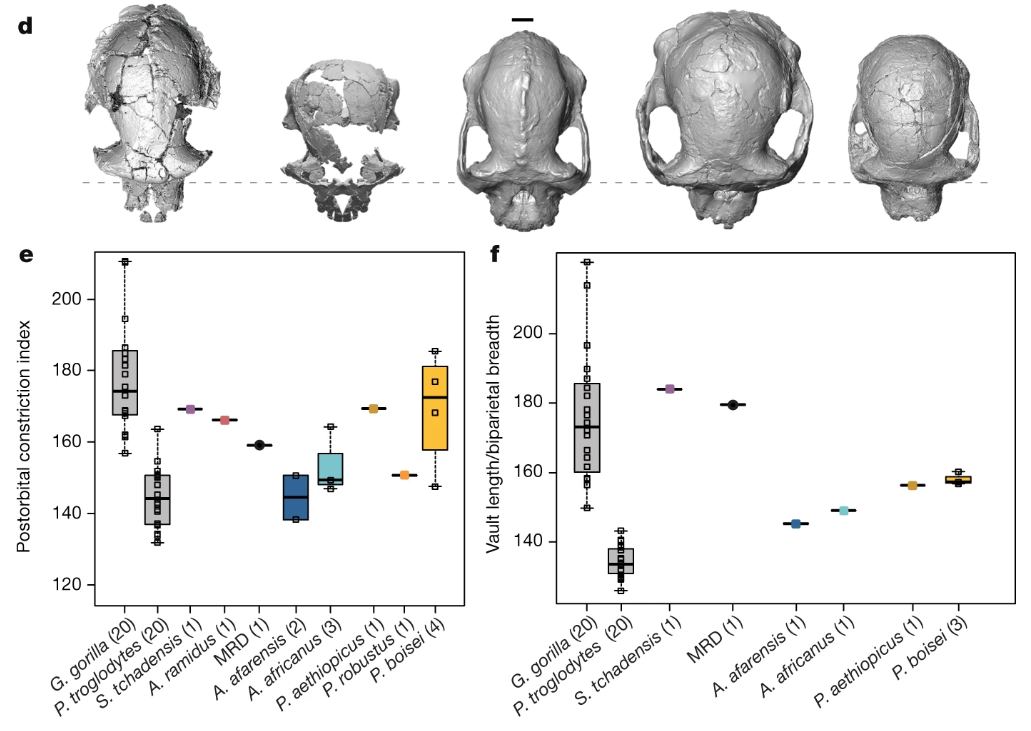
The lede, “human evolutionary tree messier than thought,” is not terribly interesting or compelling since it seems to characterize most fossil discoveries over the past several years. And in this case I don’t know how well supported the argument is, since the trait in question (narrow frontal region of the braincase or “post-orbital constriction”) can vary dramatically within a single species. The image below is from the paper itself—compare the difference in “postorbital constriction index” (left graph) between the new A. anamensis cranium (MRD) and A. afarensis (in blue). Both sets of fossils fall within the range of chimpanzees (P. troglodytes), and note the great range of variation within gorillas (G. gorilla).

Screen Shot 2019-08-30 at 8.32.37 AM

Part of Figure 3 from the paper by Haile-Selassie and colleagues. On the top is a view from above of fossil humans: Sahelanthropus tchadensis, Ardipithecus ramidus, the new A. anamensis, A. afarensis, and A. africanus. Below the graphs show how species differ in narrowing of the frontal (left) and length of the skull (right).

What I find most interesting about the new find is the great front-to-back length of the cranium—check out how long and narrow the brain-case is of the fossil compared with the later hominins to the right. This is an interesting similarity with the much earlier (6 million years ago) Sahelanthropus tchadensis, which is the left-most fossil in the figure. It makes me really curious to see the brain endocast of A. anamensis and the Sahelanthropus cranium—what was brain shape like for these ancient animals, and what does that mean for the earliest stages of human brain evolution? The Sahelanthropus endocast was presented at a conference six years ago but remains unpublished. Haile-Selassie and colleagues report that they made a virtual reconstruction of the A. anamensis endocast, so hopefully we’ll get to pick its brain soon.


Scientific Racism

The site’s been quiet in 2017, with little time to blog on top of my regular professional responsibilities, and of course watching the fascist smoke rising from the garbage fire of our 45th presidential administration with horrified disbelief. At work, my two new classes are keeping me plenty busy, and their content is quite distinct – one is on the archaeological record of Central Asia, the other centers around Homo naledi to teach about fossils. But by complete accident, examples of scientific racism came up in the readings for each course last week.

scientific-racism

Scientific racism refers to using data or evidence from the biological and social sciences to support racist arguments, that one racial group is better or worse than another group; the groups of course, are culturally determined rather than empirically discrete biological entities. This evidence is often cherry-picked, misinterpreted, and/or outright weak. Nicolas’ Wade’s 2014 A Troublesome Inheritance is a recent example of such a work. The book’s racial claims amount to nothing more than handwaving, and so egregious is the misrepresentation of genetic evidence that nearly 150 of the world’s top geneticists signed a letter to the editor rebuking Wade for “misappropriation of research from our field to support arguments about differences among human societies.” Wade’s book has no place in scientific discourse, but then almost anyone can write a book as long as a publisher thinks it will sell.

In addition to the outright misrepresentation of scientific evidence to support racist arguments, another manifestation of scientific racism is the influence of cultural biases in the interpretation of empirical observations. This may be less malicious than the first example, but is equally dangerous as it more tacitly supports systemic and pervasive racism. And this brings us to my classes’ recent readings.

First was a reference to the “Movius Line” in a review of the Paleolithic record of Central Asia (Vishnyatsky 1999) for my prehistory class. Back in the 1940s Hallum Movius, archaeologist and amazing-name-haver, noticed a distinct geographic pattern in the distribution of early stone tool technology across the Old World: “hand-axes” could be found at sites across Africa and western Eurasia, while they were largely absent from East Asian sites, which were dominated by more basic stone tools.

screen-shot-2017-02-25-at-8-28-56-am

Movius’ illustration of the distribution of Early Paleolithic technologies. From Fig. 1 in Dennell (2015).

Robin Dennell (2016) provides a nice review of how Movius’ personal, culturally influenced perception of China colored his interpretation of this pattern. Movius read this archaeological evidence to mean that early East Asian humans were unable to create the more advanced technology of the west, a biological and cognitive deficiency resulting from cultural separation: “East Asia gives the impression of having acted (just as historical China and in sharp contrast with the Mediterranean world) as an isolated and self-sufficient area, closed to any major human migratory wave” (Movius 1941: 86, cited in Dennell 2015). Racial and cultural stereotypes about East Asia directly translated to his interpretation of an archaeological pattern.

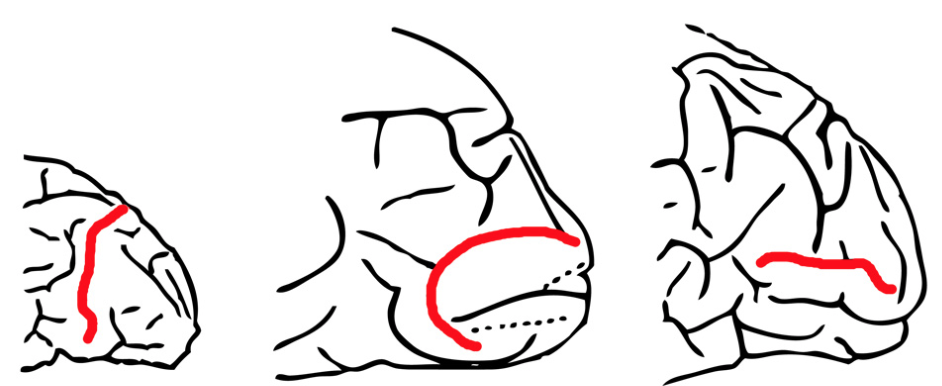
This type of old school scientific racism also arose in a review of endocasts (Falk, 2014) for my Homo naledi class. Endocasts are negative impressions or casts of a space or cavity, and comprise the only direct evidence of what extinct animals’ brains looked like. So to see how the structure of the brain has changed over the course of human evolution, scientists can search for the impressions of important brain structures in fossil human endocasts. Falk (2014) reviews one of the most famous of these structures – the “lunate sulcus” – which was used as evidence for reorganization of the hominin brain for nearly 100 years. In the early 20th century, anatomist and anthropologist GE Smith (not GE Smith from the Saturday Night Live Band)  thought he’d identified the human homologue of a groove that in apes separates the parietal lobe from the visual cortex. In humans, however, this groove was positioned more toward the back of the brain, which Smith interpreted as an expansion of an area relating to advanced cognition.

Screen Shot 2017-02-25 at 9.07.54 AM.png

The back of the brain, viewed from the left, of a chimpanzee (left) and two humans, the red line illustrating the Affenspalte or lunate sulcus (Fig. 1 from Falk 2014, which was modified from Smith 1903). The middle one also might be a grumpy fish.

It turns out that the lunate sulcus does not actually exist in humans, as the grooves identified as such are not structurally or functionally the same as the lunate sulcus in apes (Allen et al., 2006). Nevertheless, given what Smith thought the lunate sulcus was, it’s tragic to read his interpretations of human variation: “resemblance to the Simian [ape] pattern… is not quite so obvious…. in European types of brain….” (Smith 1904: 437, quoted in Falk 2014). The human condition for this trait was for it to be located in the back, reflecting an expansion of the cognitive area in front of it, and this pattern was less pronounced, according to Smith, in non-European people’s brains. This interpretation reflects two traditions at the time: 1) to refer to racial ‘types,’ ignoring variation within and overlap between groups, as well as 2) the prevailing wisdom that Europeans were more intelligent or advanced than other geographical groups.

ResearchBlogging.orgAnecdotes such as these may seem like mere scientific and historical curios, but they should serve as important reminders both that science can be accidentally guided by cultural values, or intentionally used for malevolent ends. Misconceptions and errors of the past shouldn’t be erased, but rather touted so that we don’t repeat mistakes that can have major consequences in our not-so-post-racial society.

References

Allen JS, Bruss J, & Damasio H (2006). Looking for the lunate sulcus: a magnetic resonance imaging study in modern humans. The anatomical record. Part A, Discoveries in molecular, cellular, and evolutionary biology, 288 (8), 867-76 PMID: 16835937

Dennell, R. (2016). Life without the Movius Line: The structure of the East and Southeast Asian Early Palaeolithic Quaternary International, 400, 14-22 DOI: 10.1016/j.quaint.2015.09.001

Falk D (2014). Interpreting sulci on hominin endocasts: old hypotheses and new findings. Frontiers in human neuroscience, 8 PMID: 24822043

Vishnyatsky L (1999). The Paleolithic of Central Asia. Journal of World Prehistory, 13, 69-122.

Did Neandertal brains grow like humans’ or not?

According to Marcia Ponce de Leon and colleagues, “Brain development is similar in Neandertals and modern humans.” They reached this conclusion after comparing how the shape of the brain case changes across the growth period of humans and Neandertals. This finding differs from earlier studies of Neandertal brain shape growth (Gunz et al. 2010, 2012).

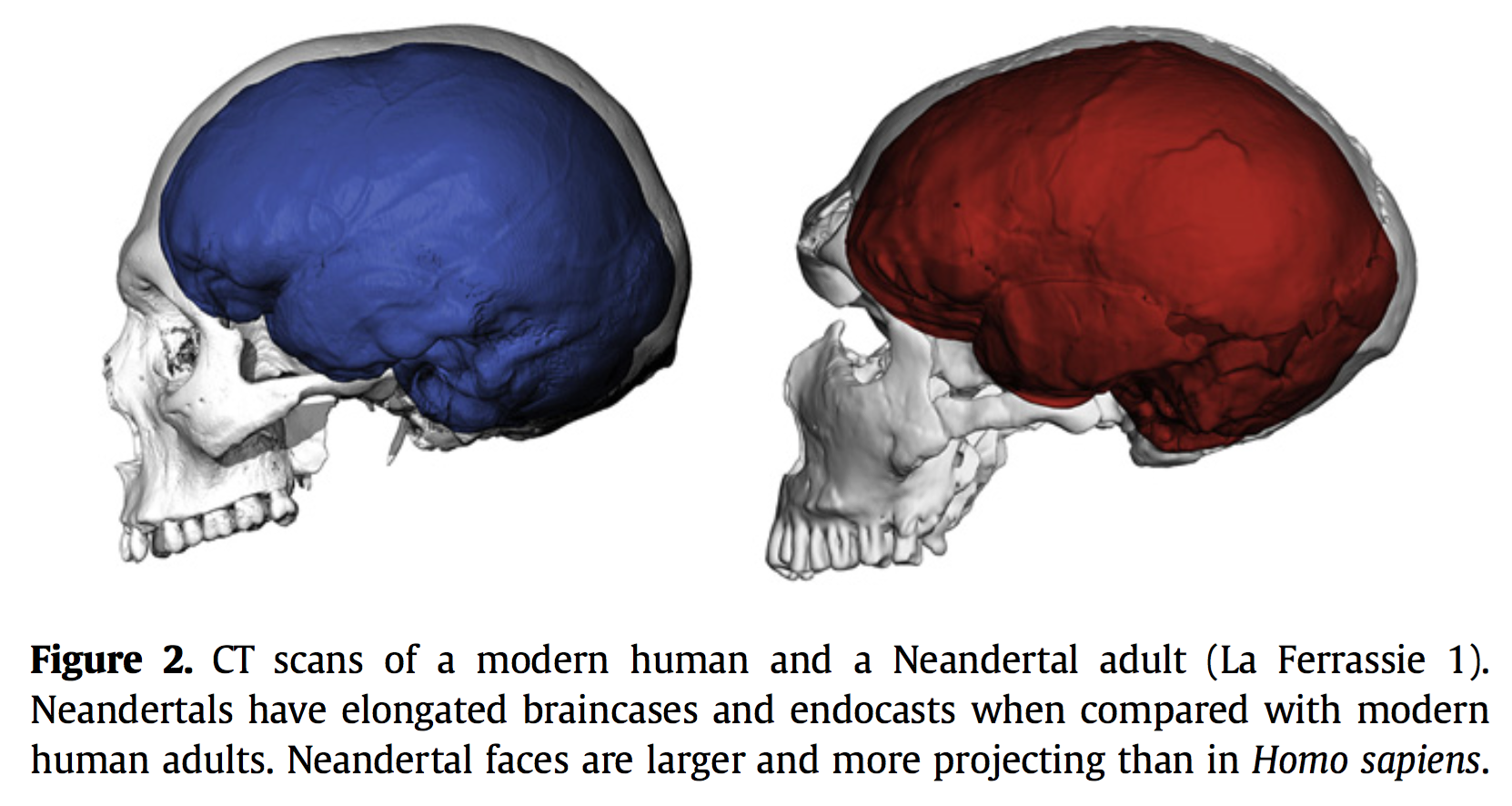
Although Neandertals had similar adult brain sizes as humans do today, the brains are nevertheless slightly different in shape:

Screen Shot 2016-07-26 at 4.31.52 PM

Endocranial surfaces of a human (left, blue) and Neandertal (right, red), from Gunz et al. (2012). These surfaces reflect the size and shape of the brain, blood vessels, cerebrospinal fluid, and meninges.

Gunz et al. (2010, 2012) previously showed that endocranial development in humans, but not in Neandertals or chimpanzees, has a “globularization phase” shortly after birth: the endocranial surface becomes overall rounder, largely as a result of the expansion of the cerebellum:

Screen Shot 2016-07-26 at 4.38.39 PM

Endocranial (e.g., brain) shape change in humans (blue), Neandertals (red) and chimpanzees (green), Fig. 7 from Gunz et al. (2012). Age groups are indicated by numbers. The human “globularization phase” is represented by the great difference in the y-axis values of groups 1-2 (infants). The Neandertals match the chimpanzee pattern of shape change; Neandertal neonates (LeM2 and M) do not plot as predicted by a human pattern of growth.

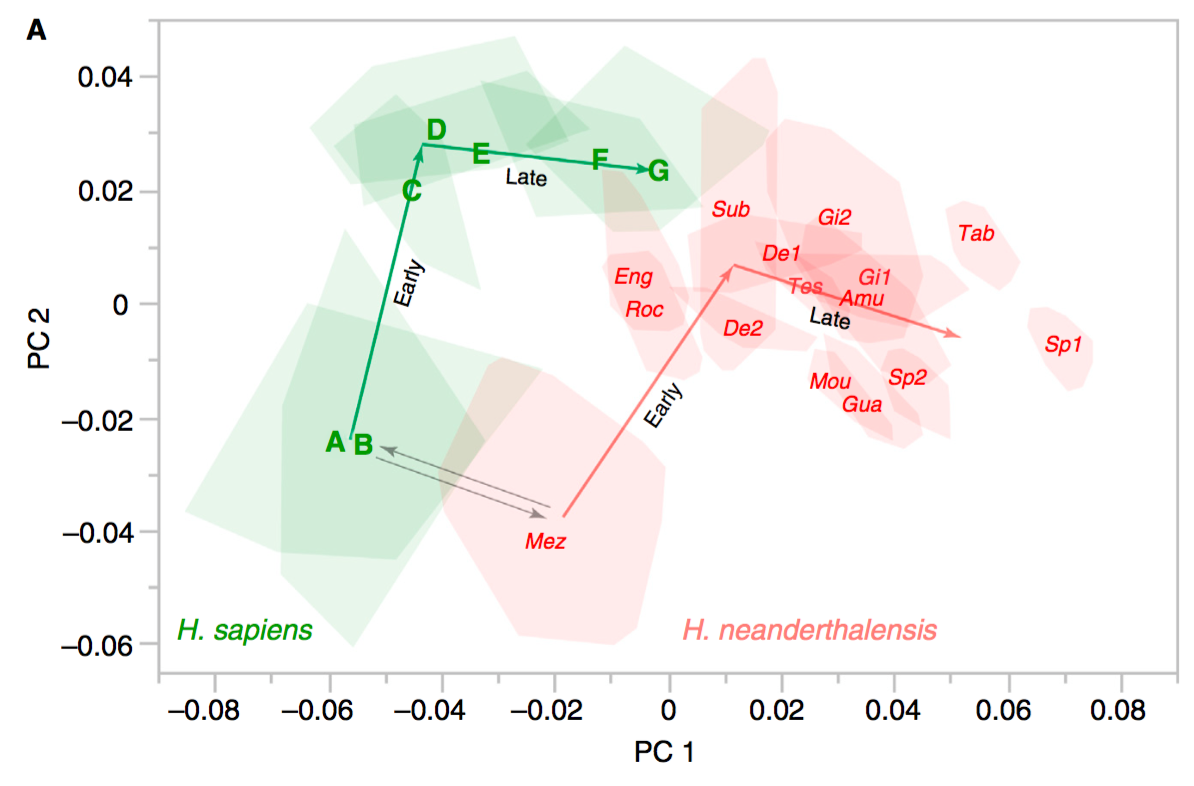
Ponce de Leon and colleagues now challenge this result with their own similar analysis, suggesting similar patterns of shape change with Neandertals experiencing this globularization phase as well (note that endocranial shapes are always different, nevertheless):

Screen Shot 2016-07-26 at 4.47.13 PM

Endocranial shape change in humans (green) and Neandertals (red), from Ponce de Leon et al. (2016). Note that the human polygons and letters represent age groups, whereas the Neandertal polygons and labels are reconstructions of individual specimens.

The biggest reason for the difference between studies is in the fossil sample. Ponce de Leon et al. have a larger fossil sample, with more non-adults including Dederiyeh 1-2, young infants in the age group where human brains become more globular.

Screen Shot 2016-07-26 at 5.01.17 PM

Comparison of fossil samples between the two studies.

But I don’t think this alone accounts for the different findings of the two studies. Overall shape development is depicted in PC 1: in general, older individuals have higher PC1 scores. The globularization detected by Gunz et al. (2010; 2012) is manifest in PC2; the youngest groups overlap entirely on PC1. The biggest difference I see between these studies is where Mezmaiskaya, a neonate, falls on PC2. In the top plot (Gunz et al., 2012), both Mezmaiskaya and the Le Moustier 2 newborn have similar PC2 values as older Neandertals. In the bottom plot (Ponce de Leon et al., 2012), the Mezmaiskaya neonate has lower PC2 scores than the other Neandertals. Note also the great variability in Mezmaiskaya reconstructions of Ponce de Leon et al. compared with Gunz et al.; some of the reconstructions have high PC2 values which would greatly diminish the similarity between samples. It’s also a bit odd that Engis and Roc de Marsal appear “younger” (i.e., lower PC1 score) than the Dederiyeh infants that are actually a little bit older.

Ponce de Leon et al. acknowledge the probable influence of fossil reconstruction methods, and consider other reasons for their novel findings, in the supplementary material. Nevertheless, a great follow-up to this, to settle the issue of Neandertal brain development once and for all, would be for these two research teams to join forces, combining their samples and comparing their reconstructions.

REFERENCES

ResearchBlogging.org

Gunz P, Neubauer S, Maureille B, & Hublin JJ (2010). Brain development after birth differs between Neanderthals and modern humans. Current Biology : 20 (21) PMID: 21056830

Gunz P, Neubauer S, Golovanova L, Doronichev V, Maureille B, & Hublin JJ (2012). A uniquely modern human pattern of endocranial development. Insights from a new cranial reconstruction of the Neandertal newborn from Mezmaiskaya. Journal of Human Evolution, 62 (2), 300-13 PMID: 22221766

Ponce de León, M., Bienvenu, T., Akazawa, T., & Zollikofer, C. (2016). Brain development is similar in Neanderthals and modern humans Current Biology, 26 (14) DOI: 10.1016/j.cub.2016.06.022

Bioanthro lab activity: Hominin brain size

Last week in my Human Evolution class we looked at whether we could estimate hominin brain sizes, or endocranial volumes (ECV), based on just the length and width of the bony brain case. Students took these measurements on 3D surface meshes…

Maximum cranial length in Australopithecus boisei specimen KNM-ER 406.

Maximum cranial length in Australopithecus boisei specimen KNM-ER 406.

… and then plugged their data into equations relating these measurements to brain size in chimpanzees (Neubauer et al., 2012) and humans (Coqueugniot and Hublin, 2012).

The relationship between cranial length (x axis) and ECV (y axis).

The relationship between cranial length (x axis) and ECV (y axis). Left shows the chimpanzee regression (modified from Fig. 2 in Neubauer et al., 2012), while the right plot is humans (from the Supplementary Materials of Coqueugniot and Hublin, 2012).

So in addition to spending time with fossils, students also learned about osteometric landmarks with fun names like “glabella” and “opisthocranion.” More importantly, students compared their estimates with published endocranial volumes for these specimens, based on endocast measurements:

Human and chimpanzee regression equations don't do great at estimating hominin brain sizes.

Human and chimpanzee regression equations don’t do great at predicting hominin brain sizes. Each point is a hominin fossil, the x value depicting its directly-measured endocranial volume and the y value its estimated volume based on different regression equations. Black and red points are estimates based on chimpanzee cranial width and length, respectively, while green and blue points are based on human width and length, respectively. The dashed line shows y=x, or a correct estimate.

This comparison highlights the point that regression equations might not be appropriate outside of the samples on which they are developed. Here, estimates based on the relationship between cranial dimensions and brain size in chimpanzees tend to underestimate fossils’ actual values (black and red in the plot above), while the human regressions tend to overestimate hominins’ brain sizes. Students must think about why these equations perform poorly on fossil hominins.

Here are the lab materials so you can use and adapt this for your own class:

Lab 4-Brain size (Instructions & questions)

Lab 4 data table (with equations)

ResearchBlogging.orgReferences
Coqueugniot, H., & Hublin, J. (2012). Age-related changes of digital endocranial volume during human ontogeny: Results from an osteological reference collection American Journal of Physical Anthropology, 147 (2), 312-318 DOI: 10.1002/ajpa.21655

Neubauer, S., Gunz, P., Schwarz, U., Hublin, J., & Boesch, C. (2012). Brief communication: Endocranial volumes in an ontogenetic sample of chimpanzees from the taï forest national park, ivory coast American Journal of Physical Anthropology, 147 (2), 319-325 DOI: 10.1002/ajpa.21641

A new year of bioanthro lab activities

One of my goals in teaching is to introduce students to how we come to know things in biological anthropology, and lab activities give students hands-on experience in using scientific approaches to address research questions. Biological anthropology (really, all biology) is about understanding variation, and I’ve created some labs for students to scrutinize biological variation within the classroom.

In my Introduction class, the first aspect of human uniqueness we will focus on is the brain. To complement readings and lectures, we’ll also investigate variation in brain size among students in class. Of course, measuring their actual brain sizes is impossible without either murdering them (unethical and messy) or subjecting them to CT or MRI scanning (costly and time-consuming). Instead, it’s fast and easy to measure head circumference, so we’ll estimate just how brainy they are in a way that will also introduce them to data collection, measurement error, and the regression analysis.

The lab activity is based on a paper by Bartholomeusz and colleagues (2002), who used CT scanning to measure the external head circumferences and brain volumes of males ranging from 1-40 years. Focusing on the adults of this sample, there are several possible regression equations that students could use to estimate their brain size from their head circumference:

The relationship between head circumference and brain volume in adult humans. Note each regression line is based on different age groups.

The relationship between head circumference and brain volume in adult humans. Note each regression line is based on different age groups. Data from Bartholomeusz et al. (2002).

Bartholomeusz et al. divided their sample into age groups, and students will learn that the relationship between the two variables differs subtly depending on the age group. Students will therefore have to decide (and justify) which equation they will use – should they pick the one based on their own age group, or the one with the lowest prediction error?

Once students have estimated their brain sizes, I’ll enter the data into R and we’ll look at how (estimated) brain size varies within the classroom, looking also at possible covariates including sex and region of birth. After discussing our data in class, students have to write up a brief report describing our research question and proposing additional hypotheses about brain size variation.

So that’s this week’s lab in Introduction to Biological Anthropology. There will be four more this semester, in three of which students will collect data on themselves, as well as four other labs for my Human Evolution course. In case you’re interested in using this activity for your class, I’m including the lab handout here. I’ll also try to post lab assignments to the blog (as I’ve done here) as the semester progresses.

Activity handout: Lab 1 Instructions and report

ResearchBlogging.orgReference

Bartholomeusz, H., Courchesne, E., & Karns, C. (2002). Relationship Between Head Circumference and Brain Volume in Healthy Normal Toddlers, Children, and Adults Neuropediatrics, 33 (5), 239-241 DOI: 10.1055/s-2002-36735