Bioanthro lab activity: Primate proportions

My Intro to Bio Anthro course, focusing on human uniqueness, has moved from the brain to bipedalism. After the abysmally big brain, perhaps the most grotesque aspect of the human species is our wont to walk on two legs. It’s just not natural.

Image credit.

What a terrible biped. Image credit.

Seriously, why would an animal do such a horrid thing?

Image credit.

Most animals need extra help to stay upright on just two limbs. Image credit.

This peripatetic penchant is apparent in our skeletons, most visibly in our long-ass legs. And indeed, species’ limb lengths and proportions generally reflect how they tend to move around. Quadrupeds, animals that walk on four legs, tend to have roughly equally-lengthed arms and legs. Gibbons, notorious ricochetal brachiators, have insanely long arms. So for lab this week, students measured surface scans of different primates’ long bones to see if form really follows function.

Here, students try their hands at measuring long bones on surface scans of primate skeletons, and use their data to calculate indices reflecting the relative lengths of limb segments. These data will be used to test whether limb proportions can be used to distinguish different locomotor types, and to hypothesize how fossil species might have moved about.

Measuring siamang (Symphalangus syndactylus) limb lengths with Meshlab. Data credit.

Measuring siamang (Symphalangus syndactylus) limb lengths with Meshlab. Data credit.

Since this is my students’ introduction to primate skeletons and analysis software, I only had them measure three specimens: a siamang (above), a squirrel monkey, and a grivet.  But of course you can have students look at more if you wish. This activity uses the free Meshlab software  and surface scans made from CT scans in the KUPRI database (surface scans are much smaller files than CT scans, making for easier dissemination to swarms of students). If you’re interested in using or modifying this activity in your class, here are the lab handout and datasheet I created for it:

Lab 2-Primate proportions
Lab 2-Primate limb data sheet

Info about, and materials for, other lab activities can be found on my Teaching page.

Bioanthro lab activity: Estimating Miocene ape body mass

We’ve arrived at the Planet of the Apes, also known as the Miocene, in my “Bones, Stones and Genomes” course. The living apes are but a small remnant of what was a pretty successful radiation starting around 20 million years ago. There were so many apes that it can be a bit confusing for students, but it’s important for setting up the biological and ecological contexts of hominin origins.

Possible evolutionary relationships of myriad Miocene apes and subsequent hominins. From Harrison (2010)

Possible evolutionary relationships of myriad Miocene apes and subsequent hominins. From Harrison (2010)

This week also marks my students’ first lab assignment, analyzing CT scans of bones. Here, we looked at how we estimate body size in extinct animals, using the KUPRI database and the free CT analysis software InVesalius. Because some of the KUPRI primates have body masses recorded, students can examine the relationship between animals’ weight and skeletal dimensions. The purpose of the assignment is to help familiarize students with skeletal anatomy, CT data and principles of linear regression.

One of the KUPRI specimens, an old female gorilla, with known weight.

One of the KUPRI specimens, an old female gorilla, with known weight.

I selected a few specimens for students to examine. After students download the massive files, they can load them into InVesalius for analysis. This program allows students to easily identify bone versus other tissues, and to create a 3D surface rendering of a highlighted region (tissue) of interest.

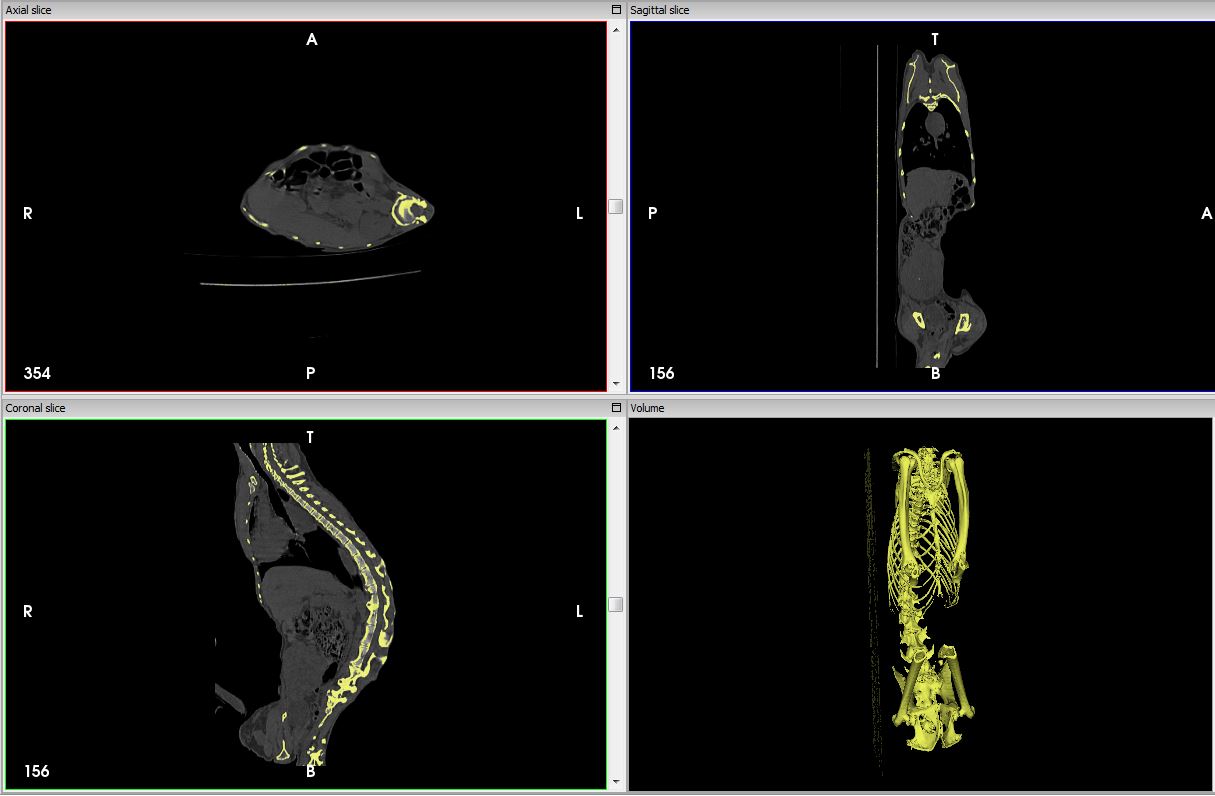
A grivet, Chlorocebus aethiops, with bone highlighted in 2D sections and as a 3D model.

A grivet, Chlorocebus aethiops, with bone highlighted in 2D sections and as a 3D model. This little guy weighs only 4 kg!

It’s pretty easy to take simple linear measurements (and angles), assuming students can get oriented within the skeleton and identify the features they need to measure. It can be a little tricky to measure a femur head if it’s still in the acetabulum (below). Luckily, InVesalius lets you take measurements on both 2D slices or the 3D volume.

Let's measure that femur head diameter.

Let’s measure that femur head diameter.

So students do this for a few specimens and enter the data into Excel, which can then easily plot the data and provide a regression equation. They then use this equation to estimate masses of the specimens – if there’s a good relationship between mass and skeletal measures, then the estimates should be close to the observed values. Students use their equation to predict body mass of some Miocene apes based on femur head diameter and femur midshaft diameter, noting how confident they feel in their estimates given how well their regression performed on the training dataset. They also compare their mass estimates to those using another equation generated by Christopher Ruff (2003).

It might be a little intense for students totally unfamiliar with apes, bones and CT scans, but it should be a good way for them to learn lots of concepts we’ll revisit over the semester.

Here’s the lab assignment, in case you want to use it in your own class: Lab 1-Miocene masses

Homo naledi in a lawn chair

It is a great relief that Homo naledi, a most curious critter, was announced to the world on Thursday. I’ve been working on these fossils since May 2014, and it was really hard to keep my trap shut about it for over a year.

Homo naledi on my mind, and phone, all year.

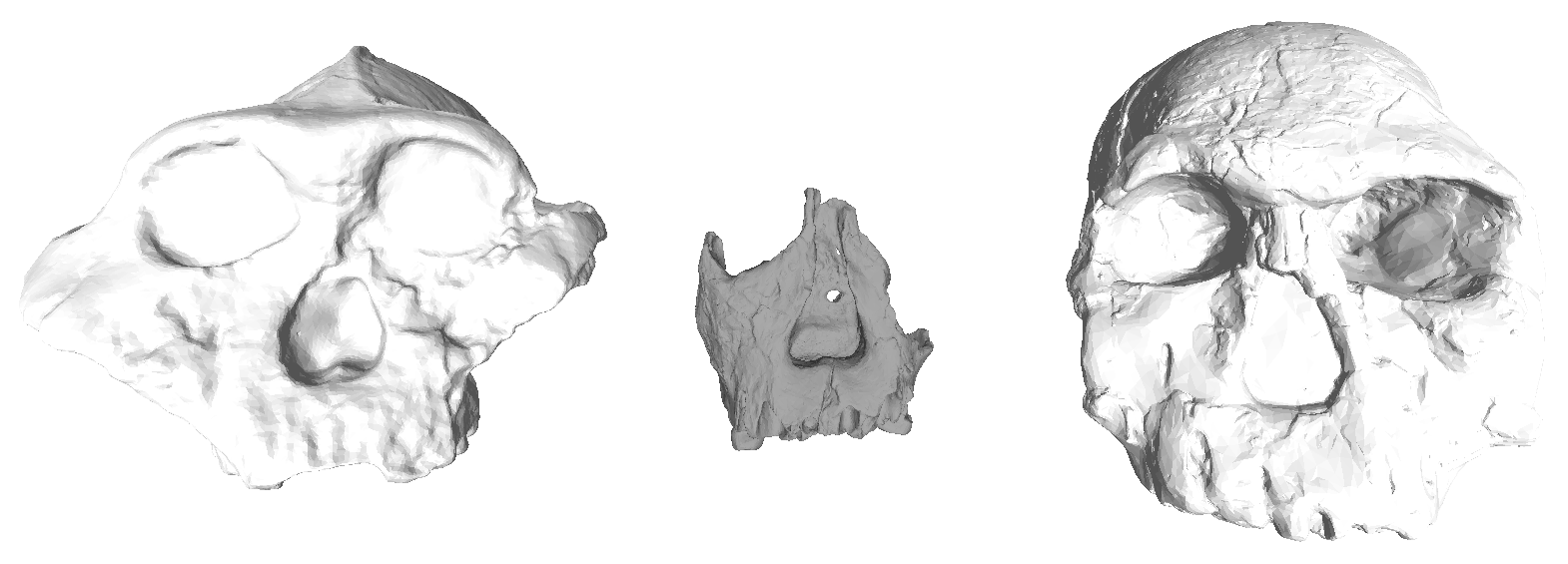
Homo naledi on my mind, and the lock screen on my phone, all year. CT rendering of cranium DH3, top is to the left and front is to the top.

I was in London for the ESHE conference last week when **it hit the fan, and so I got to attend a small press conference from the paper’s publisher, eLife, for the announcement.

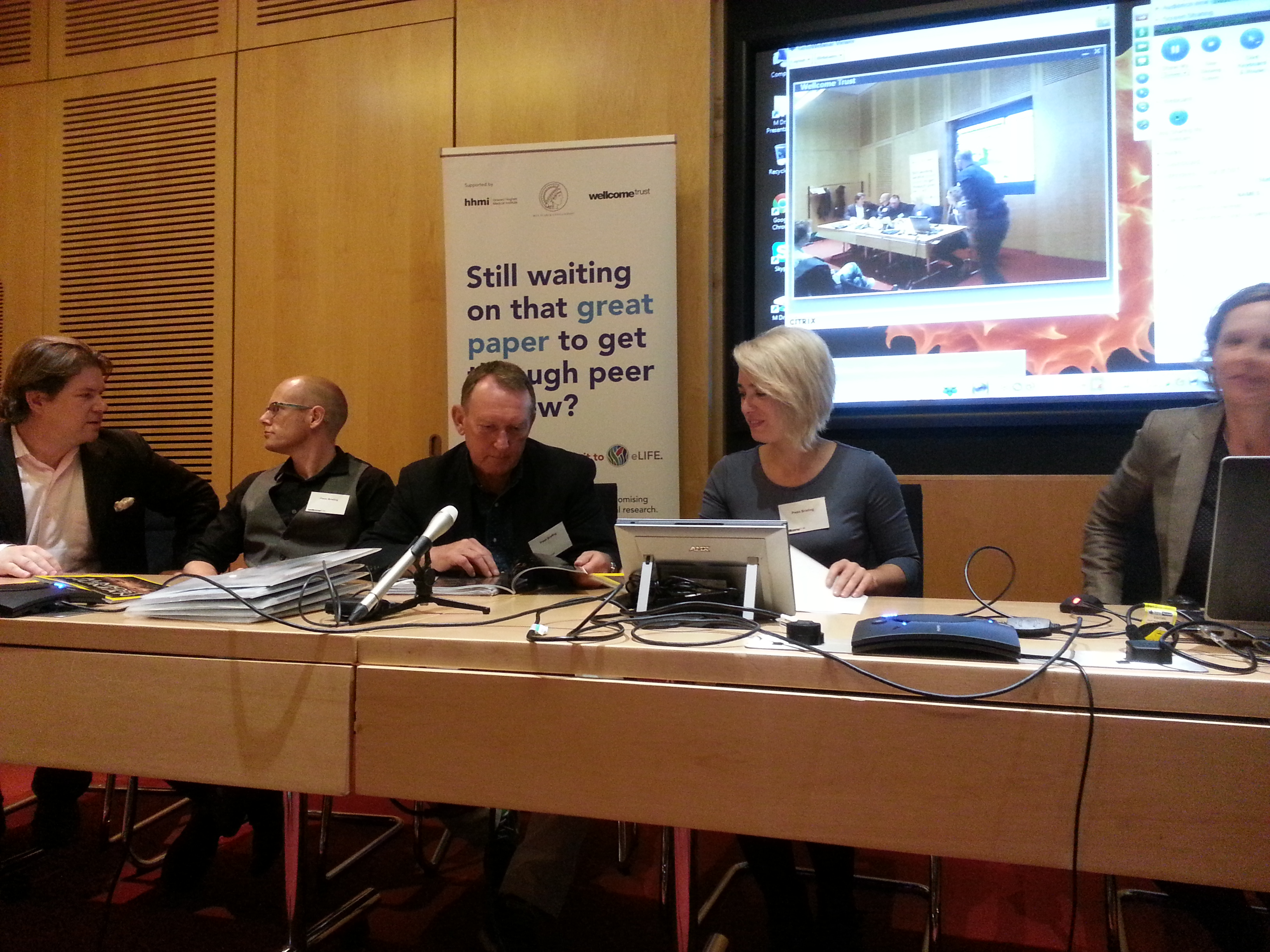
eLife press conference last Thursday. From left to right: Will Harcourt-Smith, Matthew Skinner, Noel Cameron, Alia Gurtov and Tracy Kivell.

eLife press conference last Thursday. From left to right: friends and colleagues Will Harcourt-Smith, Matthew Skinner, Noel Cameron, Alia Gurtov and Tracy Kivell.

I had just flown in from Kazakhstan, and was presenting some recent work on the evolution of brain growth (I’ll write a post about it soon, promise), so it was a bit hard to appreciate the gravity of the announcement. Although the awesome spread in National Geographic did help it sink in a bit.

Really blurry photo of Markus Bastir holding up the heaviest copy of National Geographic ever.

I’m wending my way back to Kazakhstan now, but in the coming weeks I will try to post more about these fossils, the project, and specifically what I’m working on.

Until then, I’d like to point out how much information is freely and easily available to the entire world about these fossils. The paper, full-length and filled with excellent images of many of the specimens and reconstructions, is available for free online here. In addition, you can download 3D surface scans of over 80 of the original fossils on MorphoSource, also totally free. Everything about this scientific discovery and its dissemination is unprecedented – the sheer number of fossils and the ease of access with which literally everyone (well, with an internet connection) can access this information has never occurred before. This is the way paleoanthropology should be. Hats off to Lee Berger and the other senior scientists on the project for making such a monumental resource available to all.

ResearchBlogging.orgBerger LR, Hawks J, de Ruiter DJ, Churchill SE, Schmid P, Delezene LK, Kivell TL, Garvin HM, Williams SA, DeSilva JM, Skinner MM, Musiba CM, Cameron N, Holliday TW, Harcourt-Smith W, Ackermann RR, Bastir M, Bogin B, Bolter D, Brophy J, Cofran ZD, Congdon KA, Deane AS, Dembo M, Drapeau M, Elliott MC, Feuerriegel EM, Garcia-Martinez D, Green DJ, Gurtov A, Irish JD, Kruger A, Laird MF, Marchi D, Meyer MR, Nalla S, Negash EW, Orr CM, Radovcic D, Schroeder L, Scott JE, Throckmorton Z, Tocheri MW, VanSickle C, Walker CS, Wei P, & Zipfel B (2015). Homo naledi, a new species of the genus Homo from the Dinaledi Chamber, South Africa. eLife, 4 PMID: 26354291

A new year of bioanthro lab activities

One of my goals in teaching is to introduce students to how we come to know things in biological anthropology, and lab activities give students hands-on experience in using scientific approaches to address research questions. Biological anthropology (really, all biology) is about understanding variation, and I’ve created some labs for students to scrutinize biological variation within the classroom.

In my Introduction class, the first aspect of human uniqueness we will focus on is the brain. To complement readings and lectures, we’ll also investigate variation in brain size among students in class. Of course, measuring their actual brain sizes is impossible without either murdering them (unethical and messy) or subjecting them to CT or MRI scanning (costly and time-consuming). Instead, it’s fast and easy to measure head circumference, so we’ll estimate just how brainy they are in a way that will also introduce them to data collection, measurement error, and the regression analysis.

The lab activity is based on a paper by Bartholomeusz and colleagues (2002), who used CT scanning to measure the external head circumferences and brain volumes of males ranging from 1-40 years. Focusing on the adults of this sample, there are several possible regression equations that students could use to estimate their brain size from their head circumference:

The relationship between head circumference and brain volume in adult humans. Note each regression line is based on different age groups.

The relationship between head circumference and brain volume in adult humans. Note each regression line is based on different age groups. Data from Bartholomeusz et al. (2002).

Bartholomeusz et al. divided their sample into age groups, and students will learn that the relationship between the two variables differs subtly depending on the age group. Students will therefore have to decide (and justify) which equation they will use – should they pick the one based on their own age group, or the one with the lowest prediction error?

Once students have estimated their brain sizes, I’ll enter the data into R and we’ll look at how (estimated) brain size varies within the classroom, looking also at possible covariates including sex and region of birth. After discussing our data in class, students have to write up a brief report describing our research question and proposing additional hypotheses about brain size variation.

So that’s this week’s lab in Introduction to Biological Anthropology. There will be four more this semester, in three of which students will collect data on themselves, as well as four other labs for my Human Evolution course. In case you’re interested in using this activity for your class, I’m including the lab handout here. I’ll also try to post lab assignments to the blog (as I’ve done here) as the semester progresses.

Activity handout: Lab 1 Instructions and report

ResearchBlogging.orgReference

Bartholomeusz, H., Courchesne, E., & Karns, C. (2002). Relationship Between Head Circumference and Brain Volume in Healthy Normal Toddlers, Children, and Adults Neuropediatrics, 33 (5), 239-241 DOI: 10.1055/s-2002-36735

Blood spattered Easter eggs from Raymond Dart

Some of the more colorful ideas and text in the anthropological literature are courtesy of Raymond Dart.

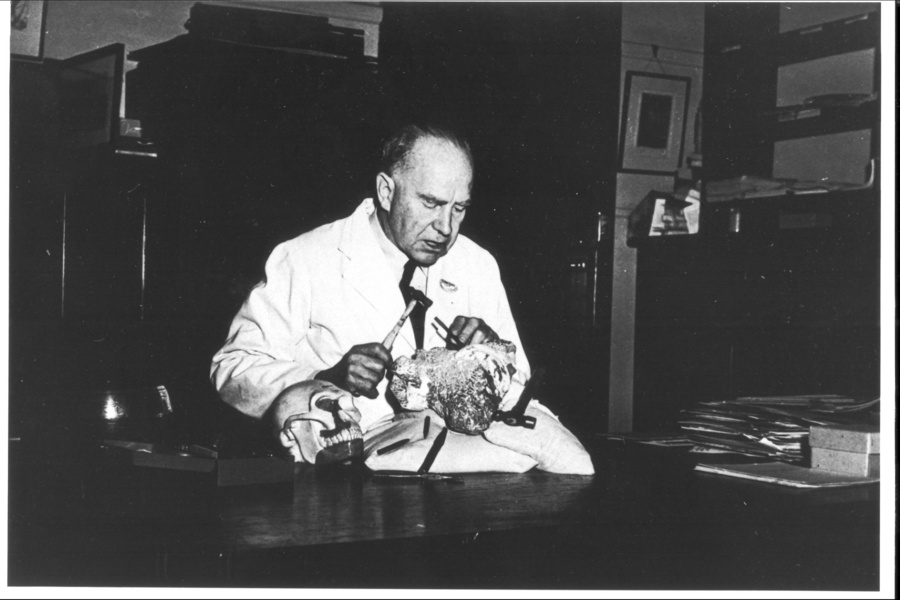
Dart, hammering away to remove a fossil from some breccia. I hope. Image credit.

Dart, hammering away at some breccia to remove a fossil. I hope. Image credit.

In 1925, Dart identified the Taung fossil as a close relative of humans, and coined the scientific name, Australopithecus africanus. This was a pretty good idea, as Taung was the first in what is now a large collection of fossils attributed to this species.

Taung was such an important discovery, you can now walk across it as you enter the fossil collections at Wits University.

Taung was such an important discovery, you can now walk across it not once, not twice, but thrice! as you enter the fossil collections at the Evolutionary Studies Institute at Wits University

Some of Dart’s ideas that made it into print, though, were a bit more fanciful. Aside from his description of Taung, he is probably most famous for hypothesizing the “osteodontokeratic” culture, the idea that the myriad broken animal bones in Makapansgat cave were in fact tools used by australopiths for hunting and murder. MURDER! It was a neat idea at the time, but his vision of bloodthirsty, bone-dagger-wielding australopithecines is not accepted today (nor back when he was writing).

Dart was trained as an anatomist, and much of his work was devoted to writing up australopithecine fossils discovered at site of Makapansgat in South Africa. These are probably the best descriptive papers I’ve found in all the literature, as Dart’s whimsical visions of violence and bloodshed occasionally made their way into otherwise dry scientific prose.

In 1948 he very casually put it out there, that the front teeth of the MLD 2 mandible were lost in “fatal combat . . . presumably by a bludgeon” (emphasis added). Of course, the teeth were probably lost long after the poor kid died, rather than being knocked out “at the hands of a kinsman more expert than himself in the accurate application of directed implements” (Dart, 1948: 393-394). But Dart’s version is certainly more interesting than the more likely taphonomic explanation.

MLD 2

The MLD 2 mandible, poor kid, as illustrated in Dart (1948). Note that the incisor tooth sockets are empty, likely the result of taphonomy rather than bloodsport.

Dart (1958) later described the MLD 7 ilium, which he’d presumed to be a female, from the same site as MLD 2. Dart recounted the violent demise of MLD 2, raising the possibility of a similar death for the MLD 7 individual: “The adolescent boy [MLD 2] … was killed by a bone-smashing blow on the chin from a club or fist. Did brother and sister share here in death the same cannibalistic fate?” (emphasis added) Bloodshed, cannibalism, Australopithecus according to Dart had it all. Although these are unlikely characterizations of australopithecines, there is evidence of cannibalism in later fossil humans.

These gruesome Easter Eggs come to mind as I’m reading his 1956 paper about brain evolution. Here, Dart (1956: 28) says that hominins began walking on two legs after a dietary shift: “The forest-loving vegetarian anthropoids clung to their four-handed climbing and fruit while the terrestrial predaceous australopithecines, depending on their speed of foot and deftness of hand, lusted after flesh!” (emphasis added) Today, this idea would simply be written as, monkeys and apes live in trees and eat fruits while australopithecines lived on the ground and ate meat. But Raymond Dart wouldn’t stand for this. Oh no.

My grad school advisor, Milford Wolpoff, used to lament that students today don’t want to read anything older than the past 5-10 years. But Dart is a shining example of some of the rewarding Easter Eggs that await those who dig deeper into the literature. [I’m reminded also of Don Cousins describing “the colossal poundage of the lowland gorilla ‘Phil,’ who lived in the St. Louis Zoo from 1941-1958″ (1972: 269, emphasis added].

ResearchBlogging.org
Some good, older stuff

Cousins D (1972). Body measurements and weights of wild and captive gorillas, Gorilla gorillaZoologische Garten NF Leipzig 41, 261-277.

Dart, RA (1925). Australopithecus africanus: The Man-Ape of South Africa Nature, 115 (2884), 195-199 DOI: 10.1038/115195a0

Dart, RA (1948). The adolescent mandible of Australopithecus prometheus American Journal of Physical Anthropology, 6 (4), 391-412 DOI: 10.1002/ajpa.1330060410

Dart RA (1956). The relationships of brain size and brain pattern to human status. The South African Journal of Medical Sciences, 21 (1-2), 23-45 PMID: 13380551

Dart, RA (1958). A further adolescent australopithecine ilium from Makapansgat American Journal of Physical Anthropology, 16 (4), 473-479 DOI: 10.1002/ajpa.1330160407

Osteology Everywhere: Vertebeer Fest

This past weekend was witness to the Summer Beer Festival, the annual showcase of Michigan’s brewing splendor. Dozens of breweries brought out batches of beer, from classics we know and love, to inspired innovations meriting a MacArthur Fellowship. There was an embeerrassment of boozes. Dark Horse Brewing Company, from Marshall, MI, put on quite the show:

Dark  Horse Brewing Co. pumping out the brews and blasting t-shirts into the crowd.

Dark Horse Brewing Co. pumping out the brews and blasting t-shirts into the crowd.

Besides towering over the bacchanal hordes, the Dark Horse beer fort also offered IPAs infused with pretty much anything that might pair well with hops. They even steeped habañero peppers in one, and it was maximally boss.

Beer still my heart.

Beer still my heart.

Having sampled only a small part of rich the smorgasbord on tap, a rest by the river was in order. The Festival was on the banks of the mighty Huron River, an excellent place to sit and sip Arcadia‘s scotch ale, taking in the evening under cloud-peppered, cerulean skies. Such a calm and relaxing setting would surely offer respite for a brain besieged by bones. Right?

Every year for the Festival they replace the river water with beer.

Every year for the Festival they replace the river water with beer.

Wrong! Peering through beer goggles over the shimmer of the river, seeking signs of Bigfoots lurking on the opposite shore, I locked eyes with a large, wooden vertebral body.

No ordinary tree stump

An eyeless frown marks the ventral surface of this centrum.

The human spine is composed of anywhere from 31-34 vertebrae (not counting the coccyx or tail bone). The body or “centrum” is the large, blocky portion of the bone, which is separated from other such bodies by intervertebral discs; it is literally a pile of bodies, stacked one on top of the other. And the intervertebral discs are remnants of the notochord, the embryonic structure that unites you and me and all other humans with all other animals known as chordates. Anyway, kiss my grits if this old tree stump across the mighty Huron River here doesn’t look like a lower thoracic or upper lumbar vertebral body, the metaphoric shark fin of a giant trunkless human waiting to pounce from the placid waters.

a) Our mystery vertebra. b) a lumbar vertebra from White et al. (2012). c) views of the right and front side of the Australopithecus africanus fossil StW H41, from Sanders (1998, Fig. 1).

a) Our mystery river vertebra. b) a lumbar vertebra from White et al. (2012). c) views of the right and front side of the Australopithecus africanus fossil StW H8/H41, modified from Fig. 1 of Sanders (1998).

Thinking on it, our mystery river vertebra doesn’t just look like any old human centrum, it is a ringer for the second lumbar vertebra of StW H8/H41, a series of the 11th thoracic to 4th lumbar vertebrae of Australopithecus africanus from Sterkfontein (see the red arrow in c, above). Sanders (1998) notes that this short segment of an early hominin spine shows clear adaptation to walking upright like we humans do today, although the size of the vertebral bodies is both absolutely and relatively small compared to ours, just as is seen in other Australopithecus fossils.

And what better way to celebrate this monumental discovery than returning to the Beer Festival – hooray beer!

Osteology Everywhere: Ilium Nublar

Jurassic Park is objectively the greatest film ever made, so I don’t need to explain why I recently watched it for the bajillionth time. Despite having seen this empirically excellent movie countless times, I finally noticed something I’d never seen before.

Hold on to your butts. What's that on the screen in front of Ray Arnold?

Hold on to your butts – what’s that on the screen in front of John Arnold? (image credit)

The film takes place on the fictitional island “Isla Nublar,” a map of which features prominently in the computer control room when s**t starts to go down. Here’s a clearer screenshot of one of Dennis Nedry‘s monitors:

Isla Nublar from the JP control room. Quiet, all of you! They’re approaching the tyrannosaur paddock…. (image credit)

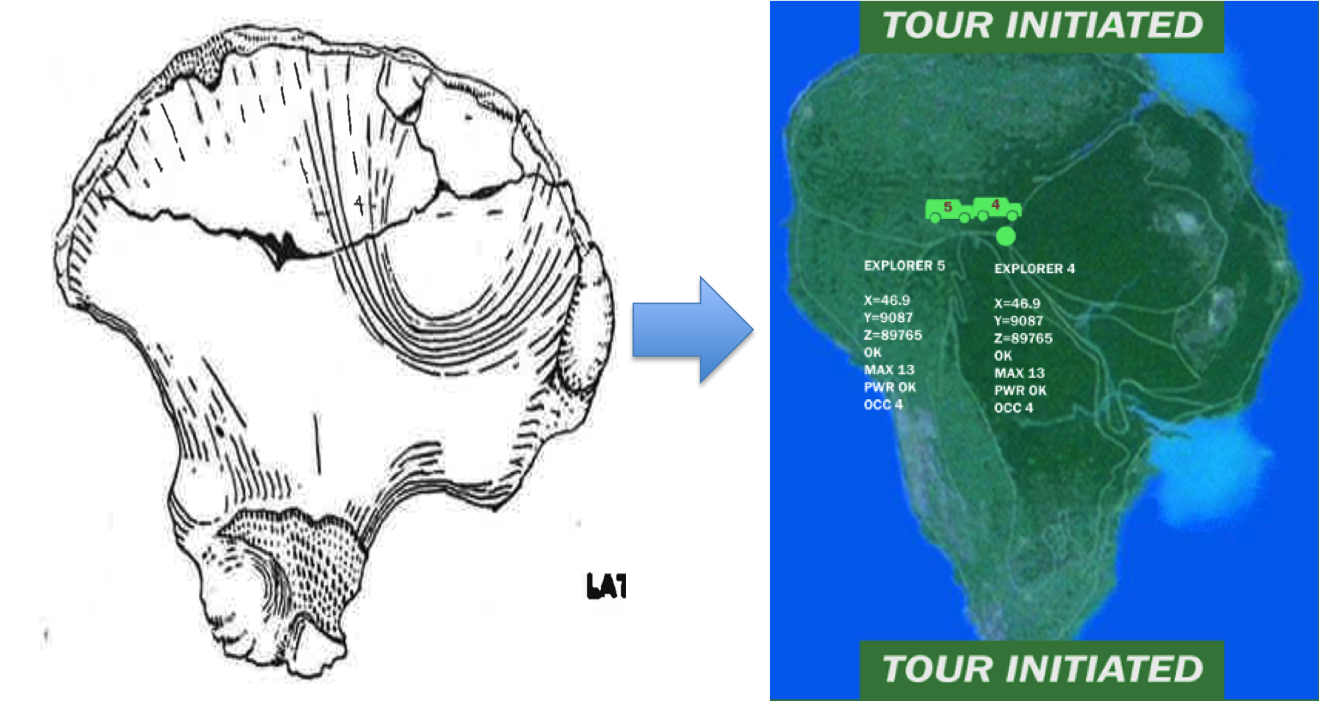
It dawned on me that the inspiration for this island is none other than MLD 7, a juvenile Australopithecus africanus ilium from the Makapansgat site in South Africa:

Figure 1 from Dart, 1958. Left side is MLD 7 and right is MLD 25. Top row is the lateral view (from the side) and bottom row is the medial view (from the inside).

Figure 1 from Dart, 1958. Left side is MLD 7 and right is MLD 25. Top row is the lateral view (from the side) and bottom row is the medial view (from the inside). These two hip bones are from the left side of the body (see the pelvis figure in this post). Note the prominent anterior inferior iliac spine on MLD 7, a quintessential feature of bipeds.

Isla Nublar is basically MLD 7 viewed at an angle so that appears relatively narrower from side to side:

MLD at a slightly oblique view (or stretched top to bottom) magically transforms into Isla Nublar.

MLD 7 at a slightly oblique view (or stretched top to bottom) magically transforms into Isla Nublar.

It’s rather remarkable that some of the most complete pelvic remains we have for australopithecines are two juveniles of similar developmental ages and sizes from the same site. In both, the iliac crest is not fused, and joints of the acetabulum (hip socket) hadn’t fused together yet. The immaturity of these two fossils matches what is seen prior to puberty in humans and chimpanzees. Berge (1998) also noted that MLD 7, serving as an archetype for juvenile Australopithecus, is similar in shape to juvenile humans, whereas adult Australopithecus (represented by Sts 14 and AL 288) are much flatter and wider side to side. Berge took this pattern of ontogenetic variation to match an ape-like pattern of ilium shape growth. This suggests a role of heterochrony in the evolution of human pelvic shape, or as Berge (1998: 451) put it, “Parallel change in pelvic shape between human ontogeny and hominid phylogeny.” In layman’s terms, ‘similar changes in both pelvic growth and pelvis evolution.’

Osteology Everywhere: Barcade bone biology

I’ve fled the Central Asian steppe to visit my childhood home, Kansas City, Missouri.

The tortuous path from the center of Eursia to the center of the US, a mere 8500 miles since there are no direct flights. Map made by Wolfram Alpha.

The tortuous path from the center of Eursia to the center of the US, a mere 8500 miles since there are no direct flights. Map made by Wolfram Alpha.

It would be a lie to say I don’t miss life in this Midwest metropolis. Kansas City is sprawling, with diverse cultures, foods and festivities in far-flung neighborhoods. It’s always a trip to revisit the people and places of my formative years.

Of course, there are differences between now and when I was growing up. A whole new world of experiences became available to me here once I was old enough to drink (legally; this is long ago now). The bar scene itself has evolved over the past decade or so, arguably culminating in Up-Down, a grown-up video game arcade that will confusingly make you both happy and sad to have become an adult.

Be still my heart. Image credit.

I’ve never seen anything like this before. But even in this novel environment, I still couldn’t help but notice Osteology Everywhere. What appears at first glance to be an oversized Connect Four contraption . . .

Go for the bottom, go for the top.

Go for the bottom, go for the top.

. . . is in fact a closeup of trabecular bone (with my friend creepily peering through):

Section through a human proximal femur (hip joint). Note the trabecular or "spongy" bone filling the top, in comparison with the thick and dense cortical bone of the shaft in the bottom left. Image credit.

Vertical section through a human proximal femur (hip joint). Note the trabecular or “spongy” bone filling the top, in comparison with the thick and dense cortical bone of the shaft in the bottom left. Image credit.

And here, we’re not playing Skee Ball . . .

20150618_003612. . . we’re hurling wooden balls into Haversian canals and lacunae of osteons. For Science.

Cross section through cortical bone, magnified to highlight an osteon. The big hole in the center is the Haversian canal, and the smaller satellite holes are lacunae housing osteocytes.

Cross section through cortical bone, magnified to highlight an osteon. The big hole in the center is the Haversian canal, and the smaller satellite holes are lacunae housing osteocytes. Image credit.

So if you’re in the KC area, I highly recommend you check out Up-Down, where you can review osteology while also playing games and sipping a refreshing beer. Who knew learning could be so fun?

Kazakhstan on #EarthCapture

BBC Earth – one of the greatest inventions of all time – has a “Big Earth” series, showcasing our planet’s awesome sights as captured by BBC readers and viewers. I submitted some pics from my recent trip to West Kazakhstan, and two are featured on the website:

Kazakhstan is an amazing place poorly known to most, and there is lots of great stuff to see in both the cities and the vast, open wilderness. You should come out and see it!

Til you make it out here, here are some more shots of the fun stuff I’ve seen here since I got a decent camera a few months ago.

Spilt milk.

Spilt milk over Mangystau, Kazakhstan.

eFfing #FossilFriday: Rekindling an old friend’s hip

Sorry for the crappy pun. Carol Ward and colleagues recently reported an associated hip joint, KNM-ER 5881, attributable to the genus Homo (1.9 million years old). Fossils coming from the same skeleton are pretty rare, but what’s more remarkable is that portions of this bone were discovered 29 years apart: a femur fragment was first found in 1980, and more of the femur and part of the ilium were found at the same location when scientists returned in 2009:

Figure 3 from Ward et al. 2015.

Figure 3 from Ward et al. 2015. A little distal to the hip, yes, but the pun still works. Views are, going clockwise starting at the top the top left, from above, from below, from the back, from the side, and from the front.

There’s also a partial ilium associated with the femur – that makes a pretty complete hip!

Figure 5 from Ward et al. shows the fossil. Jump for joy that it's complete enough for us to tell it comes from the left side!

Figure 5 from Ward et al. shows the fossil. Jump for joy that it’s complete enough for us to tell it comes from the left side!

Despite how fragmentary the femur and ilium are, the researchers were able to estimate the diameter of the femur head and hip socket reliably. The hip joints are smaller than all Early Pleistocene Homo except for the Gona pelvis. Comparing ER 5881 the large contemporaneous KNM-ER 3228 hip bone, the authors found these two specimens to be more different in size than is usually seen between sexes of many primate species. The size difference best matches male-female differences in highly dimorphic species like gorillas.

Ward et al. find that the specimen generally looks like early Homo but that the inferred shape of the pelvic inlet is a little different from all other Early and Middle Pleistocene human fossils. The authors take this discrepancy to suggest that there was more than one “morphotype” (‘kind of shape’), and therefore possibly species, of Homo around 1.9 million years ago. While I wouldn’t just yet go so far as to say this anatomy is due to species differences, I do agree that KNM ER 5881 helps our understanding and appreciation of anatomical variation in our early ancestors. Like all great fossil discoveries, the more we find, the more we learn that we don’t know. Here’s to more Homo hips in the near future!